How to Clean a Fabric Armchair (The Wood Frame Takes the Drips)
A fabric armchair's wood legs and frame rail take every drip a damp cloth lets loose. The fabric's care code matters, but the wood decides how carefully to work.
Quick answer · care label Fabric upholstery — check the W/S/WS/X code first
-
1 · Wash
Hand wash -
2 · Bleach
No bleach -
3 · Dry
Dry in shade -
4 · Iron
Do not iron -
5 · Pro care
Pro clean F
In one line Vacuum first, confirm the W/S/WS/X code before any liquid, then spot-clean small sections with a barely damp cloth, wiping any overspray off the wood legs or frame rail right away so it never has time to cloud the finish. Dry with airflow before anything leans back against it. About 35 minutes hands-on, plus 2 to 4 hours of air-drying.
Can a fabric armchair get wet, or does the wood frame underneath rule that out?
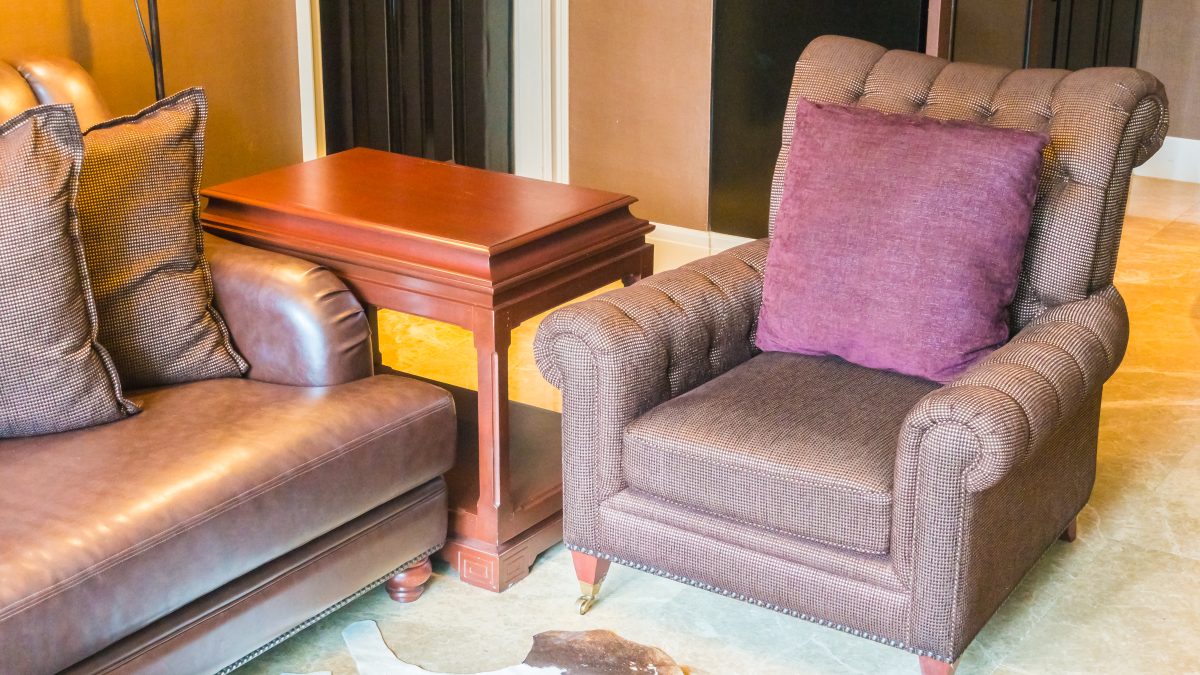
A fabric armchair looks like a smaller, simpler version of a couch, so cleaning it looks like the same job on a smaller scale. It usually isn’t. Most armchairs expose far more bare wood than a couch does: turned legs, a visible frame rail under the seat, sometimes wooden arms with only the inner pad wrapped in fabric. Learning how to clean a fabric armchair means controlling where the water goes as much as choosing what cleans the fabric itself, because every drip that runs past the cushion lands on a wood finish a fully upholstered couch base never exposes in the first place.
The fabric usually survives a careful cleaning without much drama, as long as the care code is respected. The wood is the part that actually sets the limit. A finish that picks up standing water clouds over in minutes, and a joint that gets soaked again and again, clean after clean, is what eventually works a leg loose, not any single damp cloth on its own. That’s the real reason a method built for a couch doesn’t just transfer over.
None of that means skipping water altogether. It means working in small sections, drying the fabric right behind the cloth that wets it, and keeping a second, dry cloth within reach the entire time for anything that drips, runs, or splashes onto the legs or the rail. The method below is built around that order, not just around the fabric’s own care code.
Every drop that lands on the fabric is fine once it’s handled correctly. Every drop that lands on the wood needs to come off right away, before it has time to sit. Keep a dry cloth reserved only for the legs and frame rail, and check them after every pass, not just at the end.
What you’ll need
| Item | Why | Substitute |
|---|---|---|
| Vacuum with a soft upholstery brush | Clears dust and grit out of the weave and the seams before any liquid goes near the fabric | A stiff-bristle lint brush, used in short strokes |
| Mild dish soap (for a W or WS code) | Lifts body oil and light stains without leaving a tint on pale fabric | An upholstery shampoo labeled safe for the fabric’s code |
| Dry-cleaning solvent or an S-code cleaner | The only liquid that’s safe on a fabric marked S, where water leaves a ring | Cornstarch pressed onto grease spots only, left overnight |
| Two white microfiber cloths | One carries the solution onto the fabric, the second rinses it back out | Plain white cotton rags, lint-free and washed |
| A third dry cloth, reserved for the wood only | Catches overspray on the legs and frame rail before it has time to cloud the finish | A clean kitchen towel, kept apart from the fabric cloths |
| Box fan or an open window | Moves air across the fabric and the wood so both finish drying before anything leans back against them | A hair dryer on the cool setting, held well back from the chair |
The method, step by step
Find the care code, or test a hidden spot if there isn’t one
Check the underside of the seat cushion, the base of the frame, or a swing tag still attached from new. No code anywhere means treating the chair as S-code (water-sensitive) until a small test on a hidden panel says otherwise.
Vacuum every surface, including under the cushion
Work the soft brush attachment over the seat, back, and arms, then use a crevice tool along piping and seams where grit collects. Dust left in the weave acts like sandpaper under a damp cloth, wearing the fabric thin exactly where it’s being cleaned.
Tuck a dry cloth around the base of the legs and the frame rail
Loosely wrap or lay the reserved dry cloth wherever fabric meets wood, including under the seat if the rail is visible there. This catches drips before they reach the finish, instead of relying on wiping them up after the fact.
Mix a barely damp solution and work one small section at a time
For a W or WS code, a few drops of dish soap in a cup of lukewarm water is enough; for an S code, apply the solvent cleaner to the cloth, never straight onto the fabric. Wring the cloth until it stops dripping, then blot and lift rather than scrub, moving in overlapping passes no wider than a cushion at a time.
Rinse soap sections with a second damp cloth
Soap residue left in the fabric attracts dirt faster once it dries, so go back over any W or WS section with a cloth dampened in plain water, blotting until no more suds lift onto it. Skip this step entirely on an S-code chair, where no water touches the fabric at all.
Check the protective cloth and wipe the wood dry if anything reached it
Lift the dry cloth from around the legs and rail and look for any damp patches. Wipe the wood dry immediately with a clean section of that same cloth, working with the grain, even if the amount looks small enough to ignore.
Dry with airflow before anything touches the chair again
Point a fan at the treated sections, or leave a window cracked, until the fabric is dry to the touch all the way through. Leave the protective cloth around the legs until the fabric above them is fully dry, not just the surface.
Interactive
Label decoder
Tap a symbol from your care label. No guessing, no scrolling.
19 symbols. Pick one.
Why the legs and frame fail before the fabric does
A cloudy white patch on a finished wood leg is usually moisture trapped inside the topcoat rather than damage to the wood itself, and it often fades on its own with time and a little gentle, indirect heat, the same way a water ring on a coffee table sometimes clears. A dark ring is a different problem: it means water worked past the finish and into the wood fibers underneath, and that kind of mark doesn’t come back the same way no matter how long it’s left to dry.
The glued joints are the slower risk, and a single damp cloth brushing past one isn’t what causes it. It’s the same joint getting wet repeatedly, clean after clean, over months, that eventually works the bond loose, the way any wood joint weakens under water it’s never fully given the chance to dry out from between cleanings. That’s the real argument for the dry cloth in step three: it isn’t about one spill, it’s about never letting the same spot get wet on every single cleaning pass.
A couch mostly sidesteps this because its base and legs usually sit further from where hands and cloths actually work, tucked under a skirt or hidden by a deeper frame; how to clean a fabric couch covers the same W/S/WS/X code this guide uses, without the wood concern layered on top. An armchair with a visible wood frame carries both at once, which is also what separates it from a leather chair, where the whole seat is one washable material and there’s no finish to protect underneath it. A chair that’s fixed in place against a wall has its own version of this problem for a different reason: how to clean a fabric headboard covers why water that can’t evaporate quickly is the bigger risk there, rather than water that lands on exposed wood.
The W/S/WS/X code, and what changes on an armchair
The code on the tag governs the fabric exactly the way it would on a couch cushion. What changes on an armchair is how much margin for error the code buys, since the wood sitting a few inches away has none of its own.
| Code | Means | Risk to the wood |
|---|---|---|
| W | Water-based cleaner is safe on the fabric | Higher: more liquid in use means more chances for a drip to reach a leg |
| S | Solvent-based cleaner only, no water on the fabric | Lower on the fabric side, but a spilled solvent can still dull a painted or lacquered finish |
| WS | Either water or solvent-based cleaner is safe | Same as W: protect the wood regardless of which cleaner is used |
| X | Vacuum or light brushing only, no liquid | Lowest: without liquid on the fabric, overspray on the wood isn’t a factor |
Never let a soap or rinse cloth sit against a wood leg while you move on to the next section. Standing water clouds a finish within minutes, and by the time the rest of the chair is clean, a ring left that long has usually set into the topcoat rather than wiping away.
Common armchair marks, and what the wood changes
An armchair collects a narrower set of marks than a couch does, since one person uses it at a time, but the ones it does collect sit close enough to the frame that the wood is worth checking every time one of these gets treated.
| Mark | What works | Recoverable |
|---|---|---|
| Skin oil on the arm caps, near where fabric meets wood | Soap solution on a W or WS code, blotted and rinsed in short passes with the protective cloth tucked underneath | Yes |
| A drink spilled near a leg | Blot the fabric immediately, then wipe the leg dry before it has time to pool at the base | Yes, if caught quickly |
| Grease or food oil on the seat | Cornstarch pressed on and left several hours, then vacuumed away, before any liquid cleaner | Yes |
| One side faded lighter from sitting near a window | Nothing restores faded dye at home; rotating the chair or adding a sheer curtain slows further fading | No |
| A white haze on the wood leg from standing water | Gentle, indirect heat (a hair dryer held well back, or a warm damp towel pressed briefly and lifted) over several short sessions | Often, if caught before it darkens |
A mark that turns up on the sofa instead of a single chair, especially an oily patch at the armrest, usually comes from the same cause covered in how to clean stains on a sofa: repeated skin contact rather than a single spill, which is why a powder draw-out works better on it than a wipe.
Related guides
- A velvet armchair’s pile crushes and water-marks under the same cloth that’s safe on a plain weave, a separate problem from the wood underneath it: how to clean a velvet couch covers the nap-direction method that applies to any velvet piece.
- An outdoor armchair’s cushion skips the W/S/WS/X system altogether and uses a reverse-side fabric test instead, since it’s built to get rained on: how to clean outdoor cushions.
- A loose seat cushion that unzips comes apart from the frame entirely for a deeper wash, something a one-piece armchair cushion rarely allows: how to clean throw pillows covers the insert-and-cover method.
- A smell that returns after the fabric looks and feels dry usually means the foam underneath stayed damp longer than the surface did: how to clean a couch that smells covers the sealed-bag method for tracking it down.
Questions
Can I steam clean a fabric armchair?
A handheld garment steamer, held a few inches back and used briefly, can freshen a W or WS coded fabric without soaking it, but keep it well away from the legs and frame rail, since the moisture in steam clouds a wood finish the same way a wet cloth does. Skip it entirely on an S-coded fabric.
Is Dawn dish soap safe on a fabric armchair?
A few drops diluted in a cup of water is fine on a W or WS coded fabric and is close to what most fabric-safe cleaners are built from. Using it at full strength, or spraying it directly onto the chair instead of onto a cloth, is what leaves the soap residue people usually blame on the soap itself.
How do I clean the wood legs of an armchair without damaging the finish?
A dry or barely damp cloth, wiped with the grain, handles ordinary dust. Skip household wood cleaners and polishes during a fabric cleaning session, since most are built for routine dusting, not for drying out a leg that just picked up overspray.
Why is my armchair faded on one side?
Sun exposure breaks down fabric dye unevenly, so a chair that sits near a window usually fades fastest on the side that gets the most direct light. There’s no home fix for dye that’s already faded; rotating the chair occasionally is what slows the next round of it.
What do professionals use to clean a fabric armchair?
A professional upholstery cleaner matches the solution to the fabric’s code the same way the method above does, usually with a machine that extracts more water or solvent than a hand-cleaning pass can. For a chair with a wood frame, ask whether the technician protects exposed wood during the job, since a home method and a professional one carry the same risk there.