How to Clean Outdoor Cushions
Outdoor cushions don't carry the W/S/WS/X code an indoor sofa does, and the fabric that replaces it splits into two types that react in opposite ways to bleach. Here's the reverse-side test that tells them apart, plus the foam drain test that decides how wet you're allowed to get.
Quick answer · care label Solution-dyed acrylic · quick-dry foam
-
1 · Wash
Wash 30° -
2 · Bleach
Oxygen bleach -
3 · Dry
Line dry -
4 · Iron
Do not iron -
5 · Pro care
No dry clean
In one line Two tests decide everything here. The reverse side of the fabric tells you whether diluted bleach is safe (solution-dyed acrylic) or will strip the color (printed polyester), and pouring a cup of water on the exposed foam tells you whether the core drains or holds it. Mildew feeds on the pollen and sunscreen sitting on the fabric, not on the fibers, so a thorough rinse matters more than a hard scrub.
Outdoor cushions don’t follow the indoor code system
The W/S/WS/X cleaning code that decides the method on an indoor sofa is missing from most outdoor cushions, and that isn’t an oversight. Outdoor fabric is built to be rained on, so the water question the code answers is already settled. What replaces it is a different question, and almost no guide asks it: which of the two common outdoor fabrics you actually own. They look and feel close to identical, and they react in opposite ways to the one thing that genuinely clears mildew.
Solution-dyed acrylic, sold as Sunbrella, Outdura and a handful of similar names, has its pigment stirred into the liquid acrylic before the fiber is ever spun. The color runs through the strand instead of sitting on the outside of it. Diluted chlorine bleach cannot strip color that lives inside the fiber, which is why the companies that make those fabrics publish bleach dilutions in their own care sheets rather than warning you off it. Printed or piece-dyed polyester, the cheaper fabric on most big-box bench pads and seat cushions, carries its color on the surface only. The same dilution that leaves acrylic untouched will visibly wash a printed pad out in one treatment.
Unzip a cover and check the inside face of the fabric, plus the raw edge of the seam allowance. Solution-dyed acrylic is the same color front, back and right through the cut edge. Printed polyester is noticeably paler or white on the reverse. If the reverse is pale, treat the cushion as bleach-sensitive and use the oxygen-bleach route in the mildew section below.
The foam decides how wet you’re allowed to get
The second thing no tag will tell you is what’s inside. Outdoor cushions come with one of two very different cores, and confusing them is how a cushion ends up smelling of mildew from the inside while its cover looks spotless.
Quick-dry foam, sometimes called reticulated or open-cell foam, has had the membranes between its cells burned or dissolved away. Water runs straight through it and out the bottom. It is meant to be hosed. Standard closed-cell polyurethane foam, the kind used in indoor seating and in cheaper outdoor cushions, holds water like a sponge and can take a week to dry through in humid air. Here is how to tell them apart in about ten seconds:
Unzip the cover far enough to expose a corner of the core, hold the cushion on edge over a drain or the lawn, and pour a cup of water onto the exposed foam. Quick-dry foam passes it through and out within a few seconds, and the water arrives on the other side. Standard foam swallows it and stays heavy at the point of contact. A quick-dry core can be cleaned in place with the cover on. A standard core means the cover comes off and gets cleaned separately, and the foam itself never gets more than a wipe.
What you’ll need
| Item | Why | Substitute |
|---|---|---|
| Stiff bristle brush | Outdoor cushions collect pollen, tree sap and grit that a cloth just smears around; the brush lifts it out of the weave dry, before any water is involved | A clean scrubbing brush kept for outdoor use only |
| Mild dish soap | Cuts the film of sunscreen, skin oil and body lotion that feeds mildew, which plain water leaves behind | A capful of laundry detergent in a bucket of water |
| Chlorine bleach, diluted | Kills mildew at the root on solution-dyed acrylic without touching the color | Oxygen bleach or a hydrogen peroxide solution for printed polyester |
| Garden hose with a spray nozzle | Rinses soap and bleach fully out of the weave; leftover detergent residue is itself a food source for the next bloom of mildew | A bucket and repeated clean-water rinses |
| Fabric water repellent spray | Restores the water-repellent finish, which every deep clean strips some of | None. Skip it and accept that the fabric will start absorbing rather than shedding water |
The routine clean
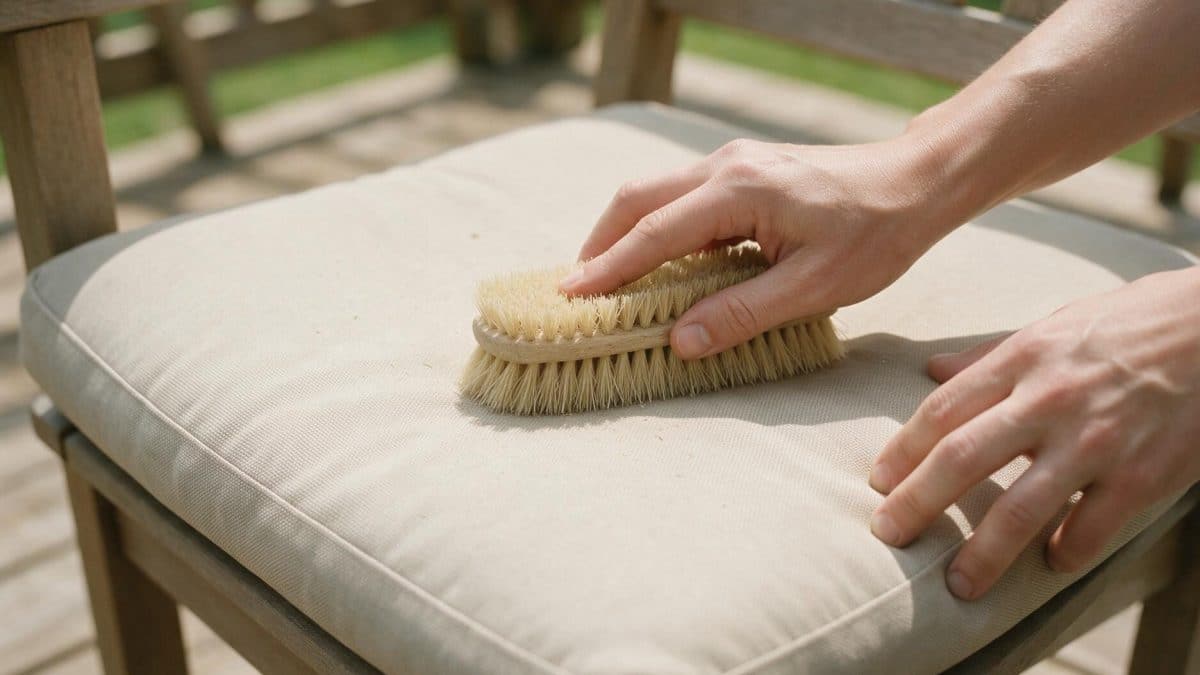
This is the seasonal pass, for cushions that are dirty rather than mildewed. Do it on a dry, breezy day with several hours of daylight left, not in the evening.
Brush the fabric dry, on both faces
Work the bristles across the weave rather than along it. Pollen and fine grit sit in the valleys of the weave, and wetting them first turns loose powder into a paste that has to be washed out instead of shaken off.
Hose the cushion down and let it soak briefly
Wet the whole panel evenly rather than starting with a stained patch. A partly wet outdoor cushion dries with a tide line in exactly the way an indoor one does, and evening it out afterwards takes longer than wetting it properly in the first place.
Scrub with soapy water, panel by panel
A capful of dish soap in a bucket of warm water is enough. Work one full panel from seam to seam before moving on, so you’re never blending a cleaned area into a dirty one halfway across a face.
Rinse until the water running off is clear
This takes longer than it feels like it should, and it’s the step most people cut short. Detergent left in the weave attracts dirt and gives mildew something to feed on, so an under-rinsed cushion gets dirty faster than one that was never washed.
Stand the cushions on edge to dry, not flat
On edge, air reaches both faces at once and water drains downward out of the seams instead of pooling along the bottom panel. Flat on a chair, the underside stays wet for hours after the top feels dry.
Check the seams and piping before calling it dry
Squeeze the corner piping and the seam allowance between finger and thumb. Those are the thickest parts of the cushion and the last to dry, and they’re where mildew starts if the cushions go back on the furniture too early.
Mildew is growing on the dirt, not on the fabric
Acrylic and polyester are both synthetic, and mildew cannot digest either of them. What it feeds on is the layer sitting on top: pollen, tree sap, sunscreen, spilled drinks, skin oil off bare legs. That is why a cushion left dirty over a damp autumn blooms with black spotting while a clean one stored in the same spot doesn’t. It also explains why rinsing thoroughly matters more here than on any indoor fabric. You are not cleaning the fabric so much as removing the meal.
This is the same principle behind treating mold on clothes, where a living colony has to be killed before it’s washed rather than after. The difference outdoors is that a solution-dyed acrylic cover lets you use the strongest option available without paying for it in faded color.
Mix the right solution for your fabric
For solution-dyed acrylic: one cup of chlorine bleach and a quarter cup of mild soap in a gallon of water. For printed polyester, and for anything you’re unsure about: oxygen bleach dissolved in warm water at the dose on its label, which works more slowly but won’t lift surface color.
Wet the whole cushion first, then apply
Applying bleach solution to dry fabric concentrates it wherever it lands first. Wetting the panel evenly beforehand spreads the solution as it goes on, which matters most on the printed polyester that you’re already treating carefully.
Let it sit for 15 minutes, out of direct sun
The solution needs contact time to kill the colony rather than just bleach the stain pale. Direct sun dries it off the surface before it has finished working, which is the usual reason mildew reappears in the same spot two weeks later.
Scrub, then rinse far longer than feels necessary
Bleach residue left in the weave keeps working on the fibers after you’ve stopped paying attention, and on printed fabric it will keep lifting color. Rinse until there is no smell of bleach at the seams.
Dry completely before anything goes back on
A cushion that killed its mildew and then went back onto a chair damp has simply been reset to the starting conditions. Same edge-on drying, same seam check.
The water repellency on outdoor fabric is a finish applied to the surface, not a property of the fiber, and detergent, bleach and UV all wear it down. When water starts soaking in rather than beading on top, the fabric is due for re-treatment. Apply a fabric water repellent to a completely dry, completely clean cushion, in a shaded spot, and give it the full cure time on the can before the cushions go back outside. Spraying it over dirt seals the dirt in.
Interactive
Label decoder
Tap a symbol from your care label. No guessing, no scrolling.
19 symbols. Pick one.
What ruins outdoor cushions
| Mistake | What happens | Fix |
|---|---|---|
| Using diluted bleach on printed polyester because it worked on an acrylic cushion | Surface color lifts unevenly in a single treatment and does not come back | Check the reverse side first; pale reverse means oxygen bleach only |
| Hosing a cushion with a standard closed-cell foam core | The core soaks up water it can take a week to release, and mildew starts inside where no cleaning reaches | Do the drain test, and clean covers separately when the core holds water |
| Putting a cover through a hot dryer to speed things up | Acrylic and polyester both shrink at dryer heat, and a shrunk cover will not go back over its foam | Air dry only, on edge, and put slightly damp covers back on the foam to finish drying in shape |
| Ironing a creased cover flat | Acrylic melts and glazes at iron temperatures, leaving a shiny hard patch that cannot be reversed | Re-fit the damp cover onto the foam and let it dry stretched into shape |
| Stacking cushions for winter storage while the seams are still damp | Stacked cushions have no airflow between them, so a damp seam becomes a mildew bloom by spring | Store bone dry, on edge or spaced apart, somewhere ventilated rather than sealed in plastic |
| Sending a cover to a dry cleaner | Cleaning solvent strips the water-repellent finish completely and does nothing bleach wouldn’t have done at home | Wash at home and re-proof; the finish is the whole point of the fabric |
Related guides
For indoor cushions where the cover and the insert carry separate instructions, how to clean couch cushions covers the cover-versus-insert distinction, which applies here too once you’ve established that the core holds water. For the code system that governs indoor upholstery and that outdoor fabric deliberately sits outside of, see how to clean a fabric couch. And if the spotting has spread beyond the cushions to fabric that came indoors with it, how to clean mold off clothes covers the kill-first method for textiles that can’t take bleach. The small decorative pillows that come out with the furniture in summer are a separate case again, since most are sewn shut around their fill and the drain test can’t be done at all without opening a seam: how to clean throw pillows.
Questions
Can outdoor cushion covers go in the washing machine?
Most solution-dyed acrylic covers can, on a cold gentle cycle with mild detergent, and the manufacturers generally allow it. Zip the cover closed first so the zipper doesn’t catch the fabric, skip the dryer entirely, and put the cover back on the foam while it’s still slightly damp so it dries stretched to shape rather than shrunk.
How do I know whether my cushions are solution-dyed acrylic?
Look at the reverse of the fabric and the raw edge inside a seam. Solution-dyed acrylic is the same color all the way through. Printed polyester is pale or white on the back. If there’s a brand tag, Sunbrella and Outdura are solution-dyed; unbranded big-box cushions usually aren’t.
Why does the mildew keep coming back in the same spot?
Either the solution didn’t get enough contact time to kill the colony, or that spot stays damp longer than the rest of the cushion. Corner piping and thick seams dry last, and a cushion that sits under a tree or against a wall gets less airflow than the rest of the set. Fixing the drying is usually more effective than treating harder.
Is a pressure washer a faster way to do this?
It’s faster and it damages the fabric. The pressure forces water past the repellent finish and into the core, and at close range it separates the weave itself, which shows up later as a permanently rougher patch. A hose with a spray nozzle has all the reach you need.