How to Clean a Faux Leather Couch (The Headrest Fails First)
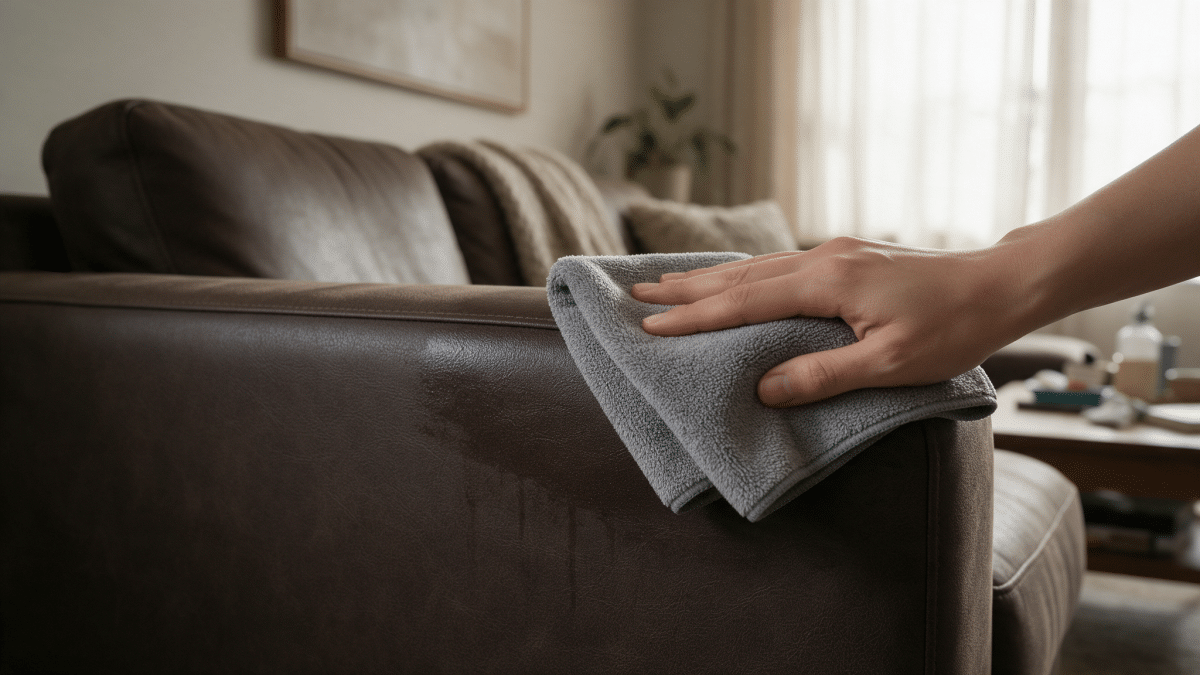
A faux leather couch doesn't crack evenly. The headrest and armrests carry the most skin oil and flexing, so they peel first while the back cushions still look new.
Quick answer · care label Faux leather couch · PU or PVC over a woven backing
-
1 · Wash
Do not wash -
2 · Bleach
No bleach -
3 · Dry
No tumble dry -
4 · Iron
Do not iron -
5 · Pro care
No dry clean
In one line Vacuum seams and crevices, then wipe the couch panel by panel with a barely damp, soapy microfiber cloth and dry each section immediately behind it; the armrests and headrest need a second pass more often since they carry the most body oil. Skip leather conditioner, furniture polish and soaking the surface, all of which speed up cracking rather than preventing it. About 25 minutes hands-on for a three-seat couch, longer if the wear points need the vinegar step.
Why does a faux leather couch crack at the armrests and headrest first?
A faux leather couch is one continuous sheet of coated plastic over a woven backing, but the people who sit on it never touch every part of it the same way. Knowing how to clean a faux leather couch starts with the armrests and the headrest, since they take the most direct contact: a hand gripping the arm to stand up, a head tipping back against the same few inches of cushion every evening, skin oil and hand lotion working into the coating each time someone leans on it. That mix of body oil and constant flexing is what breaks down a polyurethane or PVC finish, not dust or an occasional spill, which is why the arms and headrest usually crack, turn tacky, or lose color years before the seat back or the sides show any wear at all.
The method itself is mostly about not adding to that damage while removing the dirt that is genuinely there. A barely damp cloth and a mild soap solution lift body oil and everyday grime without soaking the coating; the fastest way to turn ordinary wear into a ruined armrest is scrubbing hard, soaking the surface, or reaching for a cleaner built for real leather, wood, or all-purpose surfaces instead of plastic.
A faux leather couch fails at its wear points first, where hands, arms and heads press and flex against it every day, not where dust settles. Clean the whole couch the same gentle way, but expect the armrests and headrest to need it more often than the back or the sides.
What you’ll need
| Item | Why | Substitute |
|---|---|---|
| Mild dish soap or castile soap | Lifts body oil and everyday grime without stripping the coating’s finish | A cleaner labeled safe for vinyl or synthetic leather |
| Two soft microfiber cloths | One carries the barely damp solution, the other dries the same panel right behind it | A clean, soft, lint-free cotton cloth |
| Soft-bristle brush or vacuum attachment | Clears grit out of seams and piping before wiping, so it never gets dragged across the coating | A dry, soft paintbrush for tight seams |
| Bowl of lukewarm water | Dilutes the soap so the cloth stays damp, never wet | N/A |
| White vinegar, diluted with water | Cuts through the grease that builds up at the armrests once plain soap stops working | Isopropyl alcohol, used sparingly and spot-tested first |
The method, step by step
Clear the seams and crevices before any liquid touches the couch
Run a vacuum’s soft-bristle attachment along every seam, the base of each cushion, and the piping around the armrests. Crumbs and grit trapped there get dragged across the coating by a damp cloth if they are not removed first, and that light scratching is how a faux leather couch loses its sheen years before it cracks.
Mix a barely-there soap solution
A few drops of mild dish soap or castile soap in a bowl of lukewarm water is enough. The goal is a solution that smells faintly of soap, not one that foams; a strong mix leaves residue in the coating’s texture that attracts dirt faster once it dries.
Wring the cloth out until it barely feels wet
Dip a microfiber cloth in the solution, then wring it until no water drips out on its own. The cloth should feel cool and damp against the back of your hand, not wet enough to leave a visible mark when you press it to a dry paper towel.
Wipe one panel at a time, then dry it immediately
Work in sections no larger than a cushion, wiping with the damp cloth and following straight behind with the dry one before moving to the next panel. Leaving a wiped section to air-dry on its own is how water sits in the seams and the stitching longer than it needs to.
Spend extra time on the armrests and headrest
These panels carry more body oil than anywhere else on the couch, so they often need a second pass with the same barely damp cloth, or a light wipe with the diluted vinegar solution if soap alone leaves a slight film. Never scrub; a second gentle pass does more than pressing harder on the first one.
Let it finish drying with airflow, out of direct sun
A ceiling fan or an open window clears the last of the moisture faster than letting the couch sit closed up in a warm room. Direct sunlight while the coating is still slightly damp is worse than sunlight on a dry couch, so keep it out of a sunbeam until it is fully dry to the touch.
Interactive
Label decoder
Tap a symbol from your care label. No guessing, no scrolling.
19 symbols. Pick one.
The armrests and headrest need their own routine, not just a bigger dose of the same one
Treating the whole couch on the same schedule misses the part that actually fails first. The armrests and headrest are worth wiping down on their own, on a shorter cycle than the rest of the couch, the same way a keyboard’s most-used keys get shinier than the ones nobody touches. A light wipe every week or two on just those panels, using the method above, keeps the oil from building up to the point where it needs the vinegar step at all.
Watch for a change in texture before any visible damage shows up. A panel that starts to feel slightly tacky, rather than smooth, under a dry hand is the coating absorbing oil faster than normal handling would explain, and it is the clearest early sign that a panel needs cleaning before it needs repair.
Never soak a faux leather couch or spray a cleaning solution directly onto the surface. IKEA’s own care guidance for synthetic leather furniture is direct about this: excess water can darken or damage the material, and direct sunlight on a damp or worn panel is what turns ordinary aging into visible cracking. Apply every solution to the cloth, never to the couch.
Furniture polish and leather conditioner make it worse, not better
A couch described as “leather” on the tag, even when it is faux, pulls people toward products built for real hide: leather conditioner, furniture polish, silicone-based protectant sprays. None of them do what they promise on a plastic coating. Real leather conditioner is formulated to replace oils inside a porous, organic material; a polyurethane or PVC coating has no oils to replace and no pores to absorb one, so the conditioner sits on the surface as a film that attracts dust and can make the coating feel slicker rather than protected.
Furniture polish and silicone sprays cause a more specific problem at the wear points: they build up in the same texture where body oil already collects, and the combination is what turns an armrest visibly shiny in patches long before the rest of the couch looks any different. Skip both. A barely damp cloth and, occasionally, the diluted vinegar step above are the only products a faux leather couch’s coating actually needs.
Is it actually faux leather, and does that change the method?
Faux leather sold for furniture is either polyurethane (PU) or PVC bonded to a woven backing, and the two plastics fail in slightly different ways: PVC tends to stiffen and crack, while polyurethane tends to turn tacky and peel as the coating breaks down chemically. How to clean faux leather covers the full test for telling the two apart on any item, not just a couch, and it matters here because a coating that is already tacky and shedding color onto a cloth is past the point where wiping helps at all.
A rough smell test works as a first clue without pulling up a cushion to check for a fabric or manufacturer tag: vinyl tends to carry a distinct plastic smell close to a new shower curtain, while polyurethane is close to odorless. It is not definitive, since some couches mix the two plastics across different panels, but a strong chemical smell straight out of the box is worth noting before choosing a cleaning routine.
A couch listed as genuine or top-grain leather is a different material with a different failure point: it can take a leather-specific conditioner that would do nothing for a plastic coating, and it fails from drying out rather than from the coating splitting off a backing. How to clean a leather sofa covers that method, plus the two-drop test for sofas that mix real hide on the seats with a matching synthetic on the panels you don’t touch, which is common enough that a faux leather couch and a leather sofa are not always two different products.
Stains that need more than the wipe-down
| Problem | What works | Recoverable |
|---|---|---|
| Grease or body oil built up at the armrests | Diluted white vinegar on a cloth, wiped and dried immediately; repeat rather than using a stronger mix | Yes |
| Ink | A cotton swab dipped in isopropyl alcohol, dabbed rather than rubbed, then wiped with the soap solution right after | Yes, if treated soon |
| Musty or mildew smell after the couch stayed damp | Full drying with airflow first; a couch that still smells once bone-dry likely has mildew growing where two damp layers pressed together, not just surface odor | Not always |
| A panel already tacky or shedding color onto a cloth | Nothing reverses coating breakdown; stop cleaning that panel the same way and expect it to keep flaking | No |
A smell that lingers after the surface is fully dry is not always a cleaning problem at all. How to clean a couch that smells covers how to tell whether an odor is sitting on the surface or trapped in the cushion foam underneath, which a faux leather coating does not let through the way a fabric weave does, so the source is almost always the surface itself or mildew at a seam.
Related guides
- A fabric couch takes an entirely different first step, reading the W/S/WS/X code on the cushion tag instead of testing a plastic coating: how to clean a fabric couch.
- Microfiber looks similar from across the room but reacts to water the opposite way a faux leather coating does: how to clean a microfiber couch.
- A suede couch can’t take even the barely damp cloth this method relies on, since suede shows water spotting a coated plastic never will: how to clean a suede couch.
- The cushion covers and the couch frame often carry different care tags entirely, which matters once the cushions come off for a deeper clean: how to clean couch cushions.
Questions
What is the best cleaner for a faux leather couch?
A few drops of mild dish soap or castile soap in lukewarm water, applied with a barely damp cloth, cleans everyday dirt and body oil without stripping the coating. A cleaner labeled specifically for vinyl or synthetic leather works too; anything labeled for real leather, wood, or general household surfaces does not belong on faux leather.
Can I use Dawn dish soap on faux leather?
A few drops diluted in a bowl of water is fine and is close to what most vinyl-safe cleaners are built from. Using it at full strength, or spraying it directly onto the couch instead of onto a cloth, is what causes the residue and over-wetting problems people usually blame on the soap itself.
How do you make faux leather look new again?
Regular wiping keeps oil from building up to the point where the coating dulls, but a coating that has already dulled, cracked, or started peeling does not come back with cleaning. At that point a vinyl repair kit can fill small cracks, but it restores color and texture, not the original finish.
What ruins faux leather?
Soaking the surface, direct sunlight on a damp panel, sharp objects and pet claws, and cleaners built for real leather or general household use. Heat from a nearby vent or a space heater speeds up the same breakdown that body oil causes at the armrests, just across the whole couch instead of one panel.
Can you use Clorox wipes on faux leather?
Not as a routine method. Bleach-based wipes are harsher than the coating is built to handle and can strip color or dull the finish with repeated use; save a disinfecting wipe for an occasional, quick pass and rely on the soap-and-water method for regular cleaning.