How to Clean Tree Sap From Clothes (Resin, Not Sugar)
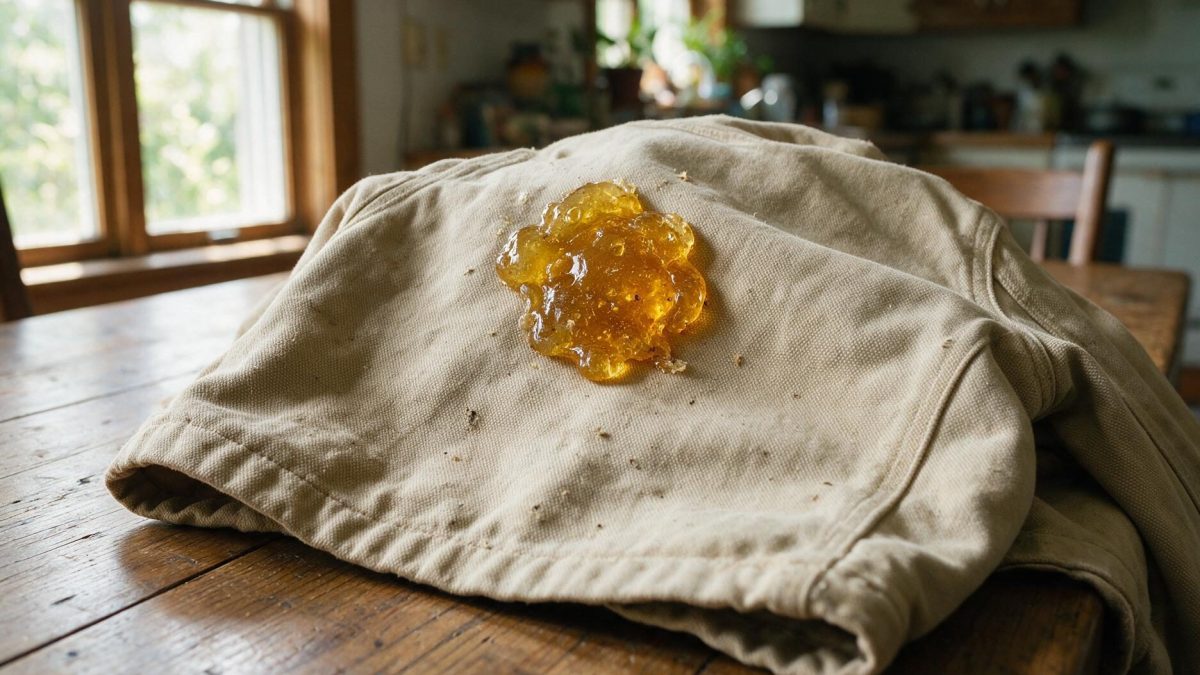
Three things get called tree sap and only one needs a solvent. Conifer resin will not dissolve in water at any temperature; the sticky film under a lime or a maple is sugar and rinses straight out.
Quick answer · care label Mixed — conifer resin on textile
-
1 · Wash
Wash 40° -
2 · Bleach
No bleach -
3 · Dry
Line dry -
4 · Iron
Do not iron -
5 · Pro care
Pro clean P
In one line Work out first whether it is conifer resin or aphid honeydew. Honeydew is sugar and washes out warm. Resin is chilled hard and lifted off mechanically, then the residue is dissolved with isopropyl alcohol worked from the back of the fabric onto a cloth, and only then does the garment go through a normal wash. Keep it away from heat until the mark has gone. About 25 minutes hands-on.
Is the sticky mark actually resin, or is it sugar?
Three different substances get called tree sap, and only one of them needs a solvent. The amber, tacky material that comes off a pine, spruce, fir or cedar is resin. Chemically it is a mixture of resin acids, mostly abietic and pimaric, suspended in a volatile terpene fraction: the same two components a distiller separates into rosin and turpentine. Resin is insoluble in water. It is freely soluble in alcohol, ether, acetone and oils. That one line of solubility data decides everything below, because it means no detergent, no soak and no wash temperature will shift it. Resin exists to seal a wound on a tree standing outside in the rain. Not being washed off is its entire job.
What drips onto a washing line or a car bonnet under a lime, a maple or a birch in midsummer is usually not that at all. Deciduous trees run a thin xylem sap that is mostly water with sugar in it, and the film that coats everything under an infested tree is often honeydew, the sugar solution aphids excrete after feeding on it. Sugar is sticky, dries to a shine, collects dust, and rinses out in warm water with ordinary detergent. Most people have already run a hot wash before they start reading about solvents. If the hot wash worked, the mark was sugar. If it did nothing, the mark is resin.
So the first move is a test rather than a treatment. Wet a corner of the mark with warm water and work it between finger and thumb for a few seconds. If it turns slippery and begins to go, it is sugar, and a normal wash finishes the job. If it stays tacky, rolls into a bead, or simply ignores the water, it is conifer resin and the rest of this applies.
Resin does not dissolve in water at any temperature, and it does dissolve in alcohol. Every decision below follows from that. Take the solid part off cold and mechanically, dissolve what is left with alcohol rather than pushing it around with water, and keep the garment away from heat until the mark is gone. Heat is the one thing in this process that turns a difficult stain into a permanent one.
What you’ll need
| Item | Why | Substitute |
|---|---|---|
| Isopropyl alcohol, 91% or higher | Dissolves resin acids directly. Rosin is insoluble in water, so the stronger bottle carries less of the one thing that does nothing to the stain | 70% rubbing alcohol. Extension stain guides list 70 and 90 percent as equally acceptable; the weaker one just needs more repeats on hardened resin |
| An ice pack, or the freezer | Hardens a soft blob so it fractures off instead of smearing into three times the area | Fifteen minutes in the freezer with the garment sealed in a bag |
| A dull knife or an old card | Lifts the brittle crust, so most of the resin is gone before any solvent is involved | A spoon edge, or a credit card, less likely to snag a thread |
| Plain white cloths or paper towels | Absorb dissolved resin from behind and show you when nothing more is transferring | Unprinted kitchen roll, folded thick |
| Liquid dish soap | Carries off the oily residue and the last of the solvent, which alcohol alone leaves behind | Liquid laundry detergent worked in neat |
| A soft toothbrush | Works solvent into a weave without abrading the surface | A fingertip, which is the right tool on anything delicate |
The method, step by step
Harden the blob before you touch it
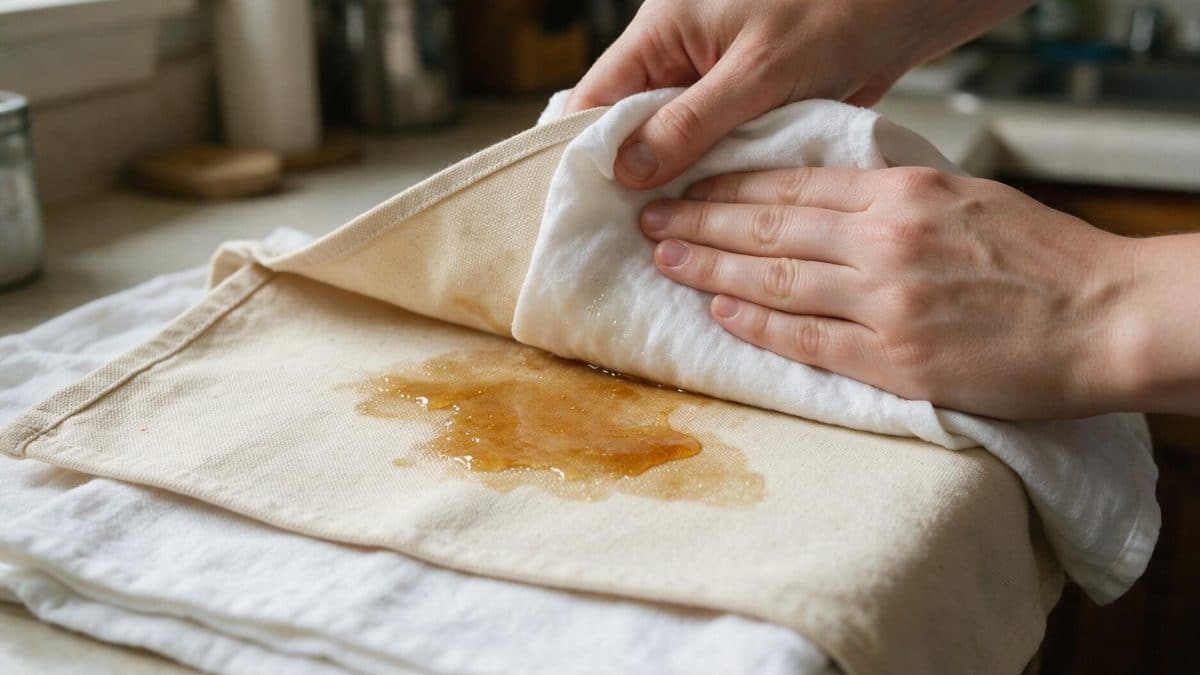
Fresh sap smears, and a smear is a much larger stain than a blob. An ice pack held on the spot for ten to fifteen minutes, or the garment sealed in a bag in the freezer, makes it brittle enough to break.
Crack the hard part off and lift it away
Flex the fabric so the resin fractures, then lift the pieces with a dull knife held almost flat to the weave. Everything removed here is resin the solvent never has to dissolve, and it is usually most of the visible mark.
Test the alcohol on an inside seam
Not a formality. Extension guidance is that alcohol fades some dyes, and it damages acetate, triacetate, modacrylic and acrylic. Hold it on a hidden seam for one to three minutes, then press a white cloth to it and look for colour. If colour transfers, stop and read the fabric section below.
Work from the back, over a white cloth
Lay the fabric face-down on a folded white cloth and apply the alcohol to the reverse of the mark. Solvent then pushes the resin out the way it came in rather than through the full thickness of the cloth, the same principle as the ink guide.
Keep it wet, and wait rather than scrub
Alcohol dissolves resin on contact time, not on pressure. Keep the spot visibly wet for ten minutes, topping it up as it evaporates. Hard rubbing is the classic way to drive softened resin deeper into the yarns and widen the mark.
Change to clean cloth and repeat until nothing transfers
A saturated cloth stops absorbing and starts handing resin back. Move to a dry area of cloth after each blot, and keep going until a fresh press comes up clean. On an old, hardened mark this stage can take three or four rounds.
Work in dish soap, then wash warm and alone
Alcohol leaves an oily film of the resin’s own residue behind. A surfactant is what removes that. Rub dish soap into the damp spot, leave it five minutes, then wash the item on its own at the warmest temperature its care label allows.
Check it wet, in daylight, before anything is dried
A resin mark is much harder to see on damp fabric than a dye stain, so hold it to a window rather than a kitchen light. If anything shows, go back to step four. Nothing goes in a dryer until the fabric is clean.
Why water was never going to work
Most stain advice sorts problems into water-based and oil-based. Resin sits awkwardly in that scheme, which is why generic advice performs badly on it. It behaves like an oil stain in that water will not touch it, and like a glue in that it physically bridges the gaps between yarns rather than colouring them.
| Agent | Effect on resin | Worth using |
|---|---|---|
| Water, at any temperature | None. Resin acids are insoluble in water, which is the property that makes them useful to the tree | No |
| Laundry detergent alone | Lifts the dirt stuck to the resin, leaving a cleaner but equally stuck mark | Not on its own |
| Isopropyl alcohol, 91% or higher | Dissolves it. Alcohol is the agent extension services and detergent brands both name for resin; the strength is our preference, not theirs | Yes |
| Rubbing alcohol, 70% | Same chemistry, diluted. Extension guides list 70 and 90 percent side by side, so this is a real option, not a compromise | Yes |
| Dish soap, after the solvent | Removes the oily residue the alcohol leaves behind, which alcohol cannot do itself | Yes, second |
| Turpentine | Dissolves it thoroughly. It is distilled from the same resin, so it is the closest thing to a native solvent | Last resort, natural fibres |
| Acetone or nail polish remover | Dissolves resin, and dissolves acetate, triacetate and modacrylic along with it | No |
| Chlorine bleach | Nothing useful. Resin is not a chromophore to be oxidised, it is a solid to be dissolved | No |
The escalation published by the University of Illinois Extension is the one to follow if alcohol stalls: sponge with rubbing alcohol, tamp, and blot; if the stain remains, sponge with turpentine, then with a detergent solution of one tablespoon of liquid dishwashing detergent in two cups of cool water, alternating the two until the mark goes, then sponge with cold water and blot dry. For a heavy deposit they suggest applying dry-cleaning solvent to the back of the stain over absorbent paper towels. Turpentine is flammable, it smells, and it can leave a ring of its own on fine fabric, so it belongs on sturdy cotton and canvas rather than on a shirt.
Fresh sap and old sap are not the same stain
On this site, most stain guides argue that age matters less than people fear. A blood stain is a good example: age is not really the problem there, heat is. Resin is the exception, and the reason matters when you are deciding whether a two-year-old mark is worth the effort.
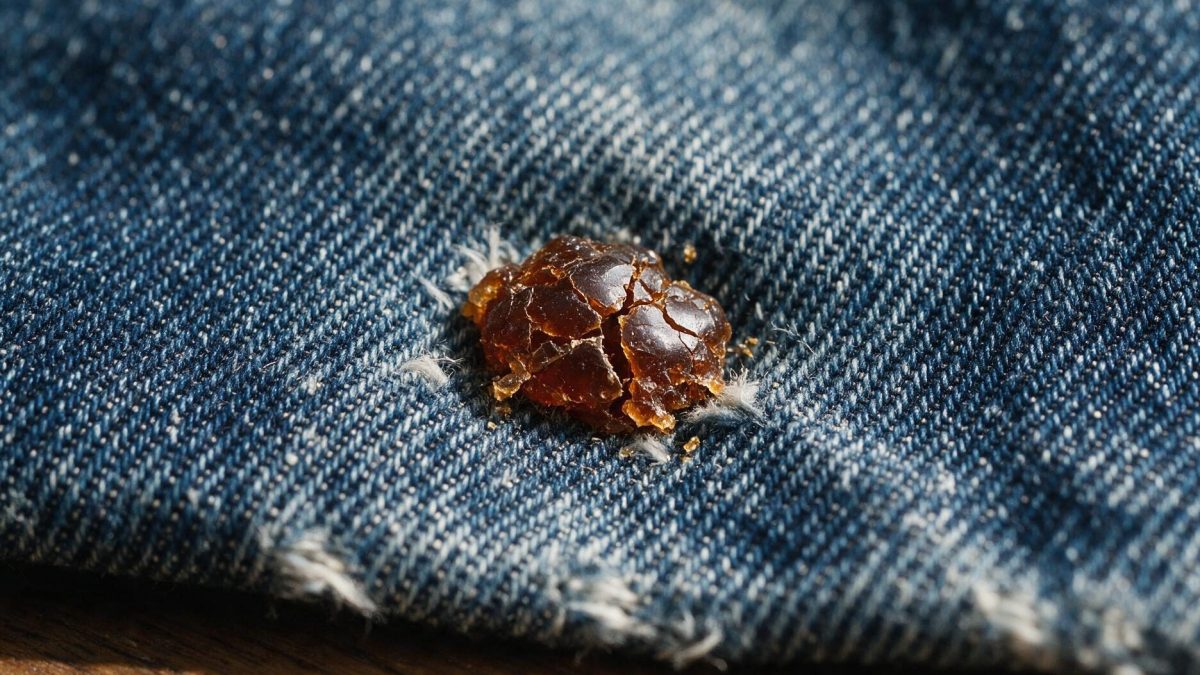
Fresh sap still contains its volatile fraction, the terpenes that make it runny and give it the smell. Those evaporate. What stays behind is rosin, the hard resin acids on their own, and rosin is a brittle solid rather than a syrup. Gum rosin does not have a sharp melting point, but its measured softening point sits around 70 to 80 °C (158 to 176 °F), and commercial gum rosin data sheets quote 76 to 78 °C. So an old mark is a harder material, sitting inside the yarn instead of on it, with more surface locked away from the solvent. It still comes out. It simply takes more rounds of alcohol and more waiting.
Stain guides agree that a dryer sets a sap mark, and rarely say why. Extension advice is blunter than the reasoning: line dry throughout the stain removal process, keep the item out of the dryer until the stain is completely removed, and do not iron a stained fabric, because heat may set the stain. The likely mechanism is not the one people picture from protein stains, where heat cooks something into the fibre. Heat softens whatever residue was left behind, tumbling presses it into the weave while it is soft, and it re-hardens further in than it was.
Never tumble-dry the garment while any trace of the mark is visible, and never iron over it. This is one of the few hard rules on this site rather than a judgement call. Air-dry between attempts, however many attempts it takes. Every source that mentions the dryer says the same thing: it makes the mark much harder to remove, and sometimes it is not recoverable afterwards at all.
Where the sap landed changes the method
Sap almost never lands on a shirt in a kitchen. It lands on the shoulder of a jacket, the seat of a pair of trousers, or the top of a rucksack, and half of those are made of things alcohol has to be used carefully around.
| Fabric | What to change | Recoverable |
|---|---|---|
| Cotton, denim, canvas | Nothing. This is the method as written, and the fabric that tolerates turpentine if it comes to that | Yes |
| Polyester and nylon | Nothing, but skip the toothbrush on smooth face fabrics: abrasion leaves a permanent sheen | Yes |
| Waterproof shell with a DWR finish | Brands differ. Arc’teryx’s own instruction for sap uses no solvent at all: freeze, scrape, then soak in one part water to one part white vinegar and wash with a mild or technical detergent. If you reach for alcohol instead, test a hidden panel first, and keep acetone and solvent-based spot removers off the fabric. Plan on reproofing afterwards | Usually |
| Down jacket | Treat the shell only, with the down pushed away from the spot so the solvent never reaches the fill. Then wash the whole garment properly rather than spot-drying it | Usually |
| Wool and silk | Extension guidance flags the dye rather than the fibre: alcohol fades some dyes, so the seam test is not optional. No hot water, no agitation | Usually |
| Acetate, triacetate, modacrylic, acrylic | Alcohol damages all four. The published workaround is two parts water to one part alcohol, which barely touches resin, so this is the case for sending the item out | Not at home |
| Anything with a printed transfer | Alcohol lifts screen prints and vinyl. Keep the solvent to the fabric and off the print entirely | Around the print only |
Two of those deserve a note. On a technical shell, the sap is usually the smaller problem: ordinary laundry detergent leaves a residue that suppresses the water repellency across the whole garment, so use a wash made for the job and reproof afterwards. On down, spot-treating and then hanging the jacket up is how a wet clump of fill dries into a hard lump; see how to clean a down jacket for the drying stage that prevents it. A rucksack has the same problem with a different geometry, covered in how to clean a backpack.
What the standard advice leaves out
- The oil method, and why sources disagree about it. A second school of advice says to soften the sap with olive or coconut oil for ten to fifteen minutes, then lift it with dish soap and a warm wash. It does work, because resin is soluble in oils. What it does is trade a resin stain for a grease stain on the same spot, which then has to be removed in turn. On sturdy cotton that is a fair trade. On a pale wool coat it is not, and nobody who recommends it says so.
- Hand sanitiser is alcohol plus a thickener. Tide’s own stain page names clear, alcohol-based hand sanitiser alongside rubbing alcohol, and the alcohol in it is the right alcohol. The gel that keeps it in place is glycerin and a carbomer, which stay on the fabric after the alcohol has gone. Rinse the spot before the mark dries or you will finish with a stiff patch.
- Freezing is half a method, not a method. It removes the lump and nothing else. The film that wicked between the fibres before the sap hardened is unaffected by cold, and that film is the part still visible after you have scraped.
- “Wash at the hottest temperature the label allows.” That instruction is correct as the final step and wrong as a first move. A wash at 40 °C (104 °F) sits well below the softening point of rosin, and resin does not dissolve in the water either way, so a hot cycle by itself lifts nothing. It only finishes what the solvent already loosened.
- Home dry-cleaning kits are the wrong tool for this specific stain. A dry cleaner’s solvent genuinely dissolves resin, and this is one of the few jobs where handing the garment over is a real answer rather than a hopeful one. The domestic kits are not the same thing: they work by running the garment through your own tumble dryer with a heat-activated cloth, which is the exact step this method exists to avoid. See how to dry clean at home.
Related guides
- Candle wax is also a solid wrapped around the yarns, but there heat is the tool that removes it rather than the thing that ruins it: how to clean wax off clothes.
- Dry paint is the other film stain that needs a solvent, except that which solvent depends on whether the paint was water-based or oil-based: how to get dry paint out of clothes.
- If the sap arrived on a jacket rather than a shirt, the spot treatment is only half the job: how to clean a down jacket.
- For where resin sits in the general stain framework, and the categories that framework does handle well: how to clean stains from clothes.
Questions
Does tree sap come out of clothes, or is it permanent?
On washable fabric that has not been through a dryer, it usually comes out completely. Resin dissolves in alcohol, so this is a stain with a genuine solvent rather than a stain you have to fade. The two situations where it commonly does not come out are a garment that has already been tumble-dried with the mark still on it, and a fabric that alcohol cannot safely touch, such as acetate.
Will washing the garment get sap out on its own?
No. Resin acids are insoluble in water at any temperature a washing machine reaches. A hot cycle removes the dirt that has stuck to the sap and leaves the sap itself exactly where it was. Detergent and heat only matter after a solvent has done the actual work.
Should I use 70% or 91% isopropyl alcohol?
Either. Extension stain guides list 70 and 90 percent without preferring one, so the bottle under your sink is not the wrong bottle. Where there is a choice, take the stronger one: rosin is insoluble in water, and the 30% water in a 70% bottle carries nothing useful. On a fresh mark the difference is invisible. On a hardened one, the weaker bottle needs more applications and more waiting.
How do I tell if it is sap or something else?
Wet a corner of it with warm water and rub. Conifer resin ignores water and stays tacky. Sugary sap and aphid honeydew, which is what usually falls from a lime or a maple, go slippery and start to dissolve. Old resin may also have hardened to something brittle and slightly amber, which sugar residue never does.
Can I use hand sanitiser instead of rubbing alcohol?
Yes. Tide’s stain guidance names clear, alcohol-based hand sanitiser next to rubbing alcohol for exactly this. Use a clear one, since the dye in a coloured gel is a stain of its own. A sanitiser is alcohol plus glycerin and a gelling agent, so rinse the spot afterwards rather than letting the gel dry into the fabric.
What if the sap is on a waterproof jacket?
Freeze and scrape as usual, then check what the maker says before reaching for a solvent. Arc’teryx, for one, tells you to soak the garment in one part water to one part white vinegar and wash it with a mild or technical detergent, no alcohol involved. If you do use alcohol, test a hidden panel and keep acetone and solvent-based spot removers off a membrane fabric. Wash with a technical cleaner rather than ordinary detergent, and plan on reproofing.