How to Get Dry Paint Out of Clothes (Dry Means Two Different Things)
The first page splits paint into water-based and oil-based, then ends by asking you which one you have. That is the whole problem, because dry means two unrelated things: water leaving, or oxygen reacting. Here is the hot-water test that tells them apart, and why the old acrylic mark is the recoverable one.
Quick answer · care label Everyday clothing - cotton, denim, cotton-poly; not acetate or modacrylic
-
1 · Wash
Wash 30° -
2 · Bleach
No bleach -
3 · Dry
No tumble dry -
4 · Iron
Do not iron -
5 · Pro care
Pro clean P
In one line Dry means two different things. Water-based paint dries because the water left, so the film is still a thermoplastic and an old mark responds nearly as well as a fresh one: soften it with boiling water or 91% rubbing alcohol from the back, then break it up with a stiff brush in several directions and wash cold. Oil-based paint dries because oxygen has reacted with it, which keeps hardening for days, so mineral spirits and a blotting cloth are the one attempt and it has a deadline. Never put either through a dryer.
The whole first page assumes you know which paint it is
Search how to get dry paint out of clothes and the answer arrives in one shape: scrape the hard bits off with a dull knife, soak the mark in rubbing alcohol, scrub it hard with a stiff brush, wash cold. Then the page splits into two columns, one headed water-based and one headed oil-based, with different solvents under each.
Read to the bottom of the AI summary and it closes by asking you a question. Tell it what type of paint this is, acrylic, latex or oil-based, and what the fabric is made of, and it will give you a more specific tip. That request is the entire problem. The person asking has a shirt with a mark on it. In the forum threads that sit at the top of the same page, someone writes that they got something on a favorite sweater and did not notice soon enough, and someone else writes that they think it is paint, they just pulled it out of the wash, is there any hope. Nobody in those threads has the can.
So this guide starts where the first page stops. The two columns are real and the difference between them matters more than any product choice, because the word dry means two unrelated things depending on which column you are in. In one of them it is a physical state that a solvent can partly undo weeks later. In the other it is a chemical reaction that keeps running whether you treat the stain or not.
Household wall paint and craft paint sold today are almost always water-based. Water-based paint dries because the water leaves, and an old mark responds nearly as well as a fresh one. Oil-based paint, artists’ oils, most spray enamel and a lot of trim and metal paint dry because oxygen is reacting with them, and that reaction keeps hardening the film for days after it feels dry. If there is any chance you are in the second group, treat it today. If you are in the first group, you have time, and the three-week-old splash on the jeans in the back of the closet is worth an attempt.
Two things called dry, and only one of them is reversible
Every other stain covered on this site is a substance that got into the fabric: dissolved, suspended, or smeared. The question is always which liquid dissolves it and at what temperature. Paint is the one common stain that is none of those things. Paint is a plastic, delivered as a liquid, that turns solid after it has already flowed down between the yarns and around the individual filaments. What is left is not a substance sitting in the weave. It is a film with the weave inside it.
How that film forms decides everything you can do about it afterward.
| Water-based (latex, acrylic, most wall and craft paint) | Oil-based (alkyd, artists’ oil, most enamel and spray paint) | |
|---|---|---|
| What dry means | The water evaporated and the polymer particles that were floating in it pressed together into one continuous film | Oxygen from the air reacted with the oil and linked the molecules into a single network |
| Type of change | Physical. Nothing new was made, the particles simply merged | Chemical. The material at the end is not the material that came out of the can |
| Does the clock matter | Barely. A film that formed last month softens under solvent about as well as one that formed this morning | Very much. It goes on hardening for days after it stops feeling wet, and each day makes it less reachable |
| What softens it | Alcohol, acetone, and heat, all of which swell the film without dissolving it away | Mineral spirits or turpentine, and only while the reaction is still incomplete |
| Worst thing you can do | Put it through a hot dryer, which melts the film deeper into the fibers | Wait. There is no second chance later in the week |
This is where the standard advice goes wrong, and it goes wrong in a direction nobody expects. Every guide on the subject opens with some version of act fast. That instruction is aimed at the branch where speed is almost irrelevant, because water-based paint is what most people are dealing with, and it is quietly missing from the branch where a week is the difference between a stain and a permanent feature. The old acrylic mark that everybody has given up on is usually the recoverable one. The fresh oil mark that feels like it can wait until the weekend is the emergency.
Two tests that tell you which column you are in
Neither of these needs anything you would have to buy, and together they take about three minutes.
The hot-water test
Stretch the stained area over the mouth of a bowl or a mug with the paint facing down, and pour just-boiled water through the back of the fabric from a few inches up. Then watch the film for the first fifteen seconds and push at its edge with a fingernail.
- It goes dull, rubbery and slightly swollen, and the edge rolls or smears under a nail. Water-based, and still thermoplastic. Everything in the first method below applies, and you have a good chance whatever the date on it.
- It stays hard and glossy and chips rather than rolls. Either oil-based, or a water-based film that has already been through a hot dryer and re-set. Both need the second method and both are harder.
The interesting part is that the first page already tells people to pour boiling water through the back of the stain. It presents it as a treatment step. It is a much better diagnostic than it is a treatment, because it answers the one question the page never answers, and it answers it before you have committed to a solvent.
Skip the boiling water on wool, on silk, on anything with a thirty degree label and on anything you suspect is heat-sensitive. On those, put a single drop of rubbing alcohol on the film instead, wait a minute, and read the same thing: tacky and swollen, or unchanged. Note that this is a different reading from the alcohol test in the ink guide, which watches for color lifting onto the swab. Here the color is not going anywhere. You are watching the texture.
The light test
Hold the fabric up to a window or a lamp and look at the stain from the back.
- Nothing shows through, or only a faint ghost. The paint bridged the tops of the yarns and set there like a sticker. Scraping from the front will take most of it off in sheets, and what remains is thin.
- The mark reads clearly from the reverse. The paint was thin enough or fresh enough to flow down through the weave before it set, and it has locked around individual filaments from both sides. Scraping the front will barely touch it. Everything has to be worked from the back, and you should expect a shadow at the end rather than a clean shirt.
This is worth doing before you start, because it decides how much effort is proportionate. Nobody enjoys finding out after forty minutes of brushing that the mark went all the way through.
What you’ll need
| Item | Why | Substitute |
|---|---|---|
| Rubbing alcohol, 91% if you can get it | Swells a water-based film until it is weak enough to break apart. The higher concentration carries less water into the fabric | Gel hand sanitizer, which is mostly the same alcohol in a thicker carrier that stays put on a vertical surface |
| A stiff-bristled brush | Does the actual removal. An old toothbrush is the usual choice and it is genuinely the right tool on anything smaller than a palm | A nail brush for larger areas, or the edge of a spoon on a delicate weave |
| A dull knife or a spoon | Lifts the loose crust off before any liquid goes on, which is otherwise work the solvent has to do | A credit card edge, which is less likely to catch a thread |
| Mineral spirits | The only household solvent that reaches an oil-based film, and only while the film is incompletely cured | Turpentine, which behaves the same way and smells worse |
| Liquid dish soap | Removes the solvent afterward. Alcohol rinses out on its own, mineral spirits does not | Any grease-cutting brand |
| Clean white cloths | Sit under the stain and take away what comes out of it, so it does not travel sideways | Unprinted paper towels, replaced often |
| Acetone | The strongest option on water-based paint, for when alcohol stalls | None. See the warning below before reaching for it |
Acetone and non-acetone nail polish remover are effective on acrylic film because acrylic paint and acrylic plastic are chemically close relatives. Acetate, triacetate and modacrylic are also close relatives, and acetone does not distinguish between the film and the shirt. On those fibers it makes a hole. Check the fiber content label, and test on an inside seam even when the label says cotton, because trim, thread and interfacing are often something else.
Method one: water-based paint
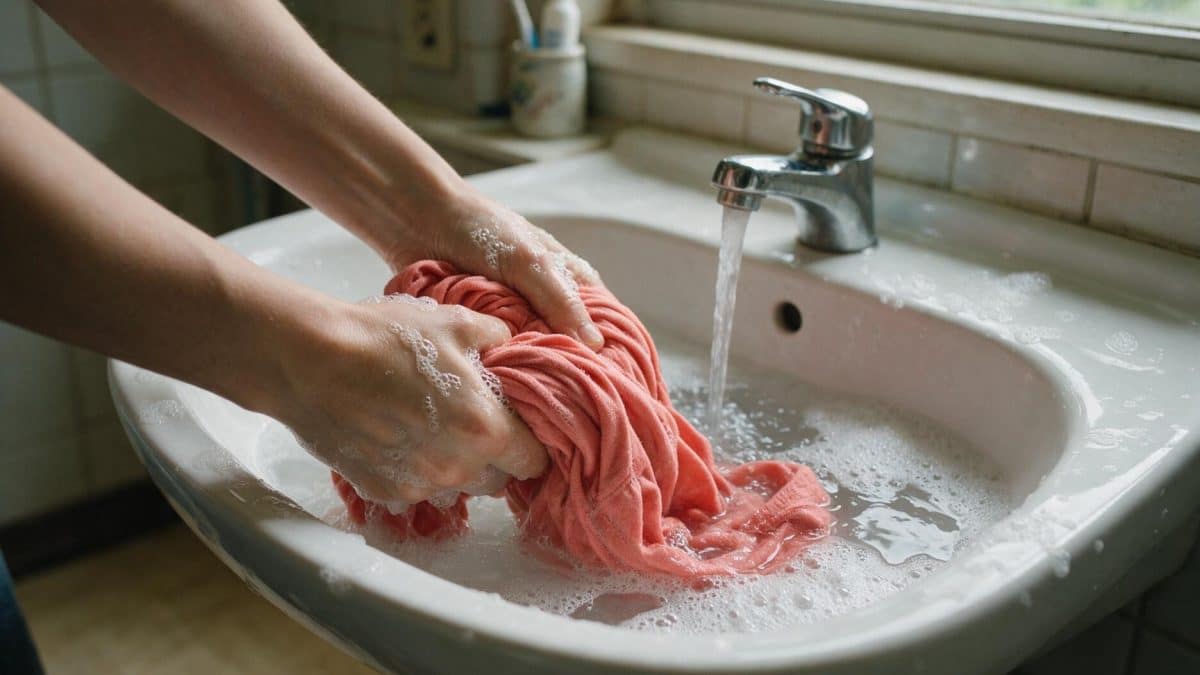
Work through this in order. The order is the method, and the most common failure is starting at step three.
Scrape the loose film off dry
Hold the fabric taut and work the edge of a dull knife or spoon under the crust. Anything that comes off dry is film you no longer have to soften, and on a thick splash that can be most of the mark. Do this before any liquid touches it, because a wetted film goes rubbery and stops flaking.
Put a white cloth underneath and keep the stain face-down
Same principle as every other pigment stain: solvent applied on top of a mark carries material sideways through the weave as much as it carries it out. Face-down over a cloth sends it downward instead. Change the cloth as soon as color transfers.
Soften the film, either with heat or with alcohol
If the hot-water test worked well, repeat it and go straight to brushing while the film is still hot and rubbery, because it firms up again as it cools. Otherwise saturate the mark with rubbing alcohol from the back and give it five minutes to swell the film through its full thickness. A splash that is thicker than paper needs longer than one that is a smear.
Brush hard, and change direction
This is the step that removes the paint. Work the brush across the weave in one direction, then across it at a right angle, then diagonally. A softened film is still one connected sheet locked around the yarns, and it does not come out until it has been broken into pieces small enough to release. Brushing in a single direction polishes it instead.
Reapply and repeat until nothing more comes away
Solvent evaporates fast and a dry film stops responding immediately. Three or four short cycles of wet, brush, wet, brush do far more than one long soak. Stop when a full cycle produces no new flakes on the cloth underneath.
Work dish soap into the spot, then wash cold and alone
The soap clears the loosened residue and any pigment the brush freed. Wash on cold, on its own, so that nothing you shook loose settles on another garment.
Check it wet, and air dry
Look at the damp spot in daylight before anything else happens to it. If a trace is left, go back to step three. Under no circumstances put it in the dryer to see whether it worked.
Method two: oil-based paint
Shorter, because there is less that can be done and the honest answer includes a deadline.
Do not wet it with water first
Water does nothing to an oil film and a wet fabric takes up solvent poorly afterward, so a rinse costs you the one attempt that had a chance.
Scrape, then flood the back of the mark with mineral spirits
Face-down on a white cloth, applied from the reverse, and generously. This is a solvent job rather than a scrubbing job: the spirits have to get through the thickness of the film and reach the fabric underneath before anything will lift.
Blot rather than brush, and keep replacing the cloth
Dissolved oil paint is a liquid again and it moves wherever there is room. Pressing a clean cloth against the back moves it out of the fabric; brushing it moves it around inside the fabric.
Work dish soap in, then rinse warm
Mineral spirits do not evaporate cleanly out of cotton and they leave their own ring, so this step is not optional. Surfactant first, water second.
Wash on the warmest setting the care label allows, alone
The heat restriction that governs method one does not apply here, because there is no thermoplastic film left to melt. What is left is an oily residue, and the oil row of the general stain method applies to it: warm water once it has been pretreated.
Interactive
Label decoder
Tap a symbol from your care label. No guessing, no scrolling.
19 symbols. Pick one.
What the first page gets wrong
Four things get repeated across the results, and each of them is either aimed at the wrong branch or leaves out the reason it works.
- The brush does the removal, and the solvent only makes it possible. Nothing in a household kit dissolves a cured paint film and carries it away in solution. Alcohol swells it, heat softens it, acetone attacks it, and all three leave you with a weakened film that is still locked in place. Something has to break it up and lift it out. That is why every result tells you to scrub without ever saying why, and it is the real answer to a question the page ignores: you can substitute the solvent, and there are several that work, but there is no substitute for the mechanical part.
- Dish soap works on wet paint and does nothing on dry paint. Two of the six questions on the page are about dish soap and not one result on the page answers them. The reason for the split experience is that latex paint in the can is already an emulsion, polymer particles held apart in water by surfactants, which is why wet paint rinses out under a tap. Once the water has gone and the particles have merged, there is a continuous solid and nothing for a surfactant to surround. That also settles the follow-up question about how long to let it sit. Time is not the missing input, so no amount of it helps.
- The AI summary gives two temperature instructions that contradict each other. Step two says pour boiling water through the stain. Step five says wash in cold water. Both appear in the same list with no explanation, and a reader can be forgiven for picking one. They are actually compatible, and the rule that reconciles them is worth stating plainly: local heat, briefly, on the film alone, is a tool. Whole-garment heat, in a machine, is what makes the stain permanent. The film softens above a certain temperature, and a softened film in a tumbling drum flows further into the weave and sets again in a worse position than it started.
- Vinegar and baking soda are on the list because they are on every list. Vinegar is a weak acid and acrylic binders are chosen for wall paint partly because they shrug off weak acids. Where vinegar genuinely helps with paint is on glass and hard surfaces, where softening plus a blade does the work and the blade is the active part. There is no blade on a shirt. Baking soda is a mild base with no solvent action, and using it as an abrasive on a film that is wrapped around individual filaments abrades the filaments too.
Hairspray comes up in the results and in the related searches as well. It has the same problem it has with ink, for the same reason, and the ink guide covers it: the alcohol in old formulas did the work, modern formulas carry much less of it, and what they add instead is a film-forming resin you now have to remove as well.
If it has already been through the wash and the dryer
This is the most common follow-up question on the subject, and the standard advice stops at a warning about it rather than saying what to do next.
A wash cycle on its own changes very little. The dryer is the step that matters, and what it does is specific: it takes a water-based film above the temperature at which it goes soft, holds it there for the better part of an hour while the garment tumbles, and lets it re-form. The result is a thinner, wider, better-anchored film than the one that went in, with pigment pressed against the surface of the filaments.
That is not the same failure as a dye stain being set by heat, and the difference is useful. A set dye has bonded chemically and there is nothing to break up. A re-melted acrylic film is still a thermoplastic and still swells under solvent, so the same method applies. It simply needs longer dwell times, more cycles, and a realistic expectation: what usually comes off is the film, and what usually stays is a shadow where the pigment is now in contact with the fiber surface. On a work shirt that is a win. On a black dress it may not be.
An oil-based mark that has been through a hot cycle has both finished curing and been heat-aged. At that point a professional cleaner’s solvent is the only remaining option worth paying for, and it is worth asking before assuming. That is the one job on this page where dry cleaning is a real answer rather than a hopeful one. Note the direction of that: a home dry-cleaning kit will not help here and will actively hurt, because those kits work by putting the garment in your own dryer with a heat-activated cloth, which is precisely the step to avoid. See how to dry clean at home for what those kits do and do not contain.
Related guides
Paint is the case that the site’s five stain categories do not have a row for, because all five sort by what the stain dissolves in and this one does not dissolve in anything. For the framework itself, and for the categories that do fit it, see how to clean stains from clothes. The closest neighbor in method is ink, which is the site’s other solvent-first stain and which shares the work-from-the-back rule, though ink is a dye or a pigment in a carrier rather than a film. For the other stain where the deadline is not the clock but the first application of heat, see how to clean a blood stain. And if the paint reached the soleplate rather than the shirt, how to clean a clothes iron covers what to do about melted plastic on the plate.
Questions
Does paint stain clothes permanently?
Water-based paint usually does not, even months later, as long as it has never been through a hot dryer. Oil-based paint often does, and the window is days rather than weeks. The single event that turns a recoverable water-based mark into a permanent one is dryer heat, not the passage of time.
Does Dawn dish soap remove paint from clothes?
On wet paint, yes, and plain water alone does most of it. On dry paint, no. Wet latex paint is an emulsion of polymer particles in water, which is exactly the kind of thing a surfactant handles. Dry latex paint is a continuous plastic film, which is not. Letting the soap sit longer does not change that.
How do I get dry paint out of clothes without rubbing alcohol?
Use heat instead. Boiling water poured through the back of the stain softens a water-based film well enough to brush, and it is free. Gel hand sanitizer is the other easy substitute, since it is mostly the same alcohol. What you cannot skip is the brushing, because the solvent only weakens the film and something still has to break it up.
Does vinegar remove paint from fabric?
No. Acrylic and latex binders resist weak acids by design, since that is part of what makes them suitable for exterior walls. Vinegar has a real use on paint spots on glass and tile, where it softens the edge and a blade does the removing, and neither half of that transfers to a shirt.
Can I use acetone on colored clothing?
Carefully and only after a seam test. Acetone lifts some dyes and dissolves acetate, triacetate and modacrylic fabrics completely rather than just staining them. Rubbing alcohol is the safer first attempt on anything you care about, and acetone is what you escalate to on cotton or denim when alcohol has stalled.
Should I use hot water or cold water on a paint stain?
Both, at different moments. Hot water applied directly to the film for a few seconds softens it and makes the brushing work. Hot water applied to the whole garment in a machine, or hot air in a dryer, softens the same film while it is being tumbled and pushes it deeper. Heat the stain, never the garment.