How to Clean Crayon Out of Clothes (The Dryer Does the Damage)
Crayola puts its crayons’ melting point between 120 °F and 147 °F, a band every tumble dryer reaches. The wax has to leave the fabric before any heat does, or one crayon marks the whole load.
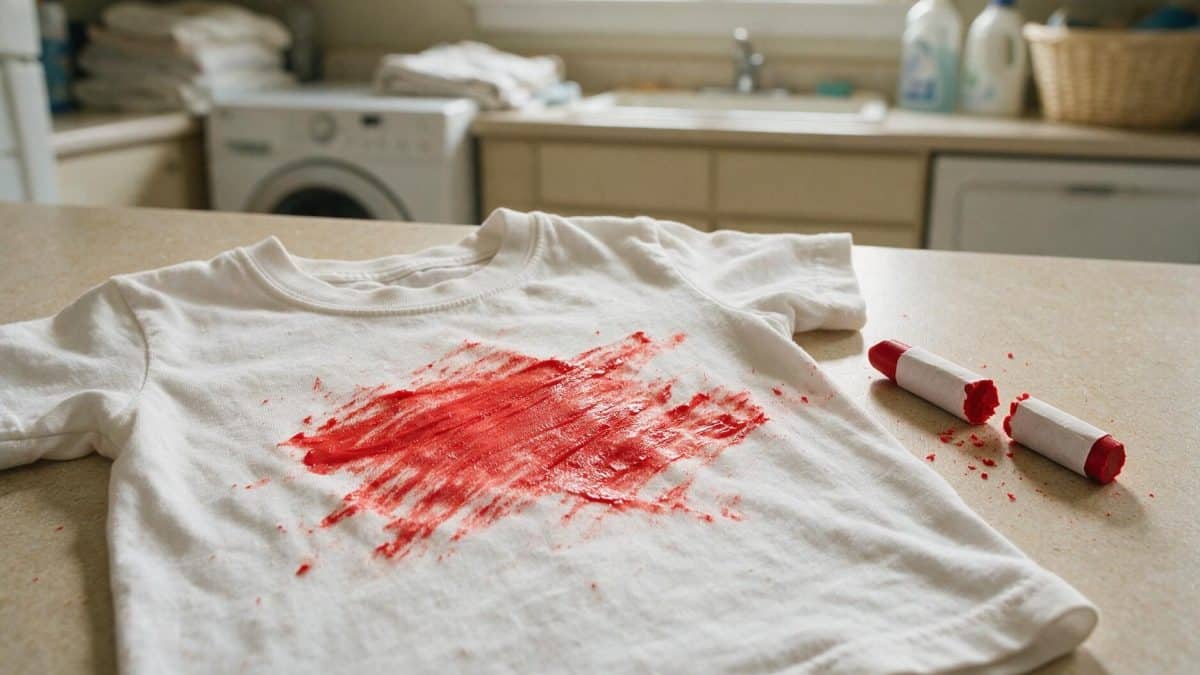
Quick answer · care label Paraffin wax and pigment — washable fabrics
-
1 · Wash
Wash 40° -
2 · Bleach
Oxygen bleach -
3 · Dry
No tumble dry -
4 · Iron
Iron 110° -
5 · Pro care
Pro clean P
In one line Scrape the raised wax off cold, then press the mark face down between white paper towels with a low iron, changing the paper every pass. Work liquid dish soap into what is left, rub it under warm running water, then wash on heavy soil at the hottest temperature the label allows with oxygen bleach. Air dry and inspect it dry, never tumble dry, and repeat if colour remains — about 25 minutes hands-on.
Why does one crayon ruin a whole load and not just the pocket it was in?
Most people who look up how to clean crayon out of clothes are not standing in front of one shirt. They are standing in front of an open dryer in which every item has picked up the same red and green speckles, including things that went in clean. One crayon, forgotten in a pocket, has marked the entire load.
That happens because a crayon is not a stain in the way that coffee or blood is a stain. Crayola describes its crayons as made primarily of paraffin wax and colour pigment, and it publishes the temperatures that matter: its crayons begin to melt at around 105 °F (41 °C) and have a melting point between 120 °F and 147 °F (49 °C to 64 °C). A domestic tumble dryer runs inside that band on every setting it has. So the crayon does not get through the wash and then get set by the dryer. It liquefies in the dryer, is flung around a rotating drum full of damp fabric, and re-solidifies wherever it lands.
Which reorders the whole job. The wash is rarely where the damage happens; the dryer almost always is. It also means the standard opening line on this kind of stain, act fast, is pointed at the wrong step, because a crayon smear on a sleeve will sit there for a fortnight without getting worse.
Heat is not the enemy here, which makes crayon unlike almost every other stain on this site. Heat is the tool, because the wax has to be liquid before anything can move it. What wrecks clothes is heat applied while the wax is still inside the weave with nowhere to travel. Melt it against absorbent paper and it wicks out of the fabric. Melt it in a tumbling drum and it spreads through the fabric and onto everything touching it. Same physics, opposite result.
What you’ll need
| Item | Why | Substitute |
|---|---|---|
| A dull knife or a spoon | Lifts the raised wax off cold, before any heat is involved. On a thick mark this is most of the removal, and it is work no solvent has to do afterwards | The edge of a credit card, which is less likely to catch a thread on a knit |
| Plain white paper towels | Sit under and over the mark and take the melted wax away from the fabric. They have to be white and unprinted, because printing ink transfers under a hot iron | A brown paper grocery bag cut flat, or proper blotting paper, which holds more before it saturates |
| An iron, lowest setting, steam off | Melts the wax in one small area so the paper can pull it out. Steam puts water where you want wax to move | A hairdryer held close. Slower and harder to aim, but it cannot scorch a synthetic |
| Liquid dish soap | The surfactant that emulsifies whatever wax the paper missed, so the wash water can carry it off. Both published methods for crayon name this step by name | A heavy-duty liquid laundry detergent worked in neat |
| Oxygen bleach | Attacks the pigment, which is the half of the mark that survives the wax removal. Crayola names OxiClean or Clorox 2; the University of Georgia extension guidance names sodium perborate. Same chemistry | Plain sodium percarbonate, sold as a laundry booster, which is what most of those products are |
| Mineral spirits or WD-40 | For a wax deposit the iron will not shift, or on a fabric that cannot take the iron. Paraffin is a hydrocarbon and dissolves in hydrocarbons | A commercial pre-wash solvent spray, or a professional cleaner, who is using the same class of solvent at industrial strength |
The method, step by step
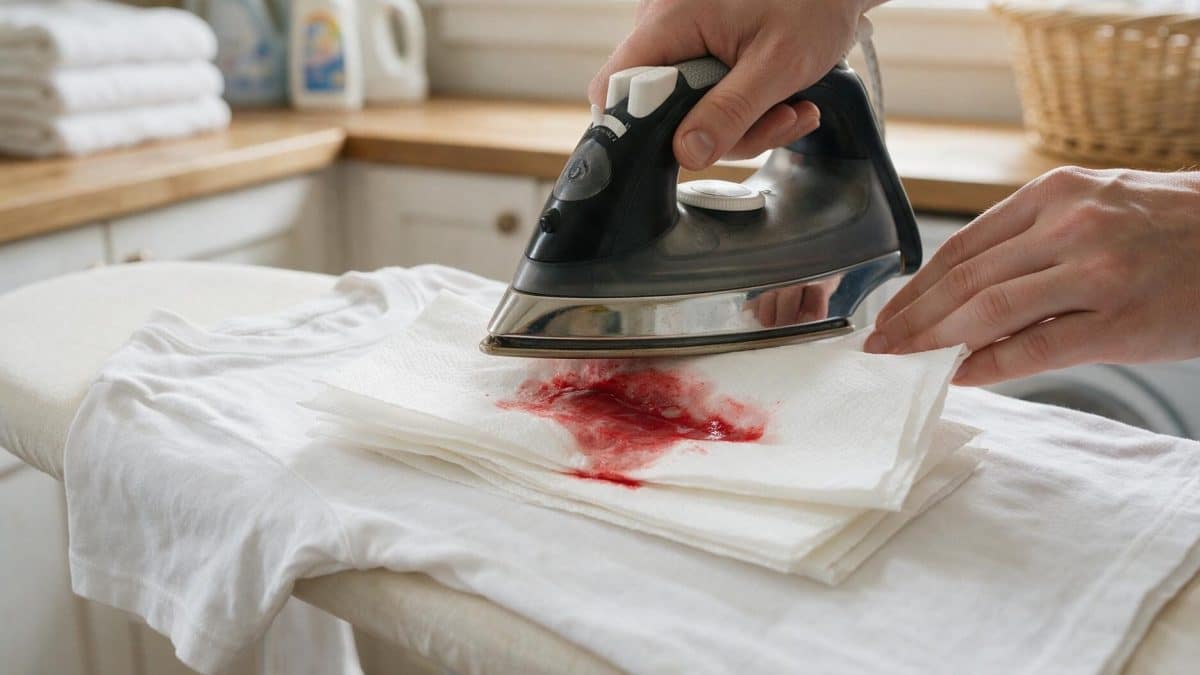
Scrape the raised wax off cold
Hold the fabric taut over the edge of a table and work the knife under the crust. If the crayon is soft, put the garment in the freezer for fifteen minutes first: brittle wax chips off, soft wax smears sideways and gets bigger.
Lay the mark face down on paper
Two or three sheets underneath, one on top, overlapping the mark generously on all sides. Everything from here works from the back of the fabric, so the wax travels out by the shortest route rather than through the full thickness of the cloth.
Press briefly from the back, and change the paper every pass
Five seconds, lift, look. A dark patch on the paper is wax that has left the shirt. Saturated paper stops absorbing and starts giving wax back, so replace it every pass rather than pressing longer. This step earns its place on a thick raised deposit and is worth skipping on a thin smear, where the heat mostly spreads pigment sideways.
Work liquid dish soap into what is left, and leave it
Neat, rubbed in with a fingertip, and given a few minutes. There is a thin film of wax still wrapped around the individual filaments that no amount of blotting reaches, and this is the step that gets it ready to wash out.
Rub it under warm running water
Warm, not hot, and rubbed between your thumbs rather than scrubbed with a brush. This is the point at which the softened wax actually leaves. What remains after it should be colour without texture.
Wash on heavy soil, hottest water the label allows, with oxygen bleach
Both published methods ask for the hottest water the fabric will take, and the reason is the last of the wax rather than the pigment: below roughly 40 °C (104 °F) it never softens enough for detergent to lift it. Neither of them says to wash the item alone. Do it anyway, because the wax that comes loose has to land somewhere.
Air dry, then look at it dry
Damp fabric hides a faint pigment shadow completely. Hang it, let it dry properly, and inspect it in daylight. If colour is still there, go back to step four; the wax is gone by now and it is the bleach and the repetition doing the work.
Where a dryer sits against the melting point
| Setting | Temperature | Reaches the wax |
|---|---|---|
| Cold or 30 °C wash | Up to 86 °F | No. Below even the point where the crayon softens, so it comes out of the machine intact |
| Warm 40 °C wash | 104 °F | Barely. One degree under the softening point Crayola gives, which is why a warm wash on its own disappoints |
| Hot 60 °C wash | 140 °F | Yes. Inside the melting range, and the wash the published methods are really asking for |
| Tumble dryer, low | GE publishes an outlet thermostat set point of 125 °F | Yes, and this is the whole problem. Hot enough to liquefy it, in a drum full of fabric with nothing absorbent in it |
| Tumble dryer, high | Manufacturers publish figures from 135 °F upwards | Yes. The same event, more of it |
| Iron on one dot | 110 °C (230 °F) | Yes, far past it, but on a coin-sized area and against paper that carries the wax away |
Two caveats. Appliance makers disagree about dryer temperatures and are careful about what they claim to be measuring: GE gives outlet thermostat set points of 125 °F on low and 135 °F on medium and high, and says plainly that those are not the air temperature inside the drum. Other makers publish higher figures. The disagreement changes nothing, because even GE’s lowest number sits inside Crayola’s melting range.
And 60 °C is the temperature the wax wants, not the temperature most garments allow. Read that row as a ceiling you aim at rather than an instruction. On anything that cannot go there, the paper-and-iron stage is not optional, because the wash will not finish the job for you.
The colour is a pigment, not a dye
A coloured candle carries dye. Dye goes into solution, enters the fibre, and behaves like every other dye stain, which is why the standard finish for candle wax is diluted alcohol on the shadow that remains. Crayola describes its crayons as carrying pigment instead, and a pigment is a solid particle that was never dissolved and is not going to dissolve now. Alcohol does nothing useful to it. Nor does alcohol do much to the paraffin, which is a nonpolar hydrocarbon that a polar solvent like isopropanol handles poorly.
So the reflex that works on ink stains on clothes is the wrong reflex here. Ink is a colourant carried in a solvent that alcohol is chemically close to; crayon is a solid particle suspended in candle wax. What moves a pigment is mechanical lifting plus an oxidising bleach, and both published methods reach for exactly that: Crayola names OxiClean or Clorox 2, the extension guidance names sodium perborate, and those are the same oxygen chemistry under two labels.
The sources part company on chlorine. The extension service allows chlorine bleach on wax stains where the fabric is safe for it; Crayola names only oxygen bleach. On white cotton either works, and on anything coloured only oxygen bleach leaves the garment’s own dye alone.
What does dissolve paraffin is the hydrocarbon family: mineral spirits, the petroleum distillates that make up most of WD-40, and the perchloroethylene or hydrocarbon solvents a dry cleaner uses. That last one is not a throwaway. Dry cleaning is a genuine answer for crayon rather than a hopeful one, which is not true of most stains.
When the whole load came out speckled
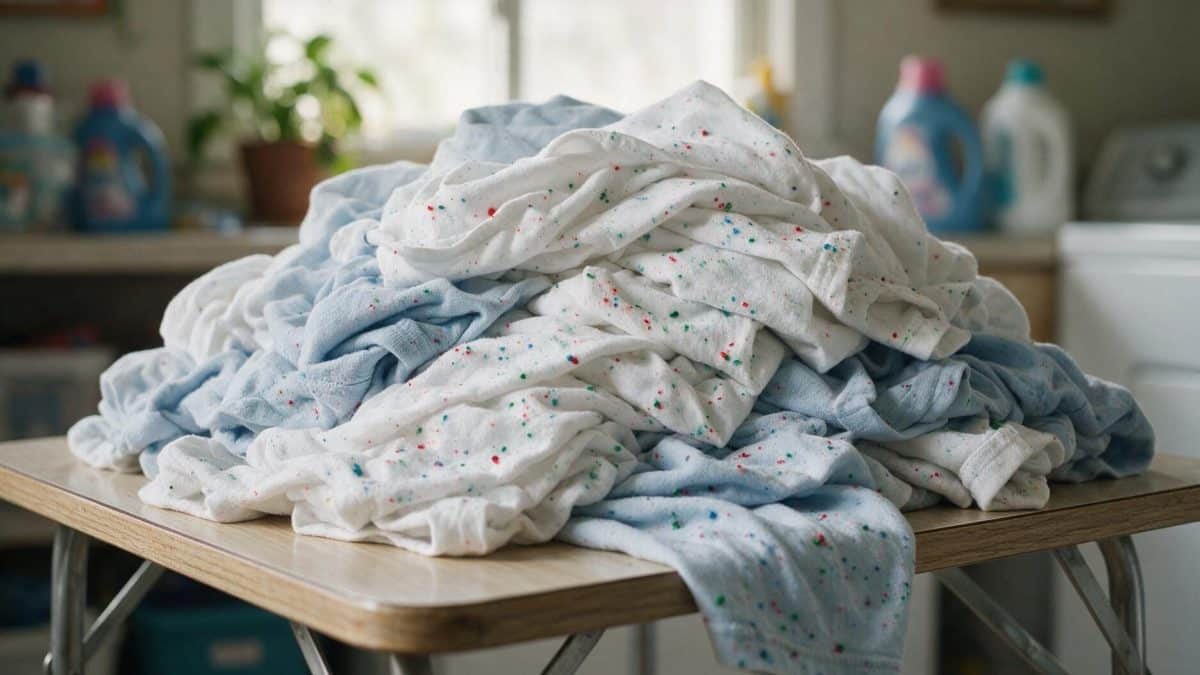
Before anything else: both drums are now the stain. Rewash the load without dealing with them and you re-deposit crayon on the same clothes, plus whatever goes in next.
For the drums, the extension guidance is to spray them with a commercial pre-wash remover, wipe with a soft cloth, then run a load of rags on a full cycle with heavy-duty liquid detergent, hot water and a full water level, and send those same wet rags through a complete drying cycle afterwards. Crayola’s version for the dryer drum is to wipe it with paper towels, use a melamine sponge according to that product’s own instructions, then run clean dry rags through a cycle. The difference is small: wet rags stay in contact longer, dry rags scour.
For the clothes themselves, the answer from the extension service is blunt, and it is one of the few places on this site where published guidance is do not attempt this at home: dry clean the load, coin-operated or commercial. The reason is the solvent, not the skill.
If you try anyway, and most people do, work in small batches, use the hottest water each batch’s labels allow with heavy-duty liquid detergent and oxygen bleach, and air dry every batch before it goes near a dryer again. Expect three or four cycles, expect the pale cottons to come back and some of the dark synthetics not to, and check every item dry before anything is tumbled, because one missed speck restarts the whole thing.
What each fabric can actually take
| Fabric | Hottest realistic wash | Iron over paper | Recoverable |
|---|---|---|---|
| White cotton, denim, linen | 60 °C (140 °F), inside the melting range | Yes, two dots, no steam | Yes, usually completely |
| Coloured cotton, poly-cotton | 40 °C, and higher costs dye | Yes, one dot | Usually, with repeats |
| Polyester, nylon, acrylic | 40 °C | One dot, brief presses only. Held heat glazes the surface permanently and that damage does not come out | Usually, though the pigment clings hardest here |
| Wool, cashmere | 30 °C or hand wash, and agitation felts it regardless | No | Rarely at home. Lift the wax cold, then take it in |
| Silk, viscose, anything marked dry clean only | No hot water available at all | No | No. This is a job for a cleaner, and a good candidate for one |
The third row is the one that surprises people. Synthetics wash easily and still hold crayon pigment worse than cotton does, because the fibre surface is smooth and non-absorbent so the pigment sits on it rather than in it, and because the ceiling on both wash and iron temperature is low. A crayon mark on a school polo shirt is a harder job than the same mark on jeans.
Related guides
- Candle wax is the same paraffin without the pigment, so that removal ends where this one is only half done, and the wicking stage is covered there in more detail: how to clean wax off clothes.
- Paint is the other common stain that is a film rather than a dissolved substance, and it is the mirror image of this one, because there heat is permanently the enemy rather than the tool: how to get dry paint out of clothes.
- If some of the wax ended up on the soleplate while you were blotting, which is the usual cost of doing this in a hurry: how to clean a clothes iron.
- For where crayon fits among the categories the site sorts stains into, and why it sits awkwardly in all of them: how to clean stains from clothes.
Questions
Does crayon come out of clothes?
Usually, if it has not been through a dryer. A crayon mark on the outside of a cotton or denim garment comes out almost completely with scraping, blotting and a hot wash with oxygen bleach. Once a crayon has melted through a full dryer cycle it is a different problem, and on dark synthetics a faint shadow often stays.
Will a hot wash on its own get crayon out?
Sometimes on a light mark, rarely on a thick one, and not at all below about 40 °C (104 °F), because that is where the wax stops softening. Even at 60 °C the melted wax has to be emulsified by detergent before the water can carry it off, which is why both published methods have you work dish soap in first rather than trust the cycle.
Does WD-40 really remove crayon from clothes?
It does dissolve the wax, because it is largely petroleum distillates and paraffin is a hydrocarbon. It is in neither published fabric method, though, and the reason is what it leaves behind: an oily mark of its own that then has to be washed out with dish soap and hot water. Worth reaching for on a stubborn deposit on cotton, not worth reaching for first.
What do I do if a crayon has already been through the dryer with a full load?
Clean both drums before you rewash anything, or the next cycle re-stains the same clothes. Then treat the garments in small batches at the hottest water each batch allows, with detergent and oxygen bleach, air drying between attempts. The published extension guidance for a whole load is to take it to a dry cleaner, and for anything you actually mind about, that is the better call.
Do vinegar or baking soda work on crayon?
No, and it is worth knowing why they keep appearing. Vinegar is a dilute acid and paraffin is chemically inert to weak acids. Baking soda is a mild base with no solvent action on a nonpolar wax, and used as an abrasive it works the pigment further into the fibre. Neither appears in Crayola’s guidance or in the extension guidance.
Are washable crayons any easier?
Only while the mark is fresh. Crayola’s instructions for a fresh washable crayon mark are simply to machine wash it with detergent on a hot cycle. Its instructions for a washable crayon that has been heat-set or melted are word for word the same as for a regular crayon. Washable describes the fresh mark, not the one that went through the dryer.