How to Clean Dog Urine from a Rug
A rug lets urine pass straight through to the pad and the floor underneath, which is why a spot you cleaned properly still smells two weeks later. Here's how to treat all four layers, and why an enzyme cleaner needs a shorter dwell time on wool.

Quick answer · care label Wool, nylon, polypropylene · latex or jute backing
-
1 · Wash
Hand wash -
2 · Bleach
No bleach -
3 · Dry
Dry flat -
4 · Iron
Do not iron -
5 · Pro care
Pro clean P
In one line Blot under body weight, pour a cup of clean water over the spot to dilute what has already spread sideways, then blot again before any cleaner touches it. Dried urine needs an enzyme cleaner to break the uric acid crystals, but on wool or silk keep the dwell time to 10-15 minutes rather than hours. Then lift the rug: the pad and the floor underneath are usually what still smells.
A rug is three layers, and the urine reaches all of them
A mattress absorbs urine into one thick block and holds it there. A rug does something different: it lets the liquid pass straight through. Pile, then backing, then the rug pad, then the floor. By the time you notice the wet patch on the surface, most of the volume is already sitting below the surface, spread wider than the stain you can see.
This is why so many people clean a pet accident properly, watch the stain disappear, and then smell it again two weeks later on a humid afternoon. The pile got cleaned. The pad underneath never did. And a dog that can still smell the spot will use it again, which is the part that turns one accident into a habit.
| Layer | What happens there | What it needs |
|---|---|---|
| Pile (the visible surface) | Holds the pigment that makes the stain, and very little of the volume | Blotting and an enzyme cleaner; this is the easy layer |
| Backing (latex, cotton scrim, or jute) | Traps liquid between the fibers and the glue; stays damp for days | Airflow underneath, not more cleaner poured on top |
| Rug pad (felt or rubber waffle) | Acts like a sponge and holds odor long after the rug is clean | Washing separately, or replacing; felt pads rarely recover |
| Floor beneath | Hardwood absorbs into the grain and gaps; the smell comes from the boards, not the rug | Cleaning the floor itself, with the rug lifted and out of the room |
Lift a corner of the rug and put your nose close to the underside of the backing, then to the pad, then to the bare floor. Whichever one is strongest is the one you have not treated yet. Cleaning the pile a third time will not fix a pad that is holding the odor.
Fresh accidents: blot hard, then flood the spot on purpose
The instinct with a fresh puddle is to use as little liquid as possible. That instinct is wrong here, and it is the single biggest reason a treated spot comes back. Urine that has soaked two inches wide needs to be diluted across those two inches, not just lifted off the top half inch.
- Blot with pressure, do not rub. Stack four or five paper towels or an old white towel over the spot and stand on it for about 30 seconds. Body weight pulls up far more liquid than hand pressure does. Repeat with a dry section until the towel comes up barely damp.
- Pour clean cool water over the spot, roughly a cup for a palm-sized puddle. This sounds like it makes things worse. It dilutes what has already spread sideways so that the next blotting round can actually reach it.
- Blot again the same way, standing on the towel. Two rounds of water and blotting remove more urine than any cleaner applied to a spot that was never diluted.
- Only now apply the enzyme cleaner. Enzymes work on what is left behind, not on a saturated puddle, and applying them into standing urine mostly wastes the bottle.
Use a white towel, not a colored one. A damp colored towel under body weight can transfer its own dye into a wet rug, which leaves you with a second stain that the enzyme cleaner will not touch.
Dried urine needs enzymes, and wool rugs are the exception that matters
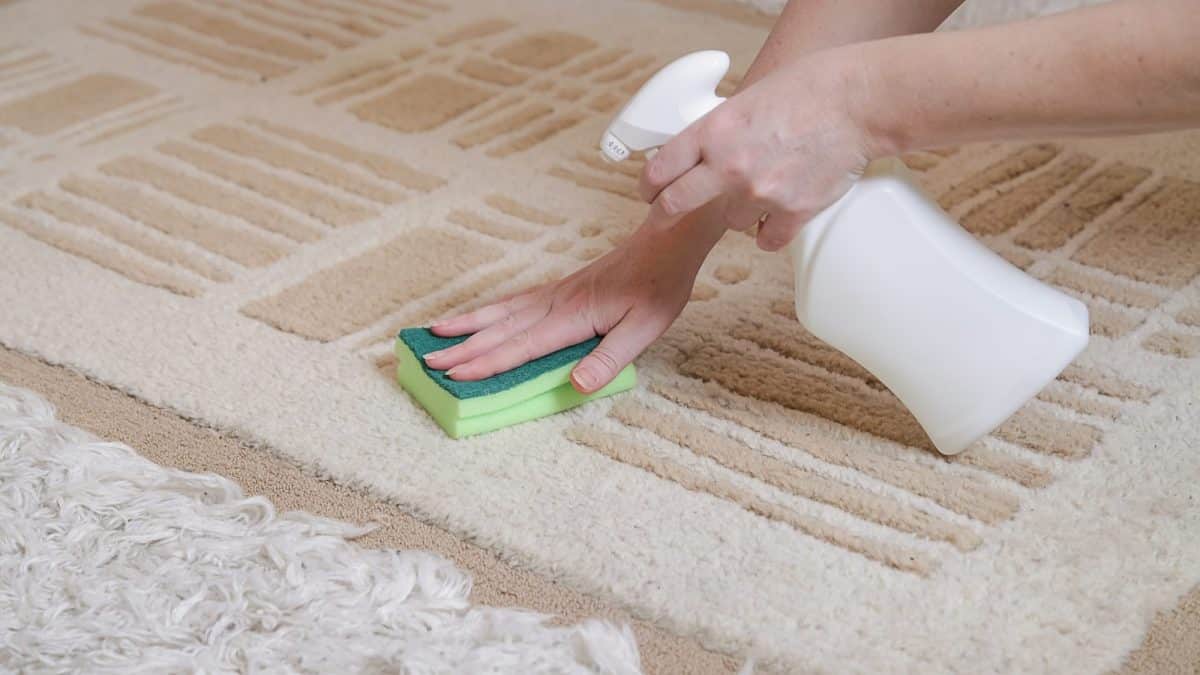
Once urine dries it leaves uric acid salts, crystals that ordinary detergent cannot dissolve. They sit in the fiber, invisible, until humidity in the air rehydrates them and the smell returns. That mechanism is the same one that makes an old mattress accident come back months later, explained in more detail in how to clean urine out of a mattress. An enzyme cleaner is the only household product that breaks those crystals down rather than covering them.
But an enzyme cleaner is a protein-digesting product, and wool is a protein fiber. So is silk. On a wool or silk rug, a strong enzyme formula left to sit for hours can dull the fiber, roughen the hand, and in the worst cases weaken the pile where it was applied. Synthetic rugs, nylon, polypropylene, polyester, have no such problem: they are not protein, and the enzymes have nothing in them to attack.
If you do not know what the rug is made of, the burn test on a single tuft settles it. Wool self-extinguishes and smells like burnt hair. Synthetics melt into a hard bead and smell chemical. The same test is described in how to clean a rug, alongside the rest of the fiber identification.
Ten to fifteen minutes instead of the several hours some labels suggest, then blot and rinse with cool water rather than letting it dry in place. You lose a little of the enzyme action and you keep the fiber intact. Test on a corner under the furniture first, and wait for it to dry before judging the color.
Never use ammonia, and go easy on the vinegar
Ammonia is a component of the smell of urine itself. To a dog, an ammonia-cleaned spot smells like a spot another dog has already claimed, which is an invitation rather than a deterrent. It is the most common reason a dog keeps returning to a patch of carpet that the owner is convinced is spotless. Check the label of any general purpose cleaner before it goes near the rug.
Vinegar is the more interesting case, because it is genuinely useful and widely oversold. It neutralizes the alkaline salts and knocks down the immediate smell, which is why it works well on a fresh accident. It does not break down uric acid crystals, so on a dried stain it buys you a few days and then the odor comes back. Use it as a first pass while you wait to get hold of an enzyme cleaner, not as the whole treatment. And keep it off natural stone floors, where the acid etches the surface if it soaks through.
Hydrogen peroxide lightens both the stain and, sometimes, the rug. On a mid or dark color it can leave a pale halo that is more visible than the urine was. If you use it at all, keep it to 3 percent, keep it to white or cream rugs, and test on the underside first.
Interactive
Label decoder
Tap a symbol from your care label. No guessing, no scrolling.
19 symbols. Pick one.
Check the pad and the floor before you call it finished
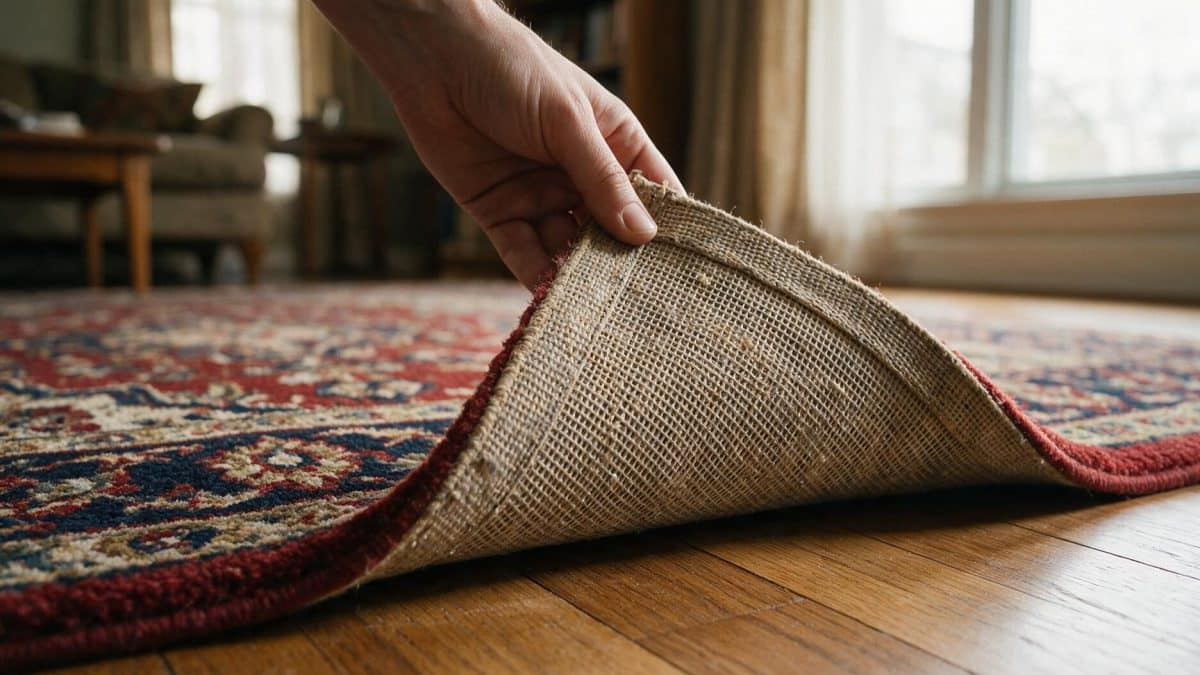
Lift the rug and hang it over a couple of chairs. Two things become obvious immediately: whether the backing has a matching wet patch, which it almost always does, and whether the pad or the floor below is stained.
- Felt pads hold odor and rarely give it back. Some can be hosed and dried outdoors, most cannot. If the pad smells, replacing it costs less than treating the rug three more times.
- Rubber waffle pads are the easier case. Wash with warm water and a drop of dish soap, rinse, and dry fully flat before it goes back under the rug.
- Hardwood absorbs into the seams between boards. Clean the floor with an enzyme cleaner too, and give it a full day dry before the rug goes back down, or the rug simply reabsorbs what the boards are holding.
- A cheap UV flashlight makes old spots visible in a dark room. Dried urine fluoresces a dull yellow-green. It is the fastest way to find the accidents you never saw happen, especially on a patterned rug.
Drying the backing is the step that decides whether mildew follows
Everything above puts a significant amount of water into the rug, and a rug that dries pile-first while the backing stays wet is exactly how mildew starts. Get air moving on both sides: rug over a railing or chairs, a fan pointed at the underside, and 24 to 48 hours before it goes flat on the floor again. Press a folded paper towel against the backing and check for damp before you put it back down.
A jute or latex backing that stays wet for several days can also start to break down and shed a fine powder, which is not reversible. If mildew has already taken hold and you can see dark specks rather than just smell something musty, the treatment is different from a normal stain: see how to clean mold off clothes for how mold behaves in fabric and why it needs killing before washing.
When it is worth paying someone
Three situations where a professional is the cheaper outcome: a hand-knotted wool or silk rug of any real value, where dye migration is the risk and it is not recoverable; repeated accidents in the same spot over months, where the volume in the backing is beyond what blotting reaches; and a rug that already smells strongly when the room is warm and closed, which usually means the pad and the floor are involved too. Ask specifically for a full immersion wash rather than a surface extraction, because surface extraction has the same blind spot as cleaning the pile at home.
Related guides
The chemistry of dried urine, and why the smell returns on humid days, is covered in more depth in how to clean urine out of a mattress. For fiber identification and the general wash and dry method for any rug, see how to clean a rug. If the rug is a bath mat or a small throw rug you can lift into a washing machine, the pile and the backing get handled in one cold cycle and only the pad and the floor are left to check: how to clean throw rugs. If you are working out what kind of stain you are dealing with in the first place, how to clean stains on a rug sorts every category by the treatment that lifts it, on a surface you cannot rinse, and how to clean stains from clothes does the same for garments.
Questions
How long do I have before a dog urine stain becomes permanent?
The odor problem starts as soon as it dries, usually within a few hours, but it stays treatable with an enzyme cleaner for a long time afterward. The color is the part with a real deadline: urine is alkaline and on wool or a natural dye it can shift the color within a day or two, and that change does not reverse. Treat a wool rug the same day if you can.
My carpet cleaner has a pet setting. Is that enough on its own?
It handles the pile well and it pulls out far more liquid than blotting does, which is genuinely useful. What it does not do is treat the pad or the floor underneath, and on a deep accident that is where the smell is living. Use the machine, then lift the rug and check the layers below before deciding you are done. That last instruction is also the one thing you cannot do on carpet fixed to the floor, which is why the same accident is a harder problem there: see how to clean carpet.
Will baking soda get rid of the smell?
It absorbs odor from the air around the fibers, so a rug does smell better for a while afterward. It does not break down the uric acid crystals causing the smell, which means the improvement is temporary. It is a reasonable finishing step after an enzyme treatment, sprinkled on, left overnight, and vacuumed off, but not a replacement for one.
My dog keeps going back to the same spot even though it looks clean. What am I missing?
Almost always one of two things: an ammonia-based cleaner used at some point, which reads to the dog as another animal’s mark, or residual odor in the pad or the floorboards that you cannot smell but the dog can. A UV flashlight in a dark room will show you where the old spots actually are, and it is often a wider area than expected.