How to Clean Throw Rugs
A throw rug is the one rug small enough to fit in a washing machine, so the real question isn't the pile, it's whether the non-slip backing survives. Water never breaks that backing. Dryer heat breaks it in a single cycle, permanently.
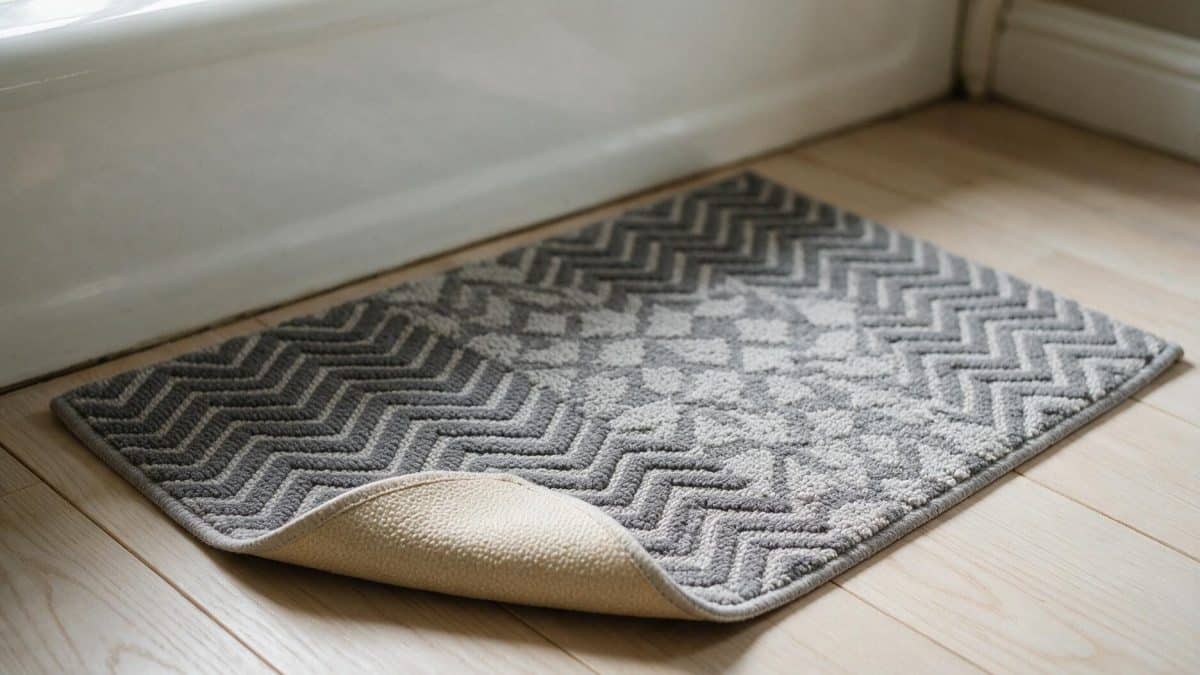
Quick answer · care label Throw rug · cotton, polyester or nylon pile over a latex, PVC or woven backing
-
1 · Wash
Wash 30° -
2 · Bleach
No bleach -
3 · Dry
No tumble dry -
4 · Iron
Do not iron -
5 · Pro care
No dry clean
In one line Check the backing before the pile. Vacuum the underside, then wash cold on gentle with two or three towels for balance, mild liquid detergent, an extra rinse and the lowest spin. Never tumble dry a rug with a rubber or PVC backing: 60-70 °C makes the foam brittle in one cycle and the tumbling breaks it into crumbs. Air dry backing-up over a rack for 12 to 24 hours.
The backing decides this, not the pile
A throw rug is the one rug in the house small enough to fit in a washing machine, and that changes what you actually have to decide. The usual question, what fiber is this and how do I treat it, barely applies here. The pile on almost every throw rug is cotton, polyester or nylon, and all three wash without drama. What decides the outcome is the layer glued to the underside. That layer is what fails, and it fails in a way that can’t be undone.
Flip the rug over. You’ll find one of four things:
- Latex or rubber non-slip backing. A grid of dots or a sprayed foam, slightly tacky, flexible. This is what’s under most bath mats and kitchen rugs. Water doesn’t hurt it. Heat destroys it.
- PVC mesh grid. Stiff, open, usually white or beige, glued rather than sprayed. Tolerates a cold wash, curls permanently above about 40 °C.
- Woven canvas or cloth backing. Flat, fabric-like, no grip at all. Fully washable, just slow to dry.
- No backing at all. A flatweave or dhurrie, reversible, the same on both faces. The easiest case on this page.
There’s a two-second test worth doing before anything else. Fold a corner of the backing back on itself. If it makes a faint crackling sound, or leaves fine grey dust on your fingers, the latex has already begun to oxidize. A wash won’t cause that damage, but it will finish it, and you’ll get the crumbs in your machine rather than on your floor.
If the underside of the rug grips your floor, it does not go in the dryer. Not on low, not for ten minutes. Air drying costs you twelve extra hours; the dryer costs you the rug, and the reason why is further down this page.
What you’ll need
| Item | Why | Substitute |
|---|---|---|
| Mild liquid detergent | Powders dissolve poorly in cold water and leave grit in the backing; oxygen boosters attack latex over repeated washes | Half the usual dose of any liquid detergent |
| Two or three old towels | They balance the drum and absorb the abrasion a lone rug takes against the metal | Any bulky item that won’t shed lint |
| Mesh laundry bag | Keeps fringe and loose edges from wrapping around the drum fins | A pillowcase knotted at the opening |
| White cotton cloth | Colorfast test: a colored cloth hides dye transfer, which is the whole point of the test | A clean white sock |
| Drying rack or two chairs | Air has to reach both faces at once, or the backing stays wet after the pile feels dry | The edge of the bathtub, rotated a few times |
The method, step by step
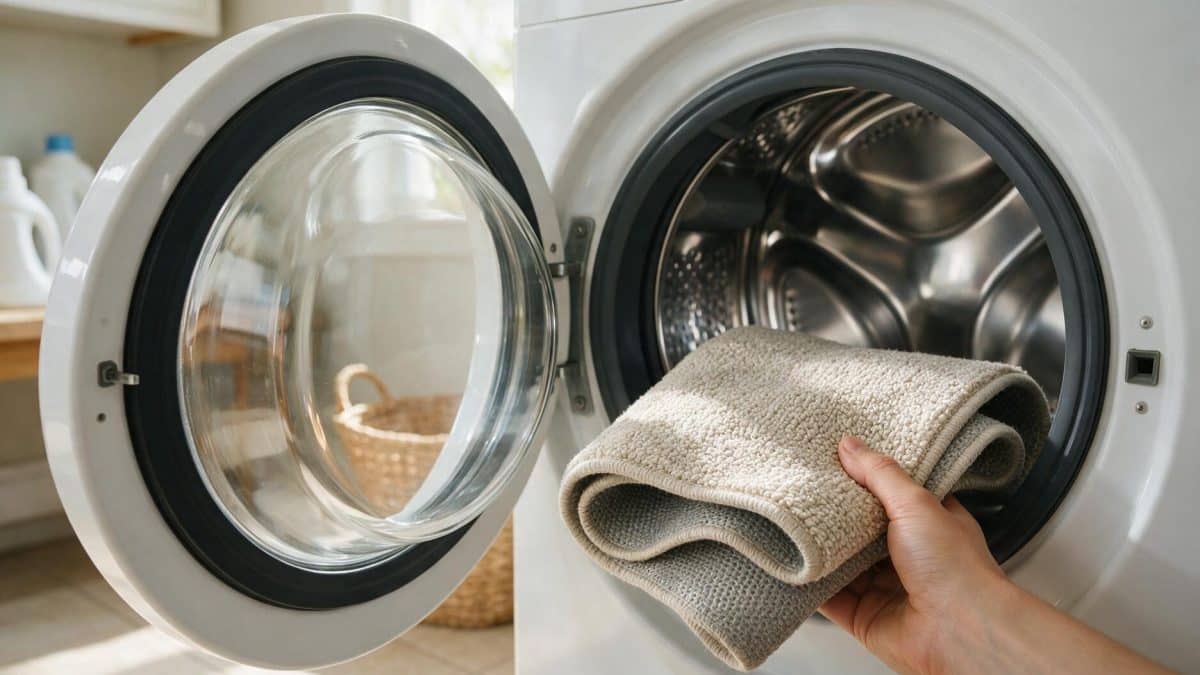
Shake it out and vacuum the back
Take it outside and shake it hard, then vacuum the underside before the top. Grit sitting against the backing is what sandpapers the pile from below once the drum starts turning. Skipping this is why a rug can come out of a wash looking flatter than it went in.
Read the backing, not just the tag
Most throw rugs have lost their care label years ago, and the tag is the less useful of the two anyway. A “machine washable” label on a rug whose latex is already crumbling is out of date; the backing tells you what’s true today.
Test for colorfastness
Press a damp white cloth into a hidden corner for ten seconds. Deeply dyed cotton throw rugs and anything with a jute border are the usual bleeders. If color transfers, wash it alone in cold water with no detergent booster, and never with anything white.
Load it with towels, not on its own
A soaked throw rug is a dense, heavy mass. Alone in a front loader it slams to one side of the drum, the machine detects the imbalance and either refuses to spin or spends twenty minutes redistributing it. Two or three towels solve that, and they take some of the friction off the rug.
Cold water, gentle cycle, extra rinse
The cold setting is there for the backing rather than the pile. Set an extra rinse if the machine has one: detergent left in a rubber backing keeps it slightly tacky, and a tacky backing collects dirt faster than the pile does.
Use the lowest spin available
A high spin presses the rug into folds against the drum wall. On a latex backing those fold lines become creases, and a crease in aging latex becomes a crack the next time someone steps on it. Damp is fine here, since the drying is going to be slow regardless.
Dry it backing-up, elevated
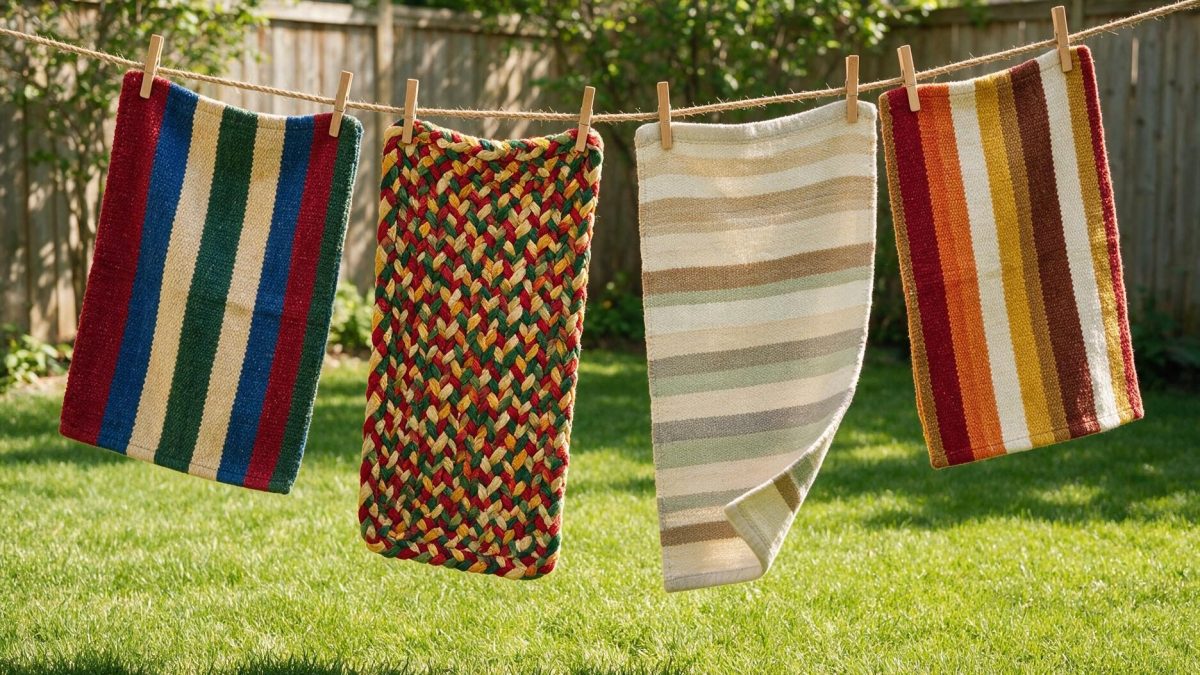
Hang it over a rack, a rail or two chair backs with the underside facing up and out. Air has to reach the backing, which holds water long after the pile feels dry to the hand. Press your palm flat against the center of the backing before putting it down on a floor.
Interactive
Label decoder
Tap a symbol from your care label. No guessing, no scrolling.
19 symbols. Pick one.
Why the dryer is what actually kills a rubber-backed rug
Non-slip backing is a foam whose flexibility depends on plasticizers held inside the polymer. A normal dryer cycle runs the drum at 60-70 °C, and at that temperature two things happen at once: the plasticizer volatilizes out, and the rubber oxidizes. The foam goes from soft and springy to brittle in a single cycle. Then the tumbling does the rest, mechanically breaking the brittle layer into crumbs.
Those crumbs are how most people discover the problem. Grey or black flakes all over the drum, then in the next three loads of laundry, then in the lint filter and eventually in the drain pump. The rug itself is finished. There is no way to reattach or replace a backing, and a rug that has lost it slides on the floor from then on.
What confuses people is that the rug looked fine going in and the label said machine washable. It was. Washing was never the risk. Sunlight does the same oxidation to a backing left on a balcony, just over two or three summers instead of forty-five minutes.
Bath mats, kitchen rugs and entry rugs fail differently
They all go through the same wash, but what they need between washes isn’t the same at all, because the thing dirtying them isn’t the same.
- Bath mat: the backing never gets a chance to dry. It lies flat against a cold floor in a humid room, so the underside stays damp from one shower to the next. Mildew starts there and only later shows on top as a grey shadow. Wash it weekly, and hang it over the tub edge between uses so both faces dry. It’s the same failure that grows mildew along the hem of a shower curtain long before the rest of the panel looks damp.
- Kitchen rug: grease, which cold water alone won’t lift. Cooking oil aerosolizes and settles on everything within a couple of meters of the stove, so the rug picks up a thin film rather than visible spots. Work a drop of dish soap into the greasy zone with your fingers, leave it ten minutes, then run the cold cycle as normal.
- Entry rug: grit, and that’s the vacuum’s job more than the machine’s. Sand and road salt carried in on shoes sit deep at the base of the pile. Vacuum both sides thoroughly before washing, or you’re running an abrasive through the drum along with the rug.
- After a pet accident, don’t start with the machine. Urine that has soaked through and dried needs an enzyme treatment before any wash, or the wash sets what’s left and the smell returns on humid days: how to clean dog urine from a rug covers the sequence.
What actually fits in a home machine
Dry weight is misleading here. A throw rug holds three to four times its own weight in water, so the number that matters is what the drum is carrying mid-cycle, not what you lifted off the floor.
| Rug size | Where to wash it |
|---|---|
| Up to 2 x 3 ft (60 x 90 cm) | Any machine from about 7 kg / 4.0 cu ft, with two towels |
| 3 x 5 ft (90 x 150 cm) | Front loader of 8-9 kg / 4.5 cu ft or larger, rug and towels only |
| 4 x 6 ft and above | Laundromat machine, or hand wash |
| Top loader with a center agitator | Not this one, at any size: the post wraps and stretches the rug |
Past 4 x 6 ft, or on any rug that shouldn’t see a drum at all, the method changes completely and it’s covered separately in how to clean a rug: fiber identification, hand washing, and getting the water back out without a wet/dry vacuum. And if you’re dealing with a single spill rather than an overall clean, washing the whole rug is the wrong move. A spot gets lifted out without soaking the backing, which is a different technique: how to clean stains on a rug.
When to keep it out of the machine entirely
- Wool pile. Agitation plus water felts wool permanently, and the rug comes out smaller and stiffer than it went in.
- Any jute, sisal or seagrass content, including just a border. These fibers weaken when saturated and the natural color runs into whatever it touches.
- A viscose or “art silk” sheen. Water alone leaves permanent rings on viscose. Nothing about a machine improves that.
- Long fringe. It tangles and mats in a drum, and fringe is usually the first part of a rug to look ruined.
- A backing already shedding dust. The machine won’t be the cause, but it will be the last straw. Wash it by hand, or accept that this rug is near the end and put a separate rug pad underneath instead.
One contradiction worth naming: a rubber-backed rug carrying a “dry clean only” tag. Perchloroethylene, the standard dry cleaning solvent, softens and dissolves latex faster than water ever will. That tag was written for the pile and ignores the backing. Hand wash it cold instead.
Questions
Can throw rugs go in the dryer?
Only if they have no rubber or PVC backing at all. A flatweave cotton rug tumbles fine on low. Anything with a non-slip underside should air dry. The heat, not the tumbling, is what breaks the backing down, so a low setting delays the damage rather than preventing it.
Can throw rugs be dry cleaned?
A wool or cotton rug with no backing, yes. A rubber-backed bath mat or kitchen rug, no: the solvent attacks the backing directly. Most rug specialists won’t take a backed throw rug for exactly that reason.
How often should they be washed?
Bath mats weekly, because the issue is moisture rather than visible dirt. Kitchen rugs every two weeks. Entry and hallway rugs monthly, with a vacuum on both sides in between.
Is vinegar useful on a throw rug?
Diluted white vinegar in the rinse helps with odor on synthetic pile. Repeated use on a latex backing accelerates the same hardening the dryer causes, so keep it to occasional rather than routine, and never use it on wool.
The backing is already crumbling. Can it be fixed?
No. Spray-on non-slip products sit on top of the failed layer and come off with the next wash. A separate rug pad underneath restores the grip and costs less than replacing the rug, and the rug itself can keep going for years once you stop expecting it to hold the floor.