How to Clean a Comforter (and What to Do When It Doesn’t Fit)
A dry comforter is mostly air, which is why it slides into the drum so easily and then triples in weight the moment the water arrives. Here is the fist test that says whether your machine can actually spin it, and why the cold cycle everyone recommends is exactly what turns a white comforter yellow.

Quick answer · care label Comforter · polyester fill, down blend or cotton batting
-
1 · Wash
Wash 40° -
2 · Bleach
Oxygen bleach -
3 · Dry
Tumble low -
4 · Iron
Do not iron -
5 · Pro care
Pro clean P
In one line A dry comforter is mostly air, so it goes into the drum easily and then carries about three times its dry weight once the water arrives. Check two things first: a closed fist should fit in the space above it in the empty drum, and the dry weight times three should be inside the machine's rated load. If either fails, use a laundromat, where the dryer matters more than the washer. Otherwise wash it alone at 40 °C on the bulky cycle with half the usual detergent, run a second spin on its own, then tumble low with dryer balls for three to five hours, shaking it open every thirty minutes. Check for damp with the back of your hand before it goes in a closet, because damp spots read colder. Yellowing is oxidized body oil, not dirt: treat it with an oxygen bleach soak in warm water, never chlorine.
A comforter fits your washer dry, and that is the wrong measurement
Every guide to this job says the same thing: use a large capacity machine. None of them tell you how to find out whether yours is one. So people fold the comforter in half, push it into the drum, and it goes in, because a dry comforter is mostly air and air compresses. The door closes. The measurement felt like it passed.
Then the water arrives and the air leaves. What was a soft, squashable object becomes a dense, heavy mass that holds its volume and refuses to move. A queen comforter that weighed seven pounds on the bathroom scale is carrying somewhere near twenty pounds by the end of the fill, and all of that weight is now packed against the drum wall.
This matters because a washing machine does not clean by soaking. It cleans by lifting the load to the top of the drum and dropping it, over and over, and the water is driven through the fabric by that fall. A comforter that fills a wet drum cannot be lifted or dropped. It turns as a single plug. The outer face gets washed, the middle gets nothing, and more importantly the middle never gets rinsed, so whatever detergent reached it stays there.
So do the two checks before you decide anything else.
- The fist check. Fold the comforter loosely in thirds and set it in the empty drum without pressing it down. You should be able to fit a closed fist in the space above it. If it is level with the door glass dry, it will be jammed solid wet.
- The weight check. Weigh it dry, holding it on a bathroom scale, and multiply by three. That is roughly what the machine will be asked to spin. A queen polyester comforter at 6 to 9 pounds dry lands around 20 to 27 pounds wet. Compare that to the load your machine is rated for, printed in the manual, usually between 12 and 20 pounds.
Fail either one and you are not looking for a better wash setting. You are looking for a different machine, and the second half of this article is about that.
A wet comforter slides to one side of the drum and stays there. The machine senses the imbalance, drops the spin speed or cancels the spin entirely, and finishes the cycle. Nothing looks broken. But the comforter comes out holding several extra pounds of water that the spin was supposed to remove, and no home dryer clears that in one cycle. People run the dryer once, feel a dry surface, and put the comforter on the bed or in a closet. The mildew smell shows up three days later, and by then it is in the fill, not on it.
Know what is inside before you pick a temperature
The word comforter covers three fills that behave differently in water, and the tag is missing on about half the ones people actually own. Hold a section up against a bright window and squeeze it.
- Polyester fiberfill. Even, cloudy translucence with no shapes in it. Springs back the instant you let go. This is the default comforter, it is the most forgiving in a machine, and it is the one this article is written around.
- Down or a down and feather blend. You can see cluster shadows against the light, and in a blend you can feel quill spines through the shell. It springs back slowly and completely. It has its own set of problems, mainly clumping inside the sewn channels, and those are covered in how to clean a down comforter.
- Cotton or wool batting, usually in a quilt. Barely springs back at all, and the whole thing is heavier and flatter than it looks. Cotton batting shifts and bunches permanently once it gets soaked, which is why old quilts are washed flat and rarely.
The shell matters as much as the fill and gets checked far less. A tightly woven cotton shell takes a full wash. A shell with a sewn-on satin border, a printed face, or any kind of applied trim is the part that fails first, long before the fill is in any danger.
What you’ll need
| Item | Why | Substitute |
|---|---|---|
| Bathroom scale | The only way to know whether the machine can spin it, and later the only honest way to plan the drying time | None. This is a thirty second step that decides the whole job |
| Mild liquid detergent, half dose | A comforter holds detergent the way a sponge does, and the residue left in the fill is what makes a clean comforter smell stale within a week | Any liquid detergent, measured short. Powder rinses out of thick fill much worse |
| Oxygen bleach powder | Sodium percarbonate is the only thing on this list that lifts the yellowing. Not the same product as chlorine bleach, despite the shared word | Any powder listing sodium percarbonate as the active ingredient |
| 3 or 4 wool dryer balls | They keep hitting the wet fill and breaking clumps apart while the clumps can still be broken | Clean tennis balls, or a pair of sneakers with the laces out |
| A second spin cycle | Every pound of water the spin removes is roughly forty minutes you do not spend in the dryer | None, and it is free |
| White cotton cloth | Colorfast test on a dyed or printed shell. A colored cloth hides the transfer, which is the whole point of the test | A clean white sock |
The method, step by step
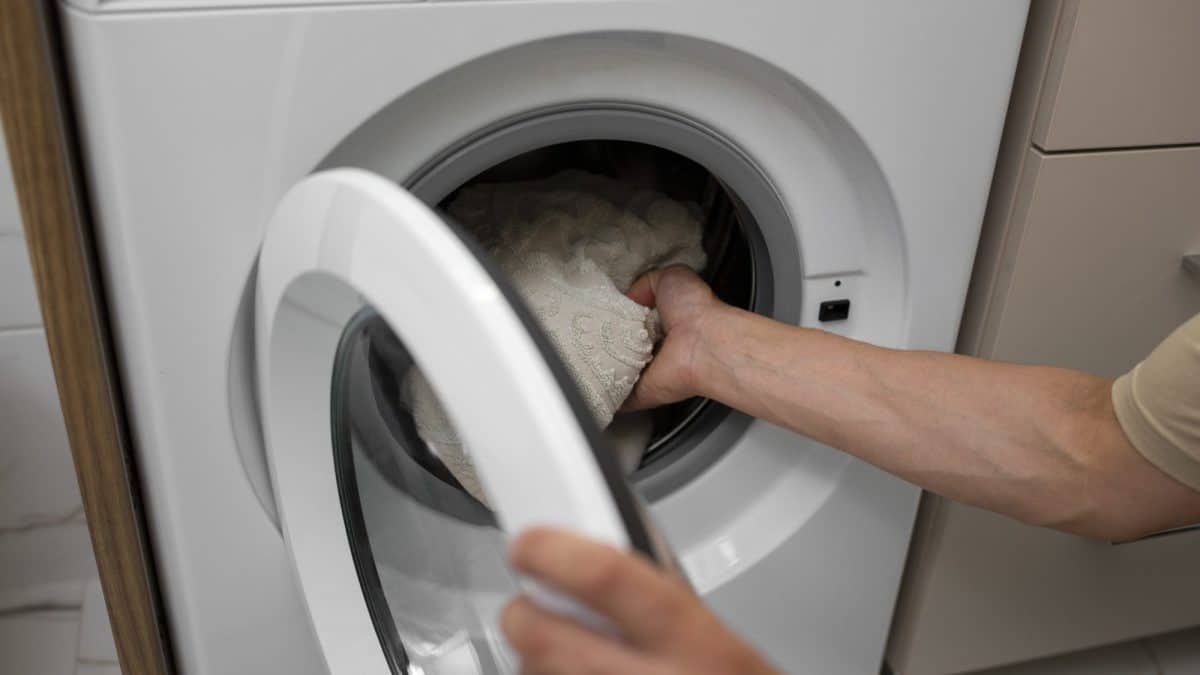
Weigh it and do the fist check
Write the dry weight down somewhere you will still have it in five hours. Multiply by three for the wet weight, then put the folded comforter in the empty drum and look at the gap above it. Two failed checks means the laundromat. Better to find that out now than halfway through a cycle.
Find the seams that are already open
Run both hands along all four edges and across the quilting lines. A split seam that survives normal use will not survive a wet tumble, and fill that escapes into the drum ends up in the pump filter. Repair anything open with a few hand stitches first. Ten minutes, and the most skipped step in every version of these instructions.
Test the shell for colorfastness
Press a damp white cloth against a hidden corner, hold it ten seconds, and look at the cloth. Deep navy, rust and printed faces are the usual bleeders. Color on the cloth means cold water only, alone, and no oxygen bleach at any point.
Pretreat the head end and the foot end separately
These are two different soils and they want different treatment. The head end carries face oil, hair product and skincare, all of it grease. The foot end carries whatever came off the floor. Work detergent into the greasy end with your fingers and give it ten minutes before it goes anywhere near the drum, because full immersion never concentrates on a spot the way pretreating does. Sorting a specific mark into its chemical family first is covered properly in how to clean stains from clothes, and marks that came from the bed itself are in how to clean bed stains.
Wash it alone, warm, on the bulky or bedding cycle
Alone means alone, not with the sheets. On a polyester fill with a white or colorfast shell, use 40 °C rather than cold, and the reason is further down this page: cold water leaves body oil in the fill, and body oil is what turns a white comforter yellow. Half the usual detergent, and add the extra rinse if your machine offers one. On down, on wool batting, or on anything that bled onto the white cloth, drop to cold and accept the trade.
Run a second spin on its own
Open the door, pull the comforter away from the drum wall and spread it around the drum so the weight is even, then run a spin only cycle. This is where an unbalanced machine gets a second chance, and this is the step that decides whether the drying takes three hours or seven. Fill does not crease, so there is no reason to be gentle here.
Tumble on low with the dryer balls, opening it out every thirty minutes
Low heat, balls in with it, and set a timer. Every thirty minutes, pull the comforter out, shake it open completely, break up any dense wet lump you can feel through the shell, and put it back in folded a different way. High heat is not a shortcut here: it dries the shell, which then acts as a lid over a wet fill. Expect three to five hours for a queen, which is longer than almost anyone allows for.
Do the cold-spot check before it goes near a closet
A dry-feeling comforter can still be damp in the middle of a quilted section. Evaporation cools the fabric above it, so damp reads cold. Press the back of your hand or the inside of your wrist flat against the corners, the middle, and each quilted seam. Anything that reads cooler than the rest is still wet, no matter what your fingertips say. Another forty-five minutes on low and check again.
Interactive
Label decoder
Tap a symbol from your care label. No guessing, no scrolling.
19 symbols. Pick one.
Why a white comforter turns yellow, and why washing it again does nothing
This is what people search once the comforter is clean and still looks wrong, and nobody on the first page of results answers it. The yellow is body oil that no wash removed and that has since changed chemically, which is why it no longer responds to the treatment that would have worked on it fresh.
Skin produces sebum continuously, and roughly an eighth of it is squalene. Squalene is an oil with six double bonds in its chain, which in practice means it reacts with oxygen readily and keeps reacting. Left in a textile it oxidizes through peroxides into aldehydes and eventually into yellow-brown polymers bound to the fiber instead of sitting on top of it. Sweat itself is nearly colorless and rinses out. The oil is the part that stays, and time is what turns it yellow.
Which explains the pattern everyone notices and nobody accounts for: a comforter yellows on the top face where the shoulders and neck rest, not underneath, and not evenly. It yellows worse in a house with no duvet cover. And it yellows on a schedule of months, not one bad night.
The reason repeated washing does not clear it is temperature. Sebum is a semi-solid at room temperature and only softens somewhere around 30 to 35 °C. A cold wash cannot emulsify it, so detergent takes the surface and leaves the film. Every guide on the first page says cold or cool, universally, and for down and for dark dyes that is correct advice. For a white polyester comforter it is precisely why the yellowing accumulates: the setting that protects the loft is the setting that leaves the oil in. Nobody states the trade-off, so people run the cold cycle four times and conclude the comforter is worn out.
The yellow actually comes out, but not with chlorine
Reaching for chlorine bleach on a yellowed white comforter is the most common way to make it permanent. Two things happen at once. Chlorine reacts with the nitrogen in the protein and skin residue already in the fabric and produces compounds that are themselves yellow and firmly attached. And most white bedding is white partly because of optical brighteners, which are dyes that convert ultraviolet into visible blue light; chlorine degrades them, the blue goes, and the natural cream of the fiber underneath is what you are left with. On a polyester fill the effect is worse and it does not reverse.
What works is slower and duller. Dissolve oxygen bleach, which is sodium percarbonate, in water as warm as the shell tolerates, and soak the comforter in it for several hours in a bathtub or a top loader with the cycle paused. Percarbonate releases hydrogen peroxide, and peroxide is what breaks the oxidized chromophores apart. It needs warmth and it needs time, so a forty minute cycle with a scoop thrown in does very little. A four hour soak at 40 °C does most of the work in one go.
Two limits worth knowing before you start. Old yellowing that has gone through many hot dryer cycles is partly set and will lighten without disappearing. And a soak of that length means a very heavy wet comforter to move afterward, so plan the extraction before you fill the tub, which brings us to the part everyone gets stuck on.
When it does not fit: three routes, ranked honestly
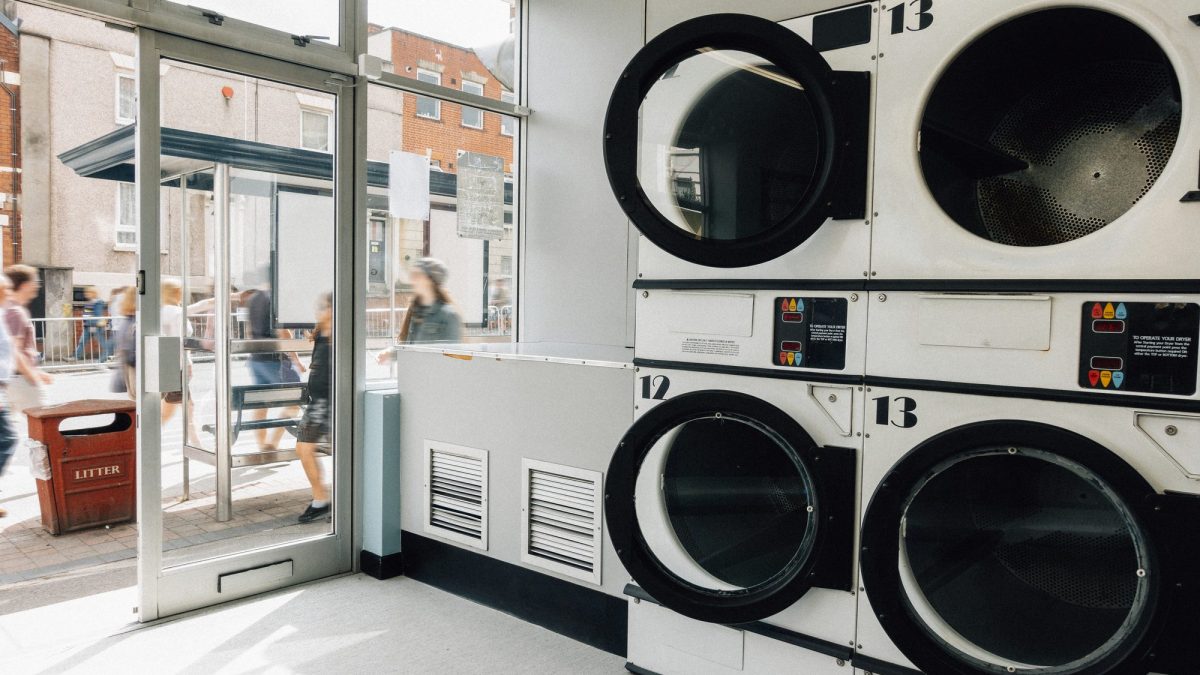
Related searches for this topic are dominated by a single problem, and no cleaning method touches it: the comforter is bigger than the machine. Here are the three answers in the order they are worth trying.
- A laundromat, and go for the dryer more than the washer. A commercial front loader takes a king comforter with room to tumble, spins it far harder than a home machine, and the large dryers finish it in about an hour instead of five. Six to twelve dollars, one trip, and the comforter comes home dry rather than damp. The boring answer, and the right one for almost everyone. One exception, and it is the only bed layer this advice reverses on: a heated blanket or heated mattress pad must never go in a commercial dryer, because those run hot enough to damage the wiring inside it. See how to clean an electric blanket.
- A bathtub, only if you have solved the extraction first. The appliance brands publish this method with its hardest step left out. Filling the tub and treading the comforter with clean bare feet works fine, and so does draining and refilling to rinse. What has no answer in a bathroom is getting twenty-five pounds of water back out. You cannot wring a comforter, a shower rod will not hold one, and a soaked comforter left to drip in the tub is a mildew culture rather than laundry. So the tub is worth it in one situation: you own a machine that cannot wash it but can still run a spin-only cycle, and you use the tub for the wash and the machine for the extraction. If you have no machine at all, the tub will get it wet and then leave you stuck.
- Do not wash it at all, and treat the surface. If nothing is spilled on it and the problem is dust, hair and general staleness, this is a legitimate answer rather than a cop-out. Vacuum both faces with the upholstery head, working slowly, then hang it over a line or two chairs outdoors on a dry breezy day for a few hours. Air movement removes far more odor than sun does, and shade avoids yellowing a white synthetic shell. Spot treat any individual marks. Then buy a duvet cover. It puts a washable barrier over an object that is hard to wash, the same job a protector does for a mattress.
One route that keeps getting recommended and should not be: cramming it into an undersized machine anyway and running two cycles. Two bad washes are not one good wash. The middle of the plug is unwashed and unrinsed both times, and you have put the machine’s bearings through two unbalanced spins for nothing.
Wash or dry clean? They remove opposite halves
The honest answer to this one is that neither method removes everything, and they fail in complementary directions.
Dry cleaning solvent is nonpolar, and so is sebum, so solvent dissolves body oil more completely than a warm wash does. For a yellowing white comforter that has never been cleaned, it genuinely outperforms a home machine on the part that matters. What it does not do is remove anything water-soluble: sweat salts, urea, sugar from a spilled drink, and the dust mite allergen that is the reason many people wash bedding in the first place all stay put, because they do not dissolve in solvent. Water takes those out and struggles with the oil.
So the split is simple. A comforter that is dingy, yellowing and never spilled on is a dry cleaning candidate. A comforter that had something spilled on it, or that is being cleaned for allergy reasons, wants water. A shell that is silk, heavily embellished, or labeled dry clean only takes the choice away from you. And whichever way you go, air a dry cleaned comforter for a full day before it goes on a bed, because residual solvent leaves an unmistakable smell that a day of air clears. What a home dry cleaning kit can and cannot do is a separate question, covered in how to dry clean at home.
The one thing neither method delivers is a genuine sanitizing wash. Dust mites die somewhere around 55 to 60 °C, and no comforter of any fill survives that temperature without losing loft. That gap does not close, and it is the real argument for a duvet cover: the cover goes through a hot wash every couple of weeks, and the comforter underneath does not have to.
Related guides
For a down or feather fill specifically, where the failure mode is clumping inside the sewn channels instead of capacity, see how to clean a down comforter. The same fill in a garment, with a water-repellent coating that ordinary detergent strips, is in how to clean a down jacket. Pillows share the trapped-moisture problem in a smaller package and answer a straight yes or no by fill type in can you machine wash pillows, with the full method in how to clean pillows in the washing machine. For why washed fill comes out flat and does not recover, which is a heat problem rather than a water problem, see how to clean throw pillows. If the musty smell has already turned into visible spotting, treat it as a living colony rather than a stain: how to clean mold off clothes. And skip fabric softener on any of it, for the reason set out in how to clean microfiber cloths: it works by leaving a waxy coating behind, and coated fill loses loft permanently.
Questions
How do I know if my washer is big enough for a comforter?
Fold it loosely in thirds, set it in the empty drum without pressing, and check that a closed fist fits in the space above it. Then weigh it dry and multiply by three, and compare that to the load rating in your machine’s manual, usually 12 to 20 pounds. A queen polyester comforter typically passes on a 4.5 cubic foot machine and a king typically does not.
Why does my comforter still smell after washing it?
Almost always because it is not dry in the middle, not because the wash failed. The shell dries hours before the fill does, so it feels finished long before it is. Use the cold-spot check: damp areas read cooler than the rest because evaporation is cooling them. The other cause is detergent left in the fill from a cycle that could not rinse properly, which smells stale rather than musty and needs a rinse-only cycle to clear.
Can I use bleach to fix a yellowed white comforter?
Not chlorine bleach. It reacts with the protein residue already in the fabric and destroys the optical brighteners that made the shell look white, and on a polyester fill the yellowing it causes is permanent. Use oxygen bleach, which is sodium percarbonate, dissolved in warm water with a soak of several hours rather than a normal cycle.
How often should a comforter be washed?
Two or three times a year if it lives inside a duvet cover that gets washed with the sheets, and every two months if it does not. The cover is doing the real work here. A comforter used bare against skin picks up body oil continuously, and that oil is what yellows it, not the number of wash cycles.
Is it safe to wash a comforter in a top loader with an agitator?
It is the worst of the home options. The center post takes up drum space you need and the comforter wraps around it instead of tumbling, so the middle never gets washed or rinsed. If it is the only machine available, wash it in the tub or at a laundromat and use the top loader for a spin-only cycle, which is the one thing it does well here.