How to Clean a Wool Rug (The Backing Decides, Not the Wool)
Wool itself tolerates water. What ruins a wool rug is heat, alkaline detergent and rubbing, plus a jute or latex backing that takes far less water than the pile above it.
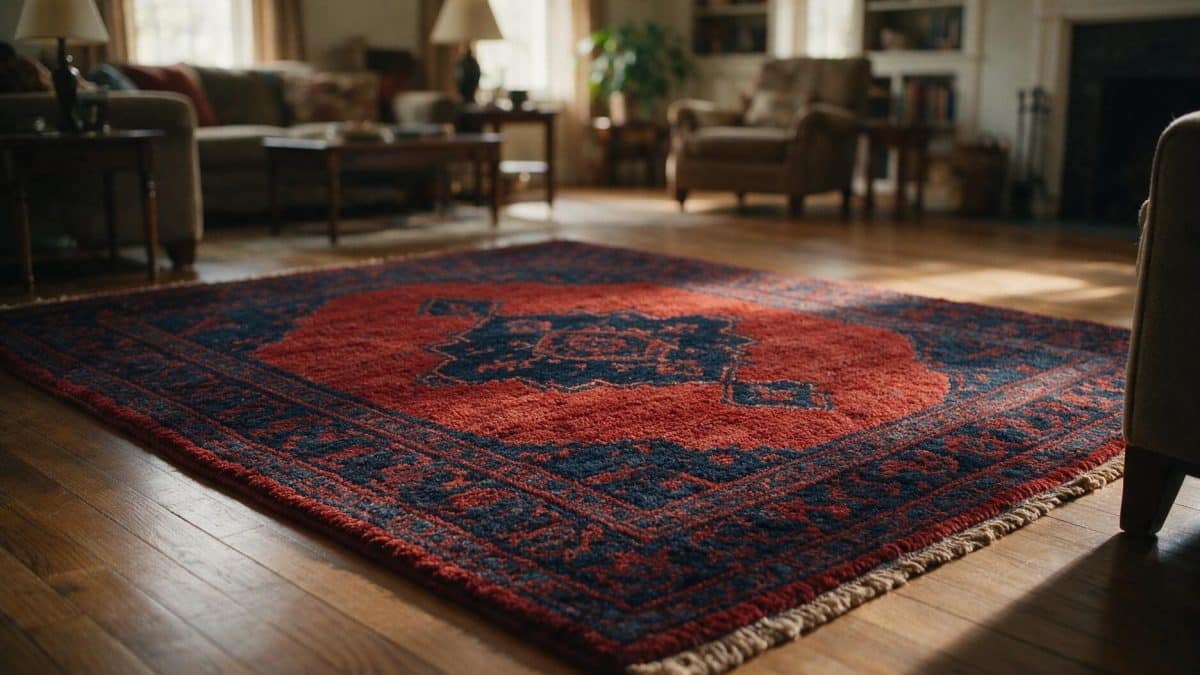
Quick answer · care label Wool — rug pile
-
1 · Wash
Hand wash -
2 · Bleach
No bleach -
3 · Dry
Dry in shade -
4 · Iron
Do not iron -
5 · Pro care
Pro clean P
In one line Vacuum both sides with the brush roll switched off, test the dye on a white cloth in a hidden corner, then beat the dry grit out before any water touches the rug. Clean section by section with cool water under 30 °C (86 °F) and a pH-neutral wool detergent, damp rather than wet, then rinse with diluted white vinegar and blot hard with dry cloths. Dry it raised off the floor with a fan on the underside, out of direct sun, inside a day. About 90 minutes hands-on.
Can you clean a wool rug at home, or does it have to go to a specialist?
Most wool rugs can be cleaned at home, and the reason has nothing to do with what the rug cost. Wool is not a fragile fiber. It is a protein fiber with a scaled outer surface, and it copes with water perfectly well; sheep stand out in the rain. What it does not cope with is heat, alkalinity and rubbing, particularly all three at once. A wool rug that comes out of a home cleaning looking worse than it went in was rarely cleaned too often. It was cleaned too hot, too soapy, or too hard.
The second constraint has nothing to do with the wool at all. It is whatever the wool is attached to. A hand-knotted rug sits on a cotton or jute foundation; a hand-tufted rug has a latex adhesive layer and a fabric scrim glued across the back. Those materials tolerate far less water than the pile above them, and they set the ceiling on how wet you are allowed to get the rug. The familiar bad outcomes — brown marks that surface a day later, a rubbery smell, a backing peeling away in sheets — all start down there.
So the honest answer splits in two. Surface cleaning and spot work are realistic on any wool rug. A full soak-and-rinse wash is realistic on flatweaves and machine-made rugs, questionable on hand-tufted ones, and a specialist job on anything hand-knotted. If you are not sure which fiber you have, how to clean a rug covers identifying it from the back.
Wool survives water. What it does not survive is what people put into the water and how long they leave it there: heat, alkaline detergent, scrubbing, and hours spent damp. Keep the water cool, the solution mild, the pressure light and the drying fast.
What you’ll need
| Item | Why | Substitute |
|---|---|---|
| Wool-safe, pH-neutral detergent | Ordinary laundry detergent is alkaline and usually enzyme-based, and both attack a protein fiber | Plain unscented shampoo, well diluted — hair is keratin, the same protein wool is |
| Vacuum with the brush roll switched off | A spinning beater bar pulls at wool pile and speeds up shedding; on loop pile it fuzzes the loops | The bare-floor head, or a manual carpet sweeper |
| Two white cotton cloths | One tests the dye, one blots. A colored cloth would hide dye transfer, which is the point of the test | An old white T-shirt cut in half |
| Spray bottle | Lets you wet the pile without wetting the foundation underneath — the whole trick with wool | A bowl and a sponge wrung out until it barely drips |
| White vinegar | A dilute acid rinse leaves the fiber near the pH its dyes were set at and neutralizes leftover detergent | Plain cool water, rinsed twice rather than once |
| Box fan | Drying speed is the real safety margin on a wool rug, not the cleaning solution | A dehumidifier in a closed room, or two windows open on facing walls |
The method, step by step
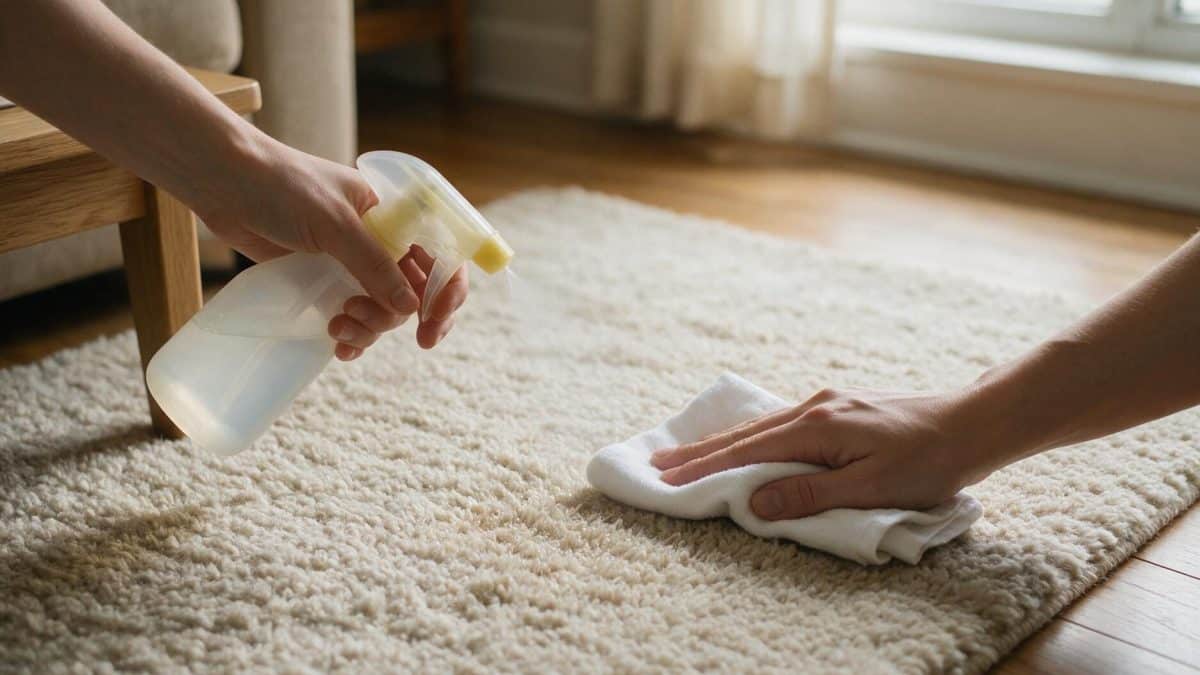
Vacuum the back before the front
Flip the rug and vacuum the underside first. Grit works down through the pile and sits against the foundation, where it cuts the yarn from below every time someone walks across. Keep the head off the fringe: a beater bar chews fringe up, and bare suction can swallow it.
Test the dye before anything gets wet
Wool is colored with acid dyes, and on older and hand-knotted rugs those dyes are not always fast. Press a white cloth dampened with your solution into a hidden corner for 30 seconds, then look at the cloth rather than the rug. Any color on it means stop; this rug needs a professional wash, not a bucket.
Get the dry soil out first
Take the rug outside, hang it face down over a railing, and hit the back with the flat of a broom. Dry grit still in the pile turns to mud the second you add water, and mud carries dirt deeper into the yarn instead of out of it.
Mix it cool, and weaker than the bottle says
Cool tap water — nothing above about 30 °C (86 °F) — and roughly half the dose you would use on a synthetic rug. Suds are not cleaning; they are what you have to rinse back out. Detergent left in wool pile is why a freshly cleaned patch collects dirt faster than the rug around it.
Work one section at a time, damp and never wet
Mist about a square yard of pile, then work the solution in with a cloth or soft brush, following the direction of the pile, with light pressure. No circles and no scrubbing: rubbing warm wet wool is literally how felt is manufactured. If you can press water out with a fingertip, you have used too much.
Rinse the detergent out, then blot hard
Go back over the section with a cloth wrung out in clean cool water, changing the water whenever it clouds. Finish with a wipe of diluted white vinegar, about one part vinegar to four parts water. Then lay dry cloths over the area, press with your body weight, and swap them until they come up almost dry.
Get it dry inside a day
Raise the rug off the floor — two chairs, a drying rack, a pair of sawhorses — so air reaches the back as well as the pile, and aim a fan at the underside. Support its whole length rather than hanging it over a single rail, because wet wool stretches out of shape under its own weight and dries that way. Keep it out of direct sun, which fades wool dye faster than anything else in a home. A rug still damp after about 48 hours is where brown marks and mildew smell come from.
The backing decides how much water the rug can take
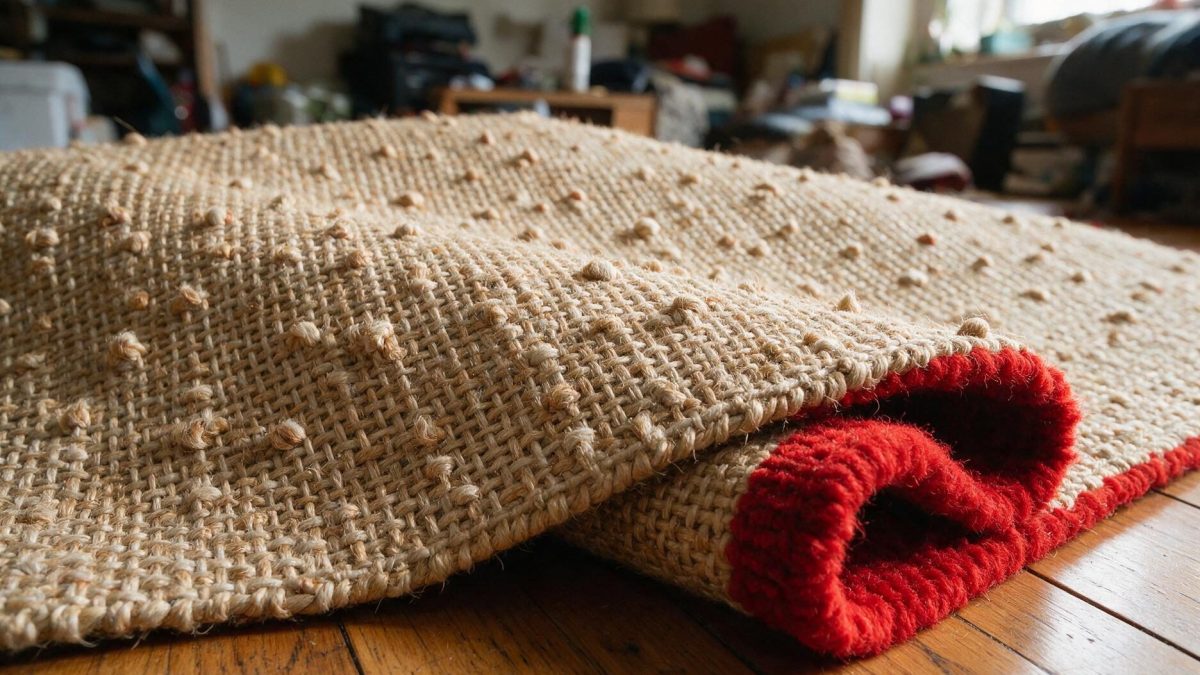
Turn the rug over before you settle on a method. The wool on top is roughly the same material in every case; what changes between a $60 rug and a $6,000 one is the structure holding it together, and that structure is what fails when a rug is over-wetted.
| Construction | How to tell from the back | How much water |
|---|---|---|
| Flatweave, dhurrie, kilim | No pile, reversible, the pattern reads the same on both sides | The most tolerant. Small ones wash through like a heavy towel |
| Hand-knotted | The pattern is visible knot by knot; the fringe is the warp running out of the rug, not sewn on | Takes a full immersion wash, but only from someone equipped to extract and dry it |
| Hand-tufted | A blank fabric scrim glued over the back, hiding the tufts | The least tolerant of any. The glue is the weak point, not the wool |
| Machine-made | Grid-regular pattern, often a stiff coated back | Damp cleaning is fine; soaking breaks down the coating |
| Any rug on a jute foundation | Coarse, straw-colored threads at the edges and between rows | Damp cleaning only, dried fast — this is the browning risk |
Two of those need spelling out. The SBR latex holding a hand-tufted rug together degrades with moisture and heat: a rubbery smell that worsens when the rug is damp, a fine pale powder on the floor underneath, then the scrim lifting away from the tufts. Cleaning reverses none of it and a deep wash accelerates it. Jute is the other. It is a plant fiber that releases tannins and lignin as it ages, and if it gets wet and dries slowly those compounds wick up the yarn and dry on the surface as brown patches that look exactly like dirt and are not. Rug cleaners call this cellulosic browning; the recipe is over-wetting, an alkaline product, and a rug left damp for a couple of days. Small rugs with rubber or foam non-slip backing have their own limits: how to clean throw rugs.
Heat, alkali and rubbing: what actually wrecks wool
Wool fibers are covered in overlapping scales. Add water and warmth and the scales lift; add movement and they ratchet into the gaps between neighboring fibers and lock there. That is felting. It is mechanical rather than chemical, and it does not come out. It is why a rug survives years of foot traffic and then shrinks and stiffens in one afternoon in a bathtub.
Alkalinity is the second mechanism and it is quieter. Wool is keratin, and keratin degrades in alkaline conditions: the fiber yellows, loses strength, and becomes more prone to felting than it was. Alkalinity also destabilizes the bond between an acid dye and the fiber, which is how a cleaning product turns a red rug into a pink floor. Published safe windows vary from one source to the next, and Woolmark’s own care guidance skips numbers altogether and simply says to use a neutral, mild wool detergent. The practical version is the same however it is phrased: nothing alkaline, and when in doubt err acid. That one rule disqualifies laundry detergent, which is both alkaline and usually enzyme-based, household ammonia, and baking soda, which does nothing useful for wool and is very hard to vacuum back out of dense pile.
Never put chlorine bleach on wool. This is not a question of dilution or of whether the rug is white — sodium hypochlorite breaks keratin down, and the treated yarn yellows, weakens and eventually crumbles where it was hit. Enzyme laundry detergent does the same more slowly, because protease is designed to break down exactly the protein the rug is made of. Neither is reversible, and neither shows itself the same day.
Stains on wool, and which ones actually come out
Wool has one real advantage worth knowing. The outer surface of the fiber repels water, so a fresh spill beads and sits on top of the pile for a minute or two before soaking in. Most of the outcome is decided in that window. Blot rather than rub, work from the outside of the spill inward, and reach for plain cool water first — it lifts more from wool than it does from a synthetic.
| Stain | Treatment | Recoverable |
|---|---|---|
| Coffee, tea, red wine (fresh) | Blot dry, then cool water with a drop of wool-safe detergent, then the vinegar rinse | Usually |
| Mud | Let it dry completely, crush it, vacuum, then damp-clean what remains | Yes |
| Grease and oil | Cornstarch or talc left on for an hour to draw it out, vacuumed off, then detergent | Often |
| Pet urine | Flush cool, blot hard, then treat the odor; the real risk is dye damage from the alkalinity of aged urine | Sometimes |
| Chlorine bleach splash | None. The fiber is chemically damaged, not stained | No |
| Sun fade along one edge | None at home. Redyeing is a specialist repair | No |
Pet accidents are the case where speed beats technique, since urine turns alkaline as it ages: how to clean dog urine from a rug covers the floor underneath as well. For one spot rather than a whole rug, the goal changes to keeping water in the pile and out of the foundation, which is how to clean stains on a rug.
When to hand it to a rug washer instead
- Any color transferred during the cloth test. Fugitive dye needs controlled water temperature and fast extraction, which is what a home clean cannot offer.
- Hand-knotted, oriental or antique rugs. They are built to be washed, but properly: flooded, groomed, rinsed and dried under airflow within hours. Half-doing that at home is worse than not starting.
- Any silk or viscose content. Viscose marks from plain water alone and loses much of its strength while wet, and the rings it leaves do not wash out.
- Moth or carpet beetle damage. The larvae eat keratin and work in the dark: along the edges, on the back, under furniture nobody moves. Bald patches and gritty debris under a sofa mean an infestation rather than wear, and a professional wash kills what is living in the rug.
- Anything larger than roughly 6 by 9 feet. Not because of the cleaning but because of the drying. A soaked rug that size is genuinely heavy and hard to lift off the floor.
Expect roughly $5 to $8 per square foot for wool, full hand washing at the top of that range and lighter machine cleaning at the bottom, so a 9 by 12 rug lands somewhere around $540 to $865. Set that against a rug that has felted, browned or bled, none of which has a repair.
Related guides
- The same sequence without the fiber-specific chemistry, for synthetic, cotton and natural-fiber rugs: how to clean a rug.
- Fitted carpet cannot be rinsed at all, which changes the approach even when the pile is wool: how to clean carpet.
- Wool clothing meets the same felting problem somewhere far more aggressive, the drum: can you machine wash wool.
- A woven wool blanket has no pile and no foundation to protect, so most of the rules above loosen: how to clean a wool blanket.
Questions
Can you put a wool rug in the washing machine?
Almost never. A drum supplies warmth, water and continuous agitation at once, which is the recipe for felting, and the spin distorts any rug with a foundation. The narrow exception is a small flatweave with no pile and no backing, on a cold wool cycle at the lowest spin available. Anything with pile, latex or a scrim stays out: can you machine wash wool covers what the drum does to the fiber.
Can I use a steam cleaner or a carpet shampooer on a wool rug?
Not a steam cleaner. Steam is heat and moisture arriving together, which lifts the scales and shrinks the rug. A carpet shampooer with cold water is possible on machine-made wool with no rubber backing, but every machine of this type sprays in more water than it recovers, and on wool the water left behind is what matters. If you use one, finish with a pass of plain water and an empty solution tank.
Is vinegar actually safe on a wool rug?
Diluted, as a rinse, yes — and this is a point where advice genuinely conflicts. Some guides warn off vinegar on wool altogether, while professional wool cleaning routinely uses a mild acid rinse, for the reason above: wool tolerates the acid side far better than the alkaline side. The sensible middle is about one part white vinegar to four parts water, used as a rinse rather than a cleaner, and only after the cloth test.
Why did my wool rug go brown after I cleaned it?
That is almost certainly cellulosic browning from a jute or cotton foundation rather than dirt, which is why cleaning the pile again will not touch it. The causes are too much water, too alkaline a product, and too long spent damp. The correction is an acid-side treatment worth handing to a rug cleaner.
My new wool rug sheds constantly. Is it defective?
Usually not. New wool rugs, hand-tufted and high-pile ones especially, release loose fiber left over from construction for the first several months, tapering off over roughly a year. Vacuum regularly with the brush roll off, since a beater bar pulls out fiber that would otherwise have stayed. Never pull a loose yarn out of the pile — snip it level with the surface.
How often does a wool rug need a deep clean?
Every 12 to 18 months in an ordinary room, and closer to every 6 to 12 months in an entryway or a home with pets. Between those, rotate the rug so traffic and sunlight never land in the same place.