How to Clean a Wool Blanket (Movement Felts It, Not Water)
Wool survives water; it does not survive movement in warm water. Felting is the one change no soaking, stretching or solvent undoes, which is why the method here is a soak rather than a wash.
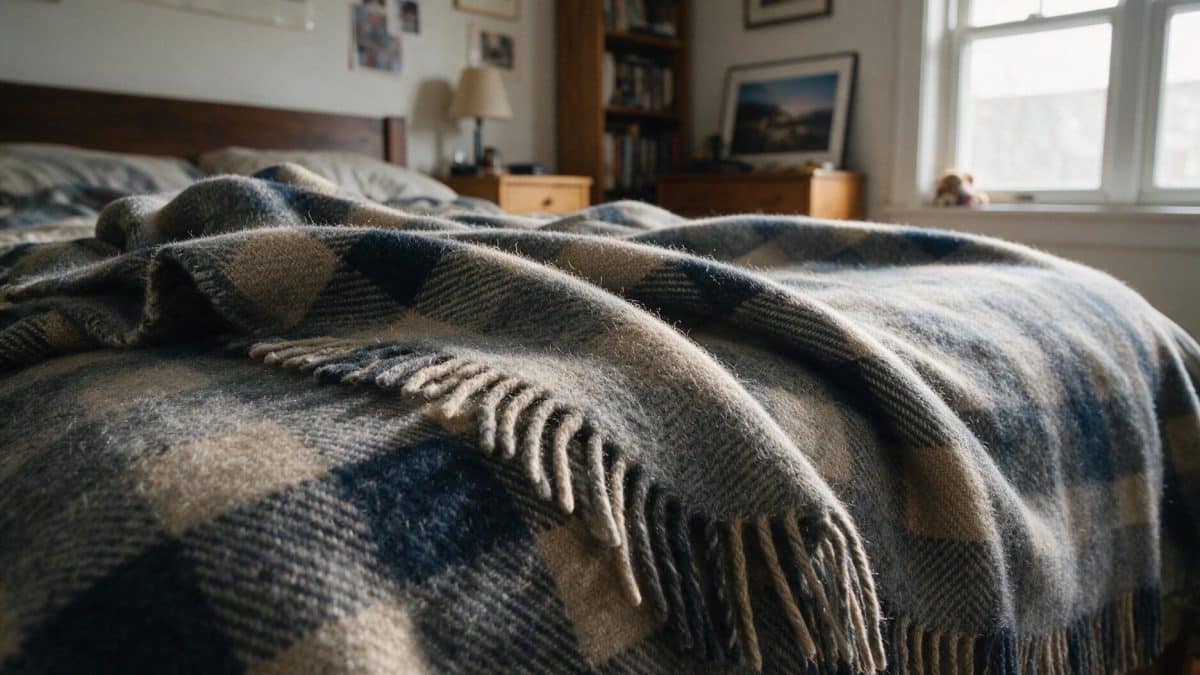
Quick answer · care label Wool — woven blanket
-
1 · Wash
Hand wash -
2 · Bleach
No bleach -
3 · Dry
Dry flat -
4 · Iron
Do not iron -
5 · Pro care
Pro clean P
In one line Check the label, dye-test a hidden corner, then lay the blanket open in cool water around 30 °C with a neutral, enzyme-free wool wash and soak it for fifteen minutes without touching it. Rinse twice at the same temperature, press the water out in towels instead of wringing, and dry it flat with its weight supported, out of sun and away from heat. About 40 minutes hands-on, plus a day to dry.
Can a wool blanket go in water at all, or does it have to be dry cleaned?
It can go in water. Wool has been washed in water for as long as people have kept sheep. What it cannot survive is being moved about while it is wet and warm, and a washing machine is a device for moving things about while they are wet and warm. That one distinction is why the same blanket comes out soft from a bath and comes out a size smaller and board-stiff from a drum.
The reason sits on the surface of the wool. Each hair is sheathed in overlapping scales, arranged like tiles on a roof and all pointing the same way. Wet them, warm them and push them against each other, and they slide easily one way and jam the other. Millions of hairs ratchet closer together and cannot travel back. That is felting, and irreversible is meant literally: no chemistry unlocks it and no soaking lets it out. A felted blanket has become a piece of felt, which is a good material and the wrong size.
Care labels disagree about what follows from that, and they are describing different blankets rather than contradicting each other. Traditional untreated blankets are usually marked dry clean only, on the grounds that a domestic wash will shrink them past use. Shrink-treated wool sold as machine washable carries a wool-cycle symbol instead, commonly with 30 °C (86 °F) printed on it and often a cap on the spin speed as well. Blankets woven from merino, alpaca or mohair are frequently marked dry clean only even by mills whose plain lambswool blankets are machine washable. Your label is the tiebreaker; without one, the method below is safe for all of them.
Felting needs water, warmth and movement at the same moment. Water on its own does nothing. Take the movement away and wool can sit in a bath all afternoon unharmed; leave it in and 30 °C is enough to ruin the blanket. Everything below is a way of removing movement from a job that normally supplies a great deal of it.
What you’ll need
| Item | Why | Substitute |
|---|---|---|
| Wool wash, neutral and enzyme free | Wool is a protein, and the protease enzymes in ordinary detergent exist to digest protein | A tablespoon of baby shampoo in a full bath |
| A bathtub | The blanket has to lie open. Folded into a basin it washes in patches, and the folds are where you end up handling it | A plugged laundry sink for a throw, or a big storage box |
| Three or four dry bath towels | Rolling the blanket inside towels is the only water extraction that puts no twist into the weave | An old duvet cover on a clean floor |
| A drying rack, or two parallel lines | The soaked weight has to be shared along a broad curve. One line takes all of it on a single crease | A spare bed with a plastic sheet and dry towels under it |
| A white cloth | For the dye test and for spot treating. A dyed cloth hands its own dye to wet wool | A white cotton T-shirt, cut into squares |
| White vinegar, optional | A splash in the last rinse returns the water to the mildly acidic side wool prefers and clears residue | Rinse a third time in plain water instead |
The method, step by step
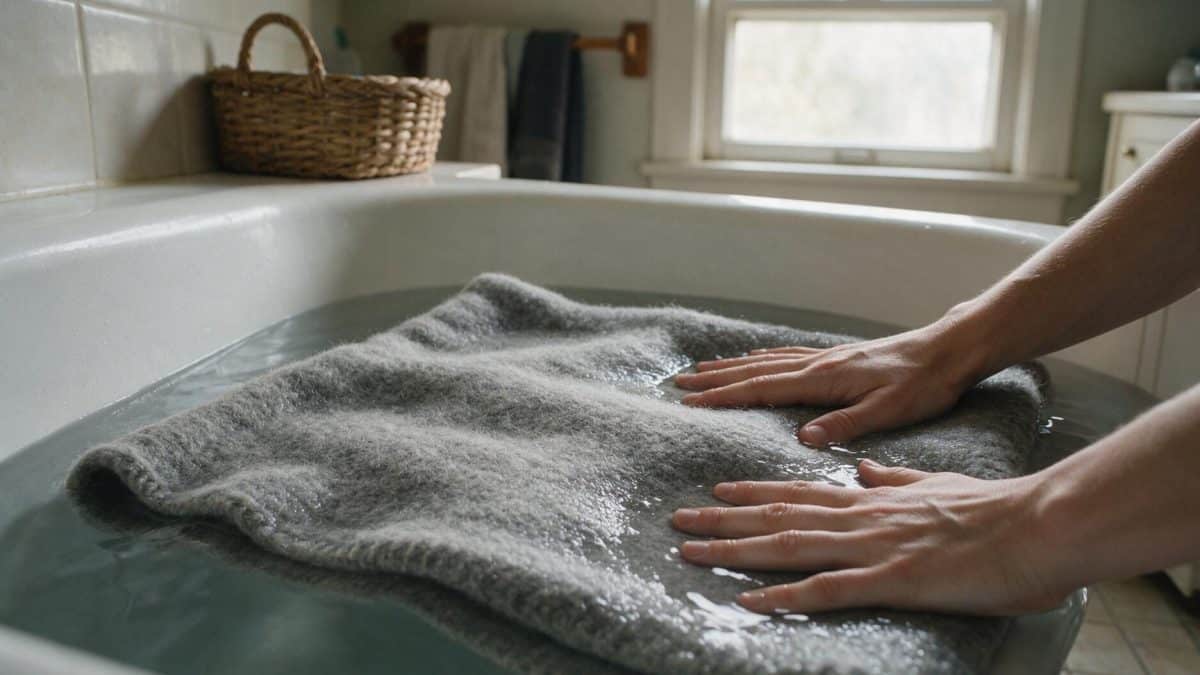
This is the hand wash, and it works whether or not you still have the label.
Shake it out hard, outdoors, before anything gets wet
Most of what is in a wool blanket is dust and grit between the yarns rather than soil bonded to them, and grit left in place turns abrasive the moment the wool softens in water.
Test the dye on a corner you cannot see
Hold a damp white cloth against an underside corner for thirty seconds. Any dye on the cloth means a bath will carry it through the whole blanket, and that blanket goes to a dry cleaner instead.
Treat marks now, cold, working inward
Dab with the white cloth and cool water, moving from the outside of the mark toward the middle. Never rub: rubbing is felting applied to one small area, and it leaves a shiny shrunken patch that catches the light afterwards.
Fill the bath and dissolve the wash before the blanket goes in
Cool water, around 30 °C (86 °F), barely warm on the wrist. Neat detergent dropped onto wet wool leaves a patch that stays stiffer and duller than everything around it.
Lay it in open, press it under, then leave it alone
Feed it in flat rather than dropping it in bundled, and press it under with flat hands until it stops floating. Fifteen minutes of soaking does the cleaning; swirling and kneading only do damage.
Drain, then rinse twice at the same temperature
Let the water out with the blanket still lying flat, press down to push the dirty water through, then refill at the same temperature. A jump between warm and cold moves the scales, which is what you have spent fifteen minutes avoiding.
Press the water out in towels, never wring
It now weighs several times what it did dry, and that weight is what stretches it, so move it as a supported bundle, never by an edge. Lay it on dry towels, roll the lot up and press along the roll.
Dry flat and supported, out of sun and away from heat
Spread it on a rack, over two parallel lines, or on a towelled bed, and push it back to its original width and length while damp. Wool holds the shape it dries in. Direct sun fades the dye and dries the surface coarse. Do not tidy the result with an iron afterwards: the raised surface is what holds the air that makes a blanket warm, and pressing crushes it flat for good.
Wool programme only, and check what your machine does on it: a true wool cycle keeps the water cool and barely rotates the drum, closer to a long soak than a wash. Thirty degrees is the usual printed limit. The spin is the setting people forget, because the programme picks it rather than the person; where a label caps it, that cap is the part worth obeying. A delicates cycle is not the same thing, and neither is a cold wash on the normal programme.
Three kinds of wool blanket, and only one belongs in a machine
The label is really telling you which of three products you own, and the difference was decided at the mill rather than in your laundry.
Untreated woven wool. Traditional blankets, army surplus, anything inherited. The scales are intact and the felting risk is complete. The maker’s own answer is usually the dry cleaner, and the bath above is a home method on something that may be irreplaceable.
Shrink-resist treated wool, sold as superwash or machine washable. Most superwash wool is made by the chlorine-Hercosett process: chlorine etches the edges off the scales, then a thin polymer resin covers what remains so they can no longer catch on each other. It is a durable finish, not something that rinses away, but the blanket is still wool underneath, so heat still matters.
Fine and blended fibres. Merino, alpaca, mohair, cashmere blends. Mills happy to let you machine wash plain lambswool routinely mark these dry clean only, and that is deliberate: the finer the fibre, the more scale surface there is per gram and the faster it felts.
A dryer applies heat and movement to a wet blanket at once, which is felting in its most efficient form. The low setting does not solve it, because the drum supplies the movement whether it is hot or not, and what comes out is smaller, denser and stiff with no way back. The only exception is a blanket whose maker prints a tumble dry symbol. Chlorine bleach belongs in the same sentence for a different reason: it cleaves the sulphur bonds holding wool’s protein together, so it dissolves the wool around a stain rather than lifting it out.
Stains on wool, and which ones actually come out
The scaled surface sheds liquid for a short while before it wets through, so a spill blotted in the first minute often leaves nothing. That advantage disappears the moment anyone reaches for hot water, and most permanent marks on wool blankets were set rather than stubborn.
| Stain | What to do | Recoverable |
|---|---|---|
| Coffee or tea | Blot with cool water at once, then a trace of wool wash on a damp cloth. Tannin dries darker than it looks wet | Yes, while fresh |
| Red wine | Dilute with cool water and blot repeatedly, moving to a clean part of the cloth each time. No salt, no boiling water | Usually, on a fresh spill |
| Blood | Cold water only, and only ever cold. Warm water cooks the protein into a protein fibre and joins the two permanently | Yes, if it never met heat |
| Grease, butter, candle wax | Lift the solids, cover with absorbent powder for an hour, brush off, then a solvent spotter. Water spreads oil sideways | Partly, better at a cleaner |
| Ballpoint ink | Isopropyl alcohol on a cloth pressed from the reverse, with an absorbent pad underneath to catch what comes through | Rarely in full |
| Mildew from damp storage | Dry it out completely and brush the growth off outdoors first, or it travels through the whole blanket in the water | The smell yes, the staining no |
For anything else, work out what the stain is made of before choosing what dissolves it, as set out in how to clean stains from clothes. The heat rule in how to clean a blood stain applies with more force here than on cotton, because on wool the heat attacks the fabric as well as setting the mark.
When the blanket is too big for the machine
A blanket that does not fit loosely in a drum is not being washed, it is being dragged. Wool needs more room than its weight suggests, because a wool cycle works by letting the load sit nearly still. Packed tight enough to press against the drum wall, it is agitated against itself for the whole cycle, on the gentlest programme, at the coolest temperature. If it cannot sit still, use the bath, or a laundromat, where the machines are much larger.
Size has a second consequence: a wet blanket must never be picked up by a corner. Wool takes up a great deal of water and is at its weakest and most extensible while wet, and a blanket with wavy, stretched edges was usually pulled out of shape in the few seconds between leaving the water and being laid down.
The third route is the one makers point to for untreated blankets. Solvent does not swell the fibre the way water does, so a dry cleaner cannot felt the blanket; the trade-offs are cost, and that solvent handles water-based marks poorly. How to dry clean at home sets out what the home kits can stand in for.
Airing does most of the work, and storage is where blankets are lost
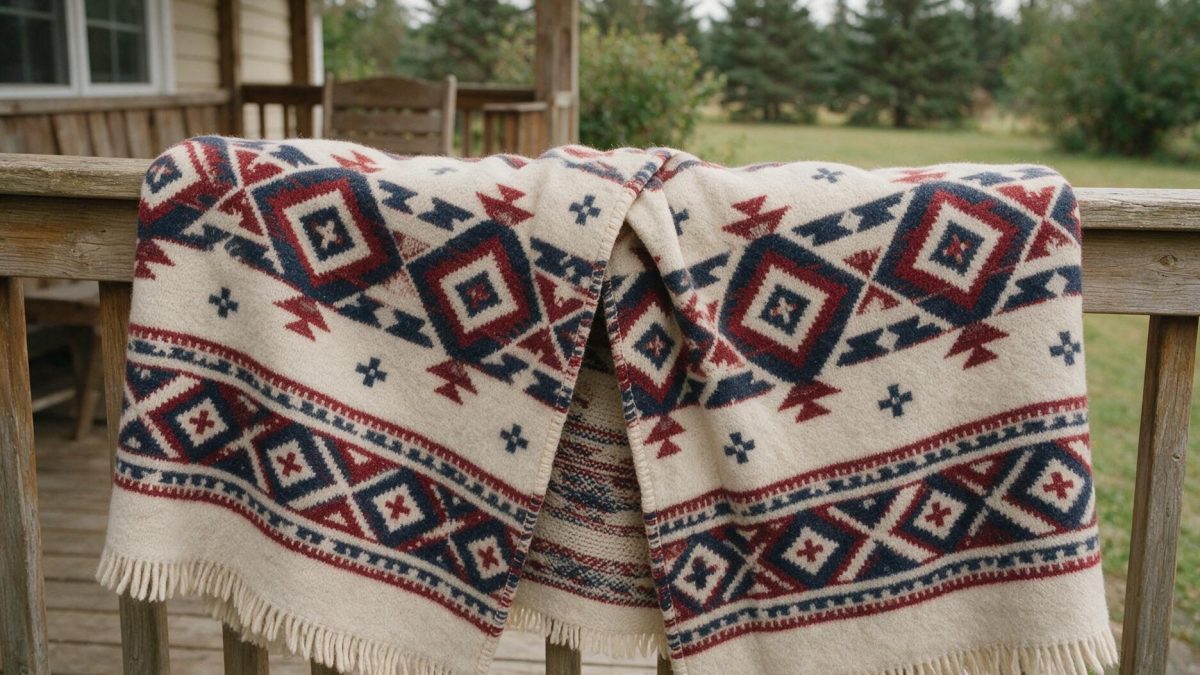
Wool resists odour and sheds dry soil, which is why wool guidance says some version of wash sparingly. A blanket in normal household use wants washing seasonally at most, and airing in between does most of what a wash would have done: hang it in moving air, on a damp overcast day rather than a bright dry one. Storage destroys more wool blankets than any washing machine, because clothes moth larvae eat keratin and prefer blankets carrying sweat and food traces to clean ones.
- Wash or air the blanket before it goes away for the season, not when you take it out again. A soiled blanket in a dark cupboard is what larvae are looking for.
- Store it in a breathable cotton bag or an old pillowcase, never sealed in plastic, which traps humidity against the wool and grows mildew by the mechanism in how to clean mold off clothes.
- Cedar and lavender deter adult moths and do nothing to larvae already in the fibre. They supplement a clean blanket rather than replacing one.
- Several days in a sealed bag in the freezer kills larvae in a blanket you suspect is infested. A domestic freezer is slower than a museum deep freeze, so give it a week rather than a night, and do it before the blanket joins the rest of the stored bedding.
Related guides
- Wool across garments and household textiles, with the fibre behaviour behind every rule here: how to clean wool.
- The machine question on its own, including what a wool programme actually does: can you machine wash wool.
- Same fibre, but a rug holds its dirt down inside the pile and cannot be lifted into a bath: how to clean a wool rug.
- The finer protein fibre, where felting is faster and the dry clean only label is even less reliable: how to clean cashmere.
Questions
Can I wash a wool blanket in the washing machine?
Only if the label says so, and only on a genuine wool programme. A machine-washable wool blanket is typically labelled 30 °C (86 °F) with the spin held down, because the spin is where a wool cycle can still do harm. An untreated traditional blanket is normally marked dry clean only, and washing one shrinks it past use. A delicates or gentle cycle is not a safe substitute: it moves the load far more than a wool programme does.
What temperature should a wool blanket be washed at?
Cool. 30 °C (86 °F) is the figure most wool labels print, and cold water is safer still. Some wool care advice allows up to 40 °C (104 °F) on a machine wool cycle, so the guidance is not unanimous at the top end. What it agrees on is that temperature matters less than movement: cold water will still felt a blanket that is being agitated, and a still bath at 30 °C will not.
My wool blanket has shrunk. Can I get it back?
It depends which kind of shrinking happened. If it merely relaxed, which is the fabric releasing tension built into it at the loom the first time it is properly wetted, rewetting and easing it back to shape while damp recovers some of that. If it felted, meaning it is denser and stiffer as well as smaller, nothing brings it back.
Can I use fabric softener on a wool blanket?
No. Softener coats fibres in a waxy film, which flattens the loft that makes a wool blanket warm. If a blanket feels harsh after washing, the cause is usually detergent residue rather than a lack of softener, and another rinse is the fix.
How do I get a smell out of a wool blanket without washing it?
Air it. Hang it in moving air out of direct sun for a day, ideally in damp overcast rather than bright dry weather, since sun fades the dye and dries the surface coarse. A smell that survives two days of airing is usually mildew in the fibre, and that does need a wash or a cleaner.