How to Wash Dry Clean Only Clothes at Home (The Fabric Decides, Not the Label)
A dry clean only tag is a warning, not a verdict on the fabric. Cool water and no agitation suit wool, silk and most synthetics; lined, tailored or beaded garments are the ones to leave alone.
Quick answer · care label Mixed fabrics · wool, silk and synthetics
-
1 · Wash
Hand wash -
2 · Bleach
No bleach -
3 · Dry
Dry flat -
4 · Iron
Iron 110° -
5 · Pro care
Pro clean P
In one line Check the fabric and the construction first, then test a hidden seam for dye. Soak the garment in cool water with a small amount of gentle detergent, press the water out in a towel without wringing, and dry it flat away from heat. About 30 minutes hands-on, plus a day or more of flat drying.
Can you wash clothes that say dry clean only, or does the label rule it out?
Knowing how to wash dry clean only clothes at home starts with reading the tag as a legal statement rather than a threat. Many garments marked this way survive a cool hand wash. Some do not, and the difference lies in the fabric and in how the garment is built, not in the words on the tag.
The short answer: wool, cashmere, silk, linen, cotton and polyester can usually be hand washed in cool water with a small amount of gentle detergent and no wringing. Tailored jackets, anything with a structured lining, beading, leather, suede and fur should go to the cleaner.
It helps to know what the tag actually promises. The Federal Trade Commission’s care labeling guidance says “Dryclean Only” is the wording a maker must use when the garment cannot be safely washed, and that the maker is supposed to hold evidence that washing would harm it. Plain “Dryclean” is different: it says drycleaning is safe, and the rule only requires one workable instruction, not a list of every safe method.
So the two tags carry different weight. “Dry clean” is a suggestion. “Dry clean only” is a warning. Whether a given maker really tested the garment behind that warning is not something you can read from the label, which is why the fabric in your hands is the better guide.
Water is rarely what ruins a dry clean only garment. The damage comes from what water does to one specific fabric or one specific construction: a fiber that is weak when wet, a lining that shrinks at a different rate from the shell, a dye that was never fixed. Know the fiber, test the dye, and if the garment is built in layers, leave it to the cleaner.
What you’ll need
| Item | Why | Substitute |
|---|---|---|
| A clean basin or sink | Gives the garment room to float, so it is never crushed against a hard surface | A clean bathtub with a few inches of water |
| Gentle liquid detergent | Lifts body oils without the enzymes and brighteners that can harm protein fibers such as wool and silk | A wool or delicates wash; plain unscented liquid soap in a very small amount |
| A white cloth or paper towel | Shows at once whether the dye is coming off in water | A white cotton sock |
| Two large towels | Press the water out without wringing, which is where most fabric damage happens | A clean bed sheet, folded |
| A flat drying surface | Lets the garment dry at its own shape, with nothing hanging from the shoulders | A mesh drying rack over the bathtub |
The method, step by step
Read the whole label, then the seams
Look for the fiber content first. The care symbols and the words are secondary. A tag reading “100% wool” is a different job from “viscose, polyester lining”, so run through the garment’s lining and trim too. Anything with padding, canvas, a stiff interfacing or attached beads is a leave-it case; see the table below.
Test the dye on a hidden seam
Dampen a white cloth in cool water, press it against an inside seam or hem for a few seconds and look at the cloth. Any color on it means the dye will run in a full wash, and the garment goes to the cleaner.
Fill the basin with cool water and a little detergent
Use cool water, not warm, and stir in only a small amount of detergent until it is fully dissolved. Adding detergent to the basin before the garment goes in keeps neat soap from sitting on the fabric.
Submerge, press gently and soak
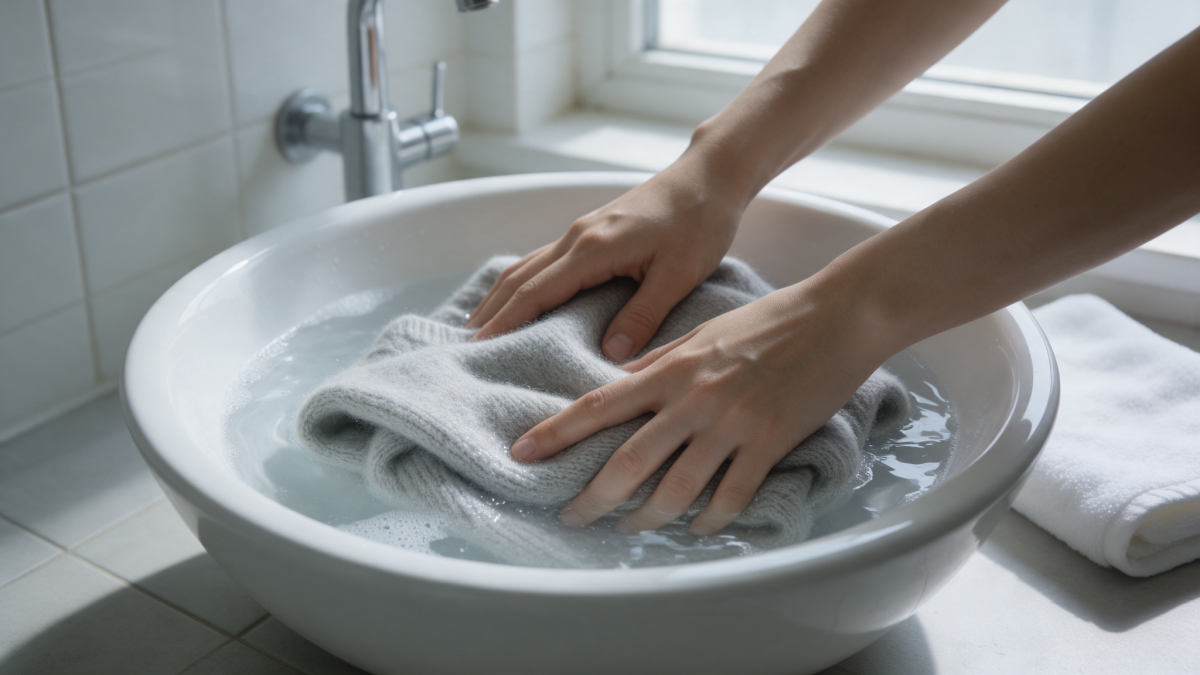
Lay the garment on the water and push it under with flat palms. Press a few times to move water through it, then leave it alone. Rubbing, twisting and scrubbing are what felt wool and pull silk out of shape. Wool takes a short soak (the wool guide covers the exact soak time), while a sturdy synthetic can stay in a little longer.
Rinse until the water runs clear
Drain the basin and refill it with clean water at the same temperature, or rinse under a gentle tap without hitting the fabric with a stream. Repeat until no suds appear. Leftover detergent leaves a stiff film and attracts dirt.
Press the water out, never wring
Lift the garment with both hands, supporting its weight so it does not stretch. Lay it on a towel, roll the towel up around it and press along the roll. Repeat on a dry part of the towel if it is still dripping.
Dry flat, away from heat and sun
Reshape the garment to its original outline on a dry towel or a rack, out of direct sun and away from a radiator. Knits in particular should never hang. Turn it once after a few hours so both sides dry evenly. Heat is the one thing to keep away from a garment that was labeled dry clean only.
Interactive
Label decoder
Tap a symbol from your care label. No guessing, no scrolling.
19 symbols. Pick one.
Which dry clean only fabrics can go in water, and which cannot?
The table sorts the common cases by what the fiber or the construction does when wet. It is a judgment guide, not a guarantee: the label on your garment, the dye test and the built-in lining still get the final say.
| Fabric or construction | Hand wash at home | What decides it |
|---|---|---|
| Wool and cashmere knits | Yes | Cool water and no movement; heat and agitation together are what felt them |
| Silk blouses and scarves | Yes | The detergent matters more than the water; avoid alkaline or enzyme products |
| Polyester and most synthetics | Yes | Water is harmless; the tumble dryer is what damages them |
| Cotton and linen | Yes | Heat shrinks them, so stay cool and dry flat, then press when damp |
| Viscose and rayon | Sometimes | Weak when wet, so no wringing at all, and expect some shrinkage |
| Velvet | Sometimes | The pile fiber decides: polyester takes water, silk and viscose velvet crush and water-mark |
| Tailored jackets, lined blazers, structured coats | No | Canvas, padding and lining shrink and warp at different rates |
| Beaded, sequined or heavily embellished pieces | No | Glue, thread and backing fail before the fabric does |
| Leather, suede and fur | No | Water strips the oils that hold the skin together |
The fabric guides on this site go deeper on the middle rows: see the notes on silk, polyester and linen when the label is all you have to go on.
Why a lined blazer is not the same garment as a silk blouse
A silk blouse is one fabric with a seam. A blazer is a small building: outer cloth, a layer of interfacing to hold the shape of the lapel and chest, sometimes canvas or shoulder pads, and a lining sewn to all of it. Each layer takes water differently, so a wash that leaves the shell looking fine can leave the layers underneath pulling in opposite directions.
The result is usually not a dramatic failure. It is a lapel that ripples, a front that puckers and a shoulder that no longer sits flat, and none of it steams out. A cleaner rebuilds that shape with presses and forms that a home iron cannot match, so this is the one category where the tag is worth obeying without argument.
Embellishment works the same way. Beads and sequins are held on by thread and sometimes adhesive, and a soak can loosen either. A garment that loses one bead on the way in has usually lost several more that you will find later on the basin floor.
Dry clean only and the washing machine
Hand washing comes first because it removes the agitation, which is the risky part of a machine. A drum adds tumbling and a spin on top of the water, and a spin is exactly what a fiber that is weak when wet cannot take. Some people machine wash sturdy synthetics and cottons on a delicates setting in a mesh bag with the spin held low, and that can work for the tough fabrics in the table above.
It is a bad bet for wool, silk, viscose and anything with structure. If you are in doubt, the hand wash costs half an hour and the machine costs the garment.
What the machine never gets is the dryer. Keep every one of these garments out of it, whatever the cycle. Lay it flat and let it take a day or longer.
Do not put a garment that was labeled dry clean only into a tumble dryer, and do not iron it hot while it is still damp. Heat is what shrinks, warps and glazes these fabrics, and it is the one mistake no later step can undo.
Three mistakes that turn a good hand wash into a ruined garment
The first is treating the garment like an ordinary load. A dry clean only piece has no margin for a hot rinse, a hard squeeze or a few hours on a radiator, and each of those three on its own is enough. Everything in the method above exists to remove one of them.
The second is washing a garment because one part of it looks washable. A wool sweater with a leather trim, a silk dress with a stiff net underskirt and a cotton jacket with a shoulder pad are all mixed builds. The most delicate part sets the rules for the whole piece, and if that part is leather, net or padding, water is off the table.
The third is skipping the dye test because the garment is pale. Pale garments bleed too, and a faint tint on the white cloth is enough to tell you the dye is loose. It is a two-minute check against a permanent stain on a sleeve, and it is the cheapest step in the whole method.
There is a fourth, quieter one: washing it in a hurry. A dry clean only garment dries slowly and flat, and if you need it tomorrow morning, that is a reason to use the cleaner rather than a reason to reach for the dryer.
What to do when the garment can’t get wet
A garment you have ruled out for water is not out of options. Most of what makes clothes seem dirty is odor and surface dust, and both respond to steam, a soft brush and time on a hanger in fresh air. A handheld steamer relaxes wrinkles and freshens the fabric without soaking it, and a soft clothes brush lifts dust from wool and heavier weaves.
Spot cleaning is for a mark, not a whole garment. Blot rather than rub, work from the outside of the mark toward the middle so it does not spread, and test the cleaner on a hidden seam first. The guide to stains on clothes sorts marks by type, which decides what you can safely reach for.
For a garment that needs a full clean and is too structured for water, the cleaner is the right answer. Point out the stain and what caused it when you drop it off, since that changes what they do.
Related guides
- Cashmere carries the most famous dry clean only tag on the site, and the soak differs from an ordinary knit: how to clean cashmere.
- If the garment is wool but not cashmere, the soak length and the felting risk change: how to clean wool.
- For an everyday load with no dry clean tag at all, the rinse matters most: how to clean clothes by hand.
- Viscose looks like silk but behaves nothing like it in water: can you machine wash viscose.
Questions
Can you wash clothes that say dry clean only?
Often, yes, by hand and in cool water, if the fabric is wool, silk, cotton, linen or a synthetic and the garment has no lining or padding. Do the dye test first, and stay away from heat. You are taking the risk on yourself, since the maker has told you not to.
What happens if you wash dry clean only clothes?
It depends on the fabric. The usual failures are shrinkage, dye running into other areas, a lining that puckers, and a fiber that stretches out of shape while wet. Some garments come through with no visible change; a structured piece may not.
Can you put dry clean only clothes in the washing machine?
Only the sturdy ones. A delicates cycle with a mesh bag and a low spin works for some polyester and cotton pieces. Wool, silk, viscose and tailored garments should be washed by hand or left to the cleaner.
How long should a dry clean only garment soak?
A short soak is enough, and longer is not better. Wool needs the least; the wool guide gives the figure. Whatever the fabric, do not agitate it, and lift it out with its weight supported.
Is there a way to dry clean clothes at home?
Not in the sense a cleaner means. What you can do is steam, brush, air and spot clean, which refreshes a garment without soaking it. It will not remove ground-in sweat or oil the way a wash does.