Can You Machine Wash Linen? (Heat Shrinks It, Water Doesn’t)
Pure linen is one of the few fibres that gets stronger wet, so the wash is not what ruins it. Heat above 40 °C, a fast spin and an over-full dryer are, and a viscose blend reverses every rule.
Quick answer · care label Linen — flax
-
1 · Wash
Wash 40° -
2 · Bleach
Oxygen bleach -
3 · Dry
Line dry -
4 · Iron
Iron 200° -
5 · Pro care
Pro clean P
In one line Check the composition first: 100% linen and linen-cotton machine wash at 40 °C (104 °F) on a gentle cycle, but viscose blends and fused blazers do not. Use half the detergent, no softener, cap the spin near 600 rpm, then line dry or pull the load from a low tumble while it is still damp, and iron damp. About 20 minutes hands-on.
Can you machine wash linen, or is the machine what shrinks it?
Yes, and linen handles a machine wash better than almost anything else in the drum. Flax is one of the very few fibres that is stronger wet than dry, with published figures putting the gain at roughly 20%. Water does not weaken it, agitation does not felt it, and it softens with washing instead of wearing out. That is why an old linen sheet feels better than a new one.
The shrinking people are afraid of is real, but it is a first-wash and a heat problem rather than a washing problem. Untreated linen gives up around 4% of its length on the first wash, and raw, unfinished linen can reach 10% if it meets hot water and a hot dryer together. Pre-washed linen, which is most linen sold now, moves 1–3% and then stops.
What ruins linen in a machine is heat above 40 °C (104 °F) and compression: a fast spin pressing wet cloth flat against the drum wall, and a packed load that leaves it nowhere to move. Linen has an elongation at break of only 2–3%, well under cotton’s and a fraction of wool’s. A crease pressed into wet linen is not a wrinkle that hangs out overnight. It is a fold the fibre keeps, and after years of the same fold it cracks along it.
Water is not the risk with linen. Heat and pressure are. Wash at 40 °C (104 °F) or below, keep the spin slow, give the load room, and take the linen out while it is still damp. Every ordinary way of ruining linen in a machine is a temperature failure or a compression failure, not a wetting one.
What you’ll need
| Item | Why | Substitute |
|---|---|---|
| Mild liquid detergent | Cleans without the brighteners and bleach that dull flax over repeated washes | Half the normal dose of any non-biological liquid |
| Mesh wash bag | Keeps hemstitched edges and loose weaves away from zips, hooks and bra wires | A pillowcase with the open end knotted shut |
| White vinegar | Half a cup in the rinse strips the detergent residue that makes washed linen feel stiff | A second rinse cycle with nothing added |
| Oxygen bleach | The only bleach flax tolerates, and only on white linen that has yellowed | A few hours on the line in direct sun |
| Drying rack or line | Linen carries its own weight wet without stretching, so hanging costs nothing | A shower rail and wide wooden hangers |
| Steam iron | Linen presses properly only while damp; a dry iron on dry linen mostly polishes the surface | A steamer, or hanging it wet and letting the water pull the creases down |
The method, step by step
Read the composition label, not the care symbols
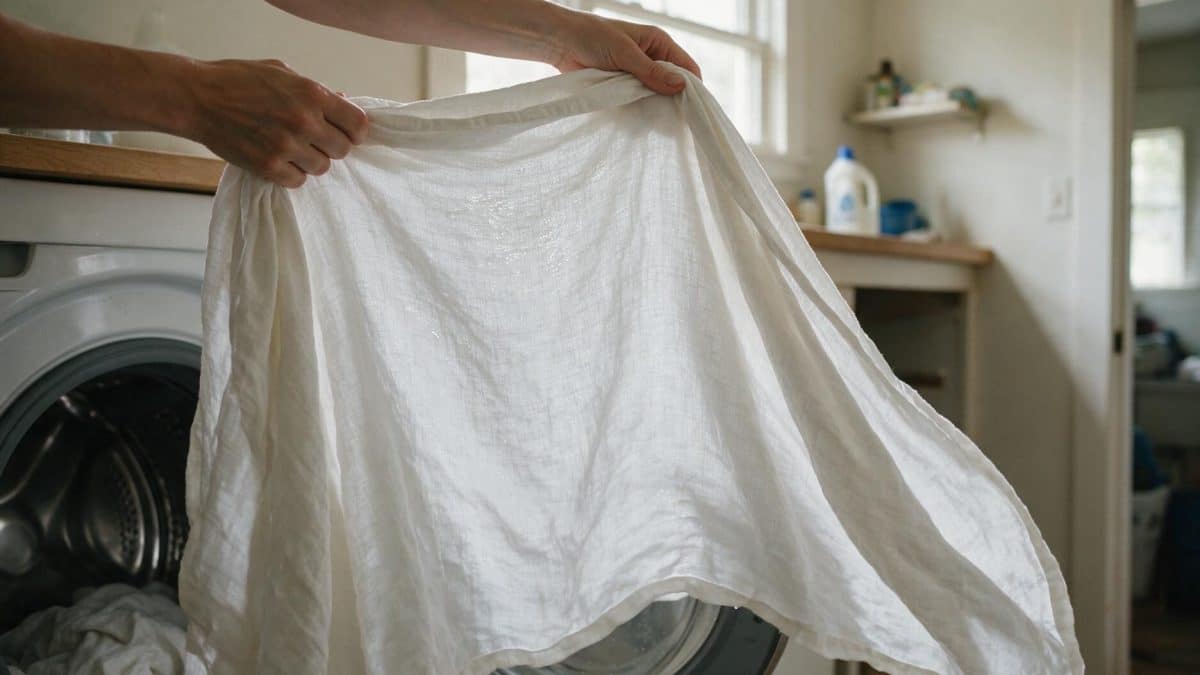
Everything below applies to 100% linen and to linen blended with cotton. Linen blended with viscose or rayon behaves like the viscose, and a structured linen jacket is a separate case entirely.
Wash linen with linen
Keep it away from towels, which shed lint into an open weave, and from anything with a zip, hook or wire. Loose-weave and hemstitched pieces go in a mesh bag, and the drum stays no more than two-thirds full.
Set 40 °C (104 °F) and a gentle cycle
Forty is the ceiling most linen makers publish; 30 °C (86 °F) is plenty for anything lightly worn. Use the delicate or gentle cotton programme rather than the intensive one: linen does not need hard agitation to come clean, and friction is what puts wrinkles in it.
Use half the detergent, and no fabric softener
A linen load is lighter than the cotton load the dose is written for, and unrinsed detergent is most of what makes linen feel harsh. Softener is worse, coating the fibre and reducing the absorbency linen is bought for; white vinegar in the rinse compartment softens by removing residue instead.
Cap the spin around 600 rpm
Spin speed, not the wash, is why linen comes out looking crushed: at 800 rpm and above the wet cloth is pressed against the drum hard enough to set creases steam struggles to lift. Six hundred is the usual compromise, 400 for a dress or shirt you intend to iron.
Take it out the moment the cycle stops
Shake each piece open and pull the seams and hems straight while it is still wet. Linen left in the drum dries into precisely the folds it is lying in.
Line dry, or tumble on low and stop early
Hung linen dries fast and straightens under its own weight. If you use a dryer, keep it low and take the load out unmistakably damp: over-drying is where linen turns stiff and brittle, and each over-dried cycle takes a little more softness away for good.
Iron while it is still damp
Damp is what does the work, not maximum heat: on bone-dry linen even a hot soleplate flattens the surface without releasing the fold. Linen’s own care label carries the three-dot iron, 200 °C (392 °F) — the hottest setting on the dial, and one of only two fibres that ask for it. In practice a 150 °C (302 °F) setting with steam presses damp linen just as flat, and it is the safer choice on a cotton blend and on a strong dye. Press dark linen on the reverse so the weave does not take on a sheen.
How much linen actually shrinks
Shrinkage in linen is the flax relaxing rather than the fabric being harmed. The fibres are held straight under tension through spinning and weaving, and water lets them return to the length they would rather be. Heat makes it worse by speeding that up and then drying the cloth in its new, shorter state.
| Type | Typical first-wash shrinkage | What to do about it |
|---|---|---|
| Raw, unwashed linen by the metre | Up to 10% if it meets hot water and a hot dryer | Wash and dry it once before cutting; the shrink happens whether you planned for it or not |
| Untreated linen garment or sheet | Around 4%, nearly all of it on the first wash | First wash cool, line dry, and buy a size up if the shape is fitted |
| Pre-washed or stonewashed linen | 1–3%, then stable | Nothing. This is most linen sold today, and why it feels soft in the shop |
| Linen blended with viscose or rayon | Unpredictable, and driven by the viscose | Treat the whole garment as viscose; the linen content does not protect it |
The linen that should not go in the machine
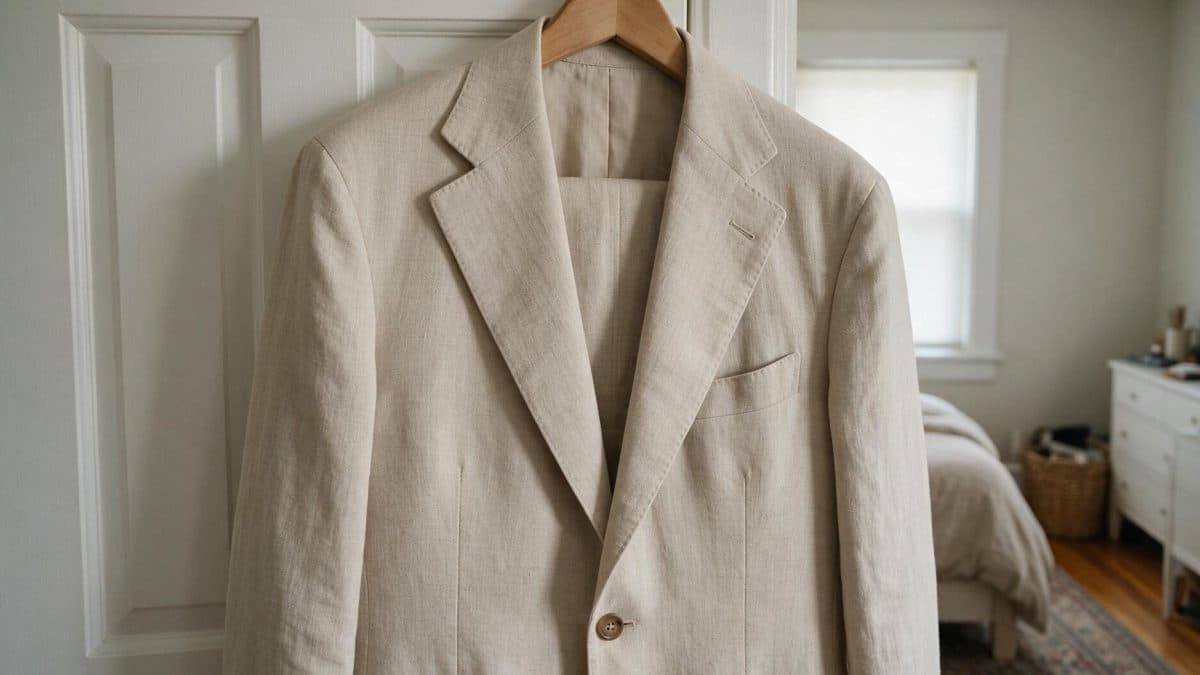
Four cases, and only one of them is about the fibre itself.
- A structured linen blazer or tailored jacket. The linen is fine. The fusible interfacing glued inside the fronts, collar and pocket flaps is not. Heat and agitation separate that glue from the cloth and the outside bubbles permanently. There is no re-fusing it at home, and a lining that shrinks at a different rate from the shell puckers every seam.
- Anything with viscose or rayon in it. The one blend that reverses the rule. Viscose loses a large part of its strength the instant it is wet, commonly put at around half; the figure moves with the type of rayon, but never in the other direction. The drum then works on a fabric that is temporarily weak while the linen half is at its strongest.
- Antique, hemstitched or very loose-weave linen. Old linen has already been oxidised by decades of light and air, and agitation snaps fibres a basin of water would leave alone. Drawn-thread and hemstitch openwork goes first, at exactly the part you cared about.
- Fitted covers and full-length curtains. The fabric survives; the fit does not. A 4% shrink on a 240 cm (94 in) curtain drop leaves it nearly 10 cm (about 4 in) off the floor, and a sofa cover that shrinks 4% will not go back onto the cushion.
Chlorine bleach, on white linen or any other. Household bleach oxidises cellulose, and while the published strength-loss figures vary a great deal between test methods, every one of them runs the same direction: measurable loss within a handful of cycles, plus a yellowing that does not wash back out. If white linen needs whitening, that is what oxygen bleach and sunlight are for.
Stains on linen, and the ones a wash sets
Linen is forgiving with stains because it tolerates a long soak and a warm wash. What it does not forgive is being dried or ironed while the stain is still there: heat drives protein and sugar residues into the cellulose, and at that point you are no longer removing a stain, you are removing a dye.
| Stain | Treatment | Recoverable |
|---|---|---|
| Red wine | Blot, flush from the back with cold water, then an oxygen bleach soak before any warm wash | Usually, if never dried |
| Olive oil and dressing | Dish soap worked into the dry cloth, left 15 minutes, then washed at 40 °C | Yes |
| Sweat yellowing on white | Oxygen bleach dissolved in warm water, a soak of a few hours, then a normal wash | Usually |
| Blood | Cold water only until it is gone; warm water sets it in one step | Yes if cold and caught early |
| Mildew from a damp pile | Dry it fully first, brush the growth off outdoors, then an oxygen bleach soak | The smell often, the staining rarely |
Two have their own methods worth reading first: blood, where the mistake is almost always warm water, and mildew, where the smell and the staining behave differently.
Related guides
Linen sits at the durable end of the natural fibres. The guides either side of it start from the opposite constraint:
- Wool is the mirror image: agitation and heat felt it permanently, and it is weaker wet rather than stronger. See can you machine wash wool.
- Viscose is the fibre hiding inside the linen blends that fail. See can you machine wash viscose.
- Antique and openwork linen belongs in a basin, where the method is mostly about the rinse. See how to clean clothes by hand.
- A fused linen jacket is the one item here that needs solvent rather than water. See how to dry clean at home.
Questions
Will my linen shirt shrink if I machine wash it?
If it was pre-washed, by 1–3%, which you are unlikely to notice on a shirt. If the label says nothing about being pre-washed or garment-washed, expect around 4% on the first wash, mostly in the length. Washing cool and line drying keeps it at the bottom of that range; a hot wash and a hot dryer push it to the top.
Can you machine wash linen in cold water?
Yes, and several linen makers recommend nothing warmer than lukewarm. Cold is safest for dyed linen and for anything unwashed, at the cost of some cleaning power on body oils. Thirty to forty degrees is the practical middle, and most makers who publish a maximum put it at 40 °C (104 °F).
Can linen go in the tumble dryer?
On low, and only until it is still clearly damp. The dryer is not forbidden, but over-drying is the main way linen is quietly wrecked at home: high heat dehydrates the cellulose, the fabric sets stiff, and the loss builds up wash after wash. Finish it on a line or under an iron.
Why does my linen come out looking crushed even on a gentle cycle?
Two causes, both mechanical. The spin speed is too high, so the wet fabric is pressed hard against the drum, and the drum is too full, so nothing can move. Drop the spin to about 600 rpm, load the machine no more than two-thirds full, and take the washing out immediately rather than letting it sit folded.
Can I wash white linen at 60 °C to get it white again?
Sources genuinely disagree here. Some linen makers allow 60 °C (140 °F) on white linen for stubborn stains; others cap everything at 40 °C (104 °F) and say cool is better still. What is not in dispute is that 60 °C accelerates first-wash shrinkage and fades dye, so treat it as a one-off for undyed whites rather than a habit. An oxygen bleach soak at 40 °C does most of the same work.
Is fabric softener ever acceptable on linen?
No, and it is one of the few hard rules here. Softener works by depositing a film on the fibre, which reduces the absorbency and breathability linen exists for, and it builds up rather than rinsing away. Linen softens on its own with every wash. Half a cup of white vinegar in the rinse speeds that up and leaves nothing behind.