How to Clean Clothes by Hand (and Why the Rinse Is the Hard Part)
Every result gives the same gentle method: a teaspoon of detergent, a soak, one rinse, never wring. That is the method for a silk camisole, and the person at the top of the page has a broken washing machine and a full basket. Here is the other method, and why the rinse is what actually decides the result.
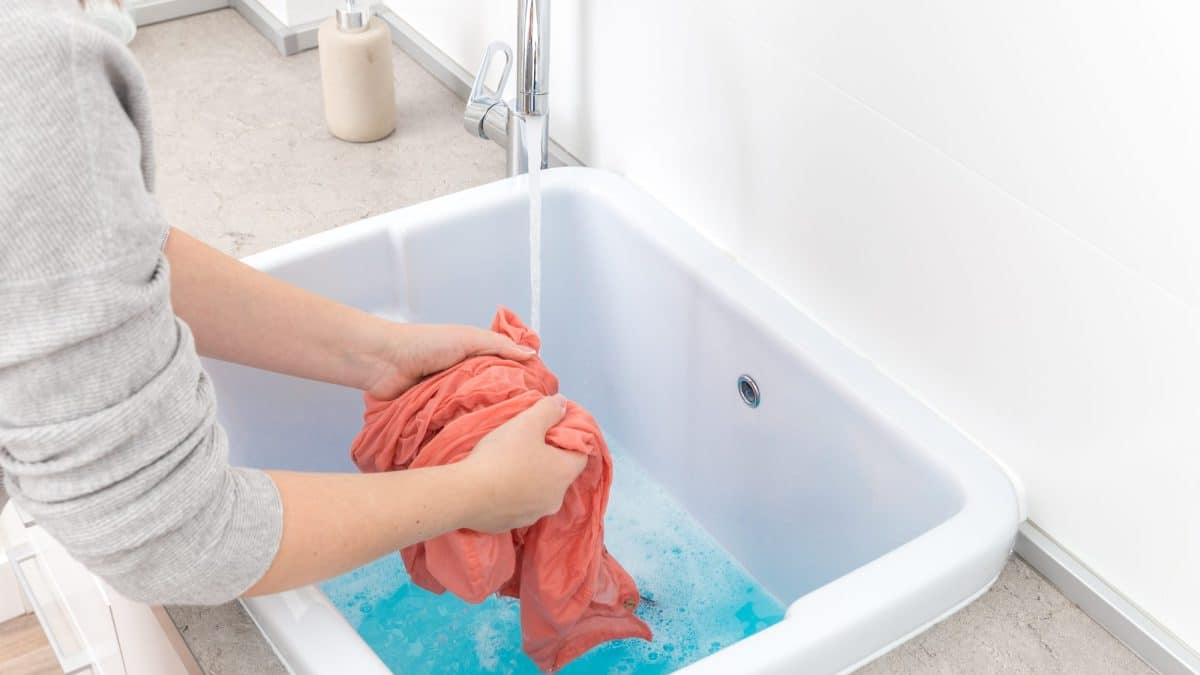
Quick answer · care label Any washable fiber · cotton, linen, denim, wool, silk
-
1 · Wash
Hand wash -
2 · Bleach
Oxygen bleach -
3 · Dry
Line dry -
4 · Iron
Iron 150° -
5 · Pro care
No dry clean
In one line Hand washing is two different methods. For a garment whose label asks for it, soak twenty minutes in cool water with dissolved detergent, do not agitate, press the water out and dry flat. For a full basket with no machine, use water as hot as gloves let you handle, soak an hour or more, then rub the soiled areas against themselves for several minutes, rinse in at least two changes of fresh water, wring the cottons hard and roll everything in dry towels. The two parts of a machine you cannot copy are the agitation and the spin, and the missing spin is why one rinse is never enough.
Two people ask this question, and only one of them gets an answer
Search how to clean clothes by hand and every result describes the same procedure: a clean sink, lukewarm water, a teaspoon of mild detergent, ten to thirty minutes of soaking, a gentle swish, one rinse, press the water out, never wring, dry flat. It is a good procedure. It is the procedure for a silk camisole.
Now look at what sits at the top of that page. The first organic result is a person whose washing machine has broken and who cannot afford to fix it, asking what they need to wash their clothes by hand for the foreseeable future. Two of the six related questions are about having no machine at all. The related searches ask about washboards, about tools, about doing it without detergent. Those are not the questions of somebody with one hand-wash label and a delicate blouse. They are the questions of somebody who now has to do the whole basket this way, every week, including the jeans and the towels and the socks.
The same instructions are handed to both, and on the second person they fail in a specific, predictable way: the clothes come out looking clean, and within a few days they are dull, slightly stiff, and starting to smell. That is not bad luck and it is not the soap. It is the two parts of a washing machine that a pair of hands cannot copy, and almost nothing written on this subject names either of them.
If the answer is “one garment, and its label says hand wash”, skip to the delicate method below and keep the whole gentle protocol. It is correct for that job. If the answer is “all of it, because I have no machine”, the gentle protocol is the thing standing between you and clean laundry. You need more mechanical work, hotter water, and considerably more rinsing than any first-page result suggests.
A washing machine does four things, and you can only replace one for free
Cleaning anything in water runs on four inputs that trade against each other: chemistry, temperature, mechanical action, and time. Herbert Sinner, working at Henkel, drew it as a circle in the 1950s, and it is still how detergent and industrial laundry people talk about a wash. Cut one input and the wash still works, as long as you pay for it out of the other three.
That is the whole story of hand washing, and it explains why the standard advice is right for one job and wrong for the other.
| Input | In a machine | By hand |
|---|---|---|
| Time | Fixed by the cycle, usually under an hour | Unlimited and free. The only input that costs you nothing, which is why a long soak is the correct centerpiece |
| Temperature | Whatever the fabric allows, up to boiling on cottons | Capped by your hands, not by the fabric. Comfortable washing-up temperature is far below what a cotton wash uses. Gloves remove the cap |
| Mechanical action | Twenty to fifty minutes of lifting and dropping the load through the water | A few minutes of kneading at best, and the first page tells you to do even less than that |
| Chemistry | Full dose, plus builders and anti-redeposition polymers, all flushed out by several fresh-water fills | Limited by what you can rinse back out, which is much less than you think |
Read the table and the delicate protocol makes sense: on cashmere or silk you deliberately give up mechanical action and temperature, because those two are exactly what destroys a protein fiber, and you buy the wash back with time. That trade is set out in full in how to clean cashmere, where the rule is that felting needs water, heat, and movement together, so removing the movement is what keeps the sweater safe.
A cotton work shirt is not a sweater. Nothing about it needs protecting from movement or from heat. Give up both anyway, as the standard advice tells you to, and you have cut three of the four inputs at once and left yourself with time alone.
Two tests: one before the water, one after
The first decides how the garment gets clean. The second decides whether it dries before it starts to smell, which turns out to be the harder problem.
The dry-brush test. Before anything gets wet, lay the garment over a light surface and brush a sleeve, a cuff and the hem briskly with a stiff dry hand, or with a clothes brush. Watch what lands. Grit, sand, lint, pet hair and dried mud falling out dry means the garment is carrying particulate soil, and particulate soil is held in the yarn mechanically rather than dissolved in it. No amount of soaking moves it, because there is nothing for the water to dissolve. That garment needs rubbing. If nothing comes off dry, what you are washing out is body soil, which is salt, urea and sebum, and most of that genuinely does come out in a long warm soak. The same garment can be both: a shirt collar is body soil, the same shirt’s cuff after a day outdoors is not.
The drip-count test. After the wash, after you have pressed or wrung as hard as you intend to, hold the garment up over the basin and count slowly to thirty. Steady dripping at the end of thirty means there is still a great deal of water in it, and in an ordinary room that garment is going to stay damp for the better part of a day. Fabric that stays damp that long gives the bacteria behind laundry smell exactly the conditions they need, which is the same mechanism set out in how to clean smelly shoes. A garment that has stopped dripping and is merely heavy is fine. One that is still running needs another towel roll, more wringing, or a spin from somewhere.
What you’ll need
| Item | Why | Substitute |
|---|---|---|
| Two basins, or a basin and a clean bathtub | Wash in one, rinse in the other. Draining and refilling a single sink wastes the minutes when the garment sits in its own soapy water going nowhere | A bucket and the sink. Any two containers that each hold the garment loosely |
| Rubber gloves | The single cheapest upgrade to a hand wash. Your hands, not the cotton, are what limits the water temperature, and warm water emulsifies body oil that cool water leaves in place | None worth having. This is the item that changes the result most for the least money |
| Liquid detergent, not powder | Powder is built to dissolve in a machine’s agitation and its water volume. Undissolved granules sitting against wet fabric leave marks, and they are one more thing to rinse out | Any liquid laundry detergent. Wool wash for anything protein. A capful of clear shampoo at a pinch |
| Two dry bath towels per load | The towel roll is your substitute for the spin, which makes it the step that decides how long the load takes to dry. One towel saturates fast on anything bigger than a shirt | An old bath sheet. Anything thick, dry, and colorfast |
| Something to rub against, for dirty items | A washboard, the ribbed side of a scrubbing brush, or the fabric itself folded and worked against itself. This is the mechanical action you removed, bought back deliberately | Your own two hands, rubbing the fabric against itself. It works. It is just slower than a board |
The washboard is worth a note, because it is one of the things people search for on this exact query and no result on the page mentions it. It is a machine for supplying mechanical action to a wash that has none, which is precisely the input a hand wash is short of. What replaced it was the electric washer, not a better soap.
Method one: the delicate wash, for a garment whose label asks for it
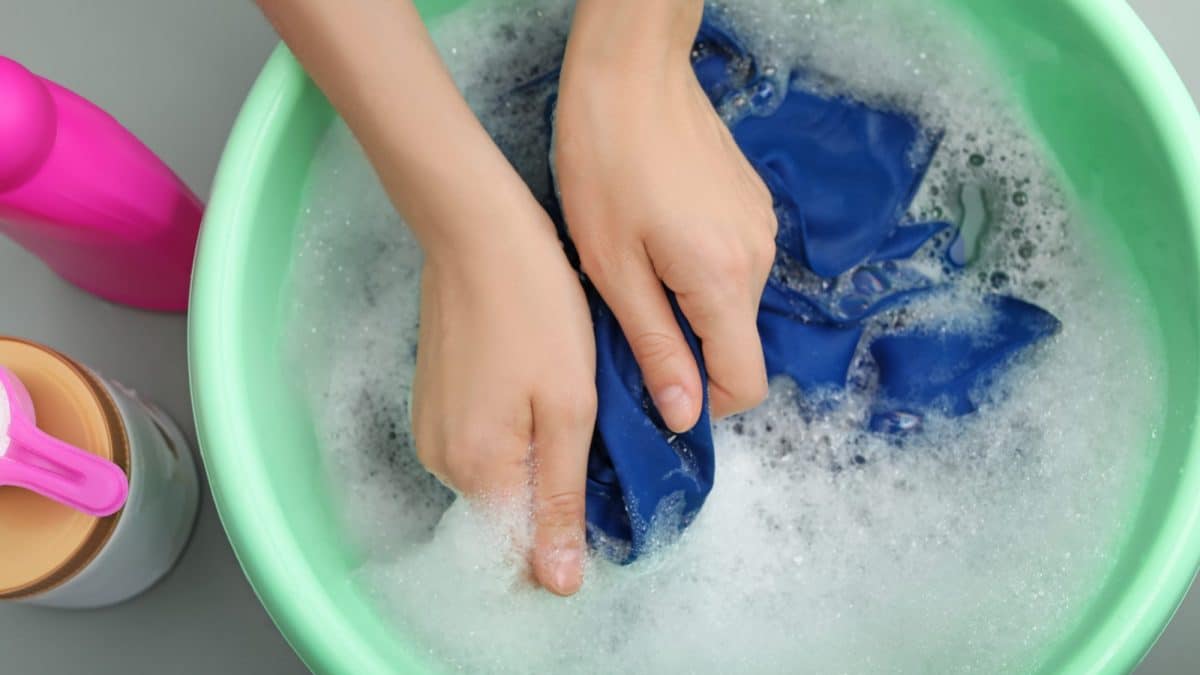
This is the version the first page describes, and for this job it is correct. Wool, silk, lace, anything knitted loosely, anything with beading or an unlined structure.
Fill the basin and dissolve the detergent before the garment goes in
Cool to lukewarm, and mix the wash into the water first. Neat detergent dropped onto wet fabric leaves a patch that rinses differently from everything around it and can stay visibly stiffer.
Submerge it, press it under, and then leave it alone
No swirling, no kneading, no rubbing one part against another. On protein fibers the movement is the risk, not the water. Twenty minutes.
Rinse in water at the same temperature, twice
Two rinses, not one, and matched in temperature to the wash water. The reason for the second rinse is the same as everywhere else on this page and it is covered in full below.
Press the water out against the basin, then roll in a towel
Support the whole garment with both hands when you lift it, so its soaked weight is not hanging from the shoulders. Press, do not twist. Then roll it inside a dry towel and press along the roll.
Dry flat, pushed back to its own shape
Flat on a fresh towel or a mesh rack, pushed back to the measurements it had before it got wet. Knitwear holds the shape it dries in, which is what makes this step the one that decides how the garment looks for the rest of its life.
For the fiber-specific version of this, including what makes a sweater felt and why the first few washes reduce pilling rather than cause it, see how to clean cashmere. For a garment with a down fill, the water changes the problem completely and how to clean a down jacket covers it.
Method two: the laundry wash, for a basket and no machine
Everyday cotton, linen, denim, synthetics, towels, socks, kids’ clothes. Nothing here is fragile, and treating it as if it were is what produces laundry that never quite feels clean.
Sort by color and by soil, and keep the loads small
Color, as always. Then soil, which matters more by hand than it does in a machine: everything in the basin shares one bath and there is no fresh-water fill halfway through, so a pair of muddy work pants puts its dirt into everything washed with it. Four or five shirts is a load. A basin crammed full has no room for water to move through the fabric, which costs you the little mechanical action you have.
Treat stains before the load goes in the water
Once the garment is in a basin of dilute detergent, no individual mark is getting any attention. Work the treatment in now, on the dry or barely damp fabric, and give it the dwell time it asks for. What to use depends entirely on what the stain is, and how to clean stains from clothes sorts them by the chemistry that lifts each one.
Fill with water as hot as gloves let you handle, and dissolve the detergent first
This is the step that separates the two methods. Body oil does not begin to soften until the water is properly warm, which is why a cold hand wash leaves a collar looking clean and gray again by Thursday. Wear the gloves and use the temperature the fabric allows rather than the temperature your bare hands allow. Full dose of detergent for the water volume, dissolved before the clothes go in.
Soak, and give it far longer than thirty minutes
Time is the one input that is free, so spend it. An hour is reasonable, and heavily soiled cotton can sit for several hours or overnight without harm. This is where the dissolved soil leaves the fabric, and it costs you nothing but patience.
Now do the work: rub, knead, and agitate for several minutes
Lift each item, fold it on itself, and rub fabric against fabric at the collar, cuffs, underarms and any area that failed the dry-brush test. Use the board if you have one. Then work the whole load through the water with your hands or a clean plunger for two or three minutes. This is the step the first page tells you to skip, and it is the only source of mechanical action in the entire process.
Drain, then rinse at least twice in fresh water
Lift the load out, drain the basin, and refill with clean water. Move each item through the fresh water, press it, lift it, and repeat. Then do it again in a third change of water. Two rinses is the minimum and three is better, for reasons that are pure arithmetic and are set out in the next section.
Wring the cottons, press the rest, then roll everything in towels
Cotton, linen and denim get wrung, properly and with both hands. Anything knitted, stretchy or protein gets pressed instead. Then lay each item on a dry towel, roll it up, and press or kneel on the roll. Whatever the towel takes is water that no longer has to evaporate off a drying rack.
Hang immediately, with air on both faces
Straight onto a line or rack, spaced so nothing touches anything else, shirts on hangers, in the airiest place available. A hand-washed load holds far more water than a spun load, so airflow is doing work here that a dryer would otherwise have done.
Interactive
Label decoder
Tap a symbol from your care label. No guessing, no scrolling.
19 symbols. Pick one.
The rinse is where a hand wash actually fails
Here is the part that no result on the first page works through, and it is the reason hand-washed clothes go dull and start to smell while machine-washed clothes do not.
A machine rinses by filling with clean water, tumbling, spinning most of the water out, and doing it again. The spin is the important half. Spinning at eight hundred to fourteen hundred revolutions a minute leaves the load merely damp, so the next fill of clean water meets a garment carrying very little of the previous bath. Rinsing is efficient because extraction happens between each fill.
By hand there is no spin. A pressed or wrung garment is still holding a substantial amount of water, and that water is the wash bath: detergent, dissolved soil, everything. Each rinse dilutes what remains by roughly the ratio between the rinse water and what the garment is still carrying. If a shirt holds a cup of soapy water and you rinse it in a gallon of clean water, that rinse gets you about a sixteen-fold dilution. A second rinse takes the same factor again, and a third again. One rinse is not a rinse. It is a dilution, and a modest one.
What stays behind is surfactant, and surfactant left in dry fabric does three things. It attracts and holds water from the air, which is why the fabric feels faintly clammy or stiff. It gives the next day’s soil something to stick to, so the garment gets dirty faster than it should. And it scatters light differently from clean fiber, which reads as dull. This site has already followed the same mechanism to its conclusion on a much bigger scale: a carpet has no drain and no spin either, which is why the patch you cleaned gets dirty first, set out in how to clean carpet. A hand-washed shirt is that problem in miniature.
Two practical consequences follow. First, wring or press hard before each rinse, not only after the last one, because every ounce of bath you remove is bath the rinse water no longer has to dilute. Second, resist the urge to add extra detergent because there is no machine to help. By hand, detergent is not free: every extra dose is a rinse you have to pay for later.
Three things the first page gets wrong
- “Never wring.” This is a rule about wool, silk and loose knits that has been generalized to a laundry basket. Twisting a wet sweater stretches a knit while it is at its heaviest, and on a protein fiber the twisting is also mechanical action on a fiber that felts, which is why the cashmere method forbids it and should. None of that applies to a cotton t-shirt, a pair of jeans, a pillowcase or a towel. On those, wringing is the only extraction you own, and skipping it is a direct cause of the damp-for-a-day, smells-by-Wednesday complaint. Wring firmly, over the basin, supporting the weight rather than hanging the garment from one end. Linen is the one cotton-adjacent exception worth naming: twisting sets creases in it that need an iron.
- “Soak for ten to thirty minutes and gently swish.” Soaking removes what dissolves. It does very little to what is held in the yarn mechanically, and mud, grit, lint and pet hair are all in the second category. Of the results on this page, exactly one says to rub the fabric against itself, and it is a cleaning-products company rather than a magazine. If a garment failed the dry-brush test, no soak of any length is going to finish the job.
- “Rinse until the water runs clear.” Clear water is not the same as clean water. Dissolved soil colors the first rinse and disappears well before the detergent does, so the visual cue retires several rinses too early. Count the rinses instead of looking at them: two as a minimum, three for anything heavily soiled or heavily dosed, and press the garment out between each one.
The soap questions, which the first page mostly skips
Two of the six related questions on this search are about dish soap, one is about having no detergent at all, and the answer Google surfaces for the second one recommends a baking soda soak. Those deserve better answers than they get.
- Dish soap is the wrong tool here, and the reason is the rinse. Dish detergent is formulated to foam heavily and to be rinsed under a running tap while you scrub. In a basin you have neither the running tap nor the scrubbing, and foam is the specific problem: it takes several extra changes of water to clear, and it gets in the way of water moving through the fabric while you are washing. It also has no enzymes, no builders and none of the polymers that stop loosened soil settling back onto the fabric. A drop of it on a single grease spot is fine. A squirt of it in the basin buys you an evening of rinsing.
- Baking soda is not a detergent. It is a mild alkali, so it is genuinely useful against acidic soils and acidic smells, and useless against oil, because it has no surfactant in it and nothing to carry oil into water. As a soak on its own it will freshen a garment and will not clean one.
- With no detergent at all, hot water and time still do most of the job. Sweat is mostly water, salt and urea, and all of that is water-soluble. What plain water will not remove is sebum. The best substitute in an ordinary house is clear shampoo, which is a surfactant designed for exactly that oil on exactly that scale, and bar soap is a distant second because it reacts with hard water and leaves a curd in the fabric.
- Skip the fabric softener. It works by leaving a waxy film on the fiber, and you are already fighting to get residue out. It is also what quietly ruins absorbency in towels and in microfiber cloths.
Drying is now the bottleneck, not the washing
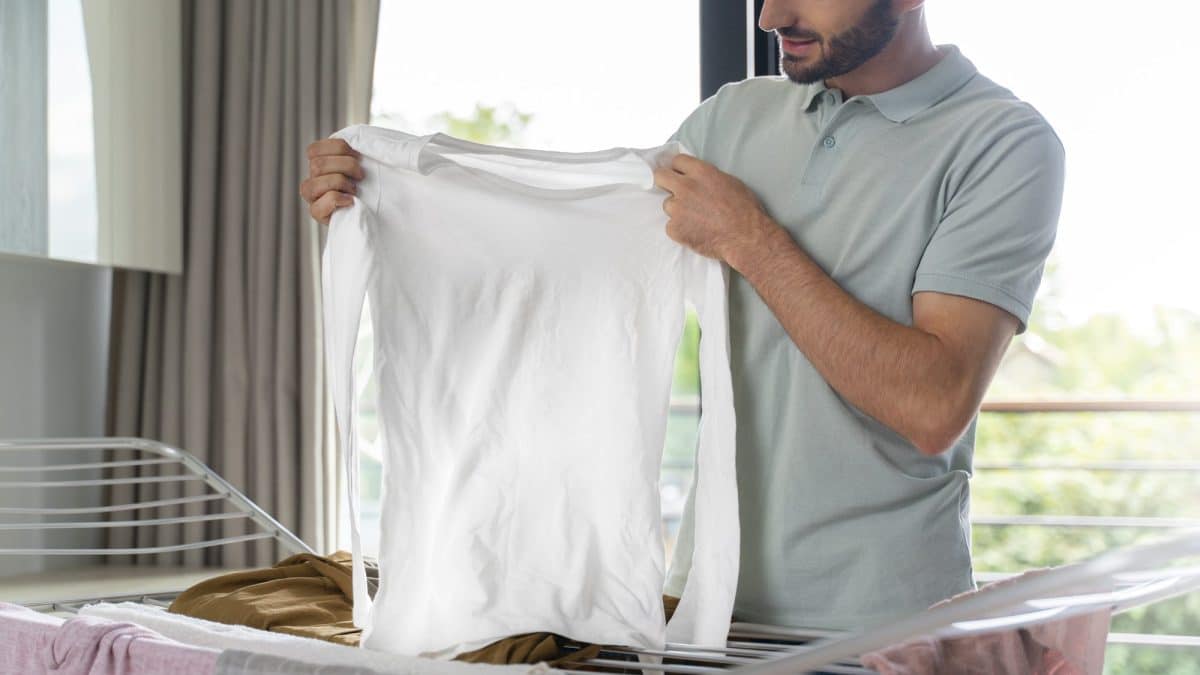
A machine hands you a load that is damp. A pair of hands hands you a load that is wet, and everything downstream changes because of it.
Space each item so air reaches both faces, and take the extra minute to hang things by the part that can carry the weight: pants by the waistband, shirts on hangers with the buttons done up so the shoulders keep their shape, knitwear not hung at all. A fan pointed at a rack makes a large difference for very little electricity, and it matters most in the first hours, while the fabric is at its wettest. Sun will dry faster still, and it also fades color and yellows some synthetics, so shade with moving air is the better default for anything you care about.
Two things worth knowing. First, an iron is not vanity on hand-washed laundry. Cotton dried without a tumble comes out stiff and creased because nothing broke the fibers apart while they dried, and a pass with an iron does the job the dryer would have done. Second, if a load stays damp for more than about a day in a closed room, you are no longer waiting for it to dry, you are growing something in it, and the fix at that point is described in how to clean mold off clothes rather than in another wash.
If a working machine is in the house and you are hand washing for other reasons, the spin-only program is the single most useful thing it can do for you. Put the pressed items in, run spin alone at a low speed for anything delicate, and you have restored the one input that hand washing cannot supply.
Related guides
For the fiber that most often sends people to a sink in the first place, and the full case against the dry clean only label, see how to clean cashmere. For working out what a mark actually is before you treat it, how to clean stains from clothes sorts stains by chemistry rather than by name, and its temperature rules matter more by hand, since a basin lets you get the water wrong in both directions. Denim is the garment where washing less is a real strategy rather than an excuse: how to clean jeans. The residue mechanism described above is the same one that makes a cleaned patch of carpet get dirty first, worked through in how to clean carpet, and the extraction problem shows up at its largest on a comforter, where a bathtub wash is easy and getting the water back out is not. If the reason you are washing by hand is a garment that will not survive a machine rather than a machine you do not have, how to dry clean at home covers what the home kits genuinely handle.
Questions
How do you clean clothes by hand without a washing machine?
Sort into small loads, pretreat stains, soak in warm water and dissolved detergent for an hour or more, then rub the soiled areas against themselves and agitate the load for several minutes. Rinse in at least two changes of fresh water, wringing between them. Wring cottons hard, press knits, roll everything in dry towels, then hang with air on both faces. The parts people leave out are the rubbing and the second and third rinse, and those are the two that decide the result.
Is Dawn dish soap good for hand washing clothes?
For one grease spot, a single drop worked in is fine. For a basin of laundry it is a poor choice, because it is built to foam and to be rinsed under a running tap, and you have neither. The foam costs you several extra changes of water, and dish detergent has none of the enzymes or anti-redeposition polymers that laundry detergent uses to stop loosened soil settling back on the fabric.
Is it okay to wash clothes by hand all the time?
Yes, with two adjustments. Use hot enough water, which means wearing gloves rather than settling for what bare hands tolerate, and rinse more than you think you need to. Clothes washed by hand indefinitely fail on residue and on drying time rather than on cleaning, and both of those are fixed with technique rather than with a better detergent.
How long should clothes soak when hand washing?
Twenty minutes for a delicate item, where the soak is the whole wash. An hour or more for ordinary cotton, and overnight is fine for heavily soiled work clothes. Time is the only one of the four cleaning inputs that costs you nothing by hand, so it is the one to spend freely. What a long soak will not do is remove grit or mud, which needs rubbing regardless of how long it sits.
Why do my hand-washed clothes still smell?
Almost always one of two things, and neither is dirt. Detergent left in the fabric holds moisture and gives new soil something to stick to, which is a rinsing problem. Or the load stayed damp too long because there was no spin to get the water out, which lets bacteria multiply in fabric that looks and feels finished. Run the drip-count test after wringing: still dripping at a slow count of thirty means it needs more towel work before it goes on the rack.
Can you hand wash clothes in cold water?
You can, and for wool, silk and anything at risk of shrinking you should. For everyday cotton it is the main reason a hand wash underperforms, because body oil stays put until the water is properly warm. Cold-washed collars and underarms look clean at first and go gray over a few wears, which is the same slow oil buildup described in how to clean a comforter.