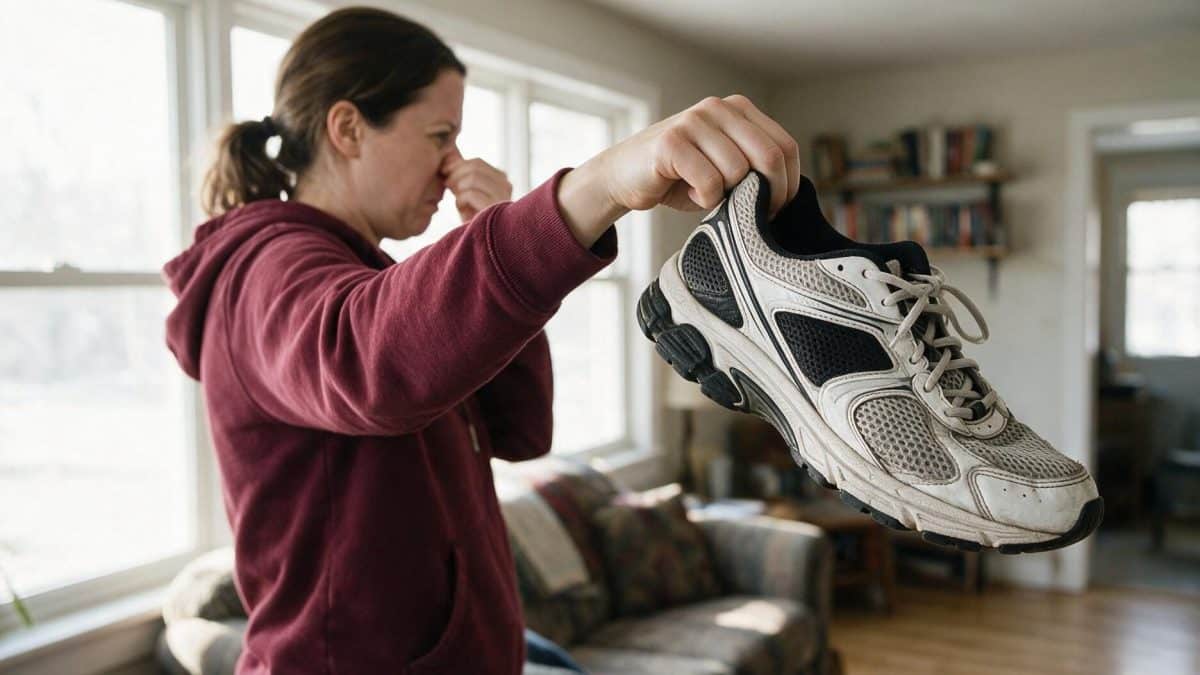
How to Clean Smelly Shoes (and Why the Smell Comes Back)
Baking soda, a vinegar spray, a night in the freezer: every fix on the first page treats the smell as a deposit. It is a live culture that makes fresh acid every time you wear the shoe, which is why it is back within two days. Here is the two-hour test that says which part of the shoe is the reservoir, and which pairs cannot be saved at all.
Quick answer · care label Smelly shoes · canvas, mesh, leather or suede
-
1 · Wash
Wash 30° gentle -
2 · Bleach
No bleach -
3 · Dry
No tumble dry -
4 · Iron
Do not iron -
5 · Pro care
No dry clean
In one line Foot sweat is odorless. The smell is bacteria converting it into isovaleric acid, and they make more of it every day you wear the shoe, so anything that only treats the acid already present works for one evening. Find the reservoir first: seal each insole in its own bag for two hours in a warm room, then smell the insoles and the empty shoes separately. Insoles are the usual answer and replacing them beats cleaning them. Wash what the upper material allows, cool and gentle, spray the inside with 70 percent alcohol, then dry for 24 to 48 hours with a fan before wearing them again. Skip the vinegar, which is an acid against an acid and adds water to the foam you are trying to dry. Rotating two pairs is the only step here that fixes the cause.
Your feet are not what smells
Sweat leaving a foot is close to odorless. It is mostly water, salt, urea and lactic acid, and the sole of the foot puts out more of it than any other patch of skin on the body. A day inside a closed shoe leaves the lining and the foam under it genuinely wet, often without the foot ever feeling wet. None of that smells on its own.
What smells is what lives in it. Two groups of bacteria do most of the work, and they produce two different smells. Staphylococcus epidermidis and Bacillus subtilis break down leucine, an amino acid in sweat, and give off isovaleric acid: the sharp, sour, old-cheese note. Brevibacterium, a close relative of the bacterium used to ripen washed-rind cheeses, works on sulfur compounds and gives off methanethiol: the flatter, warmer, gym-bag note. If your shoes smell sour, that is the first pair. If they smell heavy and faintly rotten, that is the second.
One fact follows from this and it decides everything else on this page. The smell is not a deposit sitting inside your shoe. It is a live culture, and it manufactures fresh acid every day you wear the shoe. Powder, spray and overnight soak all treat it as a deposit, which is why they all work for one evening.
Why they still smell after you washed them
This is the most asked question on the whole topic, and the answer is not that the wash failed. It is that the wash did half a job and the second half never happened.
A cold or 30 degree cycle with detergent removes the sweat residue and cuts the bacterial population hard. It does not sterilize anything: domestic washing at those temperatures never has. Meanwhile the cycle soaks the entire foam sandwich inside the shoe, including the lasting board and midsole that stay dry in normal wear. Then the shoes go back on two days later while the core is still damp, and the survivors restart in a warm, saturated cavity that is now wetter than it has ever been.
Three days after a rushed wash, a shoe usually smells worse than it did before, and the wash gets blamed. The wash was fine. The 48 hours that should have followed it were not.
The same trap catches people who deep-clean a mattress or a rug and find the smell back two weeks later, for exactly the same reason: the surface dried and the core did not. It is described in full in how to clean urine out of a mattress.
Which of the three reservoirs is yours
A shoe is not one object as far as smell is concerned. It holds three separate reservoirs, they need three different answers, and treating the wrong one is the reason so many people run through every method on the internet without a result.
| Reservoir | What it is | Fixable? |
|---|---|---|
| The insole | The removable footbed. Open-cell foam pressed directly against the sweat source, and by a wide margin the most loaded part of the shoe | Yes, and cheaply |
| The lining and upper | Textile, mesh or leather. Washes or wipes like any other fabric, dries in hours rather than days | Yes |
| The sealed cavity | The lasting board and the top of the midsole, under a glued-in insole. Never washed, never dried through, never reached by anything you pour in | Often not |
Finding out which one you have takes two hours and costs nothing, and it is worth doing before you buy anything. Pull the insoles out. Put each insole in its own sealed bag or jar, and stand the empty shoes somewhere warm for two hours. Then open them one at a time and smell each one on its own.
- Insole bag strong, empty shoe faint. Reservoir one. This is the good outcome and the cheapest fix on this page.
- Both strong. Reservoirs one and two. Replace the insole, wash the shoe, dry it properly, and it comes back.
- Insole bag faint, empty shoe strong. Reservoir three. Read the section on pairs that do not come back before you spend money on this one.
These molecules need warmth to leave the material and an enclosed space to build up to a concentration your nose can rank. Sniffing a shoe in open air tells you it smells. It does not tell you which part of it is doing the smelling, and that is the only thing worth knowing at this stage.
What you’ll need
| Item | Why | Substitute |
|---|---|---|
| Replacement insoles | The most loaded part of the shoe, and foam does not give back what soaked into it. Ten dollars beats four attempts at cleaning | None worth having |
| 70% isopropyl alcohol, in a spray bottle | Kills on contact and then evaporates instead of sitting in the foam. It is the only liquid here that does not leave the shoe wetter | None. Hand sanitizer is thickened with gel and stays damp for hours |
| Enzyme cleaner, protease based | Digests the sweat proteins the bacteria feed on, rather than lifting them off a surface | None. Detergent lifts, it does not digest |
| A fan | Takes the dry time from three days to under 24 hours. The only item on this list that changes the outcome rather than the symptom | An airy room with the door open, and more patience |
| Baking soda | Neutralizes the acid that is already there. Buys you an evening, which is sometimes exactly what you need | None needed |
| Mesh laundry bag | Keeps the shoes off the drum if you machine wash them | A pillowcase, tied shut |
The method, step by step
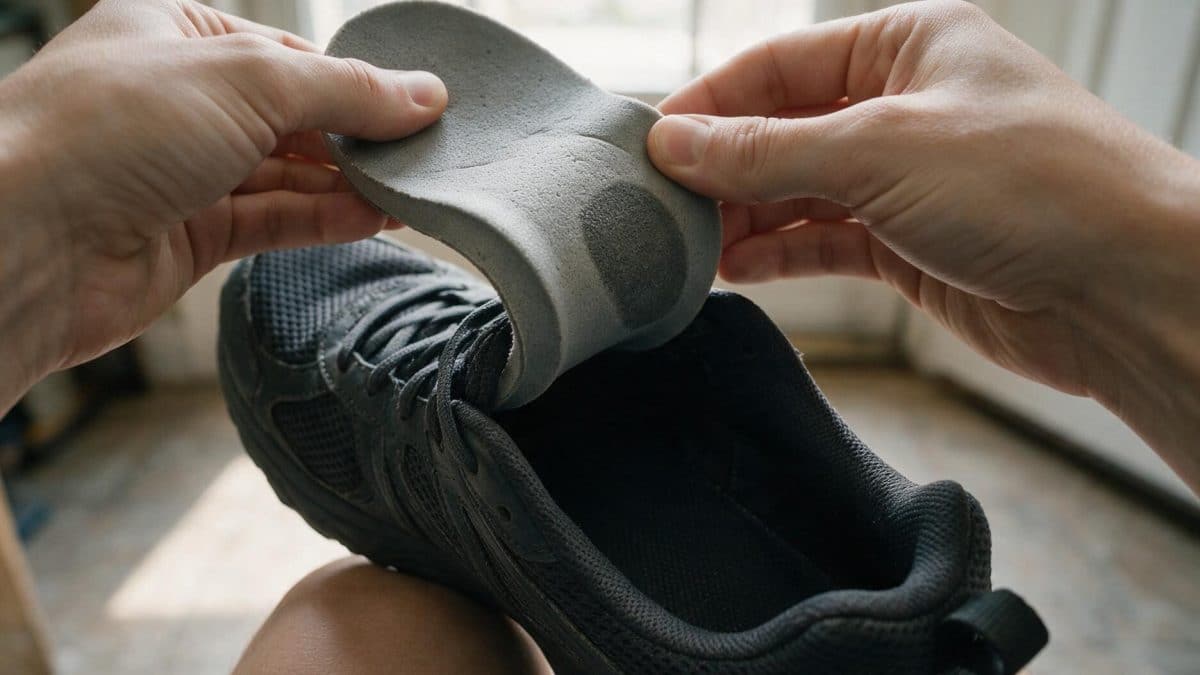
Take the insoles and laces out, and leave them out
Both hold sweat and both dry in a fraction of the time on their own. Laces go in a wash with anything else. Insoles wait for step three.
Run the bag test
Two hours decides whether the rest of this is a ten dollar job or a lost cause, so it is worth the wait rather than starting to scrub blind.
Replace the insole instead of cleaning it
An insole that has been worn for a year is saturated foam, and foam releases very little of what has gone into it. If you want to try anyway, soak it in enzyme cleaner for an hour, rinse, squeeze in a towel and dry it flat with air moving over it. Expect a partial result at best.
Wash what can be washed, cool and gentle
Canvas and mesh uppers take a cold, gentle cycle with half the usual detergent and no spin. Leather and suede take a damp cloth and nothing more. Check which pair you have first in can you machine wash shoes, and follow the cycle settings in how to clean shoes in the washing machine. For suede the answer is always no, and the alternative is in how to clean suede shoes.
Spray the inside with 70% alcohol, right into the seam
Wet the footbed and the sides properly rather than misting. Use 70% and not 90 or 99: alcohol needs some water present to denature bacterial proteins, so the weaker solution is the stronger disinfectant. It flashes off in minutes and leaves nothing behind. On a light colored leather lining, test an inside seam first, the same caution that applies to alcohol on uppers in how to clean white sneakers.
Dry to the core with air moving over it
Stuff with plain paper for the first hour to pull the bulk of the water out, then take the paper out so the inside is open to the air, tip the shoes so the openings face the fan, and leave them. A closed shoe standing in a still room takes three days. The same shoe with a fan on it takes under one. A tumble dryer is the case this step leaves out, and it is the one people reach for on a smelly pair precisely because the damp core is the whole problem: unlike the hot car below, it is heat with airflow, which changes the answer. It has a stop point rather than a time limit, set out in how to dry shoes in the dryer. Note that drying is not disinfection either way: the heat that would kill the colony outright sits above the heat that flattens the foam.
Check the core before they go back on
Press a folded paper towel into the footbed under the ball of the foot and hold it for ten seconds. Any darkening at all means the foam is still wet, and putting the shoe on now restarts everything you just did. This is the same test that decides whether a washed pillow is finished, described in how to clean pillows in the washing machine.
Rotate from now on
A shoe needs roughly a day to dry out from a day of wear. Worn daily it never gets there, and no product on the market changes that arithmetic. Two pairs alternated is the only change on this page that fixes the cause rather than the symptom.
Interactive
Label decoder
Tap a symbol from your care label. No guessing, no scrolling.
19 symbols. Pick one.
What the popular fixes actually do
Every one of these appears somewhere in the first page of results. None of them is a scam. They are just described as doing things they do not do, and the gap between the two is where people lose months.
| Fix | What it really does | What it does not do |
|---|---|---|
| Baking soda overnight | Neutralizes isovaleric acid on contact and turns it into a salt with no smell at all | Reaches nothing below the surface, and kills nothing. The colony makes more acid on your next wear |
| White vinegar, 1:1 with water | Puts water into the exact foam you are trying to dry out | Cannot neutralize the acid, and is a weak disinfectant at that dilution |
| 70% isopropyl alcohol | Kills on contact, then evaporates within minutes | Cannot reach a colony inside a sealed cavity it never touches |
| Charcoal or silica pouches | Pull moisture and some volatiles out of the air inside the shoe between wears. Genuinely useful as maintenance | Nothing at all during the eight hours you are wearing the shoe, which is when the acid is made |
| Freezing overnight | Makes the bacteria dormant | Kills almost none of them. They resume at body temperature within the hour |
| Essential oils, dryer sheets, tea bags | Add a second smell on top of the first | Everything else |
| Enzyme cleaner | Digests the protein and residue the bacteria eat, so there is less to convert into acid | Nothing instant. It needs contact time and it still needs the shoe dried afterwards |
Enzyme cleaners are the one item on that list that works on the cause rather than the smell, and they behave the same way here as they do on a carpet: the dwell time matters more than the quantity, and the fiber underneath sets the limit. That is covered at length in how to clean dog urine from a rug.
Three things page one has backwards
- Vinegar is the weakest of the four sprays, not a staple. The reason is specific. Vinegar is acetic acid, and the smell is largely isovaleric acid. The two are almost exactly as strong as each other in acid terms, so one cannot neutralize the other, and the neutralizing job people think vinegar is doing is the job baking soda actually does. What vinegar does contribute is water, delivered straight into the foam whose dryness is the entire fight. It is the one remedy that works against you.
- Sunlight does not sterilize the inside of a shoe. The germicidal part of the spectrum is UV-C, and it does not survive the atmosphere in any useful quantity. Beyond that, the inside of a shoe is the one place sunlight cannot get to. Sun helps because it is heat plus moving air, which is drying, and drying is the thing that matters. Getting the reason wrong sends people to the hot car, which is heat with no airflow, and softens the adhesive holding the sole on. Breezy shade beats a hot windowsill every time, and it also avoids yellowing white soles, which is a separate problem set out in how to clean white shoes.
- Cedar shoe trees are sold for the wrong property. The aroma is the marketing. Raw cedar is a moisture sponge, and moisture is the only variable that counts. Which also tells you what to buy: an unfinished cedar block does the work, and a varnished shoe tree does almost none of it, because the varnish seals the wood it is made of. A rolled sheet of plain paper, changed each evening, outperforms a lacquered one.
The pairs that do not come back
Secondhand and thrifted shoes are the hard case, and they are the case nobody on the first page of results admits exists. A shoe worn for years by someone else has an established colony in reservoir three, under a glued-in insole, in a cavity with no opening. There is no route into that space that does not involve soaking the whole shoe, and soaking the whole shoe is the thing that makes odor worse.
You get one honest attempt: flood the interior with enzyme cleaner, leave it an hour, blot out what you can, then dry it hard with a fan for two full days without wearing it. If the smell comes back on the first wear, it will keep coming back, and the money is better spent on the next pair. Shoes with a cork footbed are a particular case here, because cork absorbs and then holds what reaches it, which is why how to clean suede Birkenstocks is built around keeping water out of the footbed rather than getting it clean afterwards.
When the shoes are not the problem
If the skin between your toes is itchy, flaking, cracked or peeling, cleaning the shoes turns into a loop: the foot recolonizes a clean shoe within a day, and no cleaning schedule wins that race. That is a question for a pharmacist or a doctor rather than a cleaning method, and treating the two together is what breaks the cycle for people who have washed the same pair five times.
Related guides
For which pairs survive a cycle at all, see can you machine wash shoes, and for the settings once you have decided, how to clean shoes in the washing machine. Suede never goes in the machine and has its own method in how to clean suede shoes. For dirt and marks on the outside rather than smell on the inside, see how to clean white sneakers and how to clean white shoes.
Questions
Why do my shoes smell so bad even after washing?
Because the wash wet the foam core and the shoes went back on before it dried. A domestic wash cuts the bacteria down without sterilizing anything, and the survivors then find the wettest, warmest conditions the shoe has ever offered. Nothing was done wrong in the wash itself. What was missing is 24 to 48 hours of drying with air moving over the open shoe before the next wear.
How long should I soak stinky shoes in vinegar?
Don’t. Vinegar is acetic acid and the odor is largely isovaleric acid, which is an acid of almost identical strength, so no neutralizing takes place. A soak also puts water deep into the midsole foam, which is the one thing that reliably makes the problem worse. If you want a liquid, 70% isopropyl alcohol sprayed inside kills on contact and evaporates within minutes.
What is the best odor eliminator for shoes?
Judged over a month rather than an evening, it is a fan and a second pair of shoes. Every product sold as an eliminator either neutralizes acid already present, like baking soda, or absorbs moisture between wears, like charcoal. Both are useful and neither addresses why more acid appears tomorrow. The shoes that stop smelling are the ones that get a full day to dry between wears.
How do I get the smell out of thrift store shoes?
Replace the insoles before you do anything else, then wash or wipe the lining depending on the material, then dry for two full days with a fan. If the smell is still there on the first wear, it is in the sealed cavity under a glued-in insole, and there is no reliable way to reach that space without soaking the shoe and making it worse.
Can I just pour baking soda straight into the shoe?
You can, and it will work for a night or two, but loose powder works its way into the mesh and around the stitching where a vacuum will not get it back out. A quarter cup tied into a coffee filter or a thin sock does the same chemistry, sits against the footbed just as well, and comes out in one piece.