How to Clean a Backpack (the Coating Is the Part You Can Ruin)
Nearly every pack maker says the same thing: hand wash, never machine. The reason is a polyurethane film on the inside face of the fabric that abrasion and heat destroy permanently.
Quick answer · care label Coated nylon or polyester — foam back panel
-
1 · Wash
Hand wash -
2 · Bleach
No bleach -
3 · Dry
Dry in shade -
4 · Iron
Do not iron -
5 · Pro care
No dry clean
In one line Brush the pack out while it is dry, then hand wash the back panel and shoulder straps before the body, using a mild fragrance-free soap in about six inches of lukewarm water. Rinse twice until the water runs clear, press the foam between two towels, and hang the pack upside down with every zip open, out of direct sun, until the padding is dry rather than the outside. About 55 minutes hands-on, plus 24 to 48 hours of drying.
Why do the makers agree about this and almost nothing else?
Ask how to clean a backpack and the brands, for once, are not arguing.
JanSport’s care page recommends you don’t wash your backpack in the washing machine, and points you at cool water and a little non-scented soap instead. Osprey says it does not advise machine washing, because it can be harmful to the structure and fabric of the pack. Deuter is the bluntest: never wash a backpack in a washing machine, because the abrasion places stress on the material and the PU coating. Fjallraven says a machine wash will ruin the water resistance of the Vinylon F its Kanken is made from. REI, which sells most of these brands and is not defending any one of them, says never.
That is not how these searches usually go: ask can you machine wash hats and the maker, the appliance brand and the magazine give three different answers.
The agreement is not about the fabric. The outer face of a pack is 600D polyester or a Cordura nylon, chosen because it survives being dragged across gravel, and a wash cycle is nothing to it. What the makers are protecting is bonded to the back of that fabric or sealed inside the straps.
A backpack is four materials pretending to be one object: a tough outer cloth, a thin polyurethane film laminated to the inside of it, foam in the straps and back panel, and a plastic sheet or aluminum stays holding the shape. You wash to the weakest of the four, and that is a film you have never looked at.
What you’ll need
| Item | Why | Substitute |
|---|---|---|
| Mild, fragrance-free soap | Lifts skin oil without leaving a surfactant film that later pulls water into the fabric | Castile soap, or a technical wash if the pack still beads water |
| Soft sponge or soft nail brush | Does the work on the back panel and straps, where nearly all the dirt is | A washing-up sponge, soft side only |
| An old toothbrush | Gets grit out of the zip teeth and seam corners, which no sponge reaches | A stiff, dry paintbrush |
| Two dry bath towels | Press water out of the foam without wringing it, which is what takes hours off the drying | Any old towel you don’t mind dirtying |
| Baking soda | Sits inside afterward and pulls odor out of the padding, which washing rarely finishes | Activated charcoal in an open container, left in for a few days |
The method, step by step
Empty every pocket, then turn it upside down
Including the hidden ones and the laptop sleeve. A pen left in a pocket while the pack is wet is the usual way ink gets into a lining.
Vacuum and brush it out while it is still dry
Crumbs and sand first, with the toothbrush along every zip. Dry grit that goes into water becomes a suspension you then have to rinse back out, and grit left in zip teeth is the most common way a pack is retired while the fabric is still fine.
Take off only what is designed to come off
Osprey tells you to remove the harness and hipbelt if yours detach. Deuter says the opposite about its own back systems, which are not built to come apart. Pull out the rain cover and hydration reservoir either way. If a part needs force, it was not meant to come off.
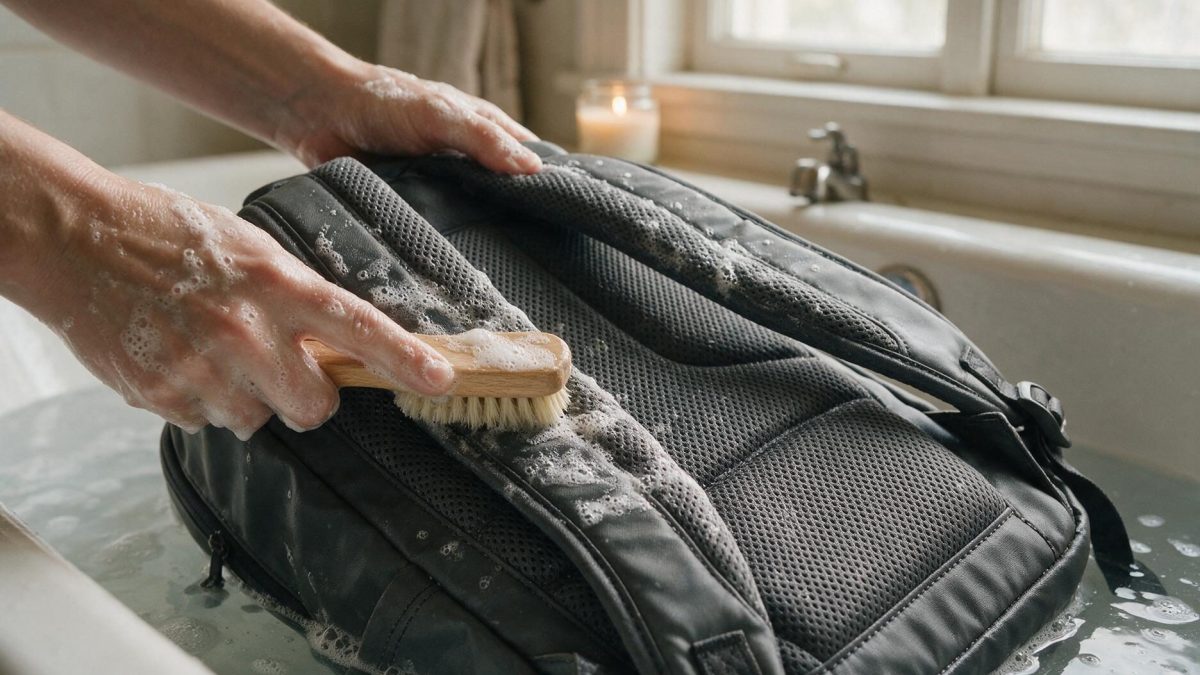
Wash the back panel and shoulder straps first, by hand
Soapy water and the brush, worked into the mesh and webbing. These are the only parts that touch skin all day, and they hold nearly all the sweat and body oil.
Sponge the body in six inches of lukewarm water
Lukewarm means about 30 °C (86 °F), never hot. Sponge rather than submerge: the coating and the foam both do better with less water in them. If the pack has a suede or leather base panel, keep it dry and treat it the way how to clean suede describes.
Rinse twice, until the water runs clear
Drain, refill with clean cool water, rinse, repeat. Soap left in the fabric is not cosmetic. It holds moisture, so a badly rinsed pack feels damp in humid weather and wets out in rain where it used to bead.
Press the foam between two towels
Straps and back panel on one towel, second towel on top, lean on it. Do not wring or twist a pack: that creases the framesheet and stresses the seams where the harness is stitched on.
Hang it upside down with every zip open
Upside down so water drains out of pocket corners instead of pooling, every compartment open so air moves through, out of direct sun and away from any radiator. Leave it until the foam is dry, not until the outside is.
The coating on the inside is the part you can ruin
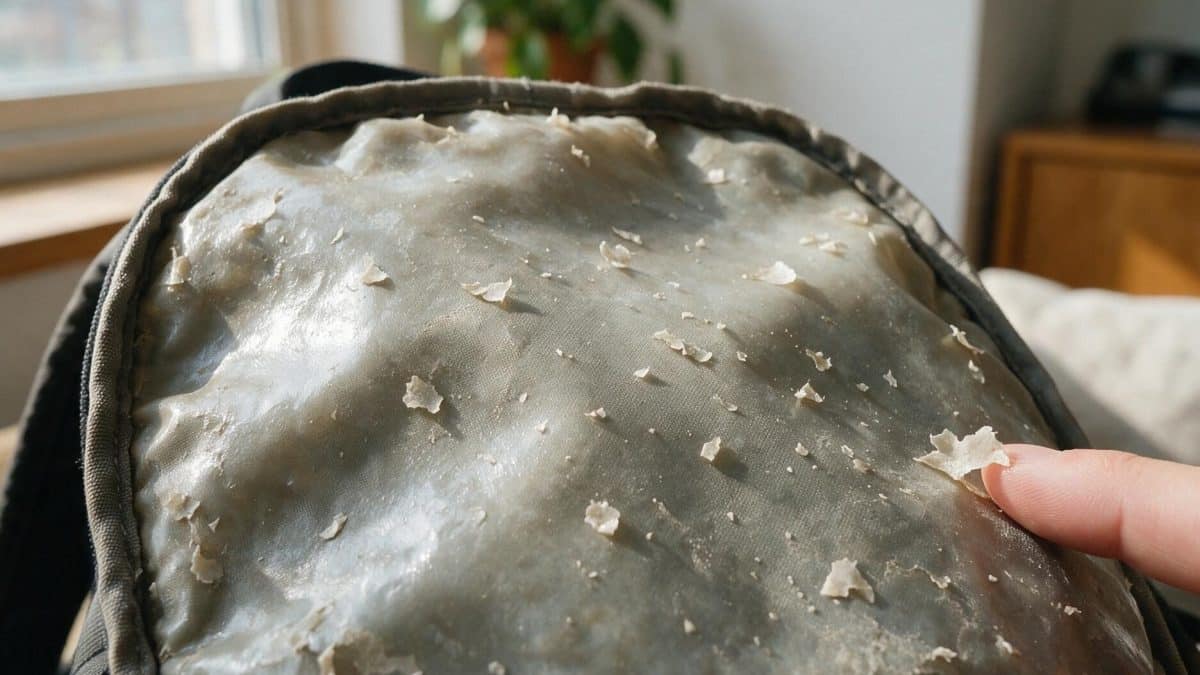
Turn a pack inside out. On most packs above the cheapest tier there is a faint sheen on the inner face, sometimes visibly grid-lined. That is a polyurethane film, spread on as a liquid and cured onto the cloth, and it is what makes the fabric water resistant. The weave is not.
Ordinary ester-based polyurethane has one well-documented enemy, which is water plus time. The ester bonds split, the film loses molecular weight, and it turns from a flexible skin into a tacky crust that flakes off in your hand. This is hydrolysis, and it is why a pack stored damp in a warm cupboard for two years comes out sticky inside for no visible reason. There is no repairing it. A wash cycle attacks the same film mechanically instead: a drum works by lifting things and dropping them, so it rubs a coated surface against itself, against buckles and against steel a few thousand times in an hour. That is the abrasion Deuter names. It is the polymer family described from the outside in how to clean faux leather.
The water-repellent finish on the outer face is a separate and more fragile layer. Laundry detergent is built to make water spread across fibers, and its residue does exactly that afterward, which is why a pack washed with detergent often wets out faster than it did dirty. That is where the makers differ: JanSport suggests a little non-scented dish soap, fine on an uncoated school pack with no repellent finish to lose, poor on a hiking pack that still beads.
The foam is why this takes two days
The outer fabric is dry within two hours. The foam in the back panel and shoulder straps is not, and neither is the spacer mesh over it. Water sits in there behind two layers of cloth with almost no airflow.
The standard advice on any soaked material is to get it dry inside 24 to 48 hours before mold establishes, and a pack back in a cupboard at hour six is still wet in the one part that is warm, dark and full of skin oil. It is the mechanism behind how to clean smelly shoes: bacteria feeding on sweat residue in foam that never dried, which is why the smell returns a week after a clean that seemed to work. The honest schedule is an hour of work and two days of waiting, and a fan does more than heat.
No tumble dryer, at any heat setting, for any pack. The drum softens the polyurethane coating while flexing it, warps a plastic framesheet, and can distort buckles enough that they no longer hold. The general case is in how to dry shoes in the dryer.
Direct sun is a smaller trade, but real. Every maker says shade, because ultraviolet light breaks down pack fabrics, and nylon is more sensitive to it than polyester. Suppliers’ accelerated-exposure numbers disagree too much to quote one, but they agree on the direction, as do tent makers who leave fabric out for a season. Advice about mold says the opposite, that sun kills spores, and it does. An hour or two on a mildewed pack is defensible. A week on a balcony is not.
Machine washing, honestly
The one real exception is a category rather than a technique. A plain school daypack in polyester or canvas, with no coating inside, no molded foam back system, no frame and no leather trim, is close to being just a bag, and some are sold with a machine-washable label. Fewer than you would expect: L.L.Bean’s Original Book Pack is about as plain as a school pack gets, and is sold spot clean only. Read your own label. If it does say machine washable, what you risk is mostly a strap catching.
If you do it anyway, buckle every strap closed and tuck the loose ends, use cold water and the slowest spin, and skip the detergent for the mild soap. Mass in the drum reduces how far anything falls, so a full load is gentler than a lone pack, which is the argument developed in how to clean shoes in the washing machine. You are spending some of the coating’s life to save forty minutes. What never goes in, whatever the label says: anything with an aluminum stay or a shaped framesheet, anything with a suede or leather base panel, and any pack you rely on to keep rain out.
Stains, and which of them come out
| Mark | Treatment | Recoverable |
|---|---|---|
| Ballpoint ink on the lining | Isopropyl alcohol on a cotton swab, dabbed inward from the edge, with a folded cloth behind the fabric to catch what dissolves. Full approach in how to clean ink stains on clothes | Usually, if fresh |
| Food grease or a leaked lunch | A drop of dish soap worked in with a fingertip, left ten minutes, then rinsed. Grease is the one mark where a degreasing soap beats a gentle one | Usually |
| Mildew spotting after damp storage | One part white vinegar to four parts cool water, sponged on, left an hour, rinsed, dried hard. See how to clean mold off clothes | The smell goes, the dark pigment often does not |
| Sunscreen, turned orange | Rinse immediately if you catch it wet. Once orange, avobenzone has reacted with iron in the water and bonded to the fiber. Not chlorine bleach, which fixes it permanently | Rarely, once the color has developed |
Related guides
- A leather backpack has no coating to protect and a lining that traps odor instead, so the method is wipe, stuff and condition: how to clean a leather bag.
- If the base panel is suede, that part is a different object with no tolerance for soaking: how to clean a suede bag.
- The odor that returns after a clean is a foam problem, not a fabric one, set out in full for the shoe version of the same failure: how to clean smelly shoes.
Questions
Can I put my backpack in the washing machine?
For most packs, no. JanSport, Osprey, Deuter and Fjallraven all advise against it, and REI’s guide says never. The exception is a plain uncoated school daypack with no frame, no molded foam and no leather, and some of those are sold as machine washable. Check the care label, which is the one source that knows what your pack is made of.
What soap should I use on a backpack?
A mild, fragrance-free soap, or a technical wash if the pack still beads water. Not laundry detergent: it is built to make water spread, and its residue does the same to your pack afterward. Dish soap, which JanSport suggests, is fine on an uncoated school pack and a poor choice on anything with a water-repellent finish to lose.
How long does a backpack take to dry?
The fabric is dry in about two hours. The foam in the straps and back panel takes 24 to 48 hours, and that is the part that matters: a pack put away with damp padding is how mold and a returning smell both start. Hang it upside down, zips open, with a fan if you are in a hurry.
Why is the inside of my backpack peeling and sticky?
That is the polyurethane coating breaking down, a process called hydrolysis. Water and warmth split the polymer over time, usually in storage rather than in use, and the film turns from a flexible skin into a flaking crust. It cannot be recoated at home. Scrape the loose material off with a blunt edge and keep using the pack, but it is no longer water resistant.
How do I get the smell out of a backpack?
Wash the back panel and straps by hand first, since that is where the sweat is, then dry the pack completely. Once it is genuinely dry, leave a few tablespoons of baking soda in an open container inside the closed pack for a day or two. If the smell survives that, moisture is still in the foam or something organic is sitting in a seam.