How to Dry Shoes in the Dryer (the Damage Starts When They Stop Being Wet)
Every result gives you a time limit and a low setting, and both count from the wrong moment. While there is still free water in the foam, a shoe cannot get hot enough to hurt. The run that wrecks a pair is the short one on a pair that was already almost dry.
Quick answer · care label Canvas & mesh
-
1 · Wash
Wash 30° gentle -
2 · Bleach
No bleach -
3 · Dry
Tumble low -
4 · Iron
Do not iron -
5 · Pro care
No dry clean
In one line Laces and insoles out, low heat or no heat, and stop when the midsole is hot to the back of your hand rather than at a fixed number of minutes. While free water is leaving the foam the shoe cannot overheat; the damage happens in the minutes after it goes dry.
The dryer is not the problem. A dry shoe in a dryer is.
Search this and you get a time limit. The AI answer at the top of the page says fifteen to twenty minutes maximum. The first article result says twenty to thirty minutes is the absolute ceiling, even on low heat. Both numbers start counting the moment you press start, and that is the wrong moment, because a shoe that is soaking wet and a shoe that is almost dry are two different objects sitting in the same machine.
Water leaving a surface carries heat away with it. That is why a paper cup of water can sit directly over a flame without catching fire, and it is why the inside of a shoe full of water cannot climb to the temperature of the air going past it. As long as there is free water in the foam, the foam is held down near the temperature of the evaporation, well under the air around it. Nothing in the shoe is in danger during that phase. The glue is not softening. The foam is not taking a set.
Then the free water runs out, and within a few minutes the same part of the same shoe is sitting at the temperature of the air. Everything the first page warns you about happens in that second phase. So the honest version of the time limit is not a number of minutes. It is a condition: stop before the shoe goes dry, not after twenty minutes.
This reverses the advice people actually follow. The dangerous run is not the long one on a pair that came out of the washer dripping. It is the ten minute run to finish off a pair that was already nearly dry, which feels like the cautious choice and is the only run where the shoe spends all of its time in the second phase.
Low heat or no heat, laces and insoles out, and pull the shoes when the midsole is still cool to the back of your hand. A shoe that comes out slightly damp finishes on its own overnight. A shoe that comes out hot has already spent time in the only phase that costs anything.
Why the sole is where it fails, and not the fabric
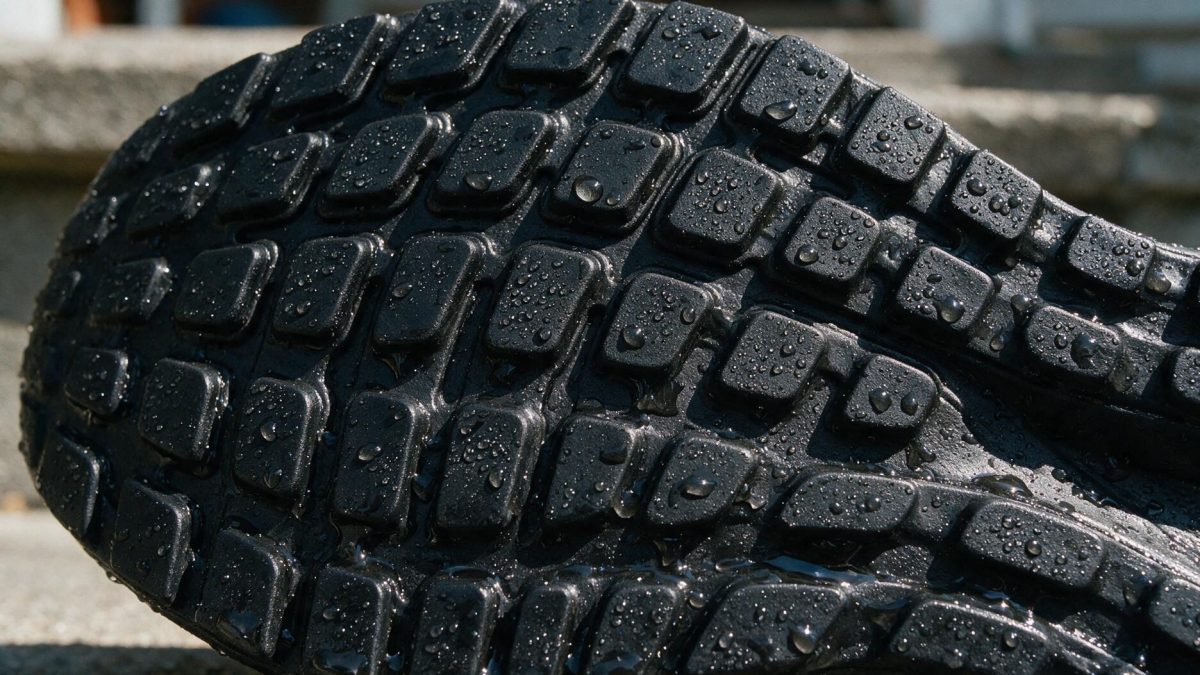
The parts of a shoe do not leave the wet phase together. A foam midsole holds a lot of water and gives it up slowly, so it stays cool for a long time. A rubber outsole holds essentially none, so it reaches the air temperature almost immediately. The woven upper is somewhere in between and dries from the outside in.
The adhesive line sits exactly on that boundary. On a cemented shoe, which is most sneakers, the outsole is bonded to the midsole and the upper is bonded to both. That bond is being heated from the rubber side while it is still being cooled from the foam side, and the drum is flexing the joint on every rotation. This is why separation, when it happens, starts at the toe bumper and along the outside edge rather than in the middle of the shoe: those are the thin rubber parts furthest from any water.
It also explains the check everybody gets wrong. People open the dryer and touch the upper. The upper is the first part to leave the wet phase, so it is warm early and tells you nothing about the state of the shoe. The midsole is the part that is still protected, and it is the part whose temperature is worth knowing.
The foam has its own failure, separate from the glue. A midsole is a closed cell foam that was blown into shape under heat and pressure at the factory. Warm it up again with nothing holding its shape and the cells give in where the shoe is resting its own weight, then set that way when it cools. That is the flat, dead feeling people describe after a dryer cycle, and unlike a mark on the fabric, it does not come back.
Two checks: one before, one during
The first tells you what your shoes are made of. The second tells you when to stop.
Turn the shoe over and run a fingernail along the line where the upper meets the sole, on the inside of the arch. A faint lip of hardened adhesive squeezed out along that line means the shoe is cemented, and the sole is something that can come apart. Visible stitching running through the join means the sole is sewn on, and heat cannot separate it at all. Sewn shoes still have a foam midsole to protect, but they only have one failure to worry about instead of two.
At every check point, press the midsole, not the upper, against the back of your hand for three seconds. Warm and easy to hold means water is still leaving the foam and the shoe is in the protected phase. Hot enough that you take your hand away means the free water is gone from that part and every further minute is spent at full air temperature. That is the stop signal, and it arrives at a different time for every pair, which is the reason no fixed number of minutes works.
| Part | Holds water? | Protected while wet? | What failure looks like |
|---|---|---|---|
| Canvas or mesh upper | A little, dries fast | Only briefly | Rarely fails; may shrink slightly at the toe box on high heat |
| Foam midsole | A lot, gives it up slowly | Yes, for a long time | Flattens where the shoe rested, loses spring, does not recover |
| Rubber outsole and toe bumper | None | No | Edges lift, usually starting at the toe |
| Cement line between them | None itself | Partly, from the foam side | Peel that opens further every time the shoe flexes |
| Insole or footbed | A lot | Yes | Curls or delaminates if left in; take it out and dry it separately |
| Leather, suede, or a glued applique | Varies | No, different failure entirely | Stiffening, cracking, trim detaching; these do not belong in a dryer wet or dry |
The method
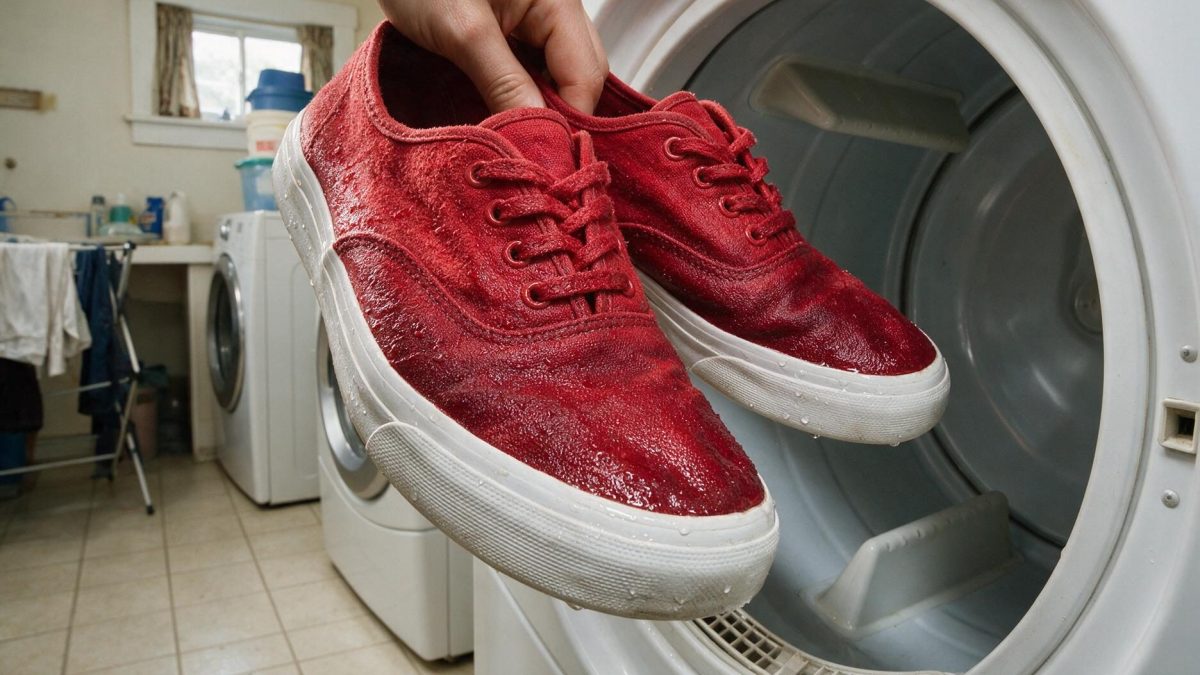
Run the arch seam check and rule out the wrong materials
Canvas, cotton, mesh, and knit synthetic uppers are candidates. Suede, smooth leather, anything with glued rhinestones or foam trim, and light up soles are not, at any temperature. If you are not sure what the upper is, can you machine wash shoes has the material by material breakdown, and the same list applies here.
Take out the laces and the insoles
Both come out and dry separately, flat, outside the machine. This is the one preparation step every source agrees on and it is right, but it has a consequence nobody mentions: pulling the insole opens up the inside of the shoe and shortens the protected phase. You are trading a shoe that dries slowly and safely for one that dries faster and needs checking sooner.
Decide between heat and no heat, and understand that these are not two settings
Air fluff, air dry, or no heat blows room temperature air. A shoe in that airflow never leaves the safe phase, so it has no time limit at all and can run for two hours while you do something else. Low heat is faster and has a stop condition. Choosing between them is a real decision. Choosing between low and medium is not, because both are in the phase that costs something and only the clock changes.
Contain the shoes rather than suspending them
Put the pair in a mesh bag or a tied pillowcase and let it tumble. The popular alternative is to knot the laces together, hang them over the top of the door, and shut the door on the knot so the shoes hang inside. That trick works, and it solves a genuine problem, but the problem it solves is the banging noise, not the heat. It also makes the one check that matters awkward, because you have to undo the whole arrangement to reach the midsole. If your dryer is loud enough that noise is the real obstacle, use no heat and let it run long.
Check at ten minutes, then every ten
Open the door and press the midsole to the back of your hand. Still cool or mildly warm means keep going. Hot means the pair is out, whether or not it feels dry. On a soaked pair after a wash cycle this can take three or four checks. On a pair that got rained on for twenty minutes it can arrive at the first one.
Stuff and finish in the air
Plain unprinted paper inside for the first hour holds the shape and pulls out the bulk water, then comes out so air can reach the inside. The last of the water in a foam midsole leaves slowly no matter what you do, and the dryer is the wrong tool for that final stretch: it is the phase where the shoe is dry enough to heat and still damp enough that you are tempted to keep going.
Interactive
Label decoder
Tap a symbol from your care label. No guessing, no scrolling.
19 symbols. Pick one.
Three things the first page has backwards
- The lace trick protects the dryer, not the shoes. It is the centerpiece of the AI answer and it is what the top forum thread, the top video results, and both of the popular social posts are demonstrating. Every one of them is showing you how to stop the drum from banging. That is a real problem and it has a good solution, but it is presented as the method for drying shoes safely, and it does nothing whatever about the only variable that damages a shoe. A pair hung silently on the door and left for an hour is in worse condition than a pair that rattled around for fifteen minutes and came out warm.
- The time limits measure the wrong clock. Fifteen to twenty minutes, or twenty to thirty as an absolute maximum: both are counted from when the machine starts. The minutes that matter are the ones after the free water is gone, and how many of those a twenty minute run contains depends entirely on how wet the shoes were when they went in. The same number is generous on a dripping pair and reckless on a damp one, which is why people get away with this dozens of times and then ruin a pair without changing anything they did.
- Air fluff and low heat are not neighbors on a dial. They get listed together as the safe options, so people pick low heat believing they have chosen the careful one. No heat is a different operation: it cannot push the shoe past room temperature, so the timer stops being a safety device and becomes a matter of patience. Low heat is genuinely faster and genuinely has a limit. Presenting them as two degrees of the same choice is what makes the limit feel optional.
The questions the results page leaves open
Four of the eight related searches under this query are about speed, and two of the six follow up questions are asking whether this is allowed at all rather than how to do it. Neither of those gets an answer from anything on the page.
- Five minutes, ten minutes, overnight. You can make an upper wearable in ten minutes. You cannot dry a foam midsole in ten minutes by any method, because the water is inside a closed cell structure and has to migrate out. This distinction matters more than it sounds: a shoe with a dry upper and a wet core is the exact condition that brings the smell back within two days, and it feels like success when you put it on.
- The oven. This appears in the related searches and the answer is no, for a reason worth stating rather than asserting. An oven has no meaningful airflow, so the water that leaves the shoe stays in the box, and its lowest setting is well above what any dryer produces. The evaporative protection that makes a dryer survivable depends on moving air taking the water away. Without that, you have heat with none of the cooling.
- Whether to do it at all. The question block on this search serves “is it okay to dry shoes in the dryer” and “why should you not dry shoes in the dryer” one after the other, which is a fair summary of the state of the advice. The answer is that a low or no heat cycle, stopped while the midsole is still cool, is a normal thing to do to a canvas or mesh sneaker, and that almost everything written about the damage is describing a hot cycle run to completion.
Every other method, judged by the same rule
Three of the eight related searches on this query are people looking for a way to do this without a dryer, or faster, or overnight. The competing article on the first page answers with five options and no way to rank them. There is a way to rank them, and it is the same rule the dryer runs on.
Drying a shoe is two separate jobs. Something has to turn the water into vapor, and something has to carry the vapor away. Heat only does the first. Airflow does the second and, on its own, does a surprising amount of the first as well. Every method below is some mix of the two, and the ones that fail are the ones that supply heat with nowhere for the water to go.
| Method | Heat | Airflow | Time to a dry core | Verdict |
|---|---|---|---|---|
| Fan, shoes open and tipped toward it | None | High | 8 to 16 h | The best overnight option, and the cheapest. No risk at any duration |
| Dryer, no heat setting | None | High | 1 to 3 h | Fastest zero-risk route. The only reason not to use it is the noise |
| Dryer, low heat | Low | High | 20 to 40 min to the stop point, then air | Fastest overall, with a stop condition rather than a timer |
| Purpose-built shoe or boot dryer | Very low or none | Directed into the shoe | 2 to 8 h | Works because it puts the airflow where the water is. Slow but unattended |
| Paper stuffing, changed hourly | None | None | 1 to 3 days | Moves water by contact, not evaporation. Useful for the first hour, weak after that |
| Silica gel packets in a sealed bag | None | None | 1 to 2 days | Real but slow, and needs the bag closed. Best as maintenance between wears |
| Rice | None | None | Longer than doing nothing in an airy room | Skip it. Rice is a poor desiccant and it gets into the mesh |
| Radiator or heater vent | High | Low | Varies | The classic mistake. The shoe crosses out of the wet phase against a hot surface with no way to check it |
| Hot car | High | None | Varies | Heat with the water trapped in the same box. Softens adhesive for no gain |
| Direct sun | Moderate | Whatever the breeze gives | 4 to 10 h | Works when it is windy, not when it is just bright. Yellows white soles either way |
| Hairdryer held on the shoe | High | High but pointed at one spot | Never reaches the core | Dries the upper in minutes and cooks one patch of midsole. The worst ratio on the list |
Two things fall out of the table. The first is that the fan, which costs nothing and appears in none of the results for this search, beats most of what does appear. The second is that the methods people reach for when they are in a hurry are almost all in the heat-without-airflow row, and that row is where every horror story comes from. A radiator, a car dashboard and a hairdryer are the three fastest ways to reach the exact condition this whole page is about: a shoe that is no longer wet, sitting in heat, with nobody checking it.
Where this sits against the rest of the site
Three guides here give instructions that this one draws a line around.
- How to clean shoes in the washing machine lists tumble drying as a mistake and says to air dry only. That is the right call for a hot cycle run to the end, and it is the reason a wet shoe survives a short one: the entry treats heat and tumbling as a single thing, and on every dryer they are separate controls.
- Can you machine wash shoes puts the foam midsole risk on water absorption and a two to three day dry. Water alone does not set the foam. Heat does, and those two or three days are exactly the stretch during which reaching for the dryer starts to look reasonable.
- How to clean smelly shoes is built on the damp core keeping a live culture alive. The dryer is the one tool that ends a damp core quickly, which is why people reach for it on smelly pairs specifically, and the heat that would kill the culture outright sits above the heat that flattens the foam. Dry it fully at low or no heat and accept that drying is not disinfection.
- The same heat argument runs elsewhere in the house: a throw rug’s non slip backing is broken by a single dryer cycle and never by water, and a home dry cleaning kit uses the dryer’s heat deliberately, on garments with no foam and no glue in them.
- For everything that should not go near a dryer at all, see how to clean suede shoes, and for soles that yellow rather than fail, how to clean white shoes.
Questions
How long does it actually take to dry shoes in the dryer?
On low heat, a soaked pair reaches the point where you should stop in roughly twenty to forty minutes of total run time, checked in ten minute intervals, and it will still be slightly damp inside when it comes out. On no heat, there is no stopping point and a pair takes one to three hours depending on how much foam is in it. Neither route gets a foam midsole completely dry without some hours in the air afterwards.
Is the lace over the door trick worth doing?
Yes, for what it does. It stops the banging, which is the main reason people give up on this. It just is not a safety measure for the shoes, and it makes checking the midsole inconvenient enough that most people skip the check. If noise is your problem, the better trade is no heat plus a longer run, which is quiet in the sense that it does not matter how long it goes.
My shoes came out and the sole edge has lifted slightly. Can I fix it?
A small lift at the toe or along the outside edge can be re-bonded with a flexible shoe adhesive, clamped or taped tight and left overnight. What you cannot fix is a midsole that has flattened, because that is a change in the foam structure rather than a broken join. Check for both: press the midsole with a thumb and see whether the dent springs back within a second.
Can I dry running shoes this way?
With more care than canvas. Running shoes have the thickest foam midsoles, so they hold the most water and stay in the protected phase longest, which sounds good and means the check interval matters more, not less. If the pair is one you train in and the cushioning is the point of them, no heat is the setting to use.
What about a dryer sheet or a couple of tennis balls in with them?
Tennis balls do nothing here that towels do not do better; they exist to break up clumped bedding. A dryer sheet leaves a softener film, which is a problem on a mesh upper for the same reason it is a problem on microfiber cloths: it coats the fibers and stops them absorbing. Add a couple of old towels instead if you want to cushion the tumble.
Are boots different from sneakers?
Usually yes, and the arch seam check is what tells you. Many boots have a stitched sole, which removes the glue failure entirely, but they also have leather or a membrane liner that has its own reasons to stay out of the heat. A stitched, all synthetic boot on no heat is fine. Anything with leather in it is not, regardless of setting.