Can You Machine Wash Converse? (The Dryer Is What Ends Them)
Converse publishes a flat no: damp cloth only, never a machine. Cold and bagged, a canvas pair usually survives it. The dryer, direct heat and chlorine bleach are what actually end them.
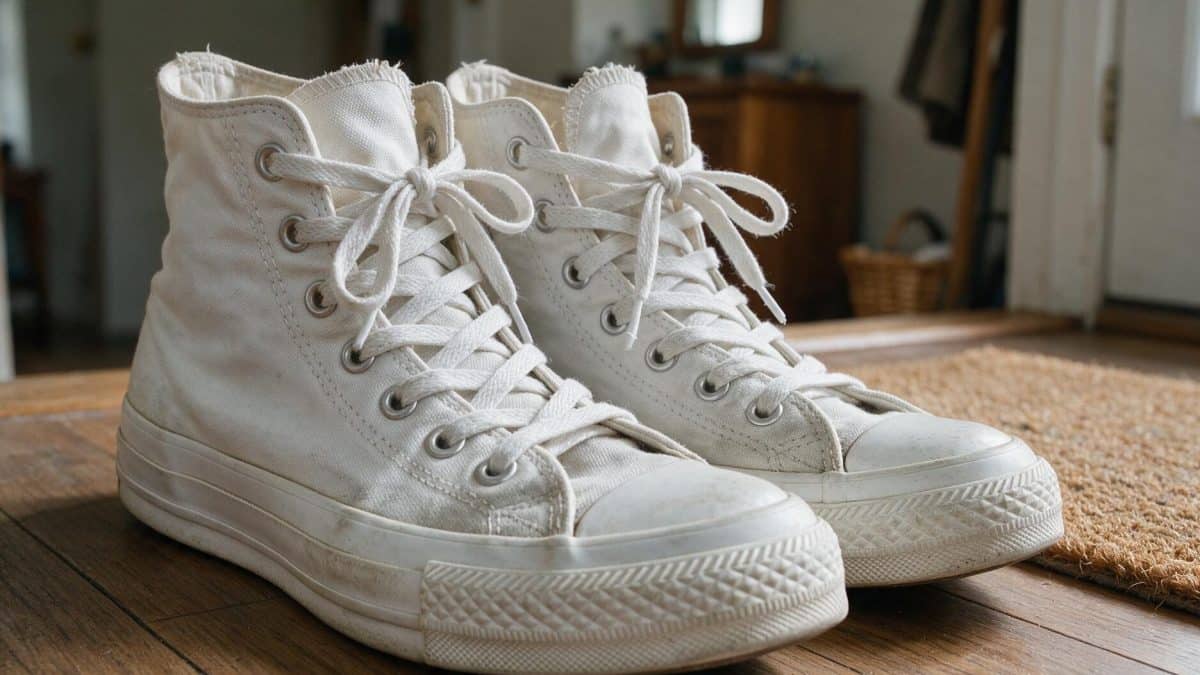
Quick answer · care label Cotton canvas — vulcanised rubber sole
-
1 · Wash
Do not wash -
2 · Bleach
No bleach -
3 · Dry
No tumble dry -
4 · Iron
Do not iron -
5 · Pro care
No dry clean
In one line Brush the dry dirt off, clean the rubber toe cap by hand, then bag the shoes with two or three towels and run the coldest, gentlest cycle the machine offers — which is already against Converse's own instruction to use a damp cloth and no machine at all. Pull the laces and the insole first, skip the bleach and the spin, then stuff the shoes with paper and dry them at room temperature for a day or two. About 20 minutes hands-on.
Converse says do not machine wash. Is that a real limit or a liability line?
The instruction is published and it is not ambiguous. Converse gives one sentence per material in its own product care pages, and the canvas line reads: “Using a damp cloth, rub gently with lukewarm water and mild soap. DO NOT MACHINE WASH OR DRY.” The capitals are theirs. Leather and synthetic get the identical sentence. Suede gets a stricter one — brush it dry, do not use water at all. There is no cycle named anywhere in it, no temperature, and no exception.
What makes people doubt it is the material. A classic Chuck Taylor is cotton canvas over a rubber sole, and cotton canvas is about the most wash-tolerant upper in footwear. The sole is not attached the way a running shoe’s is, either. It is vulcanised: the rubber and the canvas are cured together in an oven until they bond, and published descriptions of the process put that oven anywhere from about 110 °C (230 °F) for textile shoes up to 170 °C (340 °F). That is why a pair of Chucks can stand out in rain for an hour and come home intact.
So the honest reading is that the no covers everything the maker cannot see: your spin speed, your water temperature, whether you reached for bleach, and above all whether the shoes went into a dryer afterwards. Other sources do not close the gap. The Good Housekeeping Institute’s Home Care & Cleaning Lab also advises against machine washing Converse, on the stated grounds that the tumbling and spinning might damage them — a suspicion, not a mechanism. Appliance and laundry guidance runs the other way and publishes a cold, bagged, delicate method for canvas sneakers. None of them cites a test on this shoe.
Water is not what ends a pair of Chucks. Heat is. Every way this goes wrong — a yellowed toe cap, canvas dried into the wrong shape, an edge of foxing lifting away — traces back to a temperature rather than to the shoe having been wet. If you use a machine against the maker’s instruction, the whole method is about keeping heat out of it: cold cycle, no dryer, no radiator, no windowsill.
What you’ll need
| Item | Why | Substitute |
|---|---|---|
| Mesh laundry bag | Keeps the shoes off the drum wall and stops laces winding around the drum and around each other | A pillowcase with the open end knotted |
| Two or three old towels | Ballast. They cushion every impact and keep the load balanced enough that the machine does not spend the cycle trying to redistribute it | Any bulky, colourfast textile already due a wash |
| Liquid detergent | Dissolves completely. Powder lodges in the canvas weave and dries there as a pale bloom | A gel capsule, split into the drum rather than dropped in whole |
| Soft brush | Takes the dry dirt off before any water reaches it, which is most of the actual cleaning | An old toothbrush |
| Melamine sponge | The rubber toe cap and foxing stripe, which a wash cycle barely touches | A plain white pencil eraser, for small scuffs |
| White paper towel | Holds the shape through two days of drying and pulls water out of the toe | Plain unprinted paper. Not newspaper on a white pair — the ink transfers |
The method, step by step
Check what the upper is actually made of
Canvas is the only Converse upper this method applies to. Leather, synthetic leather, suede, glitter, foil and heavy printed panels each fail differently and none of them belongs in a drum. If you are unsure, look at the tongue label and the inside of the heel.
Pull the laces, and lift the insole out if it lifts
Laces go in the bag with the shoes or in a knotted pillowcase of their own; loose, they wrap around the drum. On a Chuck 70 the sockliner lifts straight out, but on a classic All Star it is often glued down, and prying at a bonded one tears it. Any insole that does come out is washed by hand in the same soapy water and dried flat, because foam left inside a wet shoe is what stays damp for a week.
Brush the dry dirt off, then do the rubber by hand
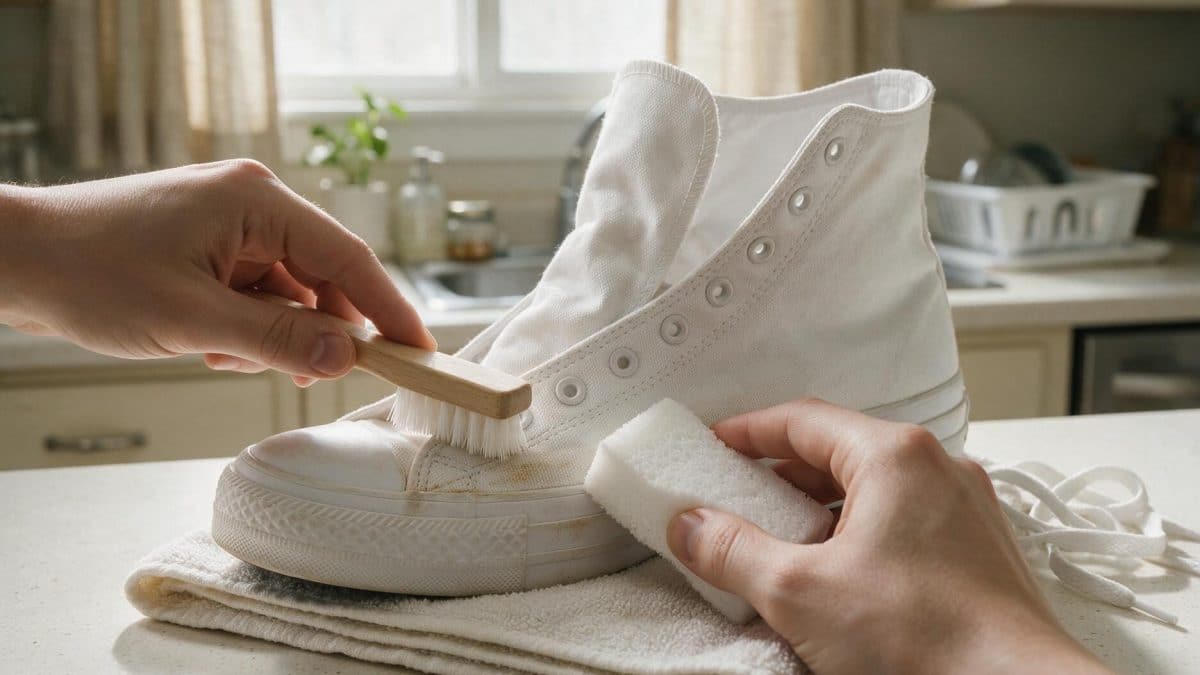
Dry dirt flakes away; wet dirt goes into the weave and stays. Brush the whole canvas out, then take the melamine sponge to the toe cap and the foxing stripe while the rubber is still dry. Keep it off the canvas and off the printed heel patch — melamine foam works by abrasion, and on a printed panel it takes the print with the mark.
Bag the shoes and load the towels in with them
One pair per bag, the bag closed, and the towels in around it. Two pairs is the sensible ceiling in a domestic drum. Shoes are dense and they hit hard, and repeated unballasted loads are what wears drum bearings and door seals.
Run it cold and delicate, on the lowest spin the machine offers
Liquid detergent, no bleach, no fabric softener, no additive sold as a whitener. If the machine will let you skip the spin altogether, skip it: the shoes come out heavier and drip for an hour, and that hour is cheaper than the alternative.
Stuff them and start the drying immediately
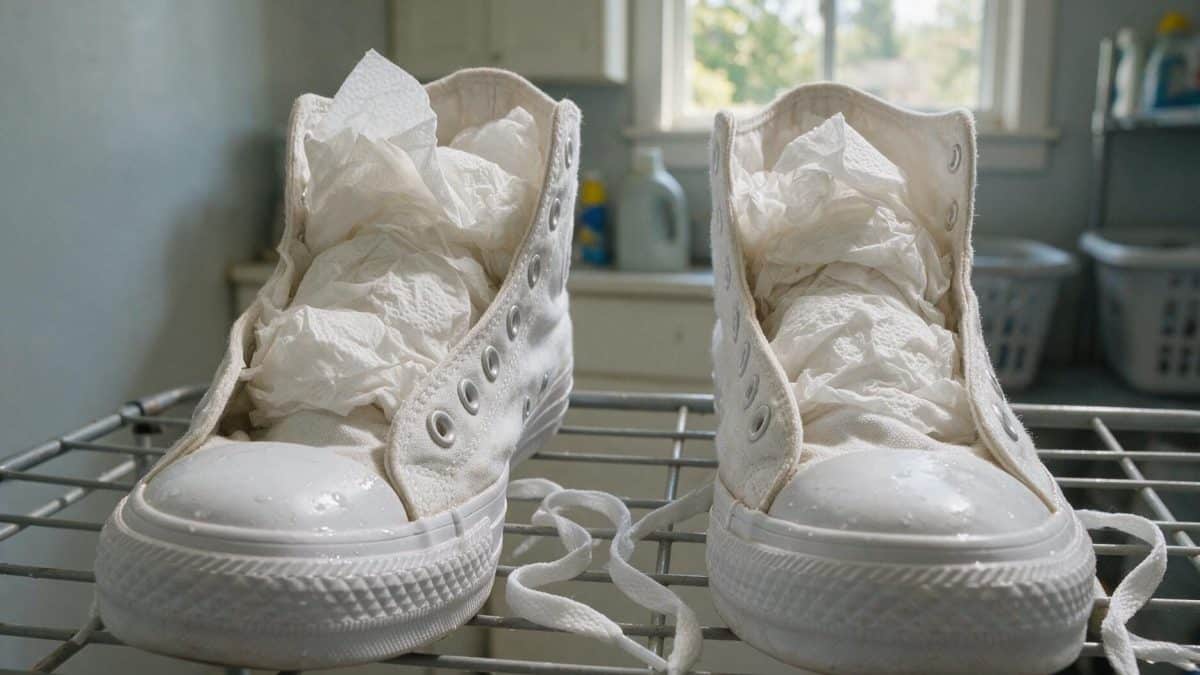
Paper towel packed into the toe and up the shaft, changed once after the first few hours. Stand them somewhere with moving air at room temperature. Getting this started straight away also gets the metal eyelets out of soaking canvas, which is the cheapest reason not to leave a wet pair sitting in the machine overnight.
Re-lace only when they are bone dry
Bone dry means the inside of the toe, not the outside of the canvas. A Chuck feels dry on the surface long before the layers under the footbed are, and lacing a damp pair up and wearing them is how the smell you were trying to remove comes straight back.
Not every Converse is a canvas Converse
The word “Converse” covers half a dozen uppers, and the maker’s own care page treats them separately. The question is only ever about the canvas ones.
| Upper | The maker’s instruction | Survives a cold cycle |
|---|---|---|
| Cotton canvas, classic All Star | Damp cloth, lukewarm water, mild soap. Do not machine wash or dry | Usually |
| Cotton canvas, Chuck 70 | The same line. The canvas is heavier at 12 oz and holds its shape better wet | Usually |
| Leather and synthetic leather | Damp cloth, lukewarm water, mild soap. Do not machine wash or dry | No |
| Suede | Brush away dirt with a suede brush, when dry. Do not use water | No |
| Glitter, foil and printed panels | Not addressed separately. The finish sits on the canvas rather than in it | No |
Suede is the one people get wrong most often, because a suede Chuck looks like a canvas Chuck from three feet away and the sole is identical. Water alone flattens and stains the nap, and there is no washing it back up. That case is covered separately in can you machine wash suede.
The dryer is what actually ends them
The common worry is that a dryer will melt the rubber. It will not, and that is the wrong thing to be afraid of: the sole was cured in an oven hotter than any domestic dryer runs. What a dryer does is worse and less obvious.
It sets the shape. A Chuck has no rigid toe box and only a soft heel counter, and a wet one collapses. Drying it fast, with nothing inside holding it open, fixes whatever shape it collapsed into. It also holds the rubber at temperature for the length of a cycle, and heat is what accelerates the oxidation that yellows white rubber: the same slow reaction that turns a shelf-stored pair yellow over years, run at speed. If the pair is a Chuck 70, its OrthoLite sockliner is open-cell polyurethane foam, which is another good reason to take it out and wash it by hand rather than cook it. And a pair of high-tops thrown against a steel drum for an hour is hard on the drum and the door glass as well as on the shoes.
You will also read that hot water shrinks the canvas against a sole that cannot shrink with it. That is mechanically plausible, and the published figures point at the drying rather than the water. Canvas suppliers put untreated cotton duck at roughly eight to fifteen per cent when it is washed and then dried hot, and at three to five per cent once it has been preshrunk. One direct comparison of untreated duck found about three per cent in length and one per cent in width whether the water was room temperature or boiling, so long as it was left to air dry. None of those numbers were measured on a shoe, where the canvas has already been cut, sewn, lasted and bonded to rubber, so read them as a direction rather than as a figure for your pair. Cold water and a slow air dry keep you at the bottom of every one of those ranges.
Put Converse in a tumble dryer, on a radiator, over a heater vent or in direct sun to speed the drying up. Converse’s own drying line is one sentence long: dry at room temperature, stuff with paper, and to prolong the life do not apply direct heat. A yellowed rubber toe cap and a shoe that dried into the wrong shape are not stains. Neither of them comes out.
Why white Converse come out of the wash yellow
Four different things get called yellowing, and only one of them is reversible. Working out which one you are looking at decides whether there is anything to do.
| What went yellow | What actually happened | Recoverable |
|---|---|---|
| The canvas, in patches or rings | Detergent that never fully rinsed out travelled to the edge of the drying front and dried there. Classic tide marks | Usually |
| The canvas, evenly, after bleach | Chlorine reacted with the optical brighteners built into the white canvas and destroyed them. The yellow is what was underneath all along | No |
| The rubber toe cap and foxing | Oxidation of the rubber itself, accelerated by heat and UV. A surface layer, but a chemical change rather than a deposit | Only at the surface |
| Everything, in comparison | Rubber oxidises on a shelf too. A wash makes old yellowing visible by putting fresh-clean canvas next to it | No |
Only the first is worth chasing, and the fix is another rinse in clean water with no detergent at all, then a slower dry in shade. For the second, there is nothing: the brighteners are gone and no amount of washing brings a fluorescent additive back. For the third, a melamine sponge takes off the outermost oxidised layer of rubber and buys back some brightness, at the cost of a little rubber each time.
Related guides
- If the pair is white and you want the maker-approved hand method rather than the machine, that is a different set of steps. See how to clean white converse.
- Other shoes answer this question differently depending on how the sole is attached. See can you machine wash shoes, and the full drum method in how to clean shoes in the washing machine.
- If the drying is really what you wanted to know about, the damage starts at a specific point. See how to dry shoes in the dryer.
- If you are washing them because of the smell, the wash is not the fix and it will come back. See how to clean smelly shoes.
Questions
Does machine washing Converse void the warranty?
Converse’s stated cover is for a workmanship or material flaw, and for converse.com purchases it will look at flawed shoes bought less than two years earlier. Damage is a different category from a flaw. Since the company publishes “DO NOT MACHINE WASH OR DRY” in its own care instructions, a sole that lifted after a wash cycle is going to be assessed against that sentence. Assume you are on your own.
What temperature should I wash Converse at?
The only temperature Converse states anywhere is “lukewarm”, and that is for a damp cloth rather than a machine. If you are using one anyway, use the coldest setting it has. There is nothing a warm cycle lifts out of canvas that a cold cycle and five minutes of dry brushing beforehand does not, and every failure mode described here gets worse with heat.
Can I put them in the dryer on the no-heat or air-fluff setting?
The heat is only half of the problem. A no-heat cycle still throws a pair of shoes against a steel drum for the length of a full cycle, and it still dries them faster than a collapsed wet shoe can hold its shape. Stuffed with paper at room temperature for a day or two is slower and it is the only method the maker publishes.
Can I use bleach on white Converse?
No, and this is one of the few hard rules rather than a judgement call. Chlorine bleach reacts with the optical brighteners built into white canvas during manufacturing and decomposes them, and the yellow that appears afterwards is not dirt. Nothing washes it back out. Bleach also weakens cotton, which matters on a shoe held together at the seams.
Are Chuck 70s and platform Converse any different?
Same canvas, same instruction, same answer. The Chuck 70 uses a heavier 12 oz canvas and has more structure to it, so it holds shape marginally better while wet, and its OrthoLite sockliner lifts out, which the glued-in insole of a classic All Star does not. Platform and Lift models put more mass in the sole, which means more energy arriving at the drum wall — bag them and add ballast, or do those by hand.
My Converse still smell after a machine wash. Why?
Because a wash removes what is on the canvas, and the smell lives in the footbed and the lining. Bacteria return within a few wears unless the conditions that produced them change, which usually means drying the shoes fully between wearings and rotating pairs. Washing them again just makes them wet.