Can You Machine Wash Suede? (No — and Water Is Not Why)
Suede survives rain, so a wash cycle looks survivable too. It is not: the drum adds alkaline detergent, sustained agitation and a hard spin to a material held soft by its oils.
Quick answer · care label Suede — split hide, nap raised
-
1 · Wash
Do not wash -
2 · Bleach
No bleach -
3 · Dry
Dry in shade -
4 · Iron
Do not iron -
5 · Pro care
Pro clean P
In one line Never a machine. Brush the dry nap first, lift oily marks with cornflour, and spot-treat what is left with a barely damp cloth, then dry slowly, in shape, away from all heat. Faux suede is a different material and does go in the machine. About 20 minutes hands-on.
If suede can get wet, why can’t it go in the machine?
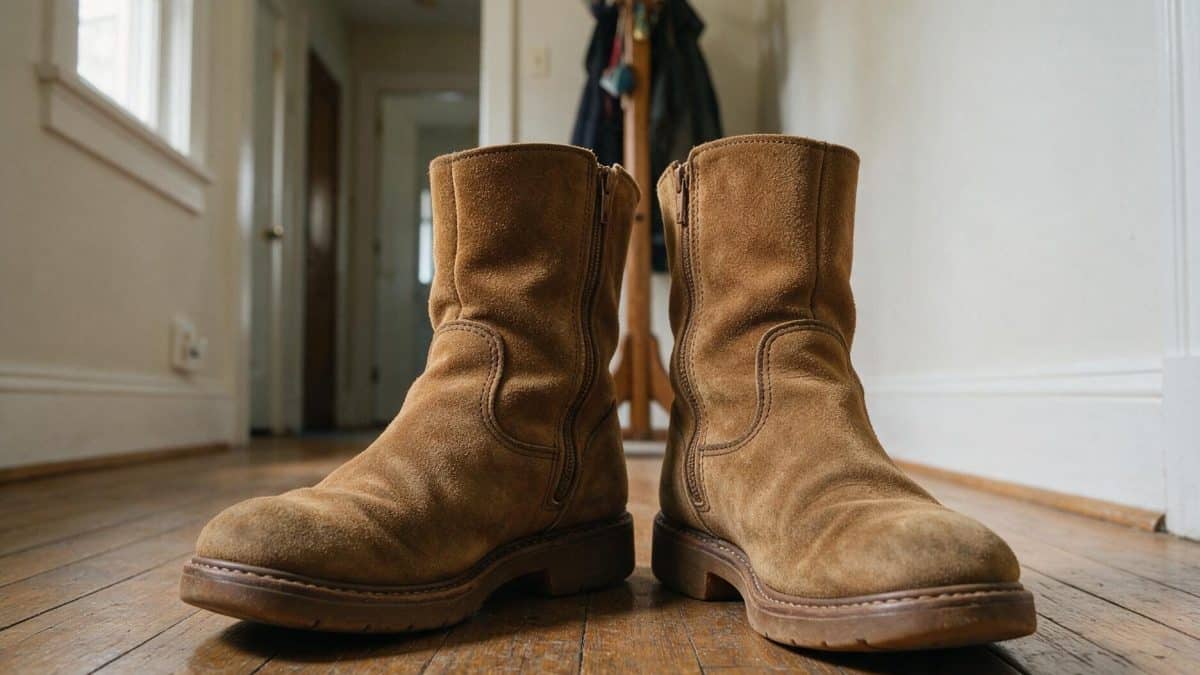
Suede is leather with the nap raised: the flesh side of a split hide, buffed until the cut fibre ends stand up. It is not waterproof and was never meant to be. A suede boot caught in rain dries back to itself, provided it dries slowly, evenly and in shape — that is the argument the general suede method rests on, and it holds.
So the instinct is reasonable: if rain is survivable, a wash cycle is a thorough version of it. It is not. A wash cycle is not water. It is water carrying an alkaline detergent, plus twenty to sixty minutes of drum agitation, plus a spin that wrings the item at several hundred revolutions a minute, plus, usually, a dryer. Water alone attacks none of the things holding suede together. Those four in sequence attack all of them.
The big makers that publish a position say no. Nike’s is unusually blunt: they do not recommend putting suede shoes in the washing machine, or even hand-washing them in soap and water, because suede absorbs water and washing it can set the stain you were trying to remove. UGG’s sheepskin instructions say hand wash only, and not to use a washing machine at all. Which part of the cycle does which damage is the useful question, because it decides what you can still do afterwards.
Water is not what ruins suede. Alkaline detergent, sustained agitation and fast drying are, and a wash cycle delivers all three at once to a material that is chemically a mildly acidic protein held soft by added oils. Any method that keeps those three away can be done at home. Any method that includes even one of them is a gamble.
What you’ll need
| Item | Why | Substitute |
|---|---|---|
| Suede brush | Lifts dry soil out of the nap, and stands the fibres back up afterwards | A clean, dry toothbrush |
| Suede eraser | A crepe rubber block that takes scuffs and dry marks off with no water at all | A white pencil eraser. Not a pink one, which leaves its own mark on pale suede |
| Two clean cloths | One to clean with, one kept for plain water; a loaded cloth puts the soil back | Two folded microfibre cloths, or two sponges |
| Distilled water | Minerals in hard tap water concentrate at the edge of a damp patch and dry as a pale ring | Cooled boiled tap water: not identical, but better than straight from the tap |
| White vinegar or rubbing alcohol | Nike’s own suggestion for a mark the brush and eraser will not shift; both evaporate instead of soaking in | Either works. Test on a hidden seam first |
| Paper towel, or shoe trees | Holds the shape while it dries; damp leather keeps whatever form it dries in | Packing paper. Not newspaper — the ink transfers onto damp suede |
What not to reach for, at any dilution: laundry detergent, washing-up liquid, shampoo, saddle soap. All are built to strip oils, and added oils are the only reason tanned suede is soft.
The method, step by step
Establish which material you actually have
Check the label for “polyester”, “microsuede”, “Ultrasuede”, “Alcantara” or “faux”. If it says any of those, skip to the faux suede section below; the rest of this is for real split leather.
Do everything dry that can be done dry
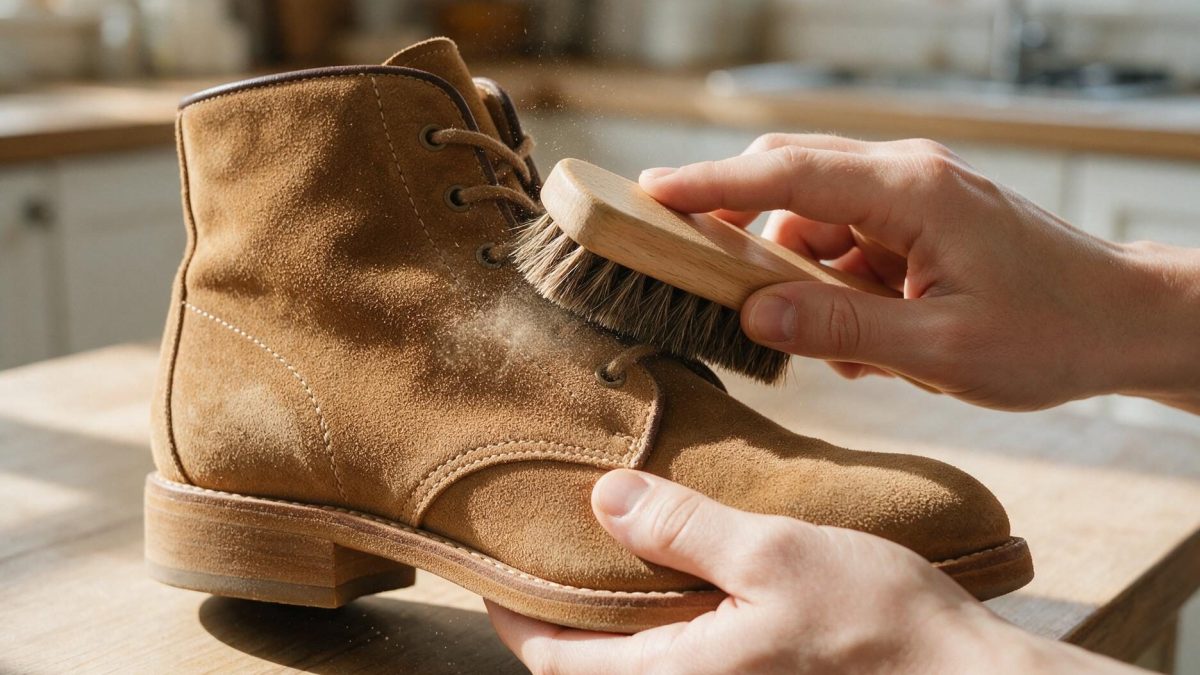
Brush the whole surface in short strokes, one direction, over every panel rather than only the dirty one. Dry soil brushes out, and the same soil turns to mud the second you add water.
Erase what the brush left behind
Work the suede eraser over scuffs and shiny patches with firm, short passes, then brush the crumbs away. A surprising share of suede marks come off entirely here, with no liquid near the hide. An oily mark is the exception: cover it in cornflour and leave it overnight, because the powder draws the oil up out of the nap where the eraser only pushes it around.
Only now add water, and add it to the whole panel
Damp cloth, distilled water, worked evenly across the entire panel until the shade is uniform. Damp, not wet. This is the step people skip, and the one that decides whether you get a tide line: a pale ring forms wherever wet met dry, and it is a drying edge rather than dirt.
Treat the mark by blotting, never rubbing
A little white vinegar or rubbing alcohol on the second cloth, pressed onto the mark and lifted, repeatedly. Rubbing burnishes the fibre ends flat, and that is no longer a stain you can remove.
Stuff it to shape and dry it cool
Pack paper firmly into a shoe, or lay a garment flat with the shoulders supported. Leave it at room temperature, out of sunlight and away from every radiator and heater vent, for a full 24 hours and longer for anything lined.
Brush the nap back up, then re-protect
Once bone dry, brush the whole item again in one direction; the shading evens out as the fibres lift. Then a suede protector spray, held about 15 cm (6 in) away until the surface is evenly damp rather than soaked.
What a wash cycle does that water alone does not
Three mechanisms run at once, and working out which one hit your item tells you whether it can be brought back.
The chemistry. Tanned leather is acidic, though published figures vary with the tannage: leather specialists commonly quote pH 4.5 to 5.5, while the conservation literature puts chrome- and vegetable-tanned hides as low as 3.0. No single number is agreed, but every source lands in the acid range, and above roughly pH 6 tanned leather is described as hardening and going brittle. Laundry detergent is deliberately alkaline, mostly pH 8 to 11. That alkali swells the collagen fibres, loosens the chromium the tannage depends on, and saponifies the fatliquors — the oils worked in at the tannery so the fibres slide past each other instead of gripping. They leave with the rinse water, and there is no putting them back at home.
The mechanics. Suede’s entire surface is standing fibre ends, and forty minutes of tumbling against wet fabric mats and burnishes them. The spin is worse: it creases wet leather under load, and leather sets in whatever shape it dries in. A shoe has a third problem, being a glued assembly rather than a sewn one; see can you machine wash shoes for which constructions survive the drum.
The drying. This one is usually explained wrongly. Wet leather has a hydrothermal shrinkage temperature, the point at which the collagen collapses: in excess of 100 °C (212 °F) for chrome-tanned leather, and typically no higher than about 85 °C (185 °F) for vegetable- and alum-tanned. A domestic tumble dryer reaches neither, running roughly 50 to 55 °C (120 to 130 °F) on low and 60 to 65 °C (140 to 149 °F) on high. So the dryer is not cooking the hide. It is drying a hide whose oils have just been washed out, fast, while flexing it, and the fibre bundles dry stuck together. Worth knowing, because it means a slow cool dry after an accidental wash genuinely helps.
Tumble dry suede, dry it near a radiator or with a hairdryer, or put laundry detergent, dish soap or shampoo on it at any dilution. And never rub a wet mark. Pressure on damp nap flattens the fibre ends permanently, which is a worse problem than the stain you started with.
Faux suede is a different material, and it does go in the machine
A good share of the people asking this question do not own suede at all. Microsuede, Ultrasuede, Alcantara, suedette and anything sold as suede-look are polyester microfibre bound with polyurethane. No collagen, no tannage, no fatliquor to strip, so the argument above stops applying. Three ways to tell them apart:
- The label. “Polyester”, “microsuede”, “Ultrasuede”, “Alcantara” or “faux” settles it on the spot.
- An unfinished edge or an inside seam allowance. Split leather is fibrous and ragged at the cut; faux suede sits on a knitted or woven backing you can see.
- One drop of water somewhere hidden. Real suede takes it straight in and goes dark, then fades back as it dries. Faux suede beads it, or darkens far less.
What the makers publish is specific. Alcantara says removable covers can be machine washed at about 30 °C (86 °F) with a mild detergent, with the spin cycle avoided entirely, then air dried and brushed with a soft-bristle brush; no chlorine bleach, and if ironed, through a white cloth with the iron below 110 °C (230 °F). Toray says Ultrasuede is designed to be machine washable, but points you at the finished article’s own care label first, because it is often combined with linings and trims that are not.
For unbranded faux suede, the safe reading is cold water, gentle cycle, half your usual dose of detergent, an extra rinse, then air drying and a brush to raise the nap. Skip the dryer even here, since heat flattens and glazes the nap, and leave the fabric softener out, since it coats microfibre rather than rinsing away.
Where the advice genuinely splits
There is one real exception to “never machine wash leather”, and naming it is more honest than pretending otherwise. Leather-specific laundry solutions exist — Absorbine’s Leather Therapy is the one that came out of the horse-tack trade — and the published dosing is concrete: 2 to 4 oz in cold water on a small-load setting for lightly soiled smooth leather and suede, or 4 oz on a warm wash with a cold rinse for sheepskin.
These are formulated to sit near leather’s own pH and to leave conditioning behind, which is the opposite of what laundry detergent does. But look at what they are used on: saddle pads, sheepskin girth covers, flat unlined riding gear. The chemistry problem is solved; the agitation and spin problems are not, and no footwear brand endorses this route. For a flat, unlined suede item you would not be heartbroken to lose, it is a defensible gamble. For a shoe, a bag, or a lined suede jacket, it is not one.
If it has already been through the wash
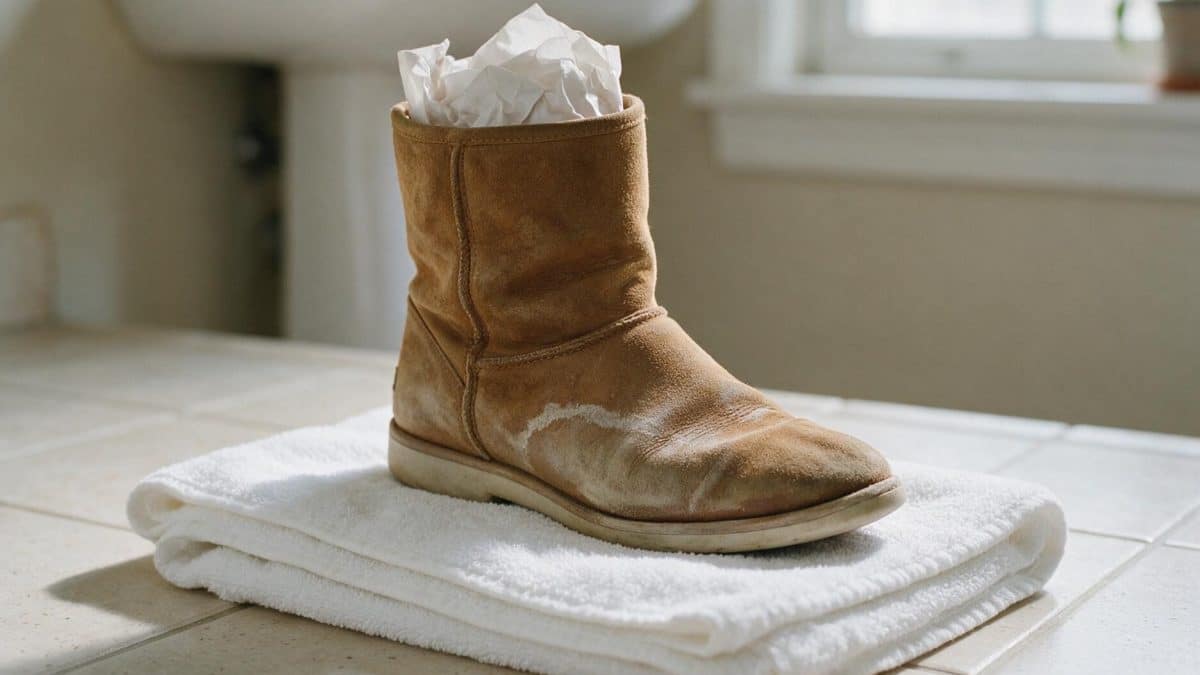
The most useful thing you can do now is slow the drying down. Press the surplus water out against a towel rather than wringing it, pack the item back into its own shape, and leave it somewhere cool and ventilated for a day or two. Then brush it, hard, in one direction. A fair amount of what looks like ruin at the wet stage is flattened nap, and flattened nap comes back.
| What came out | What to do | Recoverable |
|---|---|---|
| Flattened, shiny nap | Dry it fully, then brush firmly in one direction; a suede eraser lifts the worst burnished patches | Usually |
| Pale rings and tide lines | Re-damp the whole panel evenly with distilled water so the old drying edge disappears, then dry it slowly | Yes |
| Board-stiff feel | Once bone dry, flex and roll it repeatedly by hand; a suede conditioner helps a little | Partly at best |
| Faded or blotchy shading | Nothing dependable at home. A specialist re-dye is the only route, and it is priced accordingly | No |
| A tighter, smaller fit | Nothing. The fibre network closed up as it dried, and pulling it back tears rather than opens it | No |
| Sole lifting off the upper | A cobbler’s re-glue. Do not use superglue on a suede upper; it wicks in and sets the nap solid | By a cobbler |
Related guides
- Smooth leather carries a finish coat that suede does not have, which shifts the answer at the edges rather than reversing it. See can you machine wash leather.
- Twinface sheepskin is suede on one face and live wool on the other, so it adds felting to everything here. See how to clean UGG boots.
- For the full dry-first nap method, and how suede differs from nubuck and nappa, see how to clean suede.
- If your item turned out to be microfibre rather than hide, the upholstery version has its own code system. See how to clean a microfiber couch.
Questions
Can you machine wash suede on a delicate cycle?
No, and this is one of the few hard rules rather than a judgement call. A delicate cycle reduces the agitation but does not change the detergent chemistry, which is the part that strips the oils holding the hide soft. The gentle setting makes the outcome less dramatic, not different.
What if I use cold water and a mesh laundry bag?
A mesh bag limits impact damage and cold water avoids adding heat, so both are genuine improvements. Neither addresses the alkaline detergent or the spin. If you are set on trying, the closest thing to a defensible version uses a leather-specific wash solution rather than detergent, on the smallest load, with the spin turned off — and it is still a gamble on a shoe or anything lined.
My suede came out of the wash stiff. Can I soften it again?
Partly, and it depends what stiffened it. If it went hard because it dried too fast, flexing and rolling it by hand once bone dry recovers a fair amount, and a suede conditioner adds a little more. If the fatliquors were stripped out by detergent, home treatment cannot replace them; a leather specialist can re-fatliquor a garment, though the cost often approaches what it is worth.
Can I dry clean suede instead?
Not at an ordinary high-street cleaner. Conventional dry cleaning is built for textiles and takes leather’s oils and surface colour out along with the soil. Suede needs a leather specialist, who cleans, re-oils and re-colours the hide as one job. Ask whether the shop does leather in-house, and expect to pay considerably more than a coat clean.
Is sheepskin the same as suede here?
The suede face behaves identically, but sheepskin adds a second problem. The wool on the other side felts when water, warmth and agitation arrive together, and felting is irreversible: the scales on each fibre hook and stay hooked. That is why boots out of a machine often fit a size smaller and stop being warm.