Can You Machine Wash Polyester? (The Dryer Does the Damage)
Polyester is not harmed by water at any temperature a home machine reaches. It is harmed by heat above roughly 60 °C, and only a tumble dryer on high actually delivers that.
Quick answer · care label Polyester — 100% and blends
-
1 · Wash
Wash 40° -
2 · Bleach
Oxygen bleach -
3 · Dry
Tumble low -
4 · Iron
Iron 110° -
5 · Pro care
Pro clean P
In one line Pretreat oily marks with plain dish soap, cold, then wash at 30 °C on the synthetics or permanent press cycle with liquid detergent and no fabric softener. Take the load out as soon as the drum stops and tumble on low or hang it, because a dryer on high is the only part of the process that can permanently damage the fibre. About 15 minutes hands-on.
Can you machine wash polyester, or does the heat rule it out?
Yes, and polyester is the most forgiving common fibre you can put in a machine. It does not felt like wool, it does not lose strength when wet the way viscose does, and it does not shrink at the temperatures an ordinary wash cycle uses. Nothing in a cycle at 30 °C (86 °F) or 40 °C (104 °F) touches it chemically. If a polyester garment came out of the laundry wrong, the wash is almost certainly not the step that did it.
The confusion is real, though, because polyester does have a heat limit and it is far lower than people expect from a fibre that melts above 250 °C (482 °F). PET, the polyester used in clothing, has a glass transition temperature reported between 67 and 81 °C (153–178 °F); the range is wide because the figure shifts with polymer grade and how hard the filament was drawn. Below that band the fibre is rigid and inert. Above it the chains loosen and the fibre becomes mouldable, taking the shape it is held in and keeping it once cool. That is not a fault. It is heat setting, the same process that gives polyester its permanent pleats.
A washing machine never gets near that band. A tumble dryer on its highest setting runs somewhere around 57 to 71 °C (135–160 °F), so its top end reaches the bottom of that band. That single fact explains most complaints about polyester: creases that will not come out, a shirt that fits differently across the shoulders, a fleece that has gone hard and thin. The damage happened in the dryer, to a garment tumbling in a crumpled ball, and the wash took the blame.
Water does nothing to polyester. Heat does everything. Keep the fabric below roughly 60 °C (140 °F) at every stage — wash, dry, press — and domestic laundry has no mechanism for damaging it. Cross that line while the fabric is folded or bunched, and the shape it happens to be in becomes the shape it keeps.
What you’ll need
| Item | Why | Substitute |
|---|---|---|
| Liquid detergent | Dissolves in cool water and lifts body oil off a fibre that will not absorb water | Powder, but only above 30 °C; colder than that it can leave undissolved grit |
| Mesh laundry bag | Cuts the drum abrasion behind both pilling and fibre shedding | A pillowcase knotted shut at the open end |
| Plain dish soap | Degreases oily marks, which polyester grips harder than cotton does | A solvent-based prewash stain spray |
| White vinegar | In the rinse, strips built-up softener film and cuts trapped smell | A second plain rinse: weaker, but it does no harm |
| Oxygen bleach | Whitens polyester without the yellowing chlorine causes | 3% hydrogen peroxide, on whites only |
| Steamer, or an iron on one dot | Releases creases below the point where new ones set | A hanger in a steamy bathroom, for light creasing |
The method, step by step
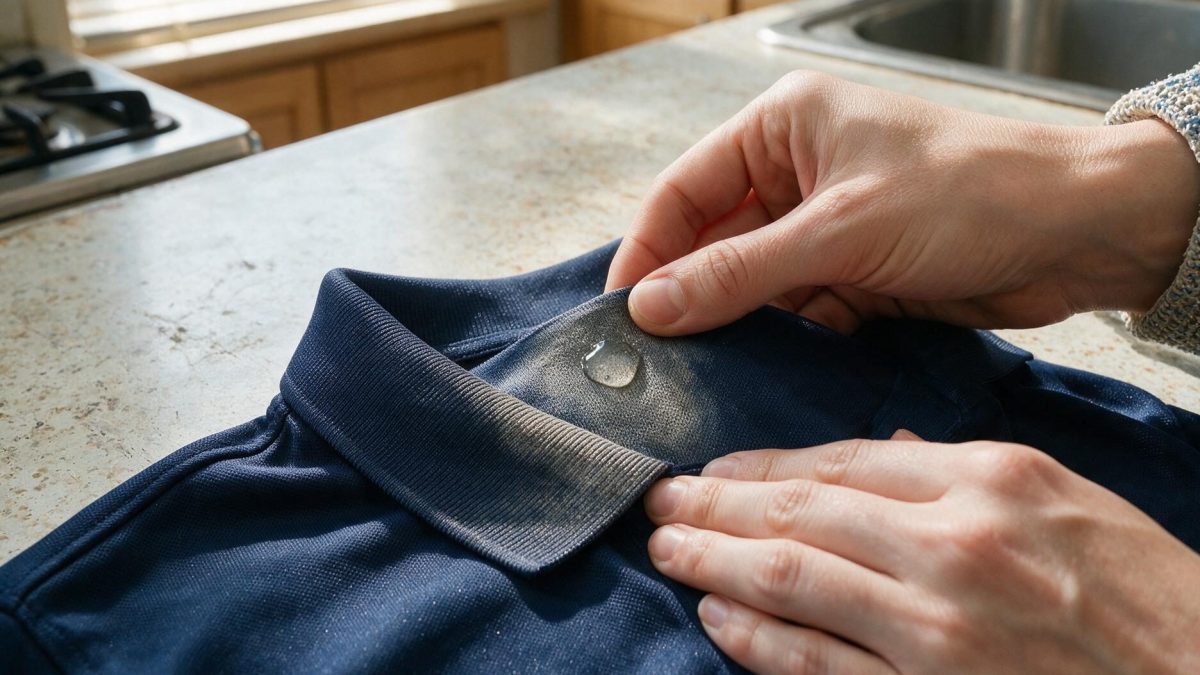
Turn it inside out and look for oily marks
Check collars, cuffs and underarms in daylight. Body oil on polyester is near invisible while the fabric is dry, and darkens with every warm wash until it reads as a grey shadow that will not shift.
Work dish soap into any oily mark, cold
A drop rubbed in with a fingertip, left ten minutes. Do not run hot water over the mark first: warmth helps oil diffuse further into the fibre, and once inside, detergent in the wash water has little chance of reaching it.
Bag anything that pills or sheds
Fleece, microfibre, printed tees and anything with a raised pile go in the mesh bag. It does nothing about heat; it reduces the fabric-on-fabric rubbing that lifts fibre ends to the surface.
Wash at 30 °C on the synthetics or permanent press cycle
The cycle matters more than the number. Permanent press pairs the wash with a cool rinse and a slower final spin, so the fabric is never spun hard while still warm. Most labels allow 40 °C and it does no harm, but 30 °C is the better default: a University of Leeds and Procter & Gamble study found a 30-minute cycle at 25 °C released up to 52% fewer microfibres and 74% less dye than 85 minutes at 40 °C.
Leave the fabric softener out
This is not a preference. Softeners deposit a waxy layer of cationic surfactants. On an absorbent fibre it works loose over time; on polyester it clings to a surface water barely wets, and builds up. The film dulls ordinary polyester and traps smell; on anything sold as moisture-wicking it closes the channels the fabric works by.
Take the load out as soon as the drum stops
Warm polyester left in a heap cools into the creases it is lying in. Ten minutes matters more here than with cotton.
Tumble on low, or hang it
Medium runs roughly 46 °C to 57 °C (115–135 °F) and low is cooler still, around 38 °C to 52 °C (100–125 °F); both stay clear of the softening band. High runs 57 °C to 71 °C (135–160 °F), and its top end is inside it. Polyester barely holds water, so it dries fast either way; pull it out slightly damp and let it finish on a hanger.
Steam creases out rather than pressing them flat
Steam relaxes a set crease without adding the pressure that creates a new one. If you use an iron, use the one-dot setting, around 110 °C (230 °F), with a pressing cloth between the plate and the fabric.
The dryer is where polyester gets ruined
Almost every irreversible thing that happens to a polyester garment happens in the twenty minutes after it leaves the washing machine. A dryer on its hottest setting reaches into the low end of the softening band, and it does so while the garment is folded over itself and tumbling. Whatever creases are in the fabric at that moment get set the way a factory would set them, and rewashing does not take them out.
Shrinkage is where published sources genuinely disagree. Tests of 100% polyester washed hot and dried on high report roughly 1.5% to 3%. Other sources put it at 5% to 10% above 60 °C (140 °F). The spread probably reflects how tightly the fabric was heat-set in manufacture: one already set hard has little left to give, a loose knit has more. Every source agrees on the direction and the threshold, which is the part you need.
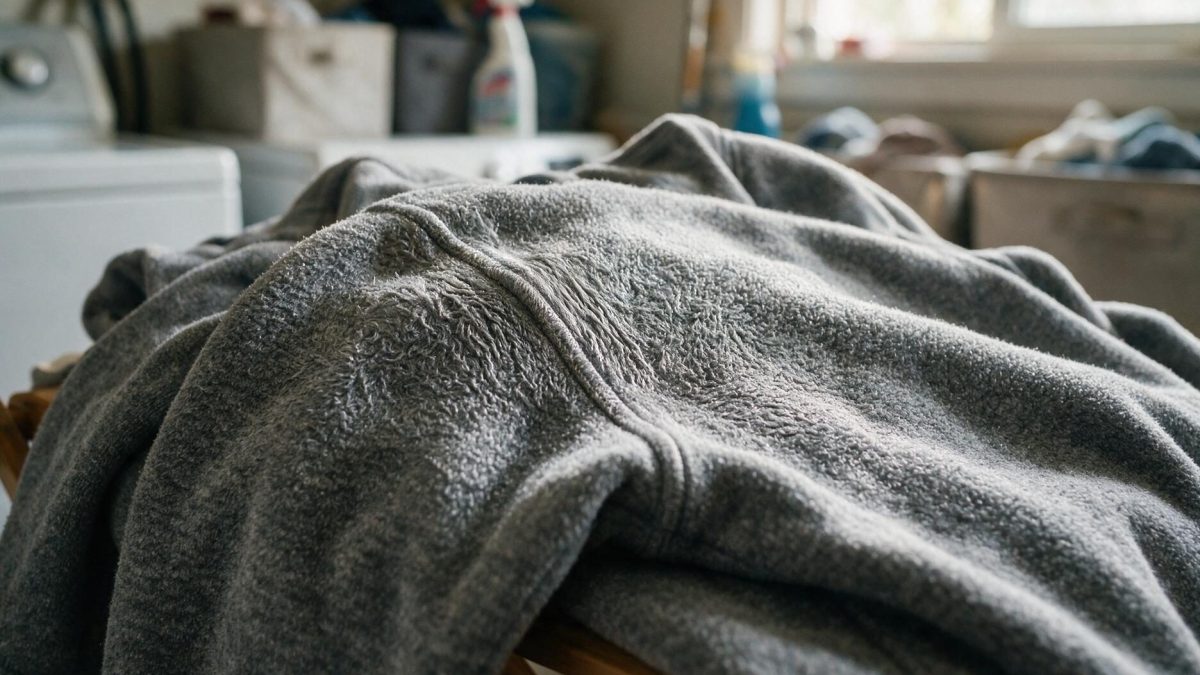
Fleece has its own version of this. The pile mats and hardens, and while some of that is heat, most is abrasion: fibre ends flattened and tangled by tumbling against themselves. A fleece dried on a rack keeps its loft years longer than the same fleece dried on high twice a week.
Why clean polyester still smells
A polyester shirt can come out of the machine smelling of nothing, then smell bad again twenty minutes into being worn. That is not a failure of the detergent. It is the fibre.
Polyester is hydrophobic, which is what makes it dry so fast, and oleophilic, which is what makes it absorb sebum from skin. Sebum is exactly what odour-forming bacteria feed on, and its fatty fraction is hard to wash out of a fibre that water does not readily wet. Microbiology work on shirts worn for a gym session found Micrococcus species selectively enriched on the polyester ones, while Staphylococcus hominis showed up only on the cotton. Worse, the carboxylic acids that carry the smell are not removed from polyester as effectively as from cotton, so they build up across the first several wear-and-wash cycles instead of starting from nothing each time. Measured build-up levels off after about five cycles, but it levels off at a residue the shirt keeps.
The fix is not a hotter wash. It is liquid detergent rather than powder, no softener at any point, a cup of white vinegar in the rinse to strip the film already there, and an occasional long soak in oxygen bleach. Then dry it promptly, because damp polyester is where the next round starts. The same mechanism drives the synthetic linings inside footwear, covered in how to clean smelly shoes.
Which stains come out of polyester
Polyester’s stain behaviour is the mirror image of cotton’s. Water-based spills sit on the surface and rinse away, because the fibre will not absorb them. Anything oily goes straight in and stays. That split decides which marks are worth working on; for the wider framework, see how to clean stains from clothes.
| Stain | Treatment | Recoverable |
|---|---|---|
| Coffee, tea, wine, juice | Cold rinse at once, then oxygen bleach if a tint remains. The fibre does not absorb liquid, so most of it never gets in | Yes |
| Collar and cuff grime | Dish soap worked in cold, before any warm wash. Repeat rather than raise the temperature | Yes |
| Cooking oil, salad dressing | The same, but expect two or three passes. One application rarely finishes an oil stain here | Yes |
| Yellowing on white polyester | A long oxygen bleach soak, several hours. Chlorine bleach makes this one worse, not better | Yes |
| Dye transfer from another garment | Nothing at home. Disperse dyes migrate into the fibre rather than sitting on it — that is how polyester is dyed | No |
| Iron glazing, a shiny flat patch | Nothing. The surface has been melted smooth, and smooth reflects light differently from textured | No |
Blends change the answer
Almost nothing sold as polyester is only polyester, and in a blend the rule is simple: obey the weakest fibre, not the strongest. Polyester is nearly always the tough half, so it rarely sets the limit. Recycled polyester is not an exception: rPET is the same fibre chemically, and needs nothing different.
| Blend | What changes |
|---|---|
| Polyester and cotton | Wash to the cotton’s tolerance, dry to the polyester’s. Cotton is the half that shrinks in water; polyester is the half that sets in heat |
| Polyester and elastane | Elastane fails first and fails quietly, going slack rather than breaking. Cool wash, no hot dryer, and softener kills the stretch fastest of all |
| Polyester and wool | The wool sets the rule: cold, minimal agitation, no tumble drying. Polyester content does not prevent felting |
| Polyester fleece | Same fibre, but the pile is the weak point. Inside out, gentle cycle, air dry. Matting is abrasion, not heat |
| Solution-dyed polyester | Pigment added to the molten polymer, not to finished cloth, so it takes sun and cleaning agents that would fade ordinary polyester. The cheaper of the two fibres used for outdoor cushions; solution-dyed acrylic is the commoner one |
Related guides
- Wool fails by a mechanism polyester does not have: heat and agitation together lock the scales shut, and felting never reverses. Can you machine wash wool.
- Microfibre is polyester at its most extreme, split into filaments so fine that softener film ruins it faster than anything else. How to clean microfiber cloths.
- Silk is a protein fibre, so its limits are chemical rather than thermal, and the rules barely overlap. Can you machine wash silk.
- Antiperspirant residue behaves worse on polyester activewear than on cotton, for the same oil-absorption reason. How to clean deodorant stains from shirts.
Questions
Can you wash polyester in hot water?
You can, but there is no benefit worth the risk. Most polyester labels give 40 °C (104 °F) as the ceiling, and 60 °C (140 °F) is where reported shrinkage begins. Hot water does not clean polyester better either, because the soil that clings to it is oily and needs a degreaser rather than heat.
Does polyester shrink in the dryer?
On low or medium, effectively no. On high, yes. Published figures disagree on how much: tests of a hot wash plus a high-heat dry report roughly 1.5% to 3%, while other sources quote 5% to 10% above 60 °C. Everyone agrees the change is permanent.
Can you bleach polyester?
Oxygen bleach, yes. Chlorine bleach, no. Sodium hypochlorite tends to leave polyester a yellowish tint rather than whitening it, and repeated exposure makes the fibre brittle. Sodium percarbonate, sold as oxygen bleach, is the right product for whitening and for deep deodorising.
Can polyester be dry cleaned?
Yes. The fibre is unaffected by standard dry-cleaning solvents, and where a polyester garment carries a professional-cleaning symbol at all it is usually the P. It is simply almost never necessary. The exception is a garment with a coating, a printed transfer or glued seams, where the solvent attacks the finish rather than the fabric.
Why does polyester pill so badly?
Because the fibre is too strong to let go. Abrasion pulls fibre ends to the surface on every fabric, but on cotton the resulting pills snap off and disappear. Polyester’s flex strength holds them attached, so they accumulate. A mesh bag and a gentle cycle slow it down; nothing reverses it.