Can You Machine Wash Velvet? (It Depends What the Pile Is Made Of)
Velvet is a weave, not a fibre. Polyester and most cotton velvet take a cold delicate cycle with the spin held low; silk and viscose velvet crush and water-mark permanently.
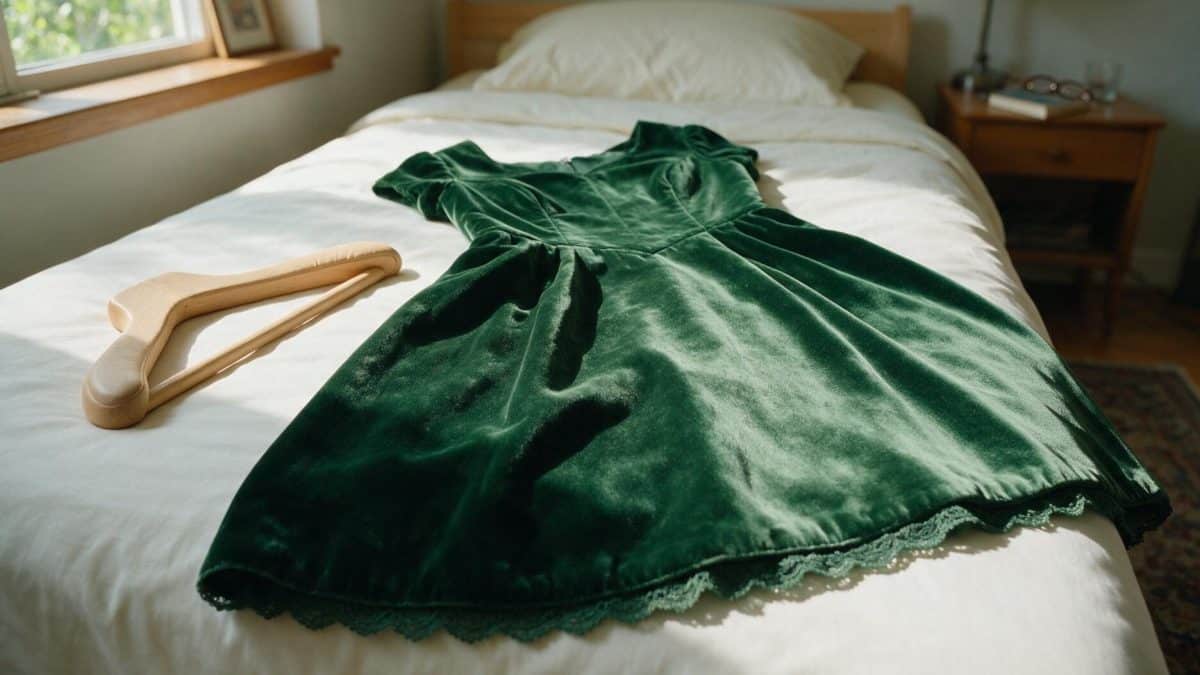
Quick answer · care label Velvet — pile weave
-
1 · Wash
Wash 30° gentle -
2 · Bleach
No bleach -
3 · Dry
Line dry -
4 · Iron
Do not iron -
5 · Pro care
Pro clean P
In one line Read the composition line, not the word velvet: polyester and most cotton velvet wash, while silk and viscose velvet do not. Wash inside out in a mesh bag, cold or 30 °C (86 °F) on delicates, with the spin at 400–600 rpm or lower, then hang it up wet and let it air dry with no heat anywhere near it. Steam from the reverse and brush with the nap to lift the pile again — about 25 minutes hands-on.
Can you machine wash velvet, or does the pile rule that out?
Some velvet, yes. The word that decides it is not “velvet” — velvet is a weave, not a fibre. It is usually made by weaving two cloths face to face with threads running between them, then slitting them apart so each comes away carrying a dense field of cut fibre ends standing upright. Those ends are the pile, and they can be polyester, cotton, viscose or silk. Polyester velvet and most cotton velvet come through a cold or 30 °C (86 °F) delicate cycle intact. Silk velvet and viscose velvet do not, and no setting on the dial changes that.
The failure people expect from a machine is shrinkage. The failure they actually get is crushing. Velvet only looks like velvet because thousands of upright fibre ends catch the light at their tips; press them over and they reflect from their sides instead, and that patch reads as a different shade of the same cloth. A machine does this three ways: friction in the drum, the spin pressing sodden fabric against the drum wall, and heat in the dryer afterwards. Only the last is reliably permanent, which is why the drying instruction here is stricter than the washing one.
The second failure mode belongs to two fibres in particular. Viscose and silk pile mark where water touches them, and what you are left with is the outline of the wet patch rather than the stain that caused it. This is why velvet advice reads as contradictory: a page about polyester cushion covers and a page about a silk velvet dress are describing different materials that share a name on the swing tag. Even on cotton velvet the published advice splits, with appliance makers allowing a gentle cycle where the care tag does and textile houses preferring a basin. Both are defensible. The difference is how much you mind if the pile takes a fortnight to stand back up.
Water is not what ruins velvet. Pressure is, and heat sets it. Every instruction below exists to keep weight, friction and warmth off the pile while it is wet, and to let the fibre ends stand up again before anything touches them.
What you’ll need
| Item | Why | Substitute |
|---|---|---|
| Mesh laundry bag | Keeps the pile off the drum and off the zips and buttons of everything else in the load | A pillowcase with the open end knotted, not pinned |
| Mild liquid detergent | A delicates or wool wash with no bleaching agents and no strong enzymes; liquid because powder settles in the grooves between the tufts and dries white | A quarter dose of ordinary liquid detergent, dissolved in water before it goes in |
| Soft-bristled garment brush | Lifts and separates the pile before the wash and again once it is dry; this is the step you can see the result of | A clean, soft baby brush, or a soft toothbrush for cuffs and collars |
| Handheld steamer | Relaxes crushed fibre ends without anything touching the surface | A steam iron held upright and well clear of the fabric, or a bathroom filled with shower steam |
| Wide padded hanger | Spreads the weight of a wet garment so the shoulders do not dent the pile as it dries | A wooden hanger with a rolled hand towel taped around each arm |
| White cotton cloth | The dye test, and afterwards the only safe way to blot a spill | A plain white pillowcase or handkerchief |
The method, step by step
Read the pile fibre, not the word velvet
Find the composition line on the label. Polyester, cotton, or a mix of those two: carry on. Silk, viscose, rayon or acetate: stop, and treat the garment as a dry-clean item. Two fibres listed usually means the pile is one and the ground weave the other, and the weaker of the two sets the cycle.
Test water and dye on a hidden patch
Put one drop of water inside a hem and let it dry on its own, then press a damp white cloth against a seam allowance for thirty seconds. A ring at the edge of the dried drop means this fabric records the boundary of every wet patch, so spot cleaning is out for good. Colour on the cloth means the dye is loose and the garment goes to a cleaner.
Brush the dry pile and shake the grit out
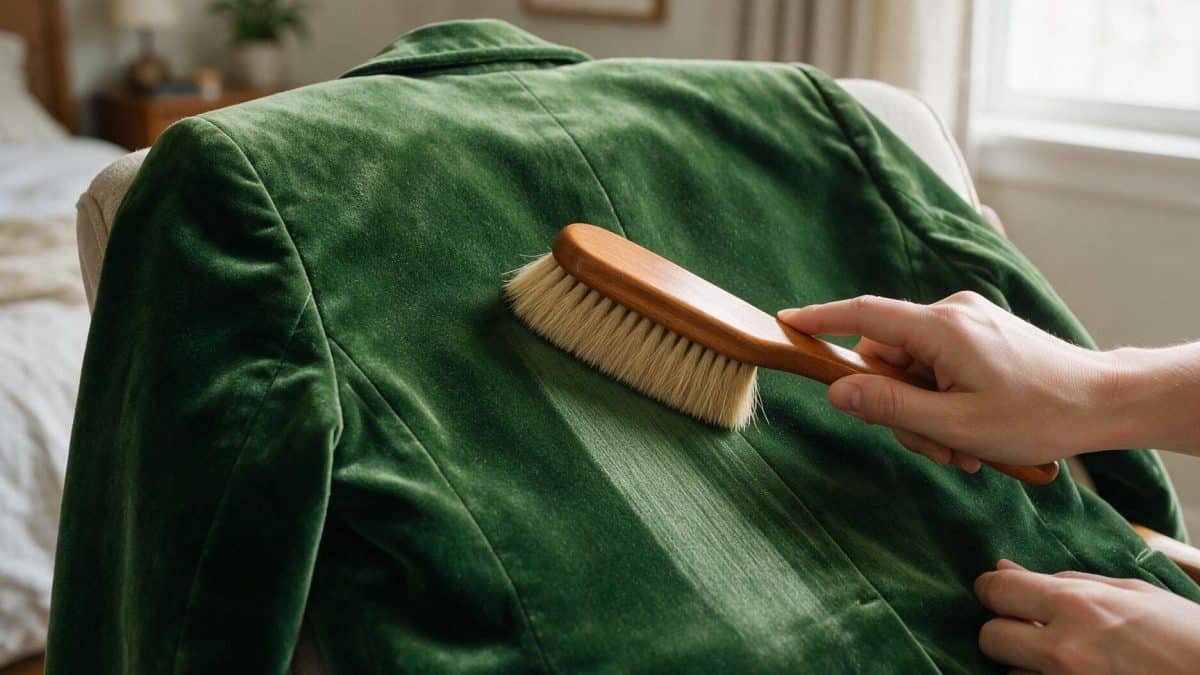
Brush in one direction only, the way the pile lies flat and looks darker. Grit left at the base of the pile turns into an abrasive the moment the fabric is wet and heavy, and that is a slow way of cutting the tufts off at the root.
Turn it inside out and bag it alone
Fasten every zip and hook first, turn the garment through, and put it in the mesh bag with nothing else. Velvet washes with velvet or by itself. Anything with a hard edge in the same drum leaves a shine on the pile where it rubbed.
Run it cold, or 30 °C at the very warmest
Delicates or hand-wash programme, mild liquid detergent, no fabric softener — softener films the pile and dulls exactly the light-catching the fabric is bought for. Cotton velvet technically tolerates 40 °C (104 °F), but the extra heat buys nothing and adds shrinkage in the ground weave.
Hold the spin down
This is the setting that decides how the garment looks afterwards. Published guidance for velvet caps the spin at 400 to 600 rpm, and lower is better. A full-speed spin holds saturated pile pressed against the drum wall for minutes at a stretch, which is the exact combination — pressure, on wet fibre, held still — that leaves a mark you cannot brush out.
Shake it out and hang it up wet
Lift the garment as a bundle, give it two firm shakes to open the pile, and hang it on the padded hanger. Do not wring it and do not roll it in a towel; both are pressure on wet pile. Keep it out of direct sun and away from a radiator.
Steam from the back, then brush with the nap
Once it is dry, turn it inside out and pass the steamer over the reverse at a distance — published advice for velvet says at least 15 cm (6 in), and never in contact. The steam travels through the ground weave and pushes the tufts upright from beneath. Brush lightly with the nap while the fabric is still warm, then leave it hanging for an hour.
Velvet is a weave, and the fibre underneath changes everything
Almost every argument about washing velvet is really an argument about which velvet. The construction is the same in each case, cut tufts standing off a woven or knitted ground, but the fibre those tufts are made of decides whether water is a nuisance or the end of the garment.
| On the label | What it is | What changes for the wash |
|---|---|---|
| Polyester velvet | The commonest modern velvet by a wide margin: dresses, cushion covers, curtains | The method above, unmodified. Water is a non-event here. Heat is the whole risk |
| Velour | Pile on a knitted rather than woven ground, so it stretches; usually cotton or polyester | Washes like its fibre, but support it wet — a knitted ground grows under the weight of water |
| Cotton velvet and velveteen | Cotton pile on a cotton ground; velveteen’s pile is shorter and runs across the cloth rather than along it | Cold and gentle where the tag allows it. Shrinkage in the ground weave is real, and the pile is slower to recover than a synthetic one |
| Viscose or rayon velvet | The affordable stand-in for silk velvet, and the one most often mistaken for it | Not a machine fabric. Viscose loses much of its strength wet, and clear water alone leaves rings that are often permanent |
| Silk velvet | Silk pile, frequently on a viscose ground, so the ground weave is often the more water-sensitive half | Hand wash cold at the very most, or dry clean. A machine crushes silk pile irreversibly |
| Crushed velvet and panne | Pile deliberately flattened at the mill: crushed in random directions, panne all one way. Panne is usually polyester or rayon on a knitted back rather than silk | Hides new crush marks better than any other velvet, but the fibre underneath still sets the cycle |
What crushing is, and when it comes back
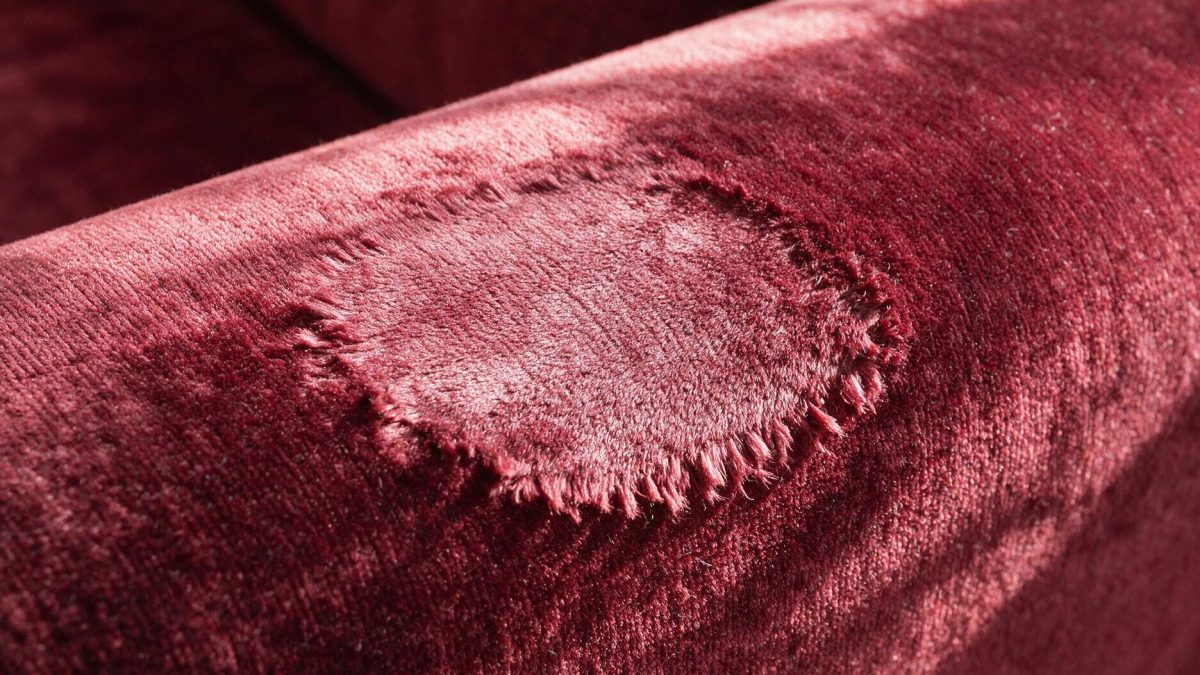
The trade calls a flattened patch bruising, shading or a pressure mark, and upholstery houses are clear that it is normal behaviour rather than a fault: velvet marks where it has been sat on, folded or leaned against. Most of that recovers on its own, given time and ordinary household humidity, and light steam followed by a brush worked with the nap speeds it up considerably. A suitcase crease will almost certainly go.
Two kinds of crushing do not come back, and both are made in the laundry rather than in the wardrobe. The first is pile pressed flat while it is wet and then left to dry that way, which is what a hard spin, a wringing hand or a folded wet garment produces. The second belongs to polyester, and it explains the strictest rule on this page. Polyester is thermoplastic: published figures put its glass transition between about 67 and 81 °C depending on how crystalline the fibre is, commonly quoted as 70 to 80 °C, and above that range the fibre softens and then re-sets in whatever shape it cooled in. Care labelling standards allow a tumble dryer on the low setting to reach 60 °C (140 °F) at the exhaust and on the normal setting 80 °C (176 °F). Low sits just under the softening range. Normal sits inside it. A polyester velvet that goes round a hot drum comes out with its crushing set into the fibre, and no amount of steaming afterwards lifts it.
Iron velvet. Not on low, not through a pressing cloth, and not from the lining side — ironing the lining presses the face of the garment into the board, which crushes the pile as thoroughly as ironing it directly. The shine an iron leaves is not something sitting on the surface to be lifted off; it is the tufts folded into the ground weave and, on a synthetic velvet, softened by the heat and set in that position. Steam held away from the cloth does everything an iron would have been for.
| Mark | Treatment | Recoverable |
|---|---|---|
| Crush from packing or sitting | Leave it a few days first, then steam from the reverse and brush with the nap | Usually |
| Water splash on cotton or polyester velvet | Let it dry completely untouched, then steam and brush. Dabbing it while wet makes it worse | Usually |
| Water ring on viscose or silk velvet | Nothing at home. More water puts a second ring outside the first; a specialist treats the whole panel evenly or not at all | Rarely |
| Dried mud on cotton velvet | Let it go hard, break it off, brush the residue out with the nap, then wash | Usually |
| Oil or grease | Absorbent powder pressed on dry and left for several hours, brushed out with the nap, then a cold wash if the fibre allows one | Often |
| Shine left by an iron | Nothing. The tufts have been folded and set flat against the ground weave | No |
Cushion covers, curtains and upholstery are a different question
Velvet in the house is usually not garment velvet. Furnishing weights are heavier and often backed, and a blackout curtain or a latex-backed upholstery cloth cannot be submerged without the backing lifting away from the face. Look for the upholstery cleaning code on the cushion tag first: W allows water-based cleaning, S means solvent only, W/S means either, X means neither. Anything marked S or X is not a washing machine case, whatever the pile is made of.
A W-coded cover has a problem the garment does not: it has to go back on. Two or three per cent of shrinkage in the ground weave leaves a cover that still looks perfect and no longer stretches over the foam. Wash cold, refit while slightly damp, and do the whole set together so any shrinkage is even. A fixed velvet sofa is vacuuming with the nap and spot treatment only, on the same logic as how to clean a fabric couch; for scatter cushions, how to clean throw pillows covers the insert too.
Related guides
Velvet borrows its problems from whatever the pile is made of, so the fibre guides carry the detail:
- The fibre behind most “silk-look” velvet, and the reason its water rings are permanent rather than merely annoying. See can you machine wash viscose.
- Real silk velvet is the case where hand washing is the ceiling rather than the cautious option. See can you machine wash silk.
- Polyester velvet washes like any polyester and fails like any polyester, which is to say in the dryer. See can you machine wash polyester.
- If the dye test failed or the label rules the machine out, the basin method applies, minus the wringing step. See how to clean clothes by hand.
Questions
Can velvet go in the washing machine at all?
Polyester velvet and most cotton velvet can, on a cold or 30 °C (86 °F) delicate cycle, inside out, in a mesh bag, with the spin held low. Silk velvet and viscose or rayon velvet cannot, because the pile crushes irreversibly and the fibres mark where water touches them. Read the composition line rather than the word velvet, and read the care tag before either.
What temperature and spin speed should I use for velvet?
Cold, or 30 °C (86 °F) at the warmest. Published guidance caps the spin at 400 to 600 rpm and lower is better still; if the machine lets you switch the spin off completely, do that and hang the garment up dripping. The temperature protects the ground weave from shrinking. The spin speed protects the pile, and it is the setting that shows in the result.
Can you tumble dry velvet?
Not with heat, and this is one of the few hard rules rather than a judgement call. Polyester softens somewhere around 70 to 80 °C, and a dryer on its normal setting is allowed to reach 80 °C (176 °F), so whatever shape the pile is tumbling in becomes the shape it keeps. Some manufacturers do permit a no-heat air or fluff cycle to lift the pile after washing, which is a different thing from drying it. Hang it up wet and let it dry in air.
My velvet came out flat and dull. Can I fix it?
Often, if no heat was involved. Hang it in a steamy bathroom, or pass a steamer over the reverse side from at least 15 cm (6 in) away, then brush lightly with the nap while the fabric is still warm and leave it hanging. Give it a couple of days before deciding it has failed, because pile recovers slowly with ambient humidity. If the flattening happened in a hot dryer on a polyester velvet, it is set and it will not lift.
Can I iron velvet on the lowest setting with a cloth over it?
No. The heat is not the only problem; the pressure is. Anything that presses the face of the fabric flat folds the tufts into the ground weave, and a pressing cloth does nothing to prevent that. Use steam held clear of the surface. If a velvet garment genuinely needs pressing rather than steaming, a tailor does it face down on a needle board, a pin-covered surface the pile sinks into instead of being crushed against.
Is crushed velvet easier to wash than plain velvet?
It is more forgiving to look at, not to wash. The pile has already been pressed in random directions at the mill, so new crush marks disappear into the pattern instead of showing as flat patches. The fibre rules are unchanged: crushed polyester velvet washes cold on a delicate cycle, and crushed silk or viscose velvet still does not go in a machine.