Can You Machine Wash Felt? (One Word, Three Different Fabrics)
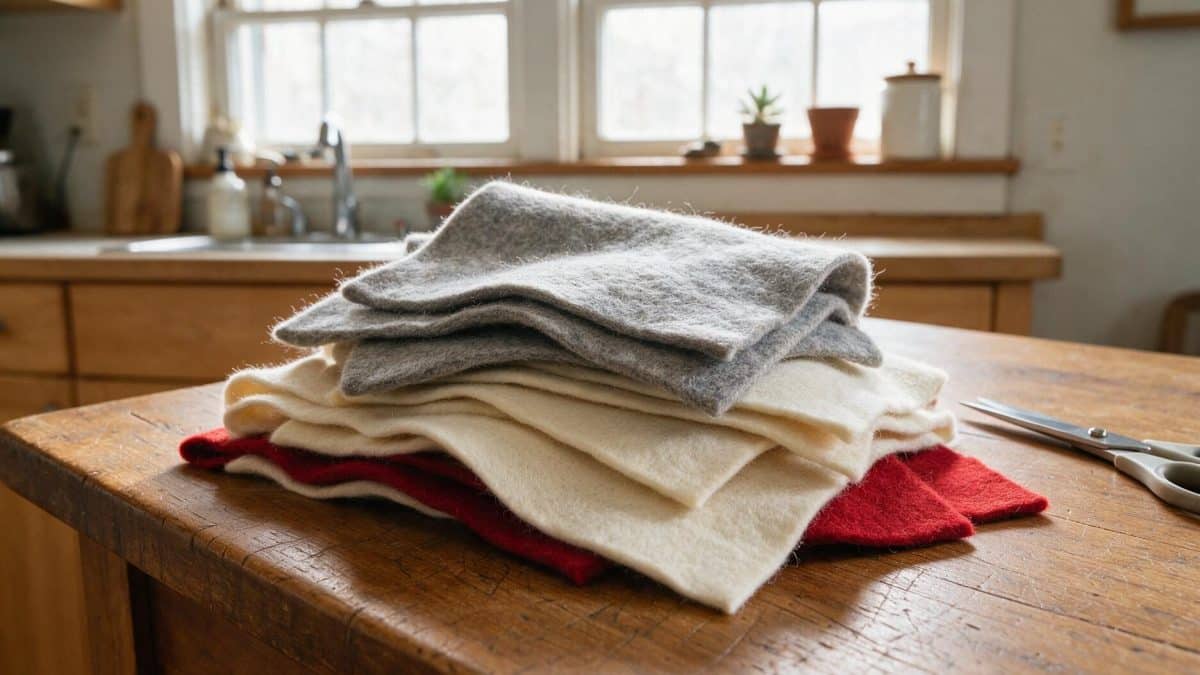
Felt is three different fabrics sold under one name, and they fail three different ways in a drum. The one that shrank most in testing had no wool in it at all.
Quick answer · care label Felt — wool, wool-blend or acrylic
-
1 · Wash
Hand wash -
2 · Bleach
No bleach -
3 · Dry
Dry flat -
4 · Iron
Iron 110° -
5 · Pro care
Pro clean P
In one line Identify the fibre before anything else, because wool felt, wool-blend felt and acrylic craft felt fail three separate ways and most felt is sold with no care label. Hand wash cool with a pH-neutral wool wash, moving the piece as little as possible, rinse at the same temperature, press the water out through a towel and dry flat back to measured dimensions. About 25 minutes of hands-on work, plus overnight drying.
Isn’t a washing machine exactly how felt gets made in the first place?
For wool felt, essentially yes. Felt is not woven and not knitted. It is wool that has been matted on purpose under controlled abuse: hot water, alkaline soap, pressure and sustained agitation, until the microscopic scales along each fibre ratchet past their neighbours and lock. Those scales travel in one direction only, which is why the tangle never comes undone. A warm machine cycle supplies all four of those conditions at once. The instinct behind the question is sound.
Where the instinct goes wrong is the outcome. Wool felt does not turn into felt in your machine, because it already is felt. It carries on densifying instead. The sheet gets smaller, thicker, harder and less pliable, and it moves by different amounts in different directions, so a square panel comes back as a slightly bowed rectangle. Felters do this deliberately and call it fulling, running a piece through cycle after cycle until it reaches the density they want. Nothing about the process runs backwards, and there is no wash, stretch or steam that returns shrunk felt to its original size.
The larger complication is that a great deal of what is sold as felt contains no wool whatever. Craft felt from a hobby shop is usually polyester or acrylic, held together by needle-punching rather than by any scale mechanism, and it fails by a completely different route: it pills, ripples, stretches at the edges and glazes under an iron. A third group, rayon and viscose felt, is neither wool nor synthetic: it is wood pulp, needle-punched the same way, and in the one published comparison it behaved worst of the lot. Wool-blend felt belongs mostly to that third group despite its name, since The Felt Store’s premium blend is 40 percent wool and 60 percent viscose. One word, four materials, four separate failure modes.
Work out which felt you are holding before you decide anything, because the safe answer for one is the destructive answer for another. When you cannot work it out, and most felt is sold by the sheet with no care label at all, hand wash cool and dry flat. That is the one routine every kind of felt comes through intact, though a saturated rayon felt may still give up dye into the water.
What you’ll need
| Item | Why | Substitute |
|---|---|---|
| A spare scrap of the same felt | The only reliable way to learn what your felt does, since the sheet it came from carried no instructions | A seam allowance, or the underside of a hem |
| pH-neutral wool wash | Cleans without the alkali that lifts wool scales or the enzymes that digest wool protein | Baby shampoo, or any delicates liquid with no enzymes on the ingredients list |
| Tape measure | Felt shrinks unevenly, and unevenly is not something you can judge by eye after the fact | A pencil outline drawn around the dry piece on paper |
| Mesh laundry bag | Keeps the felt from rubbing the drum and the rest of the load, which is where pilling starts | A zipped pillowcase |
| Two dry towels | Presses water out without wringing, and wringing is what distorts a non-woven sheet | One bath towel, used twice |
The method, step by step
Work out which felt you have
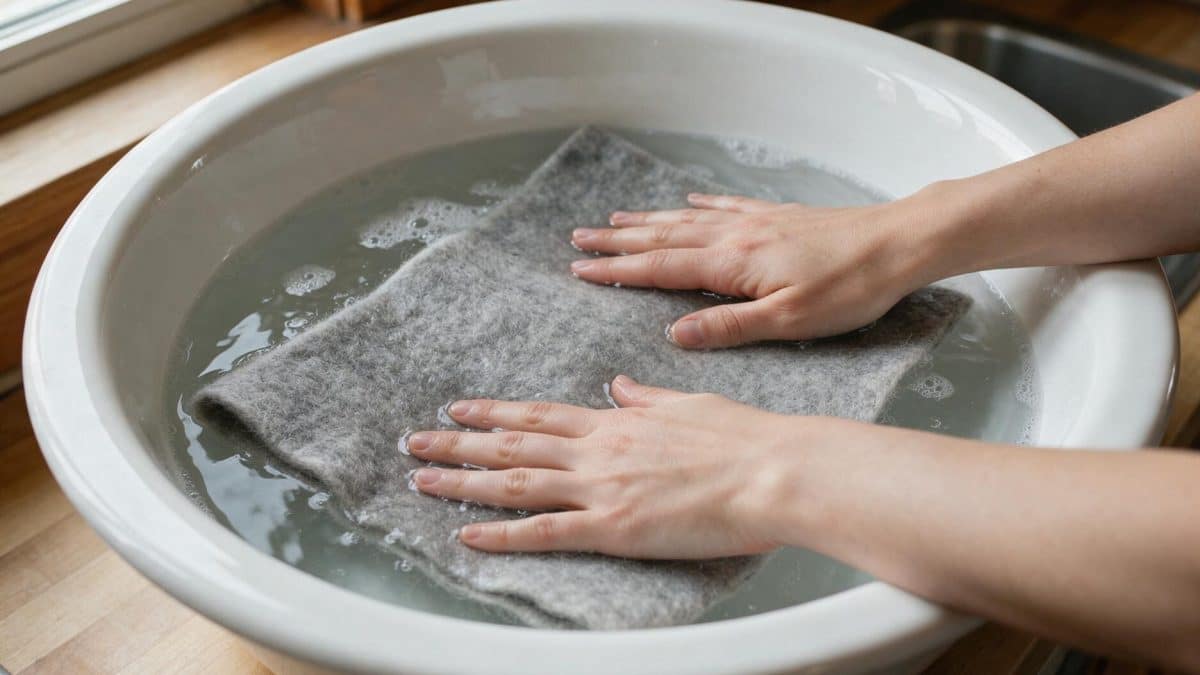
Wool felt is fuzzy, slightly uneven in thickness and expensive. Acrylic and polyester craft felt is smooth, uniform and faintly shiny, and costs a fraction as much. If you need certainty, hold a snippet in tweezers over a sink and light it: wool smells like burnt hair, self-extinguishes and crushes to a brittle ash, while acrylic and polyester melt, drip and leave a hard bead.
Test a scrap in the water you actually plan to use
Wet the scrap at your intended temperature, add a drop of the wash, and rub it between your palms for thirty seconds. Wool and wool blends visibly firm up and fuzz. Acrylic and polyester just get wet. This tells you in half a minute what a ruined project would otherwise tell you at the end.
Measure it flat and write the numbers down
Length and width, on a flat surface, before anything gets damp. Felt rarely shrinks the same amount along both axes, so a single remembered dimension is not enough to reshape it back afterwards.
Wash by hand in cool water, moving it as little as possible
Dissolve the wash into the water first, then lower the felt in and press it gently under. Squeeze the water through the piece rather than rubbing, swirling or scrubbing it. Ten minutes of soaking does more than any amount of handling, and handling is the part that costs you size.
Rinse at the same temperature you washed at
A sharp jump between wash and rinse is a felting trigger in its own right, separate from the agitation. Match the rinse water to the wash water by hand before the felt goes into it, and change the water rather than running a tap over the piece.
Press the water out through a towel
Lift the piece as a whole, supporting it from underneath so its own waterlogged weight does not stretch it. Lay it on a dry towel, roll the two together, and press. Never twist or wring.
Dry flat, in shade, back to the numbers you wrote down
On a second dry towel or a flat rack, nudged gently back to its measured dimensions while still damp. Away from radiators and direct sun. Hanging wet felt is its own mistake: there is no yarn grid to hold the shape, so the weight of the water simply drags the sheet longer.
Press with a low iron and a cloth if it dried lumpy
Wool felt often dries slightly bubbled, and a low iron through a pressing cloth flattens it. Keep the setting low whichever felt you have, because polyester glazes into a permanent shiny patch long before it scorches.
The four fabrics sold as felt
The word on the shelf label tells you the construction, not the fibre, and the fibre is what decides everything.
| Type | What holds it together | How it fails in a machine |
|---|---|---|
| Wool felt | Wool scales interlocked by heat, moisture and agitation | Densifies further: smaller, thicker, harder, and unevenly so. Permanent |
| Wool-blend felt | Some wool scale locking, the rest needle-punched viscose | Shrinks and pulls its own stitching in, fuzzes and rounds off at cut edges |
| Rayon or viscose felt | Needle-punched wood-pulp fibre, no scale mechanism | Shrank most of the four in the one published test, and bleeds dye readily |
| Acrylic or polyester craft felt | Needle-punching and thermal bonding, no scale mechanism | Pills and ripples rather than shrinking, and glazes under heat |
| Adhesive-backed or stiffened felt | A glue or resin layer over any of the above | The backing separates or dissolves, and it does not go back on |
That last row is not a footnote: manufacturers split their own ranges on it. Kunin, whose Eco-fi craft felt is polyester made from recycled bottles, publishes a care guide that gives different instructions line by line: its Classics and Premium felt is marked machine wash gentle, gentle dry, no bleach, iron low heat, while its adhesive-backed Presto and its stiffened Friendly Felt are both marked do not wash and do not dry. Same brand, same shelf, opposite instructions.
The felt that shrank most in testing had no wool in it
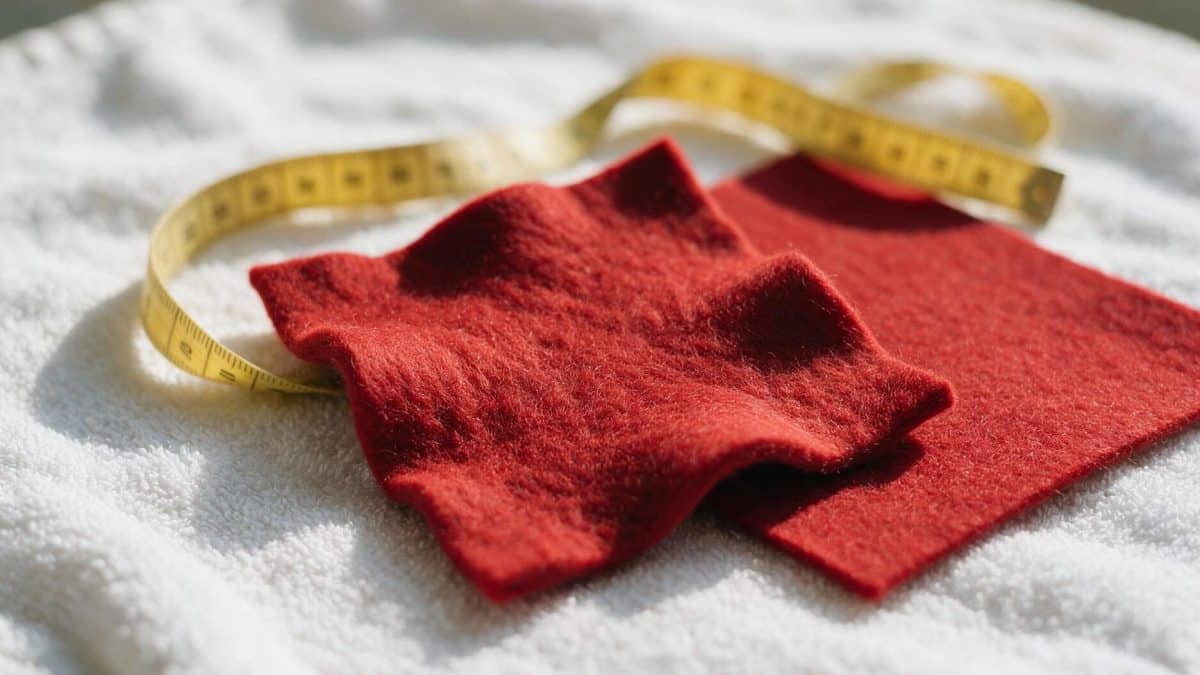
The Felt Store, a retailer rather than a laboratory, ran its own comparison across four felts: acrylic, rayon and viscose, a premium wool blend, and 100 percent wool. In the worst case they tried, a normal cycle in hot water followed by thirty minutes in a hot dryer, the acrylic moved about a quarter of an inch and picked up some rippling and pilling. The 100 percent wool lost up to an inch. The wool blend lost up to three quarters of an inch. The rayon and viscose felt lost more than an inch on the patch, fuzzed all over its surface, and came out worst of the four. Its purple dye also bled onto the backing fabric, and it did that in nearly every cycle they ran, the cold and hand washes included.
That ordering is not the one most people expect. Wool has the reputation, but the felt that behaved worst in the drum was the one with no wool in it to felt. Treat those inch figures as directional only: the store does not publish the starting dimensions of its test pieces, so there is no honest way to turn them into percentages.
For a figure you can actually scale, the felt supplier Benzie measured a six-inch square of its wool-blend felt before and after a hot pre-wash and got back roughly five and three quarter inches by five and a half. That is about four percent one way and eight percent the other, from a single wash. The uneven part is the point. A square does not come back a smaller square.
Put felt of any fibre in a tumble dryer. Heat and mechanical friction together are precisely the two inputs that shrink wool felt and pill synthetic felt, and the dryer is the only appliance that applies both at full strength for half an hour. The single run The Felt Store labelled its worst case was the one that ended in a hot dryer. There is no correcting it afterwards.
Stains on felt, and which ones come out
Felt has a raised, open surface and no smooth face to wipe, so the usual advice about blotting a stain off a fabric only half applies. Spot cleaning beats washing whenever it will do the job, because it keeps the piece out of the water entirely.
| Stain | Treatment | Recoverable |
|---|---|---|
| Dust, lint, pet hair | Lint roller, or a soft brush in short strokes one way | Yes |
| Candle wax | Harden with ice, lift the bulk off, then a low iron through plain paper | Usually |
| Grease or oil | Cornflour pressed on and left several hours, then brushed out | Usually |
| Water mark on wool felt | Damp the whole panel evenly rather than the mark alone, then dry flat | Usually |
| Ballpoint ink | Solvents spread it through the open surface, and on stiffened felt they attack the binder too | No |
| Dye bled from another colour | Nothing reliable once another felt’s dye has struck the fibre | No |
Felt with a backing, a stiffener or a shape is a different object
Once felt has been made into something, the felt itself often stops being the fragile part. Check for these before deciding anything, because each one overrides the fibre answer above.
- Felt hats. A wool or fur felt hat is blocked to a shape on a wooden form, and water plus agitation releases that shape permanently. Brush it instead, in short strokes around the crown, and take a hat you care about to a hatter for cleaning and reblocking. Submerging it is not a risk, it is the end of the hat.
- Adhesive-backed felt. Self-adhesive sheets and craft-felt stickers carry a glue layer that water lifts. Kunin marks its own adhesive line do not wash, which is about as clear as a manufacturer gets.
- Stiffened and glittered felt. The stiffener is a resin that washes out and the glitter is glued on. Both come off in the first wash and neither goes back.
- Glued craft pieces. Appliqué and ornaments assembled with fabric glue rather than stitching come apart in water regardless of what the felt itself would tolerate. Stitched pieces are the ones worth washing.
When something is genuinely worth keeping and you cannot tell what is in it, the felt suppliers themselves default to professional cleaning. Both A Child’s Dream and Benzie recommend dry cleaning as the safest route for wool and wool-blend felt, which is a notable position for shops that would rather sell you more felt. If your piece does carry a label, the label decoder will translate the symbols.
Related guides
Felt sits at one end of a family of wool problems. The neighbouring cases work differently:
- Knitted and woven wool has a yarn structure that felt lacks, which changes both the risk and the repair. See how to clean wool.
- The machine question for ordinary wool garments has a more forgiving answer than it does for felt. See can you machine wash wool.
- Felt hats belong with the hat problem rather than the fibre problem, because the shape is the thing you are protecting. See can you machine wash hats.
- For the gentlest end of protein-fibre hand washing, and why drying flat matters so much, see how to clean cashmere.
Questions
Can I machine wash felt on a delicate cycle?
Acrylic and polyester craft felt usually survives it, in a mesh bag, on cold, with a low spin, and Kunin marks its Classics and Premium lines machine wash gentle. Wool and wool-blend felt did better than their reputation in The Felt Store’s delicate cold cycle: no measurable shrinking on either, and only slightly lifted edges on the blend. That was one test on small stitched patches, though, and the cold water is doing more of the work there than the word delicate. Adhesive-backed, stiffened and blocked felt should not go in at all.
My felt shrank and went hard. Can I get it back?
No. The interlocking that causes it is one-directional by nature, and there is no soak, stretch or steam that unlocks it. Wool conditioner and blocking can sometimes relax a shrunken knit slightly, but felt has no yarn structure to relax.
Why did my red felt turn everything else pink?
Cheap felt in saturated colours is frequently under-fixed, and rayon and viscose felt bleeds the most consistently of the types that have been compared. It is the reason to pre-wash felt separately before making anything from it rather than after. Once the loose dye has struck a neighbouring piece it is in the fibre, and there is no reliable way to pull it back out.
Does felt actually need washing, or can I get away with brushing it?
Usually brushing. Felt has no weave for dirt to work down into, so surface dust lifts off with a lint roller or a soft brush more easily than it does from most fabrics. Every wash a piece of felt does not have is size it does not lose.
Can I use ordinary laundry detergent on wool felt?
Not if it is biological. Protease enzymes break down protein and they do not distinguish between a protein stain and a wool fibre, so the damage is cumulative and shows up as weakening and small holes after several washes rather than immediately. Standard detergents are also alkaline, and alkalinity lifts the very scales that drive felting. Use a pH-neutral wool wash or baby shampoo.
Is 30 °C (86 °F) safe for wool felt?
Safer than 40 °C (104 °F), which is the useful way to put it. Machine felting is normally done on a full cycle somewhere between 40 and 60 °C (104 to 140 °F), so staying below that band is doing real work. Temperature alone does not felt wool though. Agitation does, and a cool machine cycle still tumbles, which is why hand washing at the same temperature beats a cool cycle.