Can You Machine Wash Viscose? (Half Its Strength Is Gone While Wet)
Viscose loses about half its strength the moment it gets wet. Machine washing works, but only on a cycle that never wrings it, spins it hard, or leaves it hanging while it dries.
Quick answer · care label Viscose (rayon) — woven and jersey
-
1 · Wash
Wash 30° gentle -
2 · Bleach
No bleach -
3 · Dry
Dry flat -
4 · Iron
Iron 150° -
5 · Pro care
Pro clean P
In one line Test the dye on an inside seam with a damp white cloth, then wash the garment inside out in a mesh bag on the shortest cold delicate cycle at the lowest spin the machine offers. Roll it in a towel and press the water out rather than wringing, then dry it flat and reshaped, away from sun and heat. About 12 minutes hands-on.
Can you machine wash viscose, or does the wet strength rule that out?
You can machine wash most viscose. The reason people believe you can’t is that viscose fails in a way other fabrics don’t: it goes soft and weak the moment it is wet, and stays that way until it dries. Published fibre data puts standard viscose at roughly 1.5 to 2.4 grams per denier dry and 0.7 to 1.2 wet — about half its strength gone, in water, every time. Nothing looks different while it happens, which is why the damage gets blamed on the machine rather than on the ten seconds someone spent wringing a sleeve out over the sink.
So the real question isn’t whether viscose survives water. It does: viscose is regenerated cellulose, made from dissolved wood pulp, and cellulose is what cotton is made of too. The question is whether it survives what a machine does while it is wet — the drum tumbling, the spin flinging it against the wall, and the hanger you put it on afterwards. Get those three right and viscose washes at home, wash after wash. Get one wrong and the fault is permanent, because a stretched viscose shoulder does not come back.
There is a second, quieter failure mode with nothing to do with strength. At normal room conditions viscose carries a moisture content around 13 per cent against about 6 for cotton, which makes it the thirstiest of the common cellulosics. Wet one small area and it swells while the fabric around it doesn’t, pushing the sizing outward into a hard ring at the edge of the damp patch. That ring is often permanent.
Support the weight of viscose whenever it is wet. Half its strength is gone until it dries, and every permanent fault — the dropped hem, the stretched shoulder, the split side seam — happens in the few minutes when the fabric is heavy with water and something is pulling on it. Water is not the enemy. Load is.
What you’ll need
| Item | Why | Substitute |
|---|---|---|
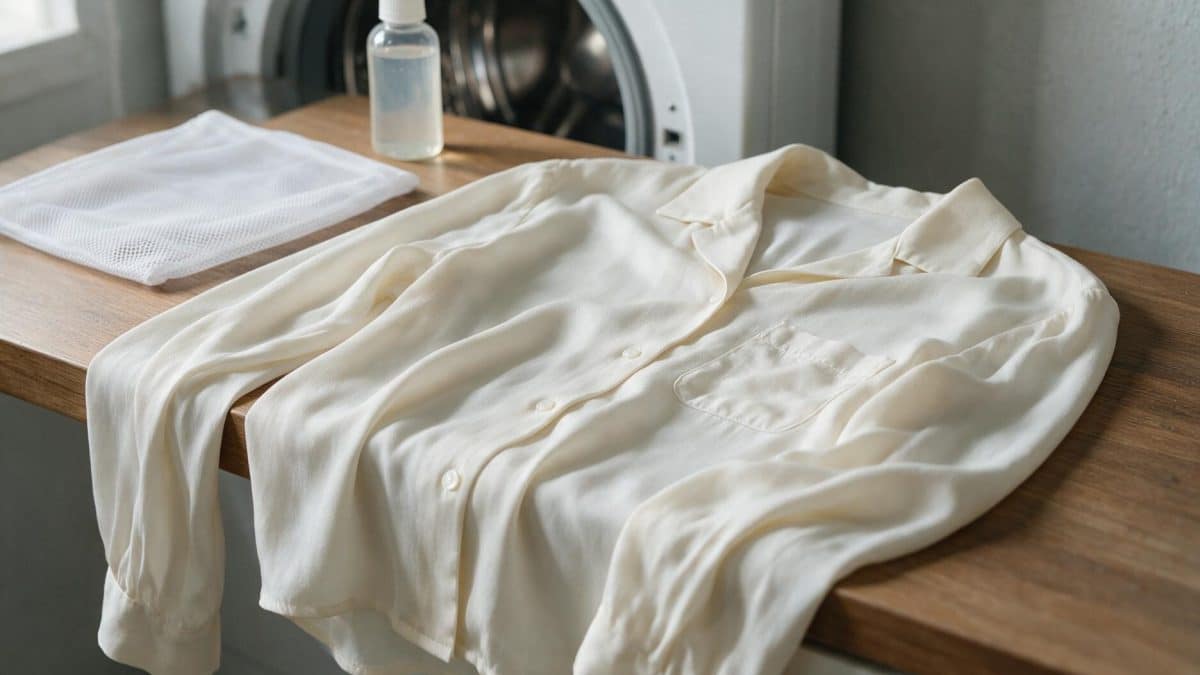
| Mesh laundry bag | Stops the garment being dragged and stretched against the drum while it is at its weakest | A pillowcase with the open end knotted, not pinned |
| Mild liquid detergent | A delicates or wool wash, pH-neutral and enzyme-free, so it cleans without attacking the cellulose | A quarter dose of ordinary liquid detergent, diluted in water first |
| White cotton cloth | Doubles as the dye-bleed test and, later, the pressing cloth that keeps the iron off the surface | An old white pillowcase or a plain cotton handkerchief |
| Two dry bath towels | One to roll the garment in, one to lay it on; this is what replaces wringing | A folded cotton bedsheet, four layers deep |
| Flat drying surface | A mesh sweater rack or any flat space out of direct sun, so gravity never gets a grip | A towel on a spare bed, turned over halfway through |
The method, step by step
Test the dye on an inside seam
Damp the white cloth with cold water and press it against a seam allowance or hem inside the garment for thirty seconds. Any colour on the cloth means the dye is not fixed, and this one goes to a cleaner rather than into water.
Wet a hidden patch and let it dry
Put a drop of water inside a hem or under a facing and let it dry on its own. If a ring forms at the edge, the fabric carries a heavy finish and localised wetting will mark it. That does not stop you washing the whole thing; it stops you ever spot-cleaning it.
Turn it inside out and bag it
Fasten every button and zip so nothing catches, turn the garment inside out, and put it in the mesh bag on its own. Wash viscose with viscose or with nothing. A pair of jeans in the same load is a rock in a bag of wet paper.
Run the shortest cold delicate cycle you have
Cold, or 30 °C (86 °F) at the very warmest, on delicates or hand-wash. Time in the drum matters as much as temperature: every extra minute is another minute of half-strength fabric being pushed around. No fabric softener.
Drop the spin as low as the machine allows
This setting decides the outcome. A typical delicates cycle still spins at 400 to 600 rpm, more force than wet viscose needs to take. Choose the lowest speed on the dial, or switch the spin off and accept a wetter garment.
Lift it out supported, not by the shoulders
Gather the whole garment into both hands and carry it as a bundle. Lifting a wet viscose dress by its shoulder seams puts the whole waterlogged weight on two points of the weakest fabric in the wardrobe, and that is where a permanently dropped shoulder line comes from.
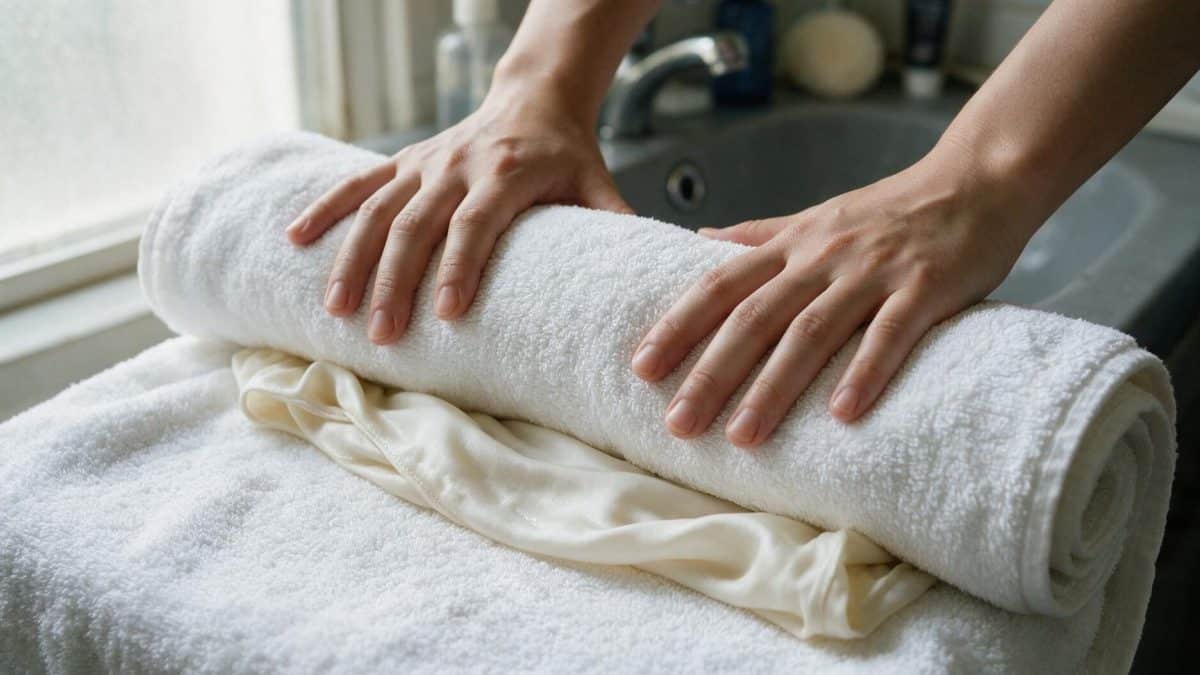
Roll it in a towel and press
Lay it flat on a dry towel, roll the two together and press down along the roll with flat hands. That pulls out most of the water with no twisting. Wringing is the most common way people destroy viscose, and it does its damage in seconds.
Dry it flat and reshaped, out of the sun
Unroll onto the second towel, pat the garment back to its proper measurements while damp, and leave it. Not on a hanger, not on a line, not in a tumble dryer, and not in direct sun, which weakens and yellows cellulose over repeated exposure.
Wet viscose is a different fabric from dry viscose
The measured tenacity is the part the fibre data agrees on. The headline percentage quoted in care advice is not: some sources put the strength loss at 30 to 50 per cent, others at up to 70, and the real figure moves with the yarn and the finish as much as with the fibre. Plan for the worse end and the method comes out the same either way.
The mechanism is easier to describe than to quantify. Water swells the cellulose, the fibre softens, and it stops resisting forces it resisted a minute earlier. Shear stress from rubbing, twisting or wringing ruptures fibres outright. Steady tension — the weight of water in a hanging garment — stretches them without breaking them, and viscose has poor elastic recovery, so that stretch is kept. This is why a garment can come out of the machine perfect and be ruined an hour later on a hanger.
Shrinkage follows the same logic and is largely avoidable. Cold wash plus flat drying typically keeps it under about five per cent, most of that a one-time relaxation on the first wash as tension put into the yarn at the mill lets go. Hot wash plus hot tumble is a different story: reported figures run from roughly eight to fifteen per cent. The dryer does more of that damage than the wash, which is why the drying instruction is not negotiable and the temperature has a little room in it.
Water rings, and why you cannot spot-clean viscose
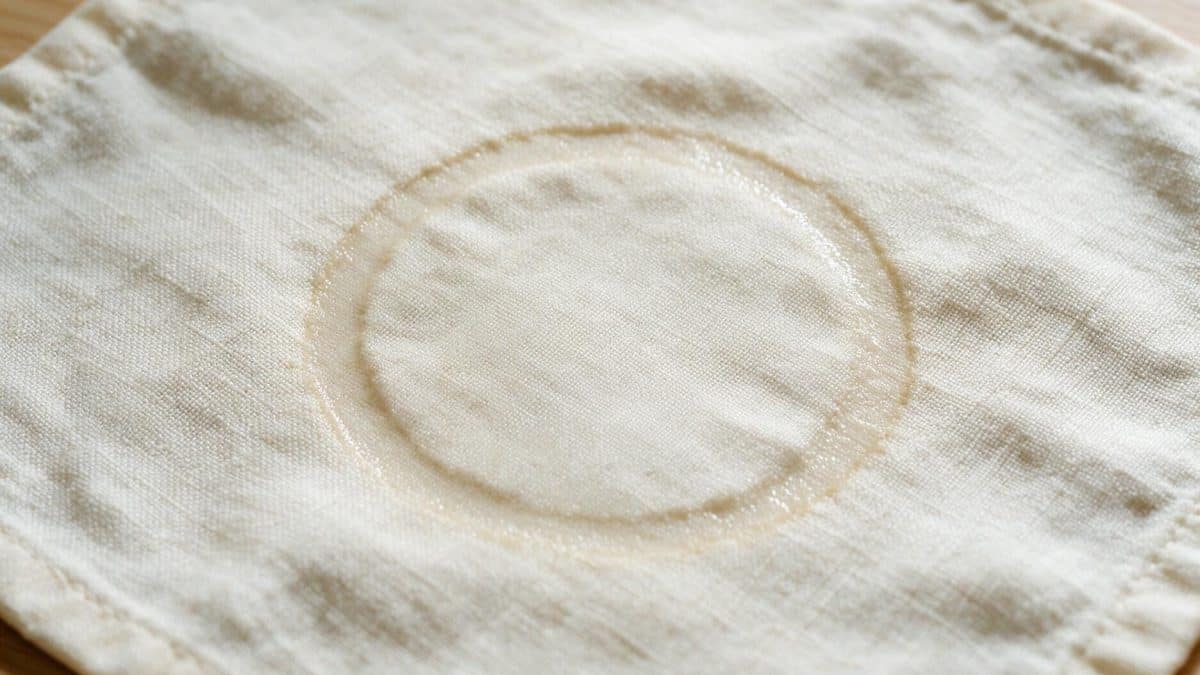
Most fabrics reward you for treating a stain early and locally. Viscose punishes it. Wetting one area makes it swell and carries the fabric’s sizing and finishing chemicals outward with the moisture, where they dry into a stiff, slightly darker ring exactly at the boundary of the wet patch. On heavily finished dress and upholstery viscose these rings are frequently permanent, and further dabbing only creates a second ring outside the first.
So the correct response to a mark on viscose is counter-intuitive: wet more, not less. Dampen the whole panel evenly, or wash the whole garment, so there is no boundary for the finish to collect at. If a ring has already formed, re-wetting the entire panel and drying it flat is the only thing that reliably works — and it does not always work.
| Mark | Treatment | Recoverable |
|---|---|---|
| Water ring from a splash | Re-wet the whole panel evenly, dry flat; never dab the ring itself | Usually |
| Perspiration in the underarm | Full cold soak with mild detergent, twenty minutes maximum, then a normal cold wash | Usually |
| Oil or grease | Absorbent powder pressed on dry and left for hours, brushed off, then the whole garment washed | Often |
| Perfume, hairspray or alcohol | Nothing reliable at home; the alcohol carrier can lift dye as it dries, leaving a pale mark worse than the stain | No |
| Brown discoloration after staying wet | Nothing at home; the cellulose itself has degraded, not the surface | No |
Household chlorine bleach, on any viscose garment, at any dilution. Regenerated cellulose is more open and more chemically reactive than cotton, and hypochlorite oxidises it into oxycellulose: the fabric loses tensile strength, creases permanently and eventually goes through at the fold. Mills do bleach viscose with hypochlorite under controlled conditions on undyed fibre, which is not the same thing as a capful in a drum with a finished garment. Oxygen bleach is gentler on the fibre but unpredictable on viscose dyes. There is no bleaching step in this method for a reason.
Viscose, modal and lyocell are not one instruction
All of these are regenerated cellulose and get described in the same sentence, but modal and lyocell were engineered specifically to behave differently in water. On a blend, the weakest component sets the cycle.
| On the label | What it is | What changes for the wash |
|---|---|---|
| Viscose | Standard regenerated cellulose, the lowest wet strength of the family | The method on this page, unmodified: cold, short, lowest spin, dried flat |
| Rayon | The same fibre. “Rayon” is the US name, “viscose” the European one | Nothing. Treat it as viscose |
| Modal | A modified viscose, spun for higher wet strength and lower shrinkage | More tolerant of the drum, but still dry it flat; better shrinkage is not a drying licence |
| Lyocell / Tencel | Cellulose dissolved in a different solvent; the strongest of the three, wet or dry | Usually a normal cold cycle, and often tumble-safe on low if the label says so |
| Viscose blends | Commonly with polyester, elastane or cotton | Follow the viscose, not the partner fibre; a 40 per cent viscose top still rings and still stretches |
When “dry clean only” on viscose is real
Viscose carries that label more often than the fibre alone justifies, because makers know how easily it is mishandled. Four things make the instruction genuine rather than defensive, and all four are visible without guessing:
- The dye moves. If the damp-cloth test in step one picks up colour, water will redistribute that dye across the garment. This test settles the question outright.
- The garment is built, not just sewn. Interfacing, shoulder pads, a fused collar or a bonded lining shrink at their own rate. The seams pucker and stay puckered.
- The finish is heavy. Viscose that feels crisp, papery or faintly coated has been sized. Washing removes that sizing unevenly, and the garment hangs differently afterwards.
- It is pleated or moiré. Both are set mechanically. Water releases them and they do not come back.
Where none of those apply, a dry-clean-only viscose blouse is usually washable by the method above, at your own risk rather than the maker’s. If you would rather not, see how to dry clean at home.
Related guides
The guides next to this one, and what each of them changes about the method:
- The identical fibre wearing its US label name, so nothing changes; if your garment says rayon rather than viscose, read that one instead. See can you machine wash rayon.
- Silk also weakens in water, but it is protein rather than cellulose, so the detergent rules invert: enzymes and alkali are the risk there. See can you machine wash silk.
- Polyester is what viscose is most often blended with, and it tolerates everything viscose does not. See can you machine wash polyester.
- If the dye test failed, the basin technique matters more than the detergent. See how to clean clothes by hand.
Questions
Does viscose shrink in the washing machine?
Some, once. A cold wash and flat drying usually keeps total shrinkage under about five per cent, most of it on the first wash as tension put into the yarn during manufacture relaxes out. The shrinkage people actually complain about comes from the dryer: published figures for a hot wash followed by a hot tumble range from roughly eight to fifteen per cent, varying by source and by knit.
Can I tumble dry viscose on the lowest heat?
No, and this is one of the few hard rules here rather than a judgement call. The dryer combines the two things viscose cannot take at once: heat, and mechanical action on a fabric at half strength. Low heat reduces the shrinkage but not the abrasion. If a blend label explicitly permits low tumble drying, take it out while still noticeably damp and finish it flat.
My viscose dress says dry clean only. Is that genuine?
Sometimes. Do the damp white cloth test on an inside seam first; if colour transfers, believe the label. Then look for interfacing, a fused collar, shoulder pads, a bonded lining, pleating or a crisp sized finish. Any of those makes the instruction real. A simple unlined viscose dress with fast dye is usually washable by the method above.
Why did my viscose top come out longer instead of shorter?
It was hung up wet. Viscose has poor elastic recovery, so tension applied while it is weak is kept rather than released. The weight of the water pulls the body and sleeves down, and the shoulders take that load at two narrow points. Drying flat is not a refinement of the method; it is the part that prevents this fault.
Can I use fabric softener on viscose?
Skip it. Viscose is already soft, softener does nothing useful for it, and the deposits sit unevenly on a fibre this absorbent. On darker viscose they show up as pale patches that look like water marks.
What iron setting does viscose take?
Two dots means 150 °C (300 °F) and that is the standard viscose setting, but published advice for the fibre spans 110 to 150 °C (230 to 300 °F), so start low and work up. Iron inside out with a slightly damp cotton pressing cloth between iron and fabric, because viscose glazes into a permanent shine under direct heat.