Can You Machine Wash Rayon? (It Depends Which Rayon)
Rayon loses roughly half its strength the moment it gets wet, and three different fibres are sold under that one name. Cold water and a flat dry matter more than the cycle you pick.
Quick answer · care label Rayon — viscose, modal, lyocell
-
1 · Wash
Wash 30° gentle -
2 · Bleach
No bleach -
3 · Dry
Dry flat -
4 · Iron
Iron 150° -
5 · Pro care
Pro clean P
In one line Measure the garment while dry, fasten it, turn it inside out and bag it, then run it cold on the delicate cycle at the lowest spin the machine offers. Roll it in a towel to press the water out instead of wringing, dry it flat and in shape rather than on a hanger, and steam or iron at medium while it is still slightly damp. About 20 minutes hands-on.
Can you machine wash rayon, or does the label mean it?
Most rayon goes through a washing machine intact, but not through a normal wash. Cold water, the delicate cycle, a mesh bag and a flat dry will give a viscose top back looking like itself. Warm water, a full spin and twenty minutes in a tumble dryer will hand you something noticeably smaller with a hem that no longer hangs straight. That gap is not fussiness. Rayon is the one common fibre that arrives at the wash far weaker than it looks on the hanger.
Published tensile figures for standard viscose rayon run about 1.5 to 2.4 grams per denier dry and 0.7 to 1.2 wet — roughly half its strength gone the moment it is soaked. Sources put the loss somewhere between 40 and 60 percent depending on the grade, so treat that as a range rather than a fact. Cotton does the opposite and is slightly stronger wet than dry, which is why laundry advice written with cotton shirts in mind travels badly to rayon.
There is a second problem, and it is the one that makes the question hard to answer honestly. Rayon is not one fibre. Under the US textile rules lyocell is a subclass of rayon, so a garment spun from lyocell can be sold with nothing but “rayon” on the label. Modal is a rayon too. Both hold up in a machine far better than plain viscose does. A European or British label has to name viscose, modal, cupro and lyocell separately; an American one does not. So the answer starts with working out which rayon you are holding.
Water is what makes rayon weak, and movement in water is what turns weak into damaged. Every step below does one of two things: it shortens the time the garment spends wet, or it reduces what happens to it while it is. Cool water, short cycle, low spin, no hanger, no dryer.
What you’ll need
| Item | Why | Substitute |
|---|---|---|
| Mesh laundry bag | Stops the garment being dragged against the drum and other clothes while it is at half strength | A pillowcase with the open end knotted shut |
| Liquid detergent for delicates | Dissolves properly in cold water, and skips the cellulase enzymes used industrially to shave fuzz off viscose | A quarter dose of unscented liquid detergent |
| Two dry bath towels | Lets you press water out by rolling instead of wringing, which is what distorts a wet rayon weave | Any large absorbent cotton towel |
| Flat drying rack, or a table | Wet rayon hung on a hanger stretches under the weight of its own water | A dry towel spread on a bed |
| Tape measure | Measuring before the first wash is the only way to know what changed rather than guessing later | A length of string and a pen mark |
| Steam iron or a steamy bathroom | Rayon creases hard as it dries flat, and steam relaxes it without pressing at full heat | Hanging it up during a hot shower |
The method, step by step
Measure it, then read the fibre content rather than the symbols
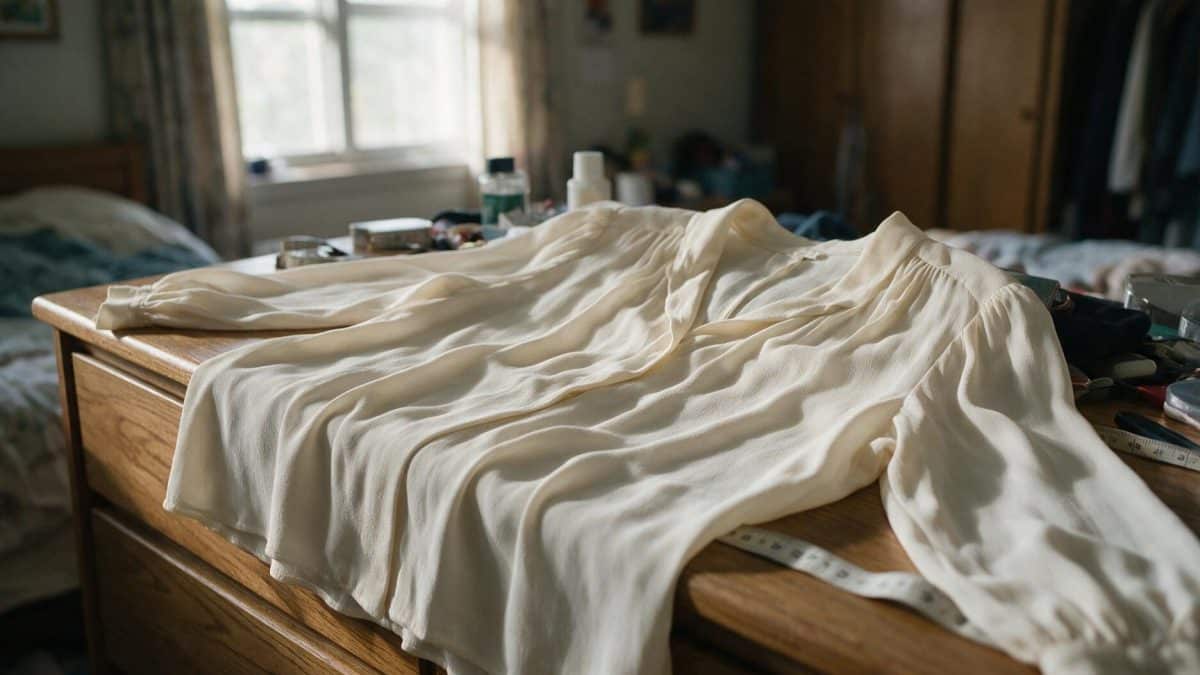
Write down the length and the width across the chest while the garment is dry. Then look for the words viscose, modal or lyocell. If the label says only “rayon”, assume viscose and use the gentlest version of everything below.
Fasten everything and turn it inside out
Open zips and loose hooks catch fabric as the drum turns, and rayon tears at a load cotton would shrug off. Inside out also puts prints and surface finishes on the protected face.
Bag it, one garment per bag
A mesh bag turns the wash from abrasion between garments into movement in water. Do not pack the bag: fabric folded tight against itself comes out with creases set into it.
Cold water, delicate cycle, lowest spin the machine offers
Treat 30 °C (86 °F) as the ceiling and cold tap water as the target. The delicate or reduced-action programme halves the drum movement, and the spin matters as much as the wash: high-speed spinning presses a weak wet fabric into creases that never fully flatten.
Roll it in a towel and press, never wring
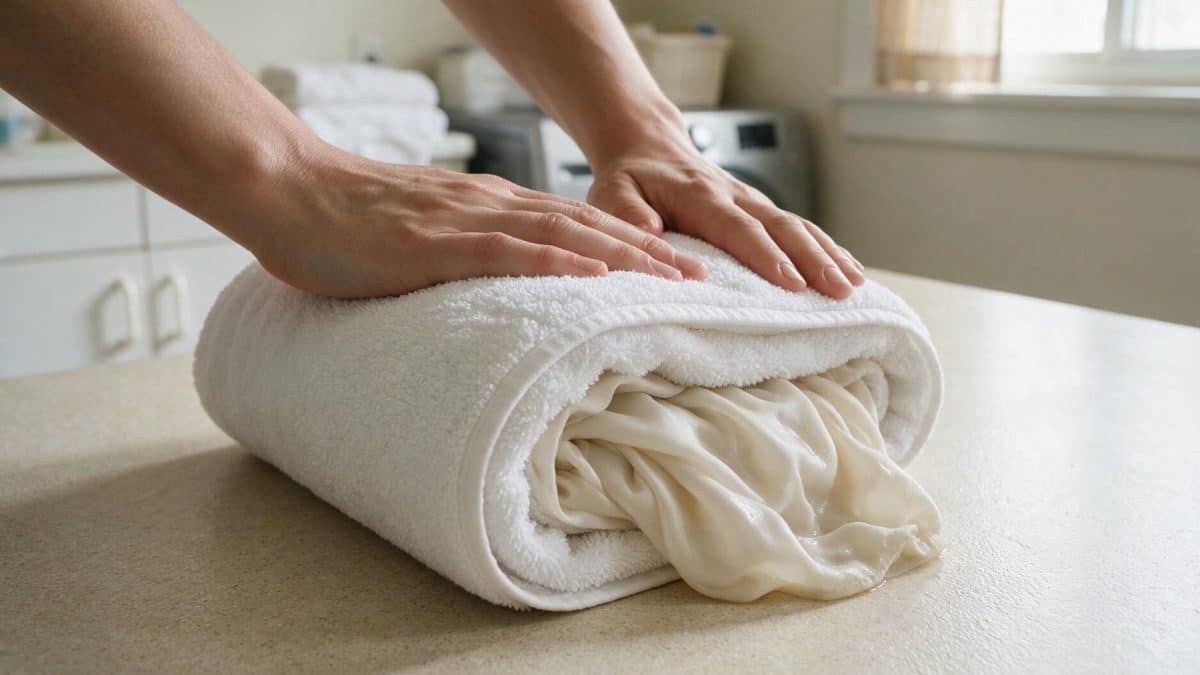
Lay the garment flat on a dry towel, roll the two up together, and press with flat hands. Wringing twists a fabric currently at about half the strength it had this morning, and that distortion does not always come out.
Dry flat, in shape, away from heat and direct sun
Reshape it while damp, easing it back toward the measurements you wrote down. Not on a hanger, not over a radiator, and not in a tumble dryer, which is how most shrunken rayon gets made.
Steam it, or iron on medium while slightly damp
The two-dot setting rayon usually carries is about 150 °C (300 °F), and published data has viscose starting to lose strength at roughly that same temperature — so treat two dots as a ceiling, not a target. Iron inside out, or hold a steamer just off the surface.
Three fibres share the name rayon, and they do not wash alike
All rayon is regenerated cellulose: wood pulp dissolved into a liquid and spun back out as fibre. What separates the types is how ordered the cellulose ends up inside the filament, and that ordering is exactly what decides whether the fibre holds together when wet.
| Name on the label | What it is | Cold delicate cycle |
|---|---|---|
| Viscose, or plain “rayon” | The original process, and the lowest wet strength of the group. This guide is written for it | Yes, exactly as written |
| Modal | A modified viscose process, defined by a minimum wet-strength requirement — high wet modulus is what the name means | Yes, and it tolerates handling |
| Lyocell (sold as Tencel) | Spun from an organic solvent with no derivative formed; the most ordered structure here, and the most stable | Yes |
| Cupro (sold as Bemberg) | The cuprammonium process. In clothing it is almost always a lining rather than the outer fabric | Rarely — the garment around it decides |
| Bamboo rayon or bamboo viscose | Viscose made from bamboo pulp. The process governs behaviour, not the plant it started as | Yes — treat it as viscose |
Two garments with identical labels can behave completely differently in the same wash, because one is lyocell and the other viscose and the label was allowed to call both rayon.
The three ways a machine wash actually goes wrong
Shrinkage comes first. Water forces its way between the cellulose chains and the fibre swells across its width; fatter fibres put more crimp into the yarn, and more crimp makes a shorter piece of cloth. That is relaxation shrinkage, and heat and agitation speed it up rather than cause it. Published figures scatter badly — roughly 3 to 8 percent on a first home wash for a well-finished woven viscose and rather more for a viscose jersey, with much larger numbers quoted for unfinished fabric or a hot wash. Most of the movement lands in the first one to three washes; whether it keeps creeping after that is a point on which sources genuinely disagree.
Stretching is the same weakness pointing the other way. A soaked garment holds a large fraction of its own weight in water, and rayon holds more of it than cotton does. Hang that on a narrow hanger and the shoulders and hem carry the load while the fibre is at its weakest. Long items — a rayon dress, a wide-legged trouser — go out of shape on a hanger faster than they shrink in a wash.
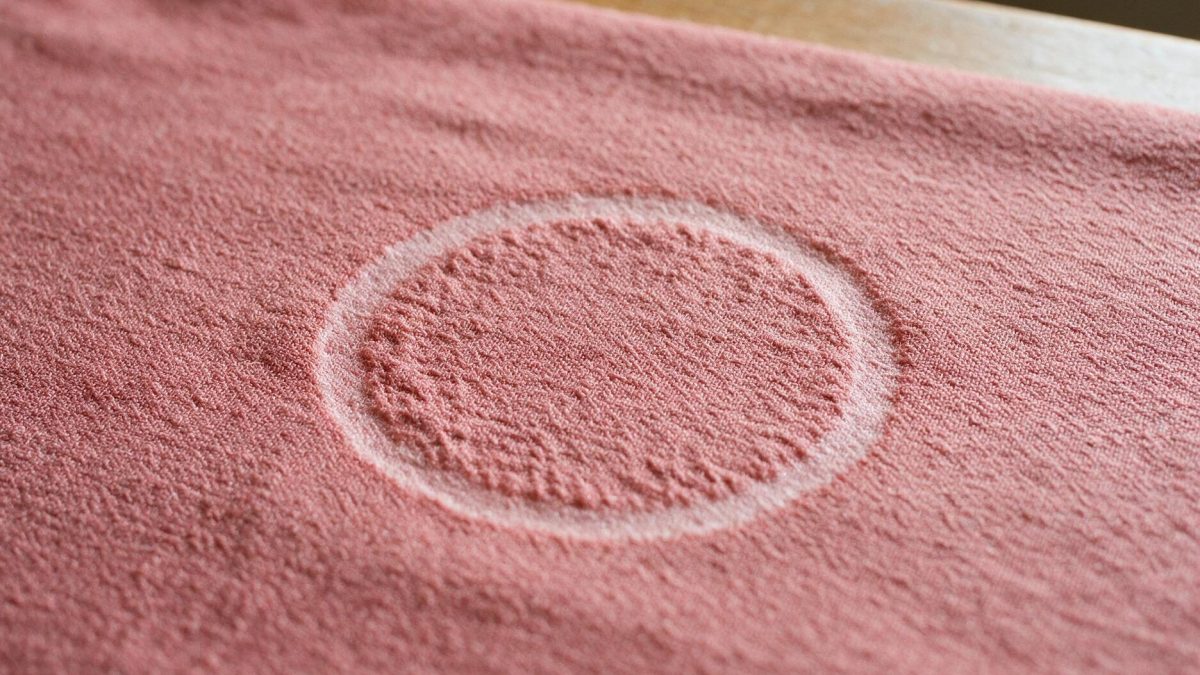
Water spotting is the one that surprises people. A single drop of clean water on dry rayon can leave a visible ring. Nothing is stained: the fibres under the drop have swollen and set in a locally deformed state, so the patch catches light differently from the fabric around it. That is why dabbing a mark on rayon with a damp cloth so often leaves a worse mark than you started with, and why the fix for a water ring is to wet the whole panel evenly and dry it flat. If the mark itself needs work, treat rayon as the exception to the general stain method.
| What happened | Recoverable | What to try |
|---|---|---|
| Shrunk in a warm wash or a tumble dryer | No | Blocking it while damp buys back a little length; the change in the fibre does not reverse |
| Shoulders or hem stretched on a hanger | Partly | Rewash cold and dry flat in shape. Knits come back further than wovens |
| Water ring from a drip or spot-cleaning | Yes | Wet the whole panel evenly, press out in a towel, dry flat |
| Fuzzed patch from rubbing while wet | No | The surface fibres are broken. Shaving the pills tidies it; it does not restore it |
| Dye bled onto the rest of the garment | Usually not | Rewash immediately while everything is still wet. Once dry, treat it as permanent |
| Hard crease set by a full-speed spin | Yes | Steam it out while the fabric is still slightly damp |
“Dry clean” and “dry clean only” are not the same instruction
Under the US Care Labeling Rule a manufacturer must give complete instructions for one safe method of care, not for every safe method: where both washing and dry cleaning would work, the label needs only one of them. A plain “Dryclean” therefore means the maker has a reasonable basis to believe dry cleaning is safe and effective. It is not a claim that washing would ruin the garment, and dry cleaning need not be the only or the best method. “Dryclean only” is not a term the rule defines at all — the glossary of standard care terms does not contain it. The word “only” is the maker’s own addition.
In practice the two still tend to mean different things on rayon, even though neither the word “only” nor the reasoning behind it has to be spelled out anywhere. A plain “Dryclean” on a simple viscose blouse is often just the one method the maker tested. “Dryclean only” more often points at construction rather than fibre: a fused interlining that separates, a lining that shrinks at a different rate from the shell, a deep dye that runs, a finish that water lifts out. A rayon jacket with structured shoulders is a different object from a rayon camisole even when the fibre content reads identically.
Related guides
- Viscose is the specific rayon that carries most of the risk here, taken on its own terms rather than alongside its cousins, in the viscose guide.
- Silk is the other fibre people fear putting in a machine, but it fails by a different mechanism — protein, not cellulose — so the rules diverge: machine washing silk.
- If the garment is structured or lined, the basin removes the agitation entirely: washing clothes by hand.
- For what home dry-cleaning kits can and cannot actually do, read how to dry clean at home.
Questions
Will rayon shrink if I wash it in cold water?
Less, but not never. Cold water still swells the fibre, which is what causes relaxation shrinkage in the first place; what it removes is the heat and mechanical action that accelerate it. A well-finished woven viscose washed cold and dried flat usually moves a little on the first wash and then settles. The dryer, not the wash, is where dramatic shrinkage happens.
Can you put rayon in the dryer?
Not on heat, and it is not worth the risk on low either. Tumbling combines the two things rayon handles worst, heat and mechanical action, at the moment the fibre is still damp and weak. A few minutes on a no-heat air setting for an already-dry garment is a different proposition; a wet garment in a warm drum is not.
Can I machine wash something labelled “dry clean only” if it is 100% rayon?
Often the fibre survives it. What decides are the parts the label does not mention: fused interfacing, a lining with a different shrink rate, an unstable dye, a finish that rinses away. A flat, unlined, single-layer garment is a far better bet than a structured one. None of it is reversible, so make that gamble on something you can afford to lose.
How can I tell whether my rayon is viscose or lyocell?
On a US label, often you cannot — lyocell is legally a subclass of rayon and may be labelled either way. A European or British label has to name viscose, modal, cupro and lyocell separately, so look for those words first. Brand names help too: Tencel is lyocell. With no evidence either way, wash it as viscose, since the gentler method costs nothing on a fibre that did not need it.
Why does my rayon top still smell after a cold wash?
Rayon takes up far more moisture than cotton — around 13 percent against cotton’s 6 percent under the same conditions — so it absorbs body oils readily and holds them deep in the fibre. Cold water plus a small dose of gentle detergent is a weak combination against oil. Use a full dose for the load size, wash the garment after fewer wears, and give it a longer soak rather than a hotter wash.