Can You Machine Wash Cashmere? (The Wash Is Survivable, the Dryer Isn’t)
Cashmere survives a 30 °C wool cycle better than most people expect. What it does not survive is a biological detergent, a top-loader's centre agitator, or ten minutes in a tumble dryer.
Quick answer · care label Cashmere — knitwear
-
1 · Wash
Wash 30° gentle -
2 · Bleach
No bleach -
3 · Dry
Dry flat -
4 · Iron
Iron 110° -
5 · Pro care
Pro clean P
In one line Wash inside out in a mesh bag on the machine's wool or delicates programme at 30 °C (86 °F) or below, with an enzyme-free, near pH-neutral detergent and the lowest spin the machine offers. Take it out the moment the cycle ends, roll it in a dry towel to blot the water, then lay it flat in shade and push it back to its own measurements while damp — never a tumble dryer, on any setting. About 15 minutes hands-on.
Is the wool cycle safe for cashmere, or is it just a slower delicates cycle?
Most cashmere survives a machine wash. The conditions are narrow but they are not mysterious: a wool or delicates programme, 30 °C (86 °F) or below, a low spin, an enzyme-free detergent, and no tumble dryer afterwards. The Woolmark Company, which certifies the wool programmes built into washing machines, is blunter about it than most cashmere sellers are: its guidance is that wool garments go on the wool setting, at 40 °C (104 °F) or below, with a mild neutral detergent, dried flat. A machine wool cycle is for garments labelled machine washable; where the label says hand wash only, Woolmark still sends you to a basin. A wool cycle is not a slow delicates cycle. It rocks the drum in short bursts with long pauses between them, and caps the spin, specifically so the fibres never rub against each other for long enough to lock together.
The brands that sell cashmere split on this. Quince publishes a machine route: delicate cycle, cool water, mesh bag, wool-specific detergent. Johnstons of Elgin publishes hand washing for its knitwear in lukewarm water with a cashmere shampoo, gives no machine wash cycle at all, and sends woven pieces such as scarves and coats to a dry cleaner instead. Neither says a machine wash destroys cashmere. The hand-wash houses say a basin carries less risk, which is a different and much weaker claim than the one people usually read into it.
The answer stays conditional because a washing machine does three things at once: it heats the water, it moves the garment, and it applies chemistry. So the machine is never the thing that ruins a sweater. A handful of specific settings are, and the most destructive of them is not on the washing machine at all.
Felting needs two things: moisture and movement. Heat and alkaline detergent do not cause it on their own; they speed it up — which means a cold wash is not automatically a safe one. You cannot take the water out of a wash, so the whole method is about limiting the movement and keeping the heat and the chemistry low. A 30 °C wool cycle does that. A tumble dryer does the opposite, which is why the dryer, not the wash, is the step that ruins cashmere.
What you’ll need
| Item | Why | Substitute |
|---|---|---|
| Enzyme-free wool detergent | Near pH-neutral and free of protease, the enzyme that cannot tell a protein stain from a protein fibre | Any non-biological liquid detergent, or clear baby shampoo, at half the usual dose |
| Zipped mesh laundry bag | Keeps the knit from catching on the door seal or twisting around anything heavier | A pillowcase knotted shut at the open end |
| Two dry bath towels | Blot the water out so the sweater can lie flat before its own weight stretches it | A cotton bedsheet folded into four |
| A flat drying surface | Cashmere dried hanging stretches at the shoulders and does not spring back | A towel on the floor of a room you can shut |
| Cashmere comb or fabric shaver | Takes off the pills the drum raises, once the knit is completely dry | A disposable razor drawn flat and very lightly across the pill |
The method, step by step
Read the label and check what the machine is
Two things decide whether you go on. If the label says hand wash only, a wool cycle is a calculated risk you are taking against the maker’s instruction, not a permission. And if your machine is a top loader with a centre agitator post, stop here and wash by hand: that post drags a knit against itself for the whole cycle, which is the one machine feature nothing on this page compensates for.
Turn it inside out and bag it
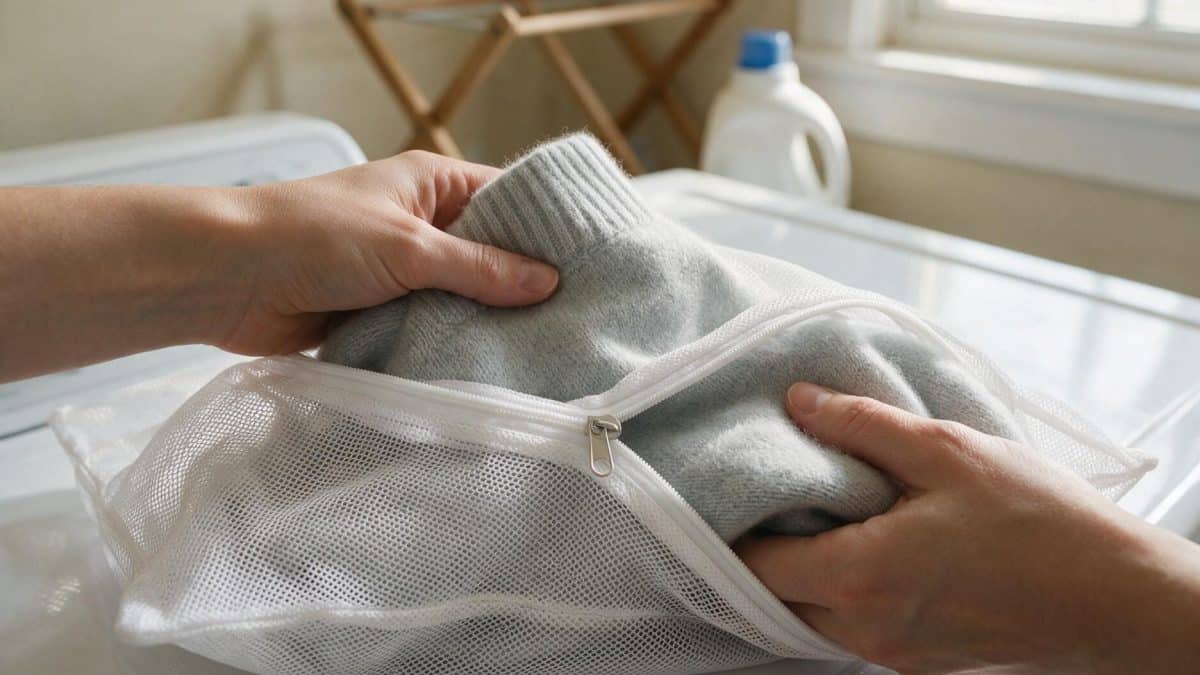
Inside out puts the abrasion on the face you do not look at, so pills form where cuffs meet sleeves rather than across the chest. The mesh bag stops the sweater wrapping itself around the drum paddles. Wash cashmere with cashmere, or on its own — never with denim, towels or anything with a zip.
Set wool or delicates, 30 °C, low spin
Choose the wool programme if the machine has one. If it does not, delicates or a cold wash is the fallback Woolmark itself names. Set the spin as low as the machine allows. A wool programme caps it for you; on delicates you usually have to turn it down yourself, and it is the setting people forget.
Use half the detergent you would for a shirt
A cashmere sweater is light and holds little soil, and detergent residue left in the fibre is what makes a clean sweater feel scratchy. Enzyme-free, pH-neutral, no bleach, no fabric softener. Softener coats the fibre and flattens the loft that you paid for.
Take it out as soon as the cycle stops
A knit left folded in a warm drum does not felt, because nothing is moving. What it does is set creases along the folds it is lying in, hold water unevenly so the wet parts stretch, and start to smell musty within a few hours. Take it out while it is evenly damp and deal with it then.
Roll it in a towel, then lay it flat and push it back to shape
Lay the sweater on a dry towel, roll the two together like a swiss roll, press down along the roll, then unroll. Move it to a second dry towel or a flat rack and work it back to its own measurements with your palms while it is still damp. Never wring it, and never hang it wet. Keep it out of direct sun and away from a radiator.
De-pill once it is bone dry
A wash raises pills that were already forming; it rarely creates them from nothing. Wait until the knit is fully dry, then take them off with a comb or a shaver, working in one direction. A brief pass with a steamer held clear of the surface lifts the fibres back up afterwards.
What felting is, and why nothing brings it back
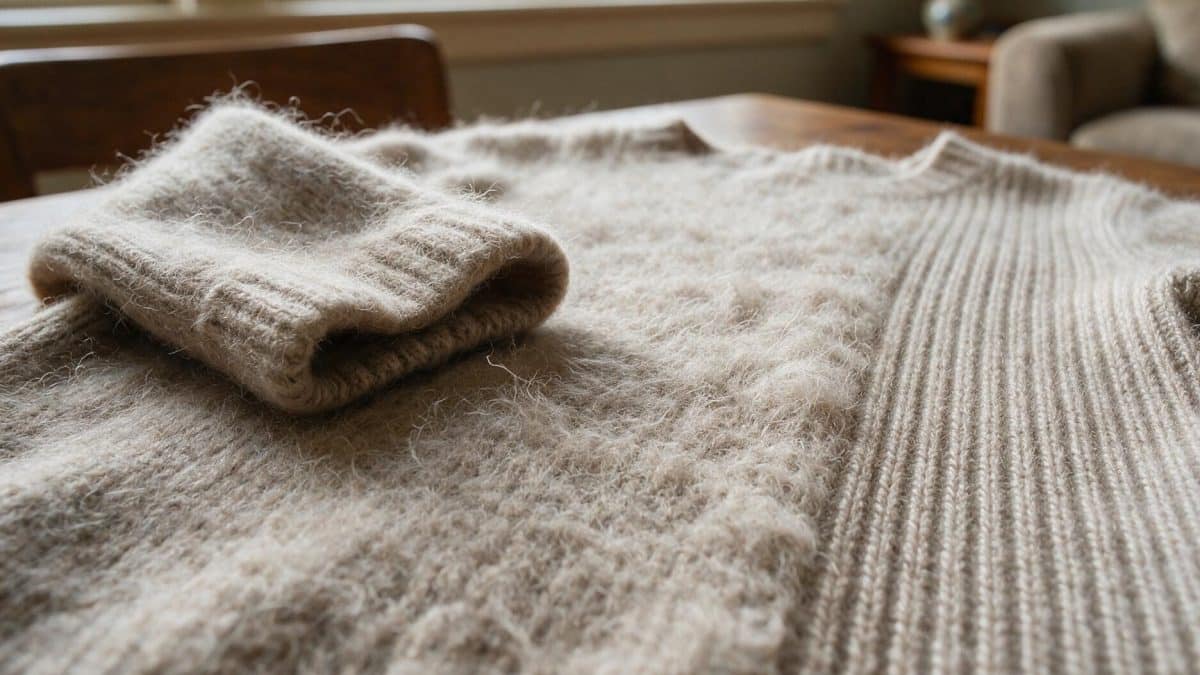
Cashmere is keratin — a protein fibre, structurally closer to hair than to cotton. Each fibre is sheathed in overlapping cuticle scales that point in one direction along its length. Warm water makes the fibre swell and those scales lift away from the shaft. Agitation then slides the fibres past one another, and lifted scales on neighbouring fibres catch like the teeth of a ratchet. They travel one way and will not travel back. The fabric pulls in on itself, the knit closes up, and what you take out of the machine is a smaller, denser, permanently matted object.
That is why felting is not a stain to treat or a shrink to reverse. It is a mechanical lock, not a chemical change, and there is nothing you can add to the water to unpick it. Measured under a microscope, cashmere carries fewer and flatter cuticle scales than fine sheep’s wool, which is part of why it feels the way it does. That is not a licence to treat it as the tougher fibre. The yarn is finer and more softly spun, so the same cycle that leaves a chunky wool jumper looking rough will thin a cashmere one, and a cashmere knit has far less structure holding its shape while it is wet.
Shrinkage and felting are worth separating, because people use the words interchangeably and only one of them is final. If the knit structure is still visible and the sweater is simply a size down, the fibres have tightened but not locked; soaking in cool water with a little hair conditioner or baby shampoo and pinning the damp garment out to its old measurements often recovers much of the loss, though never predictably and rarely all of it. If the surface has closed into a dense mat and you can no longer see the stitches, that is felting, and the garment is now a different fabric.
The three dials that decide the outcome
Three of the rows below are dials on the machine, and that is where the outcome is settled; the other two are what goes in the water and what happens when the drum stops. Where published sources disagree, they disagree on the number rather than the direction.
| Setting | Set it to | Where the guidance splits |
|---|---|---|
| Temperature | 30 °C (86 °F) or below | Woolmark permits a certified wool cycle at 40 °C (104 °F); cashmere sellers publish cool or cold. 30 °C satisfies both, and 20 °C (68 °F) is safer still if the sweater is only lightly worn |
| Cycle | Wool, or delicates if there is no wool programme | No real disagreement. A wool cycle moves the drum intermittently rather than continuously; Woolmark names cold wash or delicates as the fallback |
| Spin | The lowest the machine offers | Consumer guidance rarely names a speed, and a wool programme caps it for you. Spinning is not the same hazard as agitation: even Johnstons of Elgin, which publishes hand washing only, says a short light spin in a machine is the way to get the water out |
| Detergent | Enzyme-free, close to pH-neutral | Standard laundry detergents are alkaline; wool and cashmere do best close to neutral. Alkali lifts the scales and weakens keratin before agitation even starts, and Woolmark’s own instruction is a mild, neutral, bleach-free detergent |
| Drying | Flat, in shade, no heat | Unanimous, across every brand and every standards body |
Never put cashmere in a tumble dryer, on any setting, including air-fluff. Tumbling supplies sustained movement to a garment that is still damp and warming up, which is the exact recipe for felting rather than a milder version of it. This is one of the few hard rules on this site: there is no low setting that makes it safe, and no way to undo it afterwards.
Machine-washable cashmere is a treated fibre, not a better one
Some cashmere is sold explicitly as washable, and that label is describing a chemical treatment rather than a grade of goat. The usual route, called superwash, runs the fibre through a chlorine bath that erodes the tips of the cuticle scales and strips the natural fatty layer sitting on top of them, then coats the fibre in a polymer — most often Hercosett 125, a polyamide-epichlorohydrin resin — that seals the remaining scales under a thin membrane. Enzyme and ozone treatments reach the same result by other means, and a label almost never says which was used.
Scales that cannot lift cannot interlock, so the fibre cannot felt. It also cannot behave quite like untreated cashmere. The coating changes how the surface takes light and how the yarn springs back, and the garment can still stretch out of shape if you hang it wet or leave it in a dryer, because the treatment addresses felting and nothing else. There is no way to tell treated from untreated by touch alone, which makes the care label the only reliable source. If a sweater is marketed as machine washable, follow the temperature its own label gives rather than assuming it now tolerates anything.
What a bad wash does, and what can be undone
| What you see | What caused it | Recoverable |
|---|---|---|
| Pills at the cuffs and underarms | Friction in the drum, against itself or other garments | Yes |
| A size smaller, stitches still visible | Water warmer than the fibre likes, or a warm rinse after a cool wash | Usually |
| Dense, matted surface, stitches gone | Heat and sustained agitation together — almost always the dryer | No |
| Dropped shoulders, sagging cuffs | Hung to dry while wet, or dried on a hanger | Usually |
| Thin patches and small holes at wear points | Protease in a biological detergent attacking a protein fibre during the wash; the weakening only shows later | No |
| Yellow cast and a harsh, papery handle | An alkaline detergent, or any bleach at all | No |
Three rows in that table have no route back, and two of them look harmless while they are happening. A dryer cycle is thirty comfortable minutes; an enzyme detergent leaves a sweater that looks fine coming off the rack and gives way at an elbow two wears later, long after you have stopped associating it with the wash.
Related guides
A few adjacent situations need a different approach:
- For the full method — hand washing, stains, storage and moths — and how cashmere behaves outside the laundry, see how to clean cashmere.
- Sheep’s wool has coarser scales and felts more readily, so the settings that work here are the ceiling rather than the middle. See can you machine wash wool.
- Silk is the other protein fibre in the wardrobe and shares the enzyme problem exactly, but fails by water-marking rather than felting. See can you machine wash silk.
- If the label rules the machine out, the basin method and the rinse it depends on are here: how to clean clothes by hand.
Questions
My label says hand wash only. Does a certified wool cycle count as hand washing?
No, and Woolmark keeps the two apart: the wool cycle is what it gives for garments labelled machine washable, and it sends hand-wash-only garments to a basin. A good wool cycle is mechanically gentle, and plenty of hand-wash-only sweaters come through one unharmed. But that is a risk you are choosing against the maker’s instruction, not a permission the certification hands you. Machine wash the labels that allow it and hand wash the ones that do not.
Can I use the dryer on low or air-fluff for just a few minutes?
No. Air-fluff still tumbles, and tumbling a damp knit is the felting mechanism itself rather than a gentler version of it. The heat setting changes how fast it happens, not whether it happens. Lay it flat instead; a cashmere sweater dries in a day.
Is wool detergent worth buying, or will any gentle detergent do?
What matters is two properties, not the label on the bottle: no enzymes, and a pH close to neutral. Any detergent sold as non-biological meets the first, and most delicates liquids are close enough on the second. Clear baby shampoo meets both, and so do the cashmere shampoos the knitwear houses sell. What will not do is a standard detergent, which is both alkaline and enzymatic.
How often does cashmere actually need washing?
Less often than most clothes, and the published advice varies. Johnstons of Elgin recommends washing after every three or four wears; Quince says most pieces go five or six. Both are reasonable, and the difference is really about how it is worn — over a shirt or against bare skin. Airing a sweater overnight between wears does more for it than an extra wash.
Can I wash cashmere with other clothes to fill the drum?
Only with other cashmere or fine knits. A wool cycle is designed to run a small load in a generous amount of water, so a half-empty drum is the normal case rather than a fault. Adding a pair of jeans or a towel to bulk it out gives the knit something abrasive to rub against for the whole cycle, which is exactly what the mesh bag is there to prevent.
Is dry cleaning safer than machine washing?
It is a different risk rather than a lower one. Cashmere labels commonly carry the P symbol, which permits professional cleaning in perchloroethylene or hydrocarbon solvents, and a solvent bath cannot felt the fibre the way water and movement can. What it does do is strip natural oils over repeated cycles, and it costs money each time. For an ordinary worn sweater with no oily stain, a correct cold wash treats the fibre better than frequent dry cleaning does.