How to Clean UGG Boots (Wet the Whole Boot, Not the Mark)
UGG twinface is one hide: suede outside, fleece inside, nothing between. That is why you wet the whole boot rather than the mark, and why no washing machine cycle is a gentler option.
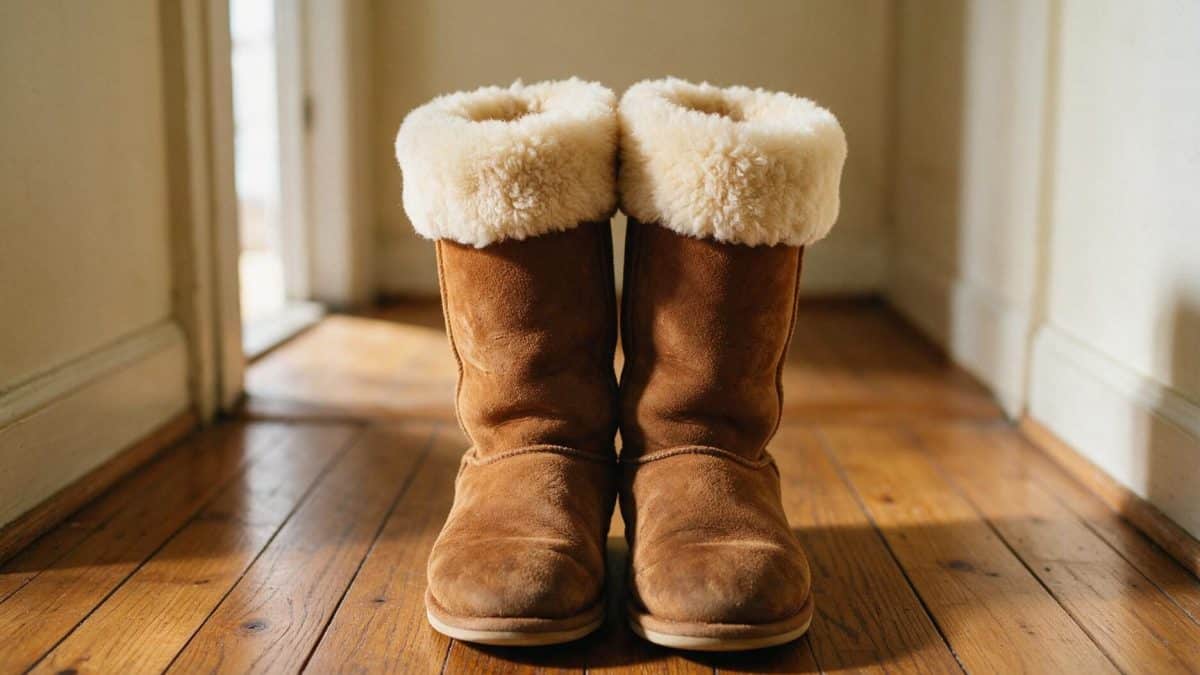
Quick answer · care label Twinface sheepskin — suede face
-
1 · Wash
Do not wash -
2 · Bleach
No bleach -
3 · Dry
Dry in shade -
4 · Iron
Do not iron -
5 · Pro care
No dry clean
In one line Brush dry, then dampen the entire outer surface with cold water so no tide mark can form, clean and rinse with a sponge, and stuff to shape before drying 24 hours away from any heat. Brush the nap back up at the end. Total hands-on time: 25 minutes.
Why does cleaning one dirty patch leave a bigger mark than the dirt did?
Because a classic UGG is made of twinface sheepskin, and twinface is a single hide. The suede you can see and the fleece against your foot are two faces of the same skin, tanned on both sides, with nothing in between them. There is no lining, no membrane, no sealed outer layer. Water that lands on the outside does not sit on the surface the way it would on a coated boot. It goes in.
That is why the usual instinct fails. You see a splash mark near the toe, attack it with a damp cloth, and when the boot dries you have a pale halo around a darker patch — larger and straighter-edged than the mark you were removing. Suede dries unevenly wherever wet met dry, and the minerals in tap water concentrate along that boundary as the moisture evaporates. A tide line is not dirt. It is a drying edge, and you cannot scrub it off.
UGG’s own instruction is the fix, and it reads as counterintuitive until you know why: moisten the entire surface with clean, cold water before you clean anything. Not the mark. The whole boot. If every part of the outer face is equally damp, there is no boundary for a tide line to form along.
Whatever you do to one part of the boot, do to all of it, then dry it slowly with the shape held. Even wetting, even cleaning, even rinsing. Every classic UGG failure — the halo, the stiff patch, the crease across the ankle — comes from treating one area differently from the rest.
What you’ll need
| Item | Why | Substitute |
|---|---|---|
| Sheepskin cleaner and conditioner | Cleans the nap while putting back some of the oils the water takes out; UGG’s own is diluted half and half with water before it goes on | A very dilute wool wash — weaker than you would mix for a jumper, and rinsed out completely |
| Suede brush | Takes dry soil off before any water goes near it, and raises the nap again afterwards | A clean, soft, dry toothbrush |
| Two sponges | One to clean with, one kept for rinsing; a dirty sponge puts back what you just lifted | Two folded microfibre cloths |
| White vinegar | The common home treatment for a chalky road salt ring, well diluted and used sparingly | A second pass with the sheepskin cleaner, which is the lower-risk route and the one UGG points to |
| Paper towel | Stuffed in, it holds the toe box and the shaft while the boot dries soft | Plain packing paper. Not newsprint — the ink transfers onto damp suede |
| Bicarbonate of soda | Left overnight in the fleece, it takes out the smell that cleaning the outside never touches | Cornflour, or equal parts of both |
The one item worth buying rather than improvising is a proper sheepskin cleaner. Washing-up liquid and laundry detergent are formulated to strip oils, and oils are what keep tanned sheepskin flexible.
The method, step by step
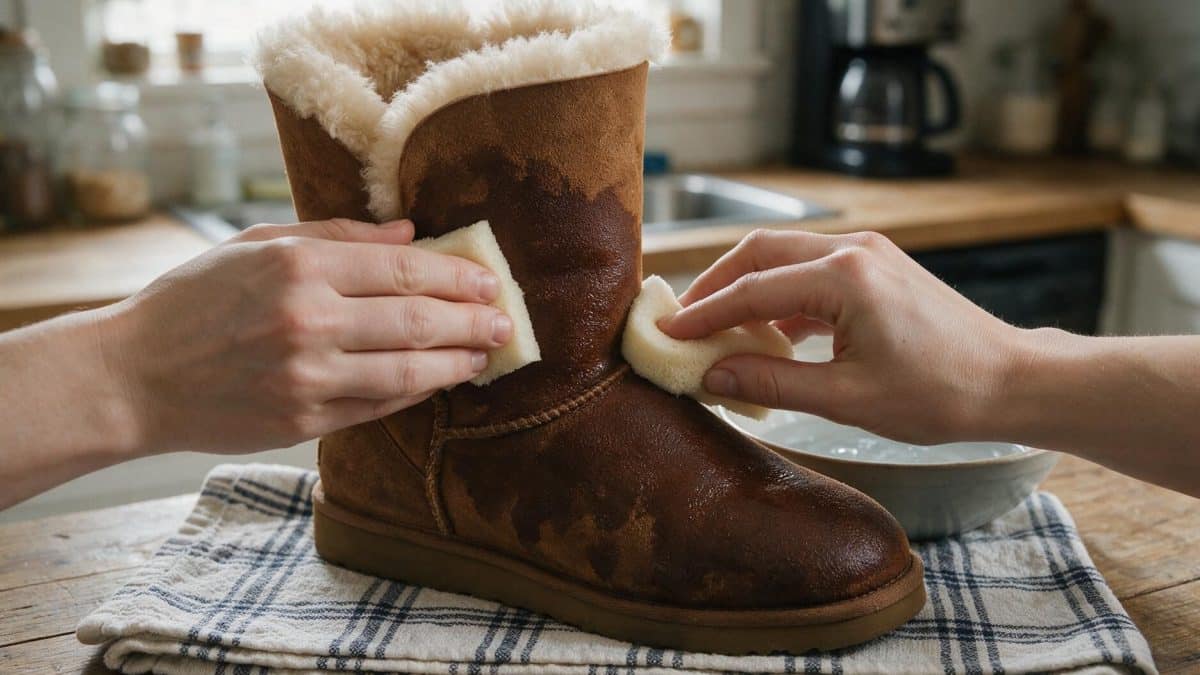
Brush the whole boot dry, and empty it
Short strokes in one direction, over every surface including the back of the heel and the fold at the ankle. Anything left on there becomes mud the moment you add water. Take the insoles out if they lift.
Wet the entire outer surface, not the mark
Clean, cold water on a sponge, worked evenly over the whole outside of both boots until the suede is uniformly damp. Damp, not soaked. This is the step people skip, and the one that decides whether you end up with a tide line.
Clean the whole area, gently
Dilute the cleaner half and half with water, which is what UGG’s own instructions specify, then work a small amount over the full surface on a wet sponge rather than concentrating it where the dirt is. Sheepskin has a delicate face: the pressure that would be fine on a canvas trainer flattens and burnishes this nap permanently.
Go back over salt rings with diluted vinegar
If there are chalky white lines, one part white vinegar to one part water on a cloth, pressed on and lifted rather than rubbed. This is a household fix rather than a manufacturer instruction, so test it on the back of the heel first. Undiluted vinegar, or vinegar left to dry in place, stiffens the leather — a harder problem than the salt was.
Rinse with clean cold water and the second sponge
Keep rinsing the sponge and going over the boot until no cleaner or vinegar remains. Residue dries as a stiff patch and attracts dirt faster than bare suede does. Rinse evenly, for the same reason you wet it evenly.
Blot, then stuff to shape
Press a dry towel against the outside to take the surplus water out — press, never wring. Then pack paper towel firmly into the toe and up the shaft so the boot stands on its own. Damp sheepskin holds whatever shape it dries in, and a slumped boot dries with a fold across the ankle that no amount of brushing removes.
Dry for 24 hours, cool, ventilated, no heat
UGG’s figure is 24 hours in a cool, ventilated place, out of direct heat and sunlight. Treat it as a minimum: a soaked pair takes longer, and the part still wet is the fleece inside, not the suede you can feel. Reach in before deciding they are done.
Brush the nap up, then protect
Once bone dry, brush the whole boot again in one direction to lift the fibres and even out the shading. Then a protector spray, held about 15 cm (6 in) away, and another full drying period before you wear them.
Twinface is one hide, and that is the whole problem
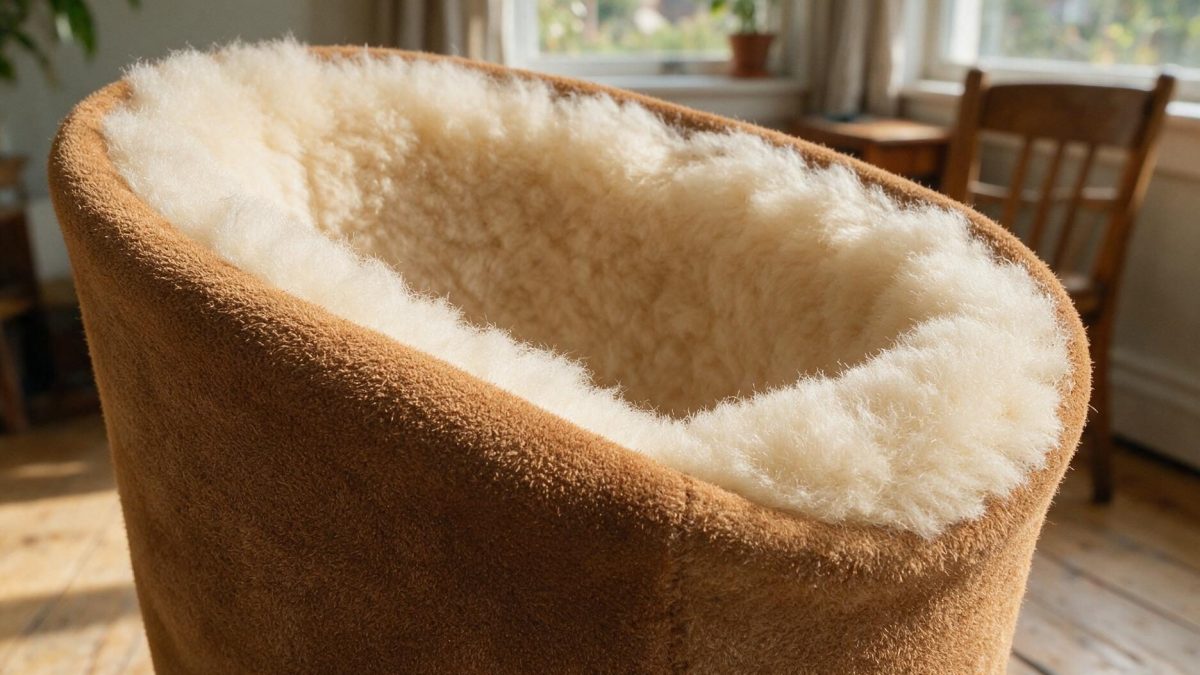
Almost everything that goes wrong with UGG boots traces back to the construction. A sheepskin was tanned with the wool still attached. One face became suede, the other kept the fleece, and there is no seam holding them together because they were never separate.
That gives you two materials with opposite weaknesses in one object, and no way to treat either alone. The suede face is uncoated leather: porous, quick to absorb, stiff if it dries without its oils. The wool face is raw fibre with microscopic scales along each strand, and when those scales are wet, warm and rubbed together they hook and will not come apart. That is felting, the same mechanism that shrinks a jumper two sizes — see can you machine wash wool for why it is irreversible.
Worth checking before you start: not every boot with an UGG label is twinface. The brand also builds styles with a separate woven wool lining sewn into a leather or suede upper, and a designated waterproof line. Look at the top edge of the shaft — twinface shows one continuous piece of skin rolling from suede outside to fleece inside, with no stitched seam between the two.
What the washing machine actually does
This one has an unambiguous answer, which is rare here. UGG’s published guidance is hand cleaning only: no washing machine, no tumble dryer, no dry cleaning. That is the manufacturer’s own instruction, not a cautious reading of it.
A wash cycle supplies all three felting conditions at once — water, warmth and sustained agitation — to the exact material worst at surviving them. The fleece mats into a hard, thin layer, which is why boots out of a machine feel a size smaller and stop being warm. The suede side is soaked, then wrung out at spin speed, and dries board-stiff and pale. Neither is a stain problem you can go back and fix. The fibre itself has changed.
Machine wash, tumble dry, dry clean, or dry these near a radiator, in a car footwell with the heater on, or in direct sun. There is no gentle cycle that makes the machine safe — not 30 °C (86 °F), not a mesh bag, not the wool programme. The agitation alone does the damage.
Common UGG boot stains
All of these start the same way: whole boot, cold water, even drying. The differences are in what you add.
| Stain | Treatment | Recoverable |
|---|---|---|
| Road salt rings | 1:1 white vinegar and water, tested on the heel first, then rinsed off with clean cold water and dried stuffed | Yes |
| Rain tide marks | Re-wet the entire panel evenly so the old drying edge disappears, then dry it properly | Yes |
| Dried mud | Let it dry hard, brush it out, then clean the whole boot. Never scrape mud while wet | Yes |
| Oil or grease | Bicarbonate of soda or cornflour pressed on and left overnight, brushed off, repeated if needed | Usually |
| Smell in the fleece | Two or three tablespoons of bicarbonate of soda inside each boot overnight, then shaken and vacuumed out | Usually |
| Dye transfer from dark denim | No reliable home treatment on pale suede; the dye has bonded to the fibre, not settled on it | No |
Protector spray, and how often to actually reapply
A water and stain repellent is the difference between a splash that beads and a splash that becomes a tide mark. Apply it before the first wear, on clean dry boots, from about 15 cm (6 in) away, until the surface is evenly damp rather than saturated, then leave 24 hours to dry.
How often to redo it is where published advice diverges, and no one interval is established: recommendations run from after every wet outing to a couple of times a season. What is not in dispute matters more. Reapply after every wet clean, because cleaning strips the previous coat along with the dirt.
Choose a protector sold for suede, nubuck or sheepskin, and check it is silicone-free. Silicone-based sprays seal the nap rather than coating individual fibres, and on a raised nap that reads as a flattened, slightly shiny patch you cannot brush back up.
Related guides
Several neighbouring cases look like this one and are not.
- The indoor version never meets road salt, but takes far more body oil and smell through the fleece. See how to clean UGG slippers.
- A suede boot with a separate fabric lining can be treated more freely on the outside, because the inside is not the same piece of material. See how to clean suede boots.
- For the general nap method behind all of this, and how suede differs from nubuck, see how to clean suede.
- If the smell comes back within a week of cleaning, the problem is bacterial rather than dirt. See how to clean smelly shoes.
Questions
Can I put UGG boots in the washing machine?
No, and this is one of the few hard rules rather than a judgement call. UGG’s own instruction is hand cleaning only, no machine and no dryer. Water plus agitation felts the wool into a hard, thin mat, permanently, and the suede dries stiff after being spun. Boots out of a machine often feel a size smaller and are no longer warm.
My UGGs got soaked in the rain. Have I ruined them?
Almost certainly not. Sheepskin tolerates being wet; what damages it is drying fast, drying hot, or drying in a slumped shape. Stuff them with paper towel straight away, stand them upright somewhere cool and ventilated, and leave them well past the point where the outside feels dry. If a tide line appears once they are dry, re-wet the whole panel evenly and dry them again.
Why do my UGGs still smell after I have cleaned the outside?
Because the smell is not on the outside. It is in the fleece, which holds sweat the way a sock does, and cleaning the suede face does nothing to it. Bicarbonate of soda left in overnight and vacuumed out is the standard treatment, repeated monthly as prevention rather than only once they smell.
Can I take UGG boots to a dry cleaner?
Not to a conventional one — UGG says explicitly not to dry clean sheepskin, and solvent cleaning is not designed for a hide with the wool still on it. A specialist sheepskin cleaner is a different trade using a different process, and is reasonable for a favourite pair with a stain the method above will not shift. Ask which of the two you are dealing with before handing anything over.
Do UGG boots shrink when they get wet?
Water alone does not shrink them meaningfully; water combined with heat and agitation does. That is exactly what a wash cycle or a tumble dryer provides, which is why the felted, tighter-fitting boot is so strongly associated with machine washing. Air drying at room temperature with the shape held is the safe path.
How often should I be cleaning them?
Less often than you would think. A full wet clean strips oils and protector every time, so most pairs need one once or twice a season at most. Brushing every few wears and dealing with salt promptly postpones the wet clean rather than replacing it.