How to Clean a Hat Without Losing Its Shape
A hat is a shape before it is a fabric, and the shape lives in a stiffener you cannot see. Work out whether it is plastic, starch or cardboard before the hat gets wet, not after.
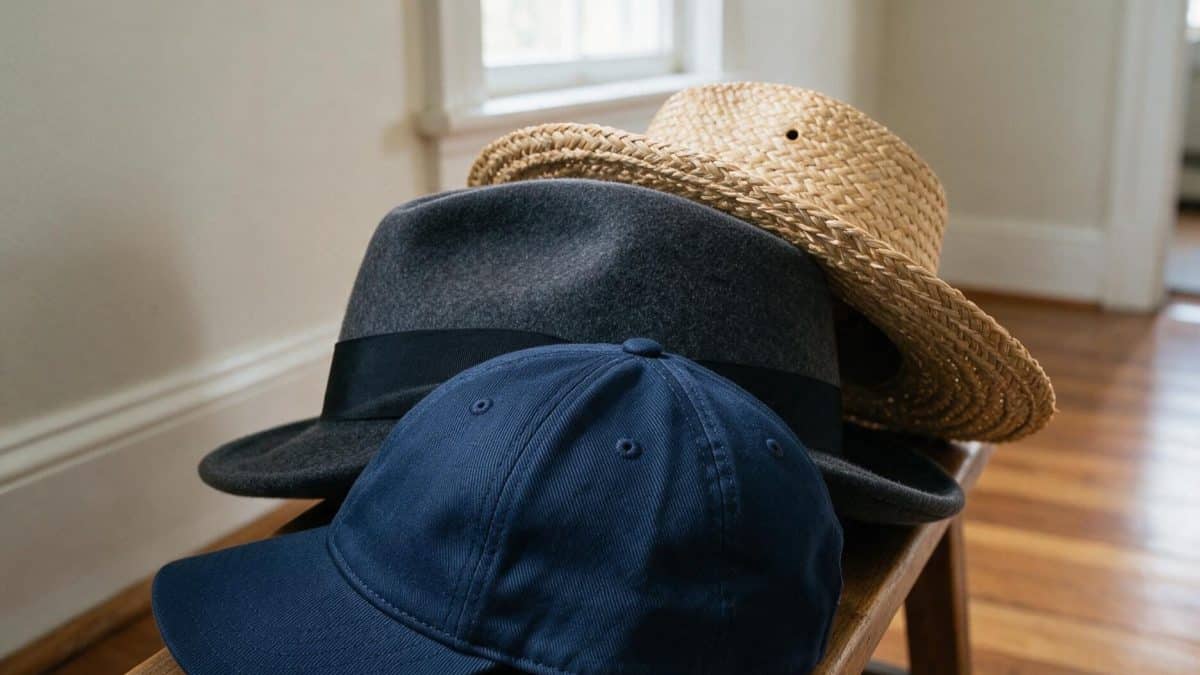
Quick answer · care label Cotton twill, wool felt & straw
-
1 · Wash
Hand wash -
2 · Bleach
Oxygen bleach -
3 · Dry
No tumble dry -
4 · Iron
Do not iron -
5 · Pro care
No dry clean
In one line Find the stiffener before anything gets wet: flick the brim and fold the sweatband, because cardboard and leather rule out water entirely. Brush the hat dry, work liquid detergent into the sweatband by hand, soak in cool oxygen bleach if there is a yellow ring, then clean the crown in water no warmer than 30 °C (86 °F) and dry it over a bowl in the shade. Wool felt and straw are cleaned dry instead, with a brush and an eraser. About 20 minutes hands-on.
Will cleaning a hat ruin the shape?
A shirt has no shape of its own, so a wash cannot take one away. A hat is the opposite: it is a shape first and a piece of fabric second, and the shape is the part you paid for.
That shape comes from something you cannot see. In a structured cap it is a stiffener behind the front panels and an insert in the brim. In a felt hat it is the felt itself, blocked over a wooden form under steam. In a straw hat it is the tension of the weave. The outer fabric of almost any hat survives cleaning without complaint. Those hidden parts are what decide whether the hat does.
So the answer splits. A hat stiffened with plastic can be soaked, scrubbed at the band and reshaped, and it comes back. One stiffened with starch, glue or cardboard, or held together only by felting or weave tension, cannot. Everything below is about telling those apart before the hat is wet, because once it is wet the decision has been made for you.
Clean the fabric, protect the stiffener, and never let a hat dry unsupported. Nearly every ruined hat is one of two failures: something structural softened in water, or the hat dried flat, folded or hanging from a peg and set that way.
What you’ll need
| Item | Why | Substitute |
|---|---|---|
| Soft-bristled brush | Dry dust that goes into water has to be rinsed back out, and that is where a dull cast comes from | A dry toothbrush, or a horsehair shoe brush |
| Old toothbrush | The only tool that reaches the fold of a sewn sweatband, where the dirt actually is | A nail brush, or a cloth over a fingertip |
| Mild liquid laundry detergent | Cleans without the heavy foam of dish soap, which is hard to rinse out of a fold | Clear baby shampoo, or a wool wash |
| Oxygen bleach powder | The yellow ring is oxidised body oil, and it needs an oxidising agent rather than more detergent | 3% hydrogen peroxide, one part to three of water |
| Two white cloths | One to apply, one to blot, and white so nothing transfers the other way | A cut-up white T-shirt |
| Something round to dry it over | A wet hat sets into the shape it dries in, and only a head-sized form gives the right one | A mixing bowl, a canister, or a balled-up towel |
The method, step by step
Find the stiffener before anything gets wet
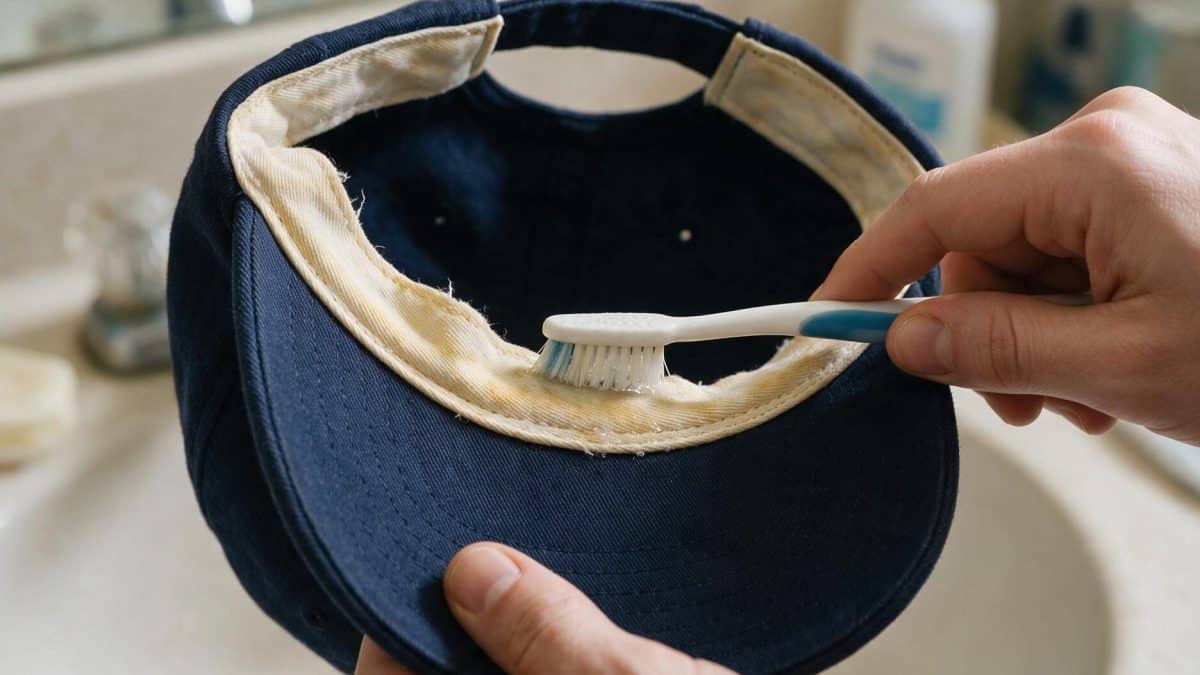
Flick the underside of the brim and bend it. Plastic clicks and springs back; cardboard sounds hollow and holds the crease. Pinch the front panels together: they give if the stiffener is soft or plastic, and feel like one board if it is buckram. Then fold the sweatband away from the crown: cloth folds flat, leather keeps the fold. Cardboard or leather means spot cleaning only, and you stop here.
Brush the whole hat dry
Crown, then the underside of the brim, then inside. Everything you take off dry is something you do not have to rinse out later.
Work the sweatband by hand first
A drop of liquid detergent straight onto the band, no water yet, and a minute with the toothbrush along both faces. The fold of a band is the one part of a hat that no soak or cycle can rub.
Soak in cool oxygen bleach if there is a yellow ring
Powder dissolved in cool water, one hour, no agitation, and only if the front panels gave when you pinched them. If the front felt like one board, keep the liquid to the sweatband and the brim: an hour of soaking is the thing that softens buckram. Where it is safe, a soak spends chemistry and time instead of mechanical action, so it costs the hat nothing. Skip it on unwashed dark cotton unless you have checked for dye bleed as how to clean stains from clothes describes.
Clean the crown, and submerge only if the stiffener allows
Cool water, no warmer than about 30 °C (86 °F), with a little detergent. If the brim insert is plastic and the front panels gave, the hat can go under and be swished by hand. If the front felt like one board, wipe it with a wrung-out cloth instead: New Era says structured fitted caps like the 59FIFTY should be spot cleaned, never machine washed or submerged.
Rinse until the water runs clear
Detergent left in a sweatband is a fresh source of the stiffness and smell you were removing. Change the water two or three times and squeeze the band rather than scrubbing it again.
Press the water out in a towel, never wring
Lay the hat on a dry towel, fold it over, press. Twisting a wet crown is what puts a permanent crease across the front panels.
Reshape while wet and dry it over the form, in shade
Pull the crown over the bowl, run a thumb along the brim to set the curve you want, and leave it in moving air, out of sun and away from any radiator. Fabric sets as it dries, which is why a wet hat looks so alarming and so rarely stays that way.
The stiffener decides everything, and it takes ten seconds to find
Three materials stiffen hats, and they behave completely differently in water.
Plastic. A moulded brim insert and, in newer performance caps, a perforated mesh behind the front panels. Water passes through and out again and it keeps its dimensions exactly. It is the only stiffener genuinely indifferent to a wash.
Buckram. An open-weave cotton or linen cloth stiffened with starch or glue, sewn or fused behind the front panels of most structured caps. The failure is undramatic: a long soak dissolves the size, the crown goes soft, and the cap gets the slumped look people call losing its shape. Steam and reblocking bring some of it back. A wash does not.
Cardboard. Older caps only, and it does not survive water in any form. A widely repeated rule of thumb puts the switch to plastic at around 1983, useful to know but poor to rely on, since bending the brim settles it in a second.
This is also where published advice contradicts itself. New Era is explicit that structured fitted caps and any cap with a cardboard visor must be spot cleaned, never machine washed or submerged. Advice that says caps wash fine is describing a soft unstructured cap without saying so, and this site’s own can you machine wash hats argues the drum does the damage rather than the cap. Cleaning by hand sidesteps the argument, which is why it is the method here.
Wool felt and straw are cleaned dry
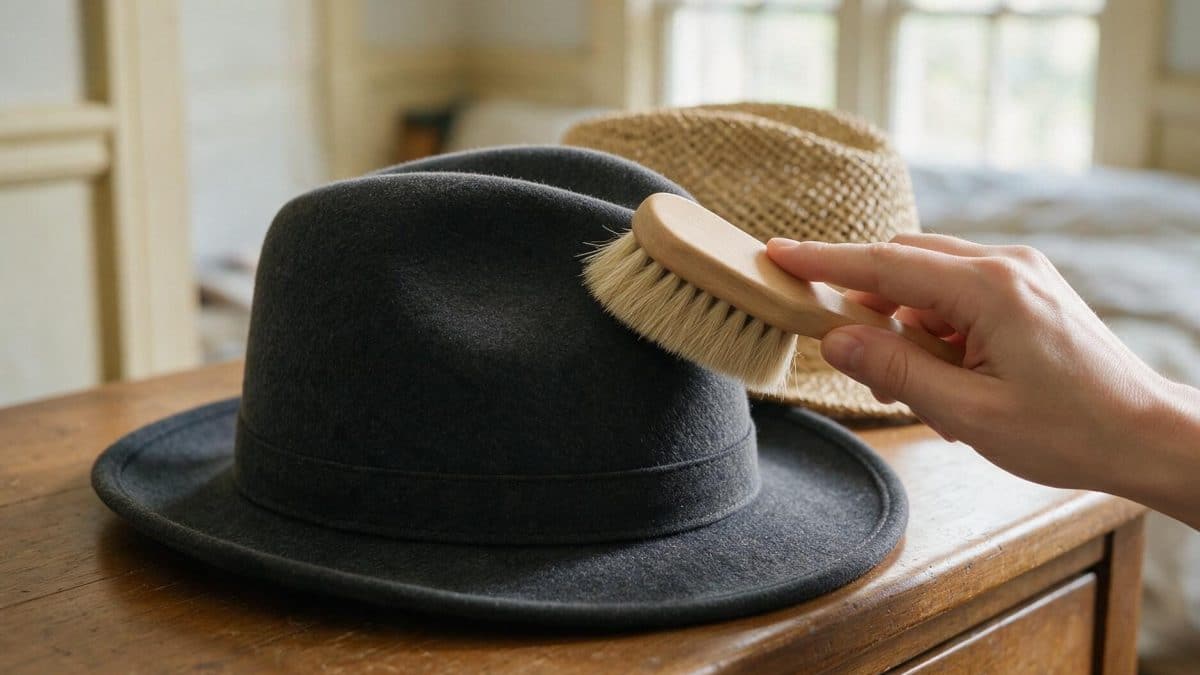
Felt and straw are cleaned without water, and every mistake people make with them comes from treating them as fabric.
Felt is cleaned with a brush. Published felt-care advice is consistent on the direction: counter-clockwise, starting at the left, because the nap was laid that way in finishing. Take that as a convention worth following rather than something you can verify at home. For a grease spot, cornstarch or talc left on overnight and brushed off draws the oil up, and repeating it twice does more than pressing harder. For a scuff, a suede eraser. Liquid cleaners and spray-on products have no place on felt, because there is no rinse step to take them out again.
If a felt hat is caught in the rain, shake it off, turn the sweatband out, and stand it on the band somewhere cool. Heat shrinks a felt crown and hardens the surface. Steam from a kettle softens felt enough to reshape a dent by hand; an iron presses the nap flat and glazes it permanently.
Straw is a different problem with the same conclusion. Each strand is a dried plant fibre, effectively a rigid tube. Water swells it, the tension holding the weave goes slack, and the fibres contract unevenly as they dry and can end up brittle. That is why a soaked straw hat can dry looking almost right and split along a fold weeks later. Wipe it one small section at a time with a barely damp cloth, and never submerge it.
Knit hats sort by fibre rather than construction. Acrylic and cotton beanies wash like any knit and dry flat. Wool felts when agitation, water and warmth meet, so hand wash those the way how to clean wool and how to clean cashmere describe.
Never dry a hat with heat: not a tumble dryer, not a hairdryer, not a radiator, not a sunny windowsill. Heat shrinks a cotton crown around a brim insert that keeps its exact length, so the fabric puckers around a rigid part. It hardens felt, makes straw brittle, softens the adhesive under a fused panel, and sets any remaining sweat stain permanently. The general case is in how to dry shoes in the dryer.
Common hat stains, and which ones come back
| Stain | What it is | Treatment | Recoverable |
|---|---|---|---|
| Yellow ring on the sweatband | Skin oil that has oxidised, plus salts | Detergent and a toothbrush, then an hour in cool oxygen bleach | Yes |
| White crust on the band | Dried sweat salts, nothing more | A cloth wrung out in plain cool water | Yes |
| Sunscreen or hair product under the brim | Oil sitting on the weave, not yet in it | Neat liquid detergent, ten minutes, then rinse | Yes |
| Grease on wool felt | Oil drawn down into the fibre | Cornstarch or talc overnight, brushed off, repeated | Yes |
| Mildew after storage in a damp bag | Fungal growth that has stained the fibre itself | Brush outdoors, then how to clean mold off clothes | No |
| A sweat ring that went through a hot dryer | The same oxidised oil, now heat-set | Nothing reliably. One oxygen bleach soak, no more | No |
Chlorine bleach belongs nowhere near a hat, even a white one. The yellow on a sweatband is body oil and protein residue, and chlorine reacts with exactly that, deepening the yellow rather than lifting it while weakening the cotton. On contrast stitching or a printed logo it strips dye in a pattern you cannot undo. The same yellowing appears on shirts, and how to clean deodorant stains from shirts covers the version with antiperspirant in it.
Buying a hat you will be able to clean
- Bend the brim. Springs back, it is plastic and washable in principle. Creases, and it is a spot-clean hat for life.
- Fold the sweatband. Stitched cloth is the band you want. A leather band takes the hat permanently out of the water, because it sits in the wet longest and dries hardest, as how to clean a leather jacket describes.
- Look for glue. Iron-on patches, foam fronts and fused stiffeners are bonded, and a bond that has begun to let go does not reattach.
- Ask who cleans it. For a good felt hat the answer is a hatter, not a dry cleaner.
Related guides
- If the hat passes the tests here and you want the machine to do the work, the argument about drums and why gentle is a trap is in can you machine wash hats.
- A dishwasher applies water without tumbling, which suits a rigid cap you will not risk in a drum: how to clean hats in the dishwasher.
- Wool hats fail by felting rather than shrinking, a different mechanism with a different fix: how to clean wool.
- The stain most likely to survive a hat cleaning is the yellow one, and its shirt version is in how to clean deodorant stains from shirts.
Questions
How do I clean a hat without ruining the shape?
Clean it by hand in cool water, keep it out of any dryer, and dry it stretched over something round and roughly head-sized. Shape damage almost always happens while drying rather than while cleaning. A wet hat that looks defeated usually looks normal again after a day over a bowl.
Can I put a hat in the washing machine?
Sometimes, and it depends on parts you have to go looking for rather than on the outer fabric. New Era says its structured fitted caps and any cap with a cardboard visor should never be machine washed or submerged, and that wool blends need cool water and careful handling. A soft unstructured cotton cap with a plastic brim insert generally survives, and how to run that load is in can you machine wash hats. Felt and straw never go in.
How do I get the yellow sweat stain out of a hat?
Treat it as a separate job from cleaning the hat. Work liquid detergent into the band with a toothbrush first, since the fold is the one place nothing else can rub, then soak the hat in cool oxygen bleach for an hour. An oxidising agent does work that more detergent will not. Keep it away from heat until the ring has gone, because heat sets it for good.
Do vinegar or baking soda work on a hat?
Partly, and not for the usual reasons. A baking soda paste left on the band for fifteen or twenty minutes is mildly abrasive and mildly alkaline, and New Era suggests it for sweat marks, so it does something real on fresh soil. Vinegar has a narrow job on mineral salts and some odours. Neither touches oxidised oil, which is what the yellow is.
Can a hat be dry cleaned?
Generally no. A dry cleaner runs garments in solvent, which can attack the adhesive under a fused panel or a patch. A hatter is a different trade, cleaning felt with brushes, steam, sanding and reblocking.
How often should a hat be cleaned?
Less often than most people assume, because every cleaning spends a little of the hat. Brushing takes a minute and can be weekly. A wet clean is worth doing when the band has yellowed or the hat has picked up a smell, which for a cap in regular wear means a few times a year.