How to Clean UGG Slippers (Without Felting the Footbed)
UGG say hand wash only, never the machine and never the dry cleaner. The real constraint is narrower: damp the whole shoe evenly, never soak it, and let it dry cold for a day and a half.
Quick answer · care label Sheepskin — suede upper, wool lining
-
1 · Wash
Do not wash -
2 · Bleach
No bleach -
3 · Dry
Dry in shade -
4 · Iron
Do not iron -
5 · Pro care
No dry clean
In one line Brush dry, lift grease with cornflour and odour with bicarbonate of soda overnight, then damp the whole outer surface evenly with cold water and clean with a sponge rather than pouring cleaner onto the shoe. Rinse cold, stuff with plain white paper and dry cool and shaded for 24 to 48 hours, then brush up both the outer nap and the wool footbed. Total hands-on time: 30 minutes.
Can UGG slippers get wet, or does water finish them?
Water is not what ruins them. UGG’s own cleaning instructions open by telling you to moisten the entire surface of the footwear with clean, cold water — the whole shoe, deliberately, before any cleaner touches it. A maker does not publish that step for an item that cannot get wet.
What ruins UGG slippers is a short list, and only one item on it involves a lot of water. The washing machine is first, and UGG state it flatly: hand clean only, never the machine, never the dry cleaner. Drying them anywhere warm is second. Third is the one people do without realising it is a mistake — dabbing at a single mark with a damp cloth, which dries as a hard-edged tide line more visible than the mark ever was.
Slippers also fail differently from boots. A boot’s problem is a tall shaft creasing and road salt climbing it. A slipper is worn barefoot, indoors, for hours at a stretch, so its problem is on the inside: a wool footbed taking sweat and body heat under a pressing heel, every day, all winter. That is why the method below spends as much attention on the inside as the outside.
Damp the whole shoe evenly, never soak it, and let it dry cold. Every failure below is a version of breaking one of those three: a patch wetted instead of a whole panel, a footbed saturated instead of dampened, or a radiator used instead of a day and a half of patience.
What you’ll need
| Item | Why | Substitute |
|---|---|---|
| Soft suede brush | Raises the flattened nap outside and the matted wool inside without cutting either | A clean, dry toothbrush, used lightly |
| Sheepskin cleaner and conditioner | Made for tanned hide with the wool still attached, so it cleans without stripping the oils out of the leather | A few drops of pH-neutral wool wash in cold water, tested on the heel first |
| Two sponges | One carries cleaner, one carries only clean water for the rinse. The same sponge cannot do both jobs | Two microfibre cloths |
| Plain white paper | Holds the shape while the shoe dries and pulls moisture out of the toe | Kitchen roll. Not newspaper — the ink transfers into damp nap |
| Cornflour (cornstarch) | Draws grease out of suede with no water involved at all | Talcum powder |
| Bicarbonate of soda (baking soda) | Handles the smell, which is bacterial and does not respond to brushing | Cornflour again, mixed half and half |
The method, step by step
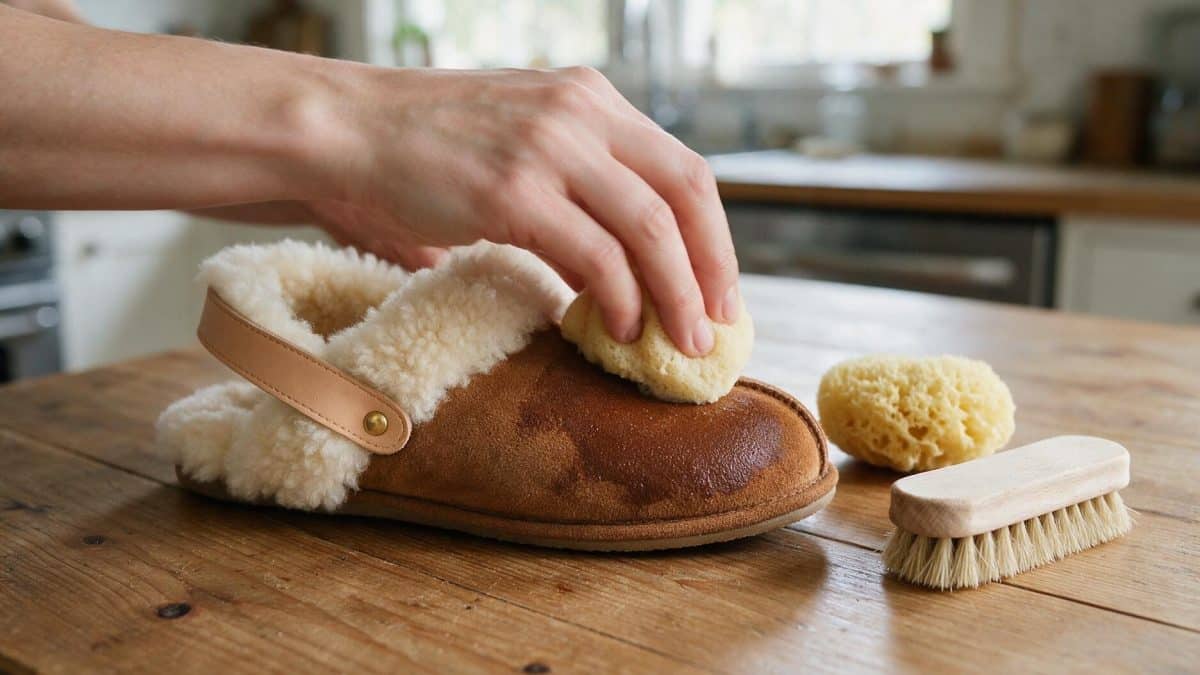
Empty them and brush the outside dry
Tip out the grit, then brush the whole upper with short strokes in one direction. Dry brushing removes more surface dirt than most people expect, and every particle you lift now is one that will not be ground into wet nap in four steps’ time.
Treat grease and smell before any water
Sprinkle a thin layer of cornflour on any greasy spot, leave it several hours or overnight on a large mark, then vacuum it off. For odour, shake a half-and-half mix of bicarbonate of soda and cornflour inside, leave overnight, and tip it out. Both jobs are far harder once the shoe is damp.
Damp the whole outer surface, not the stain
A sponge wrung out in clean, cold water, worked evenly over an entire panel from seam to seam. This is the step that prevents tide lines, and it is what separates a clean that dries evenly from one that leaves a mark where the damp stopped. Do not submerge the slipper: the footbed and the foam under it will hold that water for days.
Clean with the sponge, never with the bottle
A small amount of cleaner onto the wet sponge, then light circles across the damp surface. Never pour cleaner onto the shoe. Sheepskin has a delicate surface that scrubbing damages, so let the product and the water do the work rather than pressure.
Rinse with the second sponge and cold water
Clean, cold water only, taking the residue off in the same panel-by-panel pattern. Leftover cleaner dries as a pale bloom on the nap that looks exactly like the water mark you were trying to remove.
Stuff with plain paper and dry cold
Blot the outside with a towel, stuff lightly — enough to hold the shape, not enough to stretch it — and leave them in a cool, ventilated spot out of sun and away from any heat source. UGG say at least 24 hours; on a lined slipper with a wool footbed, plan for 24 to 48. Change the paper once when it feels damp.
Brush the nap up, and the footbed too
Once bone dry, brush the outside in one direction to raise the nap and even out the surface. Then brush the wool inside, working from the toe back. This is the maintenance step almost everyone skips, and it is the only thing that keeps a footbed from packing down permanently.
The footbed is the part that actually wears out
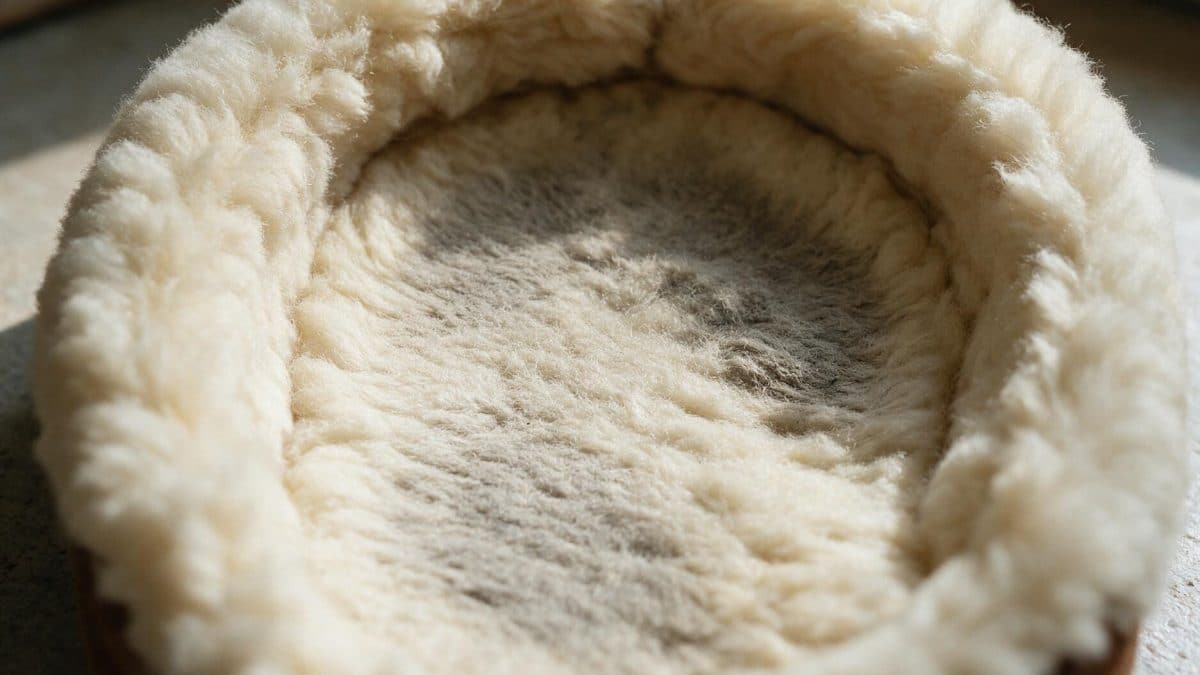
The upper on a pair of UGG slippers will outlast the inside by years. Look at a well-worn Tasman or Scuffette and the suede is fine; the wool under the heel and the ball of the foot has gone flat, dark and slightly hard. That is not dirt, and no amount of cleaning brings it back.
It is felting. A wool fibre is covered in overlapping scales that lift when the fibre is warm and damp; once lifted, friction lets the fibres ratchet past each other and lock, and they do not unlock. A barefoot slipper applies all three conditions — body heat, foot moisture, and the friction of a heel pressing and lifting — for several hours a day. A washing machine simply does the same thing in twenty violent minutes instead of one slow winter.
Two things slow it down. Brushing the footbed up regularly, while the fibres are dry and free, keeps them from packing. And alternating between two pairs gives each one a day to dry out fully, which matters more than any product. Many slipper styles have the insole bonded in rather than removable, so check yours before assuming you can swap one out the way you would on a trainer.
Why the machine is the one thing that cannot be undone
A washing machine does four incompatible things at once to a slipper. It felts the wool lining and footbed, permanently. It saturates the tanned hide, which shrinks and stiffens as it dries fast — leather is collagen, and collagen contracts with heat and moisture together. It floods a glued, foam-cushioned sole assembly that was never designed to be soaked. And it leaves a wool footbed holding water inside a closed shoe, which is how a clean pair comes out smelling worse than it went in.
Even a 30 °C (86 °F) delicates cycle in a mesh bag is still warm water plus mechanical action, which is the exact recipe for felting. A 40 °C (104 °F) wash is worse in every direction.
Sources do disagree here, and it is worth knowing why. In Australia, “ugg” is a generic term for a style of sheepskin boot rather than one company’s brand, and some Australian sheepskin makers publish more permissive washing advice. Deckers’ UGG — the brand on the label if you bought Tasmans or Scuffettes — does not. Follow the instructions from whoever actually made your pair, and when in doubt take the more cautious of the two, because the felting is the failure you cannot reverse.
Machine wash, tumble dry, or take them to a dry cleaner. UGG’s published instruction is explicit on all three. Dry-cleaning solvents also attack the adhesives holding a slipper’s sole and footbed together.
Common UGG slipper stains
| Stain | Treatment | Recoverable |
|---|---|---|
| Fresh water splash | Damp the whole panel evenly to the seams, blot, dry cold | Yes |
| Tide line from an earlier spot clean | Re-wet the entire panel rather than the line itself, then dry evenly | Yes |
| Grease or oil | Thin layer of cornflour, left several hours or overnight on a large mark, then vacuumed off | Usually |
| Salt from outdoor wear | 1:1 white vinegar and water on a cloth, tested on the heel first, pressed on and lifted, not rubbed | Yes |
| Smell | Bicarbonate of soda and cornflour overnight, repeated; alternate pairs so each dries out | Usually |
| Flattened, greyed footbed | Brushing helps before it sets. Once the wool has felted there is no home fix | No |
| Ink or dye transfer from dark socks | Nothing reliable at home; solvents that shift it also strip the nap | No |
Buying a pair that survives daily wear
A slipper takes more barefoot hours than any other shoe you own, which changes what is worth checking before you buy.
- Read the lining spec, not the marketing word. Some styles are lined with genuine sheepskin, others with a wool blend sold under its own name. Anything with wool in it felts under heat and friction, so the fibre content tells you how the inside will age; the lining’s trade name does not.
- Suede outside is easier to keep than wool outside. A suede upper takes a brush and a damp sponge. A sheepskin-out style shows every mark on the surface you then have to clean without felting it.
- A rubber outsole is an invitation to go outdoors. Useful, but it is how salt and grit get into a slipper. If you know you will step outside in them, buy the protector spray at the same time.
- Darker suede hides tide lines. Sand and pale grey show every water mark and every uneven dry.
Related guides
This method is built around an indoor, barefoot, lined shoe. A few neighbouring cases work differently:
- Boots add a tall shaft that creases and a season of road salt, and they need shaping while they dry. See how to clean UGG boots.
- For the underlying nap method, and how suede differs from nubuck and smooth leather, see how to clean suede.
- The felting that ruins the footbed is the same process that shrinks a jumper. See how to clean wool.
- If the problem is smell rather than marks, the cause sits in the lining and comes back on a schedule. See how to clean smelly shoes.
Questions
Can I put UGG slippers in the washing machine?
No. UGG’s published instruction is hand wash only, and specifically not the machine and not the dry cleaner. The lining and footbed felt irreversibly, the hide stiffens as it dries, and the glued sole takes a soaking it was not built for. This is one of the few genuinely hard rules rather than a judgement call.
Mine already went through the machine. Can they be saved?
Partly. Reshape them while still damp, stuff them with plain paper and dry them cold for two full days — that recovers some of the shape and prevents the stiffening from setting worse. Felted wool does not come back, so a flattened, hardened footbed stays that way. Brush the outer nap once bone dry and judge the result then, not while they are damp.
How do I get the smell out for good?
You reduce it rather than end it. Bicarbonate of soda mixed with cornflour, shaken in and left overnight, absorbs both moisture and odour. The reason it returns is that the bacteria live in a lining that never fully dries during daily wear, so the fix that actually holds is alternating two pairs and letting each dry out completely between wearings.
Do I need the branded cleaner, or will washing-up liquid do?
Washing-up liquid is a degreaser, and the thing it degreases on a slipper is the tanned hide, which then dries stiff and pale. A sheepskin cleaner is the safer choice; a few drops of pH-neutral wool wash in cold water is a reasonable substitute. Test either on the heel first. Never bleach, peroxide or ammonia — each one lightens sheepskin and suede in patches that do not come back.
The inside has gone flat and grey. Is that dirt?
Usually not. It is the wool compressing and felting under the pressure points, which reads as darker and denser than the fibres around it. Cleaning it does not lift it because there is nothing to lift. Frequent brushing while the wool is dry slows the process down; once it has set, replacing the pair is the only real answer.
Can I wear UGG slippers outside?
Many have a rubber outsole intended for exactly that, so yes, in the sense that the sole can take it. What comes back inside is the problem: grit that abrades the nap, and in winter road salt, which dries as a chalky ring. If they go outside regularly, treat them with a protector spray and use the vinegar treatment above on any salt marks before they set.