How to Clean White Converse (Without the Yellowing)
A white Converse is two materials pretending to be one shoe. Yellow canvas is leftover cleaner that was never rinsed out; yellow rubber is the polymer oxidising, and only one of those is your fault.
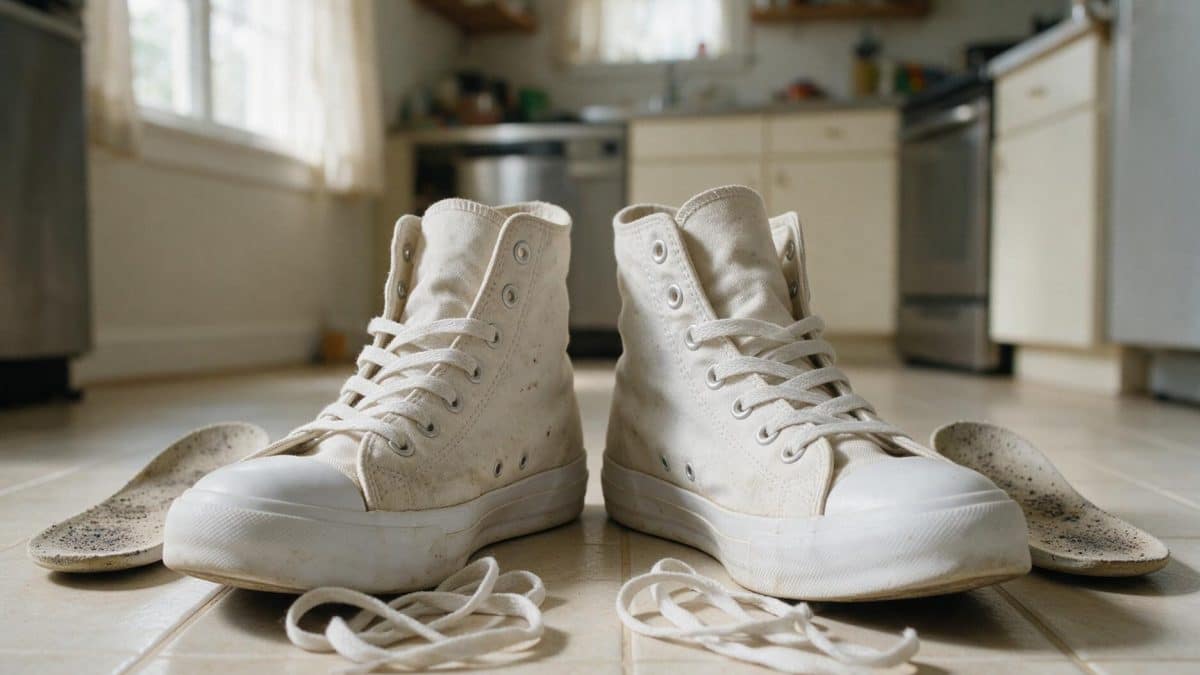
Quick answer · care label Cotton canvas — vulcanised rubber sole
-
1 · Wash
Do not wash -
2 · Bleach
Oxygen bleach -
3 · Dry
Dry in shade -
4 · Iron
Do not iron -
5 · Pro care
No dry clean
In one line Treat the canvas and the rubber as two separate jobs. Brush the canvas with a mild detergent solution and rinse it thoroughly before it dries, clean the foxing tape and toe cap separately with a melamine sponge or a baking-soda paste, then dry at room temperature out of direct sun. No chlorine bleach at any stage. About 25 minutes hands-on.
Why do white Converse often come out of a clean looking yellower than they went in?
Because a white Converse is two materials pretending to be one shoe, and the treatment that brightens one of them ages the other. The upper is cotton canvas: a woven textile that behaves much like a white shirt, takes mild detergent and light abrasion well, and goes grey with ground-in dirt rather than yellow. The foxing tape around the sole, the toe cap and the outsole are rubber, cured onto that canvas under heat in the process the trade calls vulcanisation. Rubber does not get dirty in the same way. It oxidises, and oxidised rubber is yellow.
So white Converse have two yellowing problems with two separate causes. On the canvas, yellow usually comes from cleaner left in the weave: chlorine bleach or an alkaline product that was never properly rinsed out, still reacting in the cotton under light and warmth. On the rubber, yellow is the polymer itself reacting with oxygen, a reaction both UV light and heat accelerate. The first is a mistake you can avoid entirely. The second is ageing you can slow but not undo at a kitchen sink.
Converse’s own published guidance is shorter than most people expect. Lukewarm water and mild soap on a damp cloth, tested somewhere hidden first, such as the outside edge of the tongue. Laces out and hand washed separately. Do not machine wash or dry. Dry at room temperature, stuffed with paper, and do not apply direct heat. The machine and the dryer appear only as prohibitions, in capitals; bleach and soaking are not offered as options at any point.
Treat the canvas and the rubber as two different jobs, done with two different tools, and rinse the canvas properly before it dries. Most yellow Converse were not cleaned badly. They were cleaned with something that stayed in the cotton, or dried somewhere too warm and too bright.
What you’ll need
| Item | Why | Substitute |
|---|---|---|
| Soft brush | Works soap into the canvas weave without fraying the surface fibres | An old toothbrush, held under hot water to soften the bristles |
| Mild dish soap | Meets the “mild soap” Converse asks for, and lifts grime without leaving a high-pH residue behind | A few drops of clear liquid laundry detergent |
| Melamine foam sponge | Takes scuffs off the rubber by fine abrasion alone, with no chemicals near the canvas | A clean pencil eraser, for small marks only |
| Oxygen bleach powder | The whitener that is safe on white cotton: it breaks down into hydrogen peroxide and soda ash, with no chlorine | 3% hydrogen peroxide from a pharmacy |
| Two white cloths | One to wash with, one to rinse with. White, so no dye transfers into wet canvas | A cut-up white cotton T-shirt |
| Plain white paper | Holds the shape while drying and pulls moisture out of the toe box | Paper towel. Not newsprint: the ink transfers into damp canvas |
The method, step by step
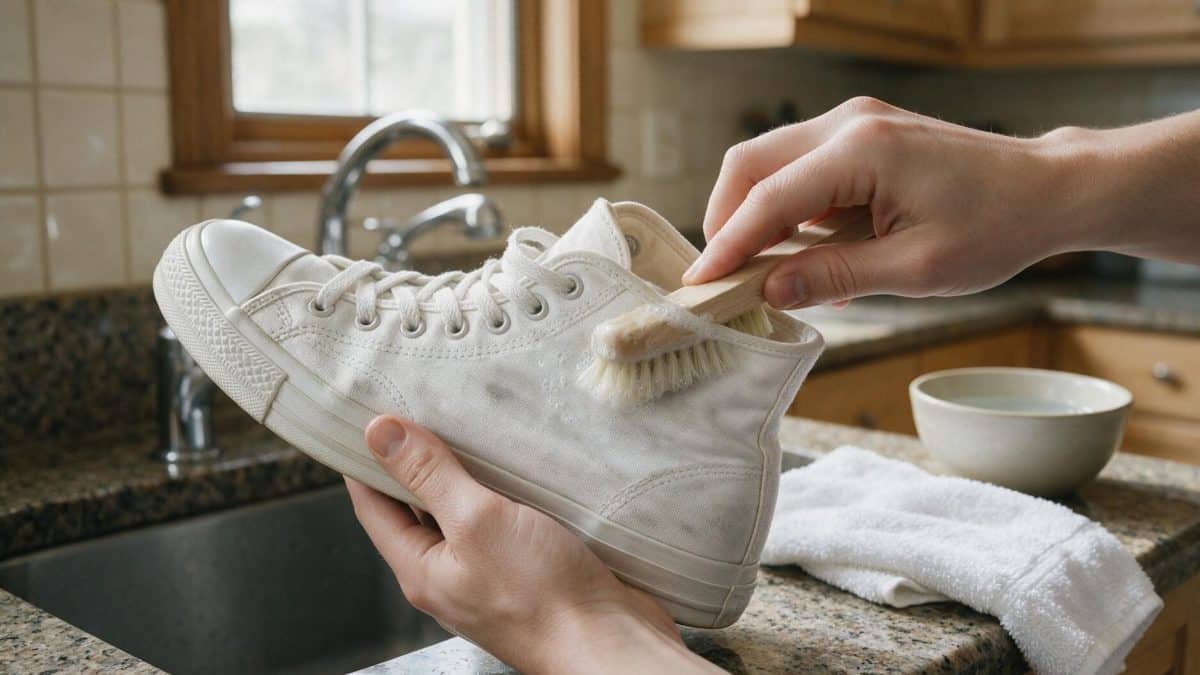
Take out the laces and the insoles
Laces and insoles carry a surprising share of the grey, and left in place they hide the dirt underneath rather than protect it. Drop the laces into warm water with a teaspoon of oxygen bleach to soak while you work. Wipe the insoles with the soap solution and stand them somewhere airy.
Brush the whole shoe dry, before any water
Dried mud, grit and street dust come off cleanly with a dry brush. Wet them first and they become a smear you then have to lift back out of the weave, which is a far harder job than the one you started with.
Wash the canvas a whole panel at a time
A few drops of dish soap in lukewarm water, roughly 30 °C (86 °F), on a damp cloth or the brush. Work a complete panel, seam to seam, rather than scrubbing just the dirty patch. A wet spot drying inside a dry panel leaves a tide line, because the edge of the patch dries last and that is where the lifted dirt collects.
Do the rubber separately, with the melamine sponge
Damp melamine foam over the foxing tape, toe cap and midsole. Light pressure only: melamine foam is a very fine abrasive rather than a sponge, and leaning on it takes the sheen off the rubber and leaves a dull patch more obvious than the scuff was.
Rinse the canvas until nothing foams
This is the step people skip and the one that decides the final colour. Take the second cloth, wring it out in plain water, and go over every panel several times, rinsing the cloth between passes. Cleaner left in cotton is what yellows later, and it looks perfectly fine while the shoe is still wet.
Blot hard, then stuff with paper
Press a dry towel into the canvas rather than wiping it, then pack the shoe with paper and change it once as it dampens. The point is to get water away from the metal eyelets fast: metal left sitting wet corrodes, and that rust bleeds into the cotton as a stain far harder to shift than the dirt was.
Dry at room temperature, out of direct sun
Indoors, with air moving past them, away from radiators, hair dryers and car dashboards. Heat works on the bond between rubber and canvas rather than on the fabric, and it is the one thing Converse singles out in its own drying instructions: do not apply direct heat. Give them a full day before lacing them back up.
The two halves of the shoe want opposite things
Each part fails in its own way, and what suits one is often wrong for the part next to it.
| Part | What goes wrong | What it needs instead |
|---|---|---|
| Cotton canvas upper | Goes grey with ground-in dirt, then yellow if cleaner is left in the fibres | Soap and a soft brush, a whole panel at a time, then a real rinse |
| Rubber foxing and toe cap | Scuffs from wear; yellows through oxidation, which UV and heat speed up | Damp melamine foam, light pressure, and storage out of sunlight |
| The join where rubber meets canvas | Heat and long soaking both work on the bond and the adhesive at the seam, which is how a foxing tape starts lifting at the toe | Brief contact with water, and no applied heat at any point |
| Metal eyelets | Corrode when left wet, and the rust migrates into the surrounding cotton | Blot dry immediately, stuff with paper, dry quickly but cool |
| Laces and insoles | Hold odour and grey, and disguise how dirty the shoe underneath has become | Removed and treated separately every time |
Which white are you trying to get back?
Before scrubbing anything, work out what colour the shoe was when it was new. The classic Chuck Taylor All Star has bright white rubber with a matte finish. The Chuck 70 does not: its rubber is a deliberately off-white cream, a shade Converse calls egret, and it is glossy rather than matte, part of the model’s intentionally vintage look. The two sit close enough together on a shelf that plenty of people spend an afternoon trying to scrub a brand-new Chuck 70 up to a white it never was, and succeed only in dulling the gloss.
There is a quick way to check your own pair. Compare the toe cap with the foxing tape behind the heel, which sees less light and less friction than anywhere else on the shoe. If both are the same cream, that is the original colour and no amount of cleaning will change it. If the heel is clearly whiter, the toe has genuinely oxidised.
What actually turns white Converse yellow
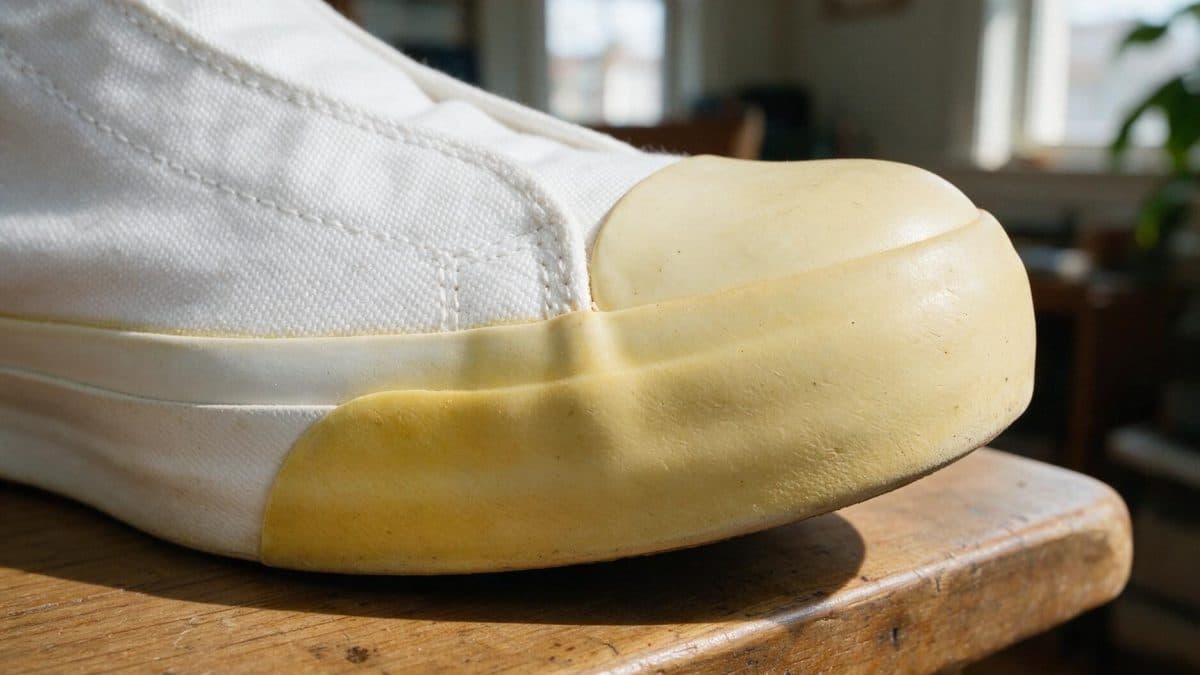
Three mechanisms produce the same yellow, and telling them apart decides whether the problem is fixable.
Chlorine bleach. Two things happen at once, and only one of them is a residue. Hypochlorite left by an incomplete rinse keeps reacting in the fibres, which is why the cast appears a day or two after a wash that looked like a triumph while it was wet. Underneath that, the bleach has attacked the cotton itself, oxidising the cellulose into new chemical groups that read yellow. Rinsing deals with the first and nothing at a kitchen sink deals with the second, which is why this is the most common way people permanently discolour white canvas.
Alkaline residue from ordinary cleaner. The same first path, gentler and slower. Detergent or soda left in the weave keeps the fabric alkaline as it dries, and the cast turns up days after the wash rather than during it. Fine on the day, yellow by the weekend.
Oxidation of the rubber. Oxygen reacts with the polymer, changing how it reflects light so that it reads cream, then yellow. UV and heat both accelerate this, which is why sun and radiators are worth avoiding even once the shoe is dry.
Sources genuinely disagree about drying in the sun. General cleaning guides recommend it, because UV does help a hydrogen-peroxide treatment brighten white cotton. Sneaker-restoration sources say the opposite, because UV is the main accelerator of yellowing in white rubber. Both are right about different materials, and on a Converse those materials are bonded into one object. Shade protects the half you cannot repair.
Chlorine bleach on white Converse, diluted or not. It oxidises the cotton as well as the dirt, and the yellow that follows is a change in the fibre rather than a deposit sitting on top of it. A rinse can take out what is left in the weave; it cannot undo the fibre, which makes bleach yellowing one of the very few marks on this page that is genuinely permanent.
Common marks on white canvas, and what comes out
| Mark | Treatment | Recoverable |
|---|---|---|
| Grey ground-in grime | Dish soap and a soft brush, panel at a time, then rinsed | Yes |
| Scuffs on the rubber | Damp melamine foam, light pressure, small circles | Yes |
| Mud | Left to dry completely, knocked off, then the panel washed | Yes |
| Grass | Oxygen bleach solution on the canvas, before any heat touches the mark | Usually |
| Oil or grease | Dish soap worked in neat, left ten minutes, then washed and rinsed out | Usually |
| Rust bleed from wet eyelets | A rust remover made for fabric. Never bleach, which sets iron stains rather than lifting them | Rarely |
| Yellowing from old chlorine bleach | Nothing available at home reliably reverses it | No |
| Yellowed, oxidised rubber | Peroxide-and-UV treatments lighten some soles, but the same UV ages the rubber further | Rarely |
Related guides
Neighbouring cases work differently:
- The machine is the question everyone asks first, and the answer turns on the sole bond and the drum rather than the canvas. See can you machine wash Converse.
- White sneakers in leather or synthetic have no absorbent textile to hold residue, so rinsing matters less and surface treatment matters more. See how to clean white sneakers.
- Suede Chucks are a different material entirely: no water, no soap, and a brush used dry. See how to clean suede sneakers.
- Odour is a separate problem from colour, and cleaning the canvas does not fix it. See how to clean smelly shoes.
Questions
Can I put white Converse in the washing machine?
Converse says not to, in capitals, on its own product care pages. The reason is not the canvas, which would survive a cold cycle; it is the weight of a waterlogged shoe hitting a steel drum, and a long soak in warm water working on the bond that holds the rubber foxing to the fabric. If you do it anyway, cold water, the delicate cycle and a mesh bag are the least damaging settings.
Does baking soda and vinegar actually whiten canvas?
Not in the way the fizzing suggests. Mixed together they react to give water, carbon dioxide and sodium acetate, so the bubbling is mostly spent chemistry. What cleans is whichever ingredient is left in excess, usually the baking soda, acting as a mild abrasive. Soap and a brush do the same work with less residue to rinse out, and residue is what yellows the shoe.
Should I dry them in the sun to whiten them?
Not on a Converse. Sun does brighten white cotton, particularly alongside a peroxide treatment, which is why so many cleaning guides recommend it. But UV is also the main accelerator of yellowing in white rubber, and the rubber is the part you cannot restore. Shade at room temperature costs a few hours of drying time and protects the half that matters.
Can I use bleach if I dilute it heavily?
Dilution changes how fast the damage happens, not whether it happens. The problem is that hypochlorite attacks the cellulose alongside the stain, and what it leaves behind is an altered fibre rather than a deposit you can rinse away. If you want a whitener, use an oxygen bleach: it breaks down into hydrogen peroxide and soda ash, contains no chlorine, and is the standard safe choice for white cotton.
The rubber toe cap looks dull now instead of scuffed. What happened?
Too much pressure on the melamine sponge. It abrades rather than dissolves, so heavy use removes the surface finish along with the scuff and leaves a matte patch. On a matte Chuck Taylor All Star that blends back in with wear. On a glossy Chuck 70 foxing it stays visible, which is a good reason to start lighter than feels effective.
Can I speed up drying in the tumble dryer on low heat?
No. Low heat is still applied heat, and heat is the specific thing Converse tells owners to avoid, because it works on the bond at the sole rather than on the fabric. Converse names no safe dryer setting because it names none at all: the instruction is room temperature, and a dryer on its lowest setting is still a long way above that. See how to dry shoes in the dryer.