How to Clean Sneakers at Home (The Inside Dries Last)
Most guides stop at air-drying and call a sneaker done. The inside, where the insole sits against foam and lining, stays damp long after the outside looks dry, and that gap is where the smell starts.
Quick answer · care label Sneakers · canvas, mesh, knit, and synthetic leather trim
-
1 · Wash
Hand wash -
2 · Bleach
No bleach -
3 · Dry
Dry in shade -
4 · Iron
Do not iron -
5 · Pro care
No dry clean
In one line Remove the laces and insoles first, since both need a separate wash and their own drying time. Dry-brush, then scrub the upper by material, mesh and knit take a soft brush worked with the weave, leather wants a damp cloth, suede trim stays dry, before cleaning the outsole on its own and wiping the soap off without ever submerging the shoe. About 20 minutes hands-on, plus at least 8 hours of drying before the insoles go back in.
Does hand-cleaning sneakers at home actually work, or does skipping the machine just leave them half-clean?
Search how to clean sneakers at home and most results give you one move: scrub the upper with soap and water, let them air-dry, done. That gets the visible dirt off, and it is genuinely enough for most sneakers most of the time. What it skips is the part that decides whether the job actually holds: the laces and insoles need to come out and get washed on their own, the outsole and the fabric upper do not respond to the same scrub, and the inside of the shoe, foam, lining, the insole itself, stays damp for hours after the outside already looks and feels dry.
That last point is the one that causes most of the comebacks. A sneaker that goes back on a foot while the insole is still damp does not stay clean long, because trapped moisture against warm foam is exactly what odor-causing bacteria need. None of this requires a washing machine or a trip to a cleaner. It requires treating a sneaker as several different materials bolted together, not one surface, and giving the inside as much drying time as the outside.
This method covers an ordinary pair built from canvas, mesh, knit, or synthetic leather trim, the combination on most running, walking, and casual shoes. A pair that is suede from the toe to the heel, not just a trim panel, needs a different approach built around never letting water touch the nap at all; how to clean suede sneakers covers that case specifically, since treating a full-suede upper like a canvas one ruins it fast.
Clean a sneaker by material, not as one surface, and do not call it dry until the inside matches the outside. The insole and the lining hold water longer than canvas or mesh ever will.
What you’ll need
| Item | Why | Substitute |
|---|---|---|
| Mild liquid detergent or dish soap | Lifts everyday dirt from canvas, mesh, and most synthetic uppers without stripping color | A few drops of a gentle laundry detergent in water |
| Soft-bristle brush and an old toothbrush | The bigger brush handles open panels, the toothbrush gets into eyelets, seams, and the gap between the sole and upper | A clean nail brush for the eyelets |
| Baking soda | Mixed to a paste, lifts scuffs on white or light rubber outsoles without a harsh abrasive | A melamine foam pad, used dry on the rubber only |
| Two microfiber cloths | One carries the diluted solution, the other wipes it off right behind it so the material does not sit wet | A soft, lint-free cotton cloth |
| Shoe trees, rolled towels, or crumpled paper | Hold the shape of the upper while it dries so canvas and knit do not collapse or crease | Plain paper towel, loosely packed |
The method, step by step
Pull the laces and insoles out first
Both hold onto dirt and odor on their own, and both need separate drying time. Soak the laces in warm water with a little detergent while you work on the shoe itself; set the insoles aside to wash last, since they take the longest to dry of anything in this method.
Dry-brush before any liquid touches the shoe
Run the soft brush over the whole upper and outsole to knock off loose dirt and grit. Wetting a sneaker before this step just turns dry dirt into mud that grinds into the material instead of brushing off.
Mix a diluted soap solution
A few drops of mild detergent in a bowl of warm water is enough; it should smell faintly of soap, not foam up. A strong mix leaves residue in the weave that attracts dirt faster once it dries, the same problem a too-strong solution causes on any fabric.
Scrub the upper according to its material, not all at once
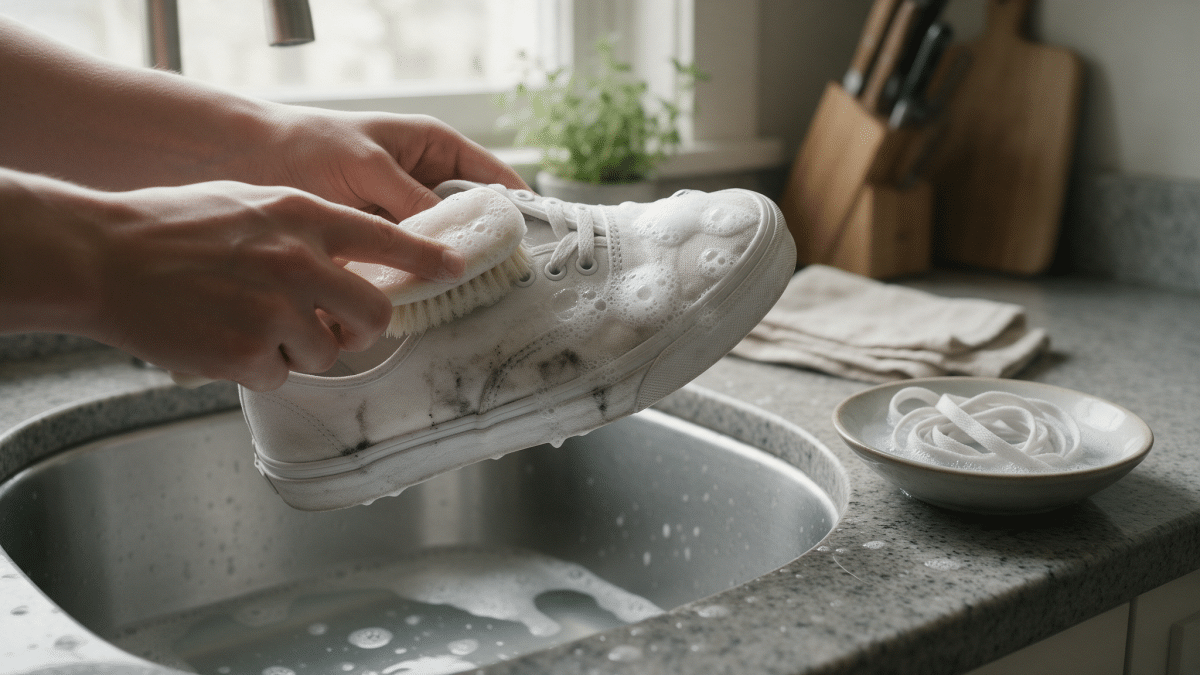
Canvas and mesh take the soft brush worked gently in the direction of the weave; scrubbing in circles frays mesh panels faster than dirt ever would. Leather or synthetic-leather overlays want a damp cloth instead of bristles. Suede or nubuck trim gets no water at all here; brush it dry and treat it on its own, covered below.
Clean the outsole and midsole separately from the upper
Scrub the rubber with the toothbrush and, on white or light soles, a baking-soda paste for scuffs. This surface can take more pressure than the upper, which is exactly why it needs to be worked as its own step instead of getting dragged into the same pass.
Wipe the solution off, do not rinse under a tap or submerge the shoe
Go over every scrubbed panel with the second, barely damp cloth to lift the soap. Holding a sneaker under running water or dunking it pushes water past the upper into the glue line and the foam underneath, both of which take days rather than hours to dry back out.
Stuff, then dry away from heat
Pack the shoe tree, towel, or paper in loosely enough to hold its shape without stretching the material, and set the sneakers somewhere with airflow, out of direct sun and away from a heater or vent. Wash the insoles now too, and let everything, shoe, laces, and insoles, dry fully before anything goes back together.
Interactive
Label decoder
Tap a symbol from your care label. No guessing, no scrolling.
19 symbols. Pick one.
Why the inside takes longer to dry than the outside
A sneaker’s foam insole is an open-cell structure built to cushion a footstep, and that same structure holds onto water the way a kitchen sponge does, not the way a flat piece of canvas does. Nike’s own care instructions tell owners to pull the insoles out, wash them separately, and give them time to dry before putting them back, and separately note that many shoes need at least eight hours to dry fully at room temperature. That number is for the whole shoe under normal conditions; a thick midsole, a lined upper, or a damp climate can push it longer.
The rubber outsole and any overlay panels on top of the mesh make this worse, not better, because they trap humidity against the foam even after the visible fabric feels bone-dry to the touch. That gap, dry on the outside, still damp two layers in, is exactly the condition that lets odor-causing bacteria keep producing fresh smell every time the shoe goes back on a foot, the same live-culture problem covered in full in how to clean smelly shoes. Checking the insole and the heel cup by hand, not just glancing at the upper, is the only way to know a sneaker is actually finished drying.
If a pair is otherwise machine-safe and the goal is a deeper clean rather than a quick refresh, how to clean shoes in the washing machine covers which uppers tolerate a gentle cycle and which do not. The by-hand method here exists for the pairs that cannot risk the drum at all, or for anyone who would rather not find out the hard way which category a favorite pair falls into.
Laces dry faster than almost anything else in this method, since they are thin and have nowhere to trap water, but they still need their own pass. A lace washed alongside the shoe instead of separately tends to pick up soap residue from the upper and dry stiff, which is a minor problem compared to a damp insole but still worth the extra two minutes it takes to treat them on their own.
Mesh, knit, suede trim, and leather don’t take the same scrub
Most sneakers are not one material wearing a single name. A running shoe might combine a knit upper, a rubber toe cap, a foam midsole, and a leather heel patch, and a method safe on one of those will damage another. None of those panels were designed to be cleaned as a set; they were designed to each do one job, flex, grip, cushion, or reinforce, and the fastest way to shorten a sneaker’s life is to scrub all of them the same way because they happen to sit on the same shoe. Nike’s own guidance is specific here too: brush mesh and knit gently in the direction of the weave rather than scrubbing in circles, keep bleach off colored panels entirely, and avoid hard scrubbing on leather since it wears down the finish rather than lifting dirt from it. The same caution that applies to cleaning clothes by hand, work with the material instead of against it, applies here panel by panel.
| Problem | What works | Recoverable |
|---|---|---|
| Mesh or knit panel still dingy after one wash | A second, lighter pass with the same diluted soap, brushed in the direction of the weave rather than in circles | Yes |
| Suede or nubuck trim scuffed or stained | A dry suede brush or a rubber eraser worked with the nap, no soap or water on that panel at all | Mostly, if treated before it sets |
| Musty smell even after the upper feels fully dry | Pull the insoles back out and check the heel cup by hand; it holds moisture longest of any spot in the shoe | Not always |
| Toe seam separating or a glue line showing after a wash | Stop wearing the pair until it is completely dry and inspect again; cleaning does not reverse a weakened bond | No |
Never hold a sneaker under running water or submerge it, soaking is what pushes water past the upper into the glue line and the foam, and that takes days rather than hours to dry back out. Never put a wet sneaker in a clothes dryer or set it next to a heater or vent; that heat can warp foam and loosen the bond between the sole and the upper. Never use bleach on colored mesh or knit panels.
When a quick wipe is enough, and when it isn’t
Not every sneaker needs the full seven-step method after every wear. A pair worn for a walk on dry pavement usually just needs the dry-brush step and a damp-cloth wipe on any visible mark, no soap, no insole removal, no overnight drying time. The full method is for the pairs that pick up real dirt, mud, grass, or a sweat-heavy workout, since those are the cases where skipping the insoles and the drying time is what shows up later as a smell or a stiff, soap-crusted lace.
- Dusty from an ordinary walk: dry-brush the upper and wipe the outsole with a damp cloth, no soap needed.
- Visible dirt or a light stain: the full soap-solution pass on the affected panel, insoles can stay in if the shoe itself never got wet through.
- Mud, grass, or a sweat-heavy workout: the complete method, laces and insoles out, every panel treated by material, full drying time before the next wear.
Related guides
- White sneakers pick up grass stains and black rubber scuff marks that a general wash does not fully lift on its own: how to clean white sneakers covers the separate treatment each one needs.
- Some uppers survive a gentle machine cycle and some do not, and the material decides it, not the price of the shoe: can you machine wash shoes sorts that out before a pair goes in the drum.
- A dryer looks like the fast way to finish a wash this guide keeps sneakers away from entirely: how to dry shoes in the dryer explains why the damage shows up once a pair is already mostly dry, not before.
Questions
Can I use Dawn dish soap to clean sneakers?
A few drops diluted in a bowl of warm water works on canvas, mesh, and most synthetic uppers, and it is close to what several shoe-specific cleaners are built from. Used at full strength or sprayed straight onto the shoe instead of diluted first, it can leave residue that attracts dirt faster once it dries.
Does baking soda actually clean sneakers?
Mixed into a paste with a little water, it works as a mild abrasive on rubber outsoles and midsoles, lifting scuffs without scratching the surface the way a harsher cleaner can. It is not a substitute for the soap solution on fabric or leather uppers; it belongs on the rubber parts specifically.
How do you clean the inside of sneakers that can’t go in a washing machine?
Pull the insoles out and wash them on their own with the same diluted soap and a soft brush, then let them dry completely, separately from the shoe, before they go back in. The lining inside the shoe gets wiped with a barely damp cloth rather than soaked, since it is one of the slowest parts of the whole shoe to dry.
Is it safe to wash sneakers in a washing machine?
It depends entirely on the upper material, not the brand or the price. Suede, certain leather trims, and structured foam midsoles generally do better staying out of the drum and sticking to the by-hand method here; canvas and most synthetic uppers tend to handle a gentle cycle, but check the material first rather than guessing.
What’s the best way to dry sneakers without a dryer?
Stuff them loosely with a shoe tree, rolled towel, or crumpled paper to hold their shape, then set them somewhere with airflow, out of direct sun and away from any heater or vent. Nike’s own care guidance puts the minimum at around eight hours at room temperature for the shoe itself, and the insoles, washed and dried separately, often need just as long.
Why do sneakers smell again a day or two after cleaning?
Almost always because something went back together before it finished drying, usually the insole, sometimes the lining around the heel cup. Warm, trapped moisture is what lets odor-causing bacteria keep producing fresh smell, so a sneaker that smells clean the day it dries and sour again soon after points at an insole that was pressed back in a little early rather than a cleaning method that failed.