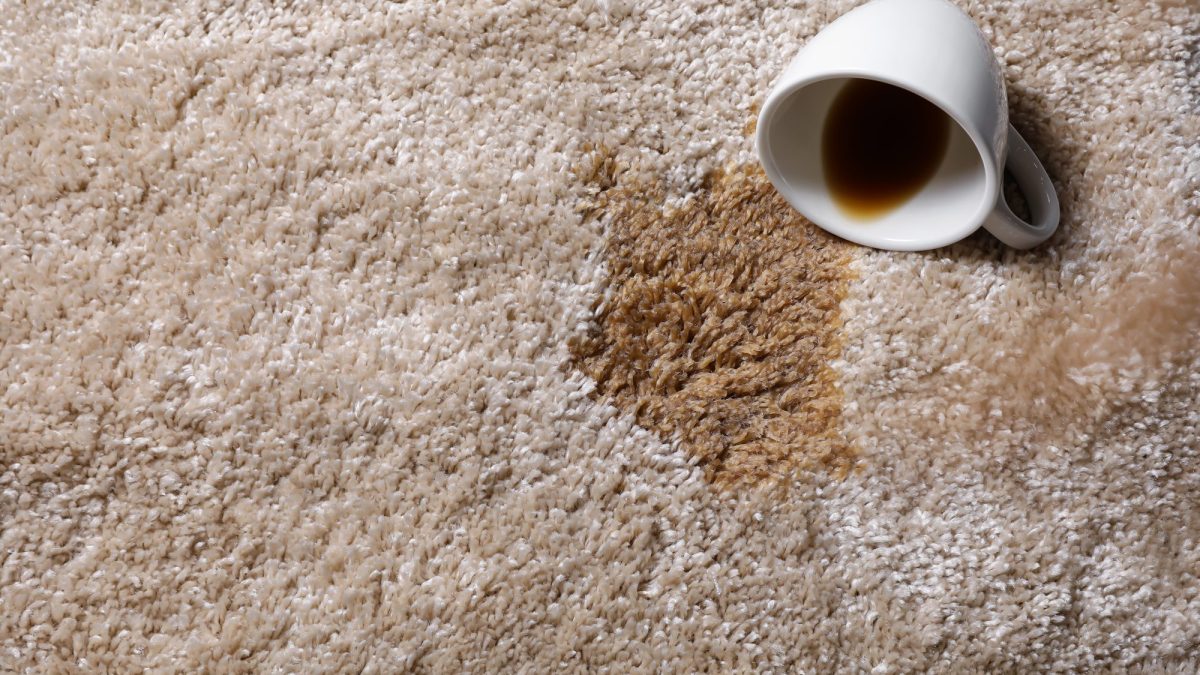
How to Clean Carpet (and Why the Clean Patch Gets Dirty First)
A carpet is the only textile in your house with no drain, so the question is not what dissolves the dirt. It is what you can get back out of the floor. That rules out most of what gets recommended, including the vinegar and baking soda mix that cancels itself out.
Quick answer · care label Fitted carpet — nylon, polyester, olefin or wool
-
1 · Wash
Do not wash -
2 · Bleach
Oxygen bleach -
3 · Dry
Dry flat -
4 · Iron
Do not iron -
5 · Pro care
Pro clean P
In one line Vacuum slowly in two directions with an empty bin, run the foam test to find leftover detergent, pretreat walkways only, clean with one wet pass and three dry recovery passes, rinse with plain water, then blot and force dry within a day. Total hands-on time: 100 minutes.
A carpet is the only textile in the house with no drain
Everything else you clean has a way out for the water. A shirt gets a spin cycle. A cushion cover comes off and goes in with it. Even a rug can be carried outside, hosed down, and hung over a rail so the water runs through the pile and drips onto the grass. A carpet stretched over tack strips and stapled at the edges has none of that. Whatever you put on it goes down into the pile, into the backing, and into the pad, and it comes back out only if you pull it back out yourself.
That one fact reorders the whole job. The question stops being which product dissolves the dirt, because nearly all of them do. The question becomes which product you can retrieve, and that rules out most of what gets recommended for carpet, including the two ingredients that turn up in almost every list.
It also explains the complaint that brings most people here in the first place: the carpet looked great for three weeks and then the cleaned area started collecting dirt faster than the parts you never touched. That is not the dirt coming back. That is the cleaner you left behind.
This guide is for carpet that is fixed to the floor. If yours can be picked up and carried outside, you have far better options than anything below, starting with an actual rinse: see how to clean a rug. For the small washable kind with a rubber backing, how to clean throw rugs covers what the backing tolerates.
Two tests, five minutes, before you buy anything
Both of these decide something. The first decides whether this job is a cleaning or a rinse, and the second decides whether the carpet is dirty at all.
The foam test. Wet a white cotton cloth with plain warm water and wring it out hard, so it is damp rather than wet. Rub it over a walkway with real pressure for about ten seconds, then look at the cloth and at the pile. Two things can happen. Color transfers to the cloth, which is ordinary soil and means the carpet is dirty. Or suds appear, in a spot where you added no soap at all. Foam that comes up out of plain water is detergent from a previous cleaning, still sitting on the fiber. If that happens, adding more detergent is the one thing you should not do, and the method below runs with water only.
The tuft test. Pull a piece of furniture that has not moved in a year, and compare the yarn under it with the yarn in the walkway three feet away. Roll a tuft of each between your finger and thumb. The protected yarn has tips that are still closed and a twist that holds. The walkway yarn is splayed open at the tips, untwisted, and slightly fuzzy. If the gray band down the middle of the room feels like that, it is not dirt.
Carpet soil is mostly dry mineral grit walked in from outside, and quartz sand is harder than any carpet fiber made. Every step grinds it against the yarn and scratches the surface of the filament. A smooth fiber reflects light and reads as color. A scratched fiber scatters it and reads as gray, and it does that whether it is clean or not. This is why a heavily used hallway comes back looking better for a day and then goes gray again while the rest of the room stays fine. No cleaner repairs a scratched surface.
Crushing is the one that looks the same and is fixable. Flattened pile that still has closed tips and an intact twist has only been bent over, and it comes back up with moisture and grooming. Open, frayed tips are wear, and wear is permanent.
What you’ll need
| Item | Why | Substitute |
|---|---|---|
| A vacuum you empty first | Dry soil is the majority of what is in the carpet, and a half full bag or bin cuts airflow badly. Removing grit dry is also the only step that stops the abrasion above | None. This is the step that does the most and gets rushed the most |
| White cotton cloths | The foam test, and blotting. White so you can see what is transferring and how much | An old white towel cut into pieces |
| Low foaming carpet detergent | Formulated to be left in a fiber that cannot be rinsed, and to not foam in a recovery tank | Plain warm water at 90 to 105 °F, which is genuinely better than the wrong soap |
| White vinegar | A rinse acid that neutralizes leftover alkaline residue. Used on its own, in the rinse pass, and never mixed with powder | Skip it on wool, where repeated acid use is its own problem |
| Oxygen bleach powder | The only bleaching agent a dyed synthetic carpet survives, for general dinginess on a light colored pile | Not on wool, which it yellows |
| A stack of dry towels and something heavy | Your extraction, if you do not have a machine. This is where the water and the dirt actually leave the floor | Books inside a plastic bag |
| A box fan | Drying time is the entire safety margin on a carpet you cannot lift | Two open windows on opposite walls and a fan pointed out of one |
The method, step by step
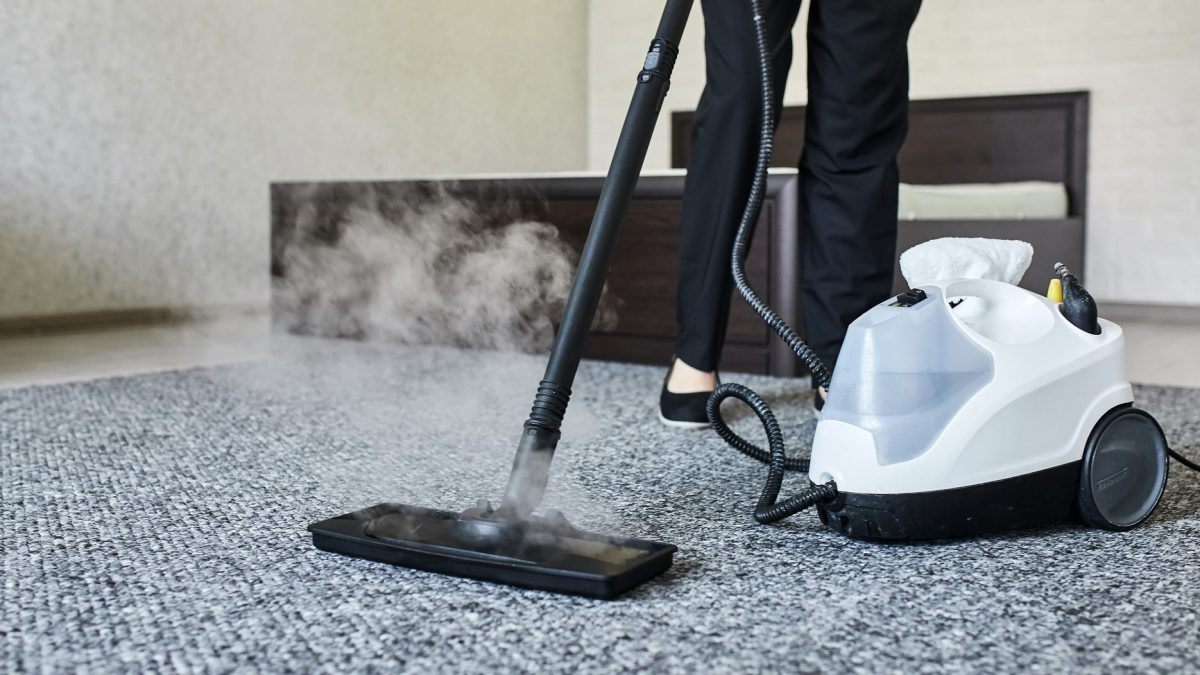
The order matters more than the products. Three of these six steps involve no cleaning agent at all, and they are the three that decide how the room looks in a month.
Vacuum slowly, in two directions, with an empty bin
Go north to south over the whole room, then east to west. Slow passes, not fast ones: the brush needs time to lift grit out of the base of the pile, and speed is the difference between removing most of it and removing a third. Grit left in place is what keeps scratching the fiber for the next year, so this is not preparation for the cleaning, it is most of the cleaning.
Run the foam test and decide what kind of job this is
Damp white cloth, hard rub, ten seconds. Suds mean the carpet is holding detergent from last time, and everything below runs with plain warm water and vinegar instead of a cleaning product. Color and no suds mean you can clean normally.
Pretreat the walkways only, and let it sit
Spray the entry paths and the strip in front of the sofa, not the whole floor. Give it ten to fifteen minutes without touching it. Dwell time does the work that people try to do with pressure, and pressure is what splays the fiber tips and creates the permanent gray from the tuft test.
Clean in one pass, extract in three
With a machine, that means one wet pass forward and three dry passes back over the same strip, trigger released. Without one, it means a barely damp cloth or a bonnet over the area, then towels. The ratio is the point. Whatever number of passes feels like enough, the drying pass count should be triple it, because the machine sprays more easily than it recovers.
Do a rinse pass with nothing in the tank
Plain warm water, or water with a splash of vinegar on synthetic pile, and no product at all. This is the substitute for the rinse the carpet is never going to get, and skipping it is what creates the sticky patch that outcollects the rest of the room. If you are working by hand, this is a cloth wrung out in clean water, wiped over the area, then blotted dry.
Extract until the towel comes up damp, then start the fans and stay off it
Press dry towels down with your body weight, or leave them weighted for half an hour. When a fresh towel comes up damp rather than wet, you are done pulling. Then air: fans at floor level aimed across the carpet, not down at it, and windows open if the outside air is drier than the inside air. Keep everyone off it until the backing feels dry to the back of your hand, not just the tips.
Interactive
Label decoder
Tap a symbol from your care label. No guessing, no scrolling.
19 symbols. Pick one.
The three ingredients page one recommends, and what they do
Vinegar, baking soda, and dish soap turn up in nearly every carpet cleaning list, usually in combination. Two of the three have a real use here. None of them works the way the recipes imply, and one pairing is self defeating in a way that is easy to demonstrate.
- Vinegar and baking soda cancel each other. Vinegar is useful because it is acidic. Baking soda is useful because it is alkaline. Put them together and they react: the acid and the carbonate destroy each other and give off carbon dioxide, which is the fizzing everyone finds so convincing. The foam is not the cleaning, it is the sound of both ingredients being used up. What stays in the pile is a salt, plus whichever ingredient was in excess, and in the usual half cup and half cup recipe that is a lot of undissolved powder. Used separately they each do something. Poured on top of each other they do less than either alone.
- Dish soap cleans well, and that is exactly the problem. Dawn and its equivalents are built to lift grease and then vanish under a running tap. They foam hard on purpose, because foam is how a person judges a sink. A carpet has no tap. The surfactant stays on the fiber, and dried surfactant is faintly tacky and attracts water from the air, so it holds every particle that lands on it. That is the mechanism behind the patch that gets dirty first, and it is also why the carpet cleaning trade sells low foam products that would look useless in a sink. If you have already done this, the fix is not another cleaning. It is several rinse passes with plain water on that area alone.
- Baking soda on its own does one job, and only against acid. It is a base, so it neutralizes acidic smells: sour milk, vomit, sweat, and the isovaleric acid that makes shoes smell. Against an alkaline odor, stale urine being the common one, it does close to nothing, which is why it disappoints so reliably on pet accidents. It is also a fine powder going into a pile you cannot turn over, and a household vacuum recovers only part of what settles at the base. What stays is alkaline, and on a wool carpet that is a slow problem rather than a neutral one.
The short version: use vinegar in the rinse water, keep the baking soda for a smell you can identify as acidic, vacuum it out thoroughly, and leave the dish soap in the kitchen.
Cleaning carpet without a machine
This is the most common version of the question, and the honest answer changes the method rather than shrinking it. Without extraction there is no way to take water back out of a floor except through towels, so the rule is simple: never put in more moisture than you are willing to blot back out by hand. That rules out the scrub brush and bucket approach that gets recommended most, because a bucket of soapy water poured into a carpet you cannot rinse is the exact problem this page opened with.
- Work in squares of about one yard. Clean one, dry it, then move. Working the whole room at once means the first square sits wet for an hour while you finish, and time spent wet is the only variable that matters for smell.
- Use a damp cloth or bonnet, not a soaked one. A microfiber cloth wrung out until it will not drip, worked over the pile with moderate pressure, lifts a surprising amount of surface soil. A folded towel under your foot works on the same principle, which is what the bonnet machines in offices actually do.
- Towels and body weight are your extraction. Lay dry towels over the damp square, stand on them, swap for fresh ones, and repeat until the towel comes up barely damp. Four changes gets close to what a machine would have pulled.
- A carpet powder is a legitimate no water option. The dry compound products are absorbent granules carrying a small amount of solvent and detergent: they are brushed in, they take up the soil, and they get vacuumed out an hour later. They will not do what a hot extraction does, and they leave granules at the base of the pile if you undervacuum, but they add no water at all, which on a ground floor slab or over a wooden floor is worth a lot.
- Do not rent a steam machine to fix a hand cleaning that went wrong. If the foam test came up sudsy, more water is going to release more of the old detergent and carry it down toward the backing. Rinse by hand first, in that area, and then decide.
What quietly makes a carpet worse
- Hot water and a strongly alkaline cleaner. Most nylon carpet leaves the mill with a stain resist treatment on the fiber, and heat plus alkalinity is what strips it. The carpet comes out clean and then stains more easily than it did before, which reads as bad luck and is actually a removed coating. The industry recommendation of roughly 90 to 105 °F is not caution, it is the ceiling that keeps the treatment on. Rental machines will happily go hotter.
- Chlorine bleach anywhere near it. On dyed nylon it removes the color permanently and leaves a pale patch that no cleaning fixes. On wool it attacks the fiber itself rather than just the dye. Oxygen bleach is the only version worth using here, on synthetic pile, and it still needs the rinse pass afterward.
- Scrubbing a spot hard. Even when it removes the mark, it opens and frays the fiber tips in that one circle, and that circle then catches light differently from the pile around it forever. A clean spot with distorted pile is still a visible spot.
- Putting the furniture back before the carpet is dry. Metal feet leave rust marks on damp pile and wooden ones leach stain into it, and both marks are harder to remove than whatever you were cleaning. Foil or a plastic coaster under each leg costs nothing.
- Letting it stay wet. The smell that shows up a day or two after a carpet cleaning is not the cleaning product. It is the backing and the pad, which stayed damp long enough for what lives in them to get going, and a surface clean does not reach either. Fast drying is the whole defense, and it is the step that gets abandoned because the pile already feels dry to the fingertips.
- Treating a wool carpet as a synthetic one. Wool is a protein, so alkaline cleaners, enzymes, and high heat affect it the way they would affect hair. It also holds far more water for its weight, which turns a four hour dry into a day and a half.
Related guides
A rug is the same fiber with an escape route, and the method changes completely once you can lift it and rinse it: see how to clean a rug. For one spill rather than a whole floor, the chemistry sorts into five categories and the no rinse constraint is identical, so how to clean stains on a rug applies to fixed carpet line for line, including the brown ring that surfaces two days later. Pet accidents go through the pile into the pad and the subfloor, which is why the spot you cleaned still smells two weeks later: how to clean dog urine from a rug treats all four layers. The same detergent residue trap catches upholstery, where a fabric couch has a cleaning code on the tag that tells you whether water is allowed at all. And for the general framework of sorting a stain before touching it, see how to clean stains from clothes.
Questions
Does baking soda really clean carpet?
It deodorizes acidic smells and absorbs fresh liquid, and that is the whole of it. It is a base, so it neutralizes acids like sour milk, vomit and sweat. Against an alkaline smell such as old urine it does very little. It is not a cleaner in any useful sense, it does not lift soil, and a household vacuum will not recover all of what settles to the base of the pile. Sprinkle, leave it a few hours, then vacuum in two directions rather than one.
Will Dawn and vinegar clean carpet?
They will clean it and then leave it dirtier than before. Dish soap is designed to be rinsed away under a tap and foams heavily because that is what sells it, and a carpet gives you no rinse. The residue stays tacky and collects soil, so the cleaned strip picks up more dirt than the floor around it within a month. Vinegar is genuinely useful, but as a rinse acid in plain water at the end, not mixed into the wash.
What should you not clean carpet with?
Chlorine bleach, which removes dye from nylon permanently and damages wool fiber directly. Dish soap and shampoo, for the residue reason above. Very hot water on nylon, because heat and alkalinity strip the mill applied stain resist treatment. Ammonia after a pet accident, since ammonia is a component of urine and the treated spot still reads as a marking site to the animal. And any powder you cannot fully vacuum back out.
How can I deep clean my carpet myself?
Vacuum thoroughly in two directions, pretreat the walkways only and let it dwell, then clean with one wet pass and three dry recovery passes, run a rinse pass with plain water and nothing else, blot with towels until they come up damp instead of wet, and dry with fans across the surface. If you have no machine, do the same thing in one yard squares with a barely damp cloth and towels for extraction.
Why does my carpet smell worse after cleaning it?
Because water reached the backing and the pad and stayed there. The pile dries within hours while the layers underneath take much longer, and what lives in them wakes up in the meantime. It is a drying failure rather than a cleaning failure. Fans at floor level, moving air across the carpet rather than down onto it, and no foot traffic until the backing feels dry to the back of your hand.
My carpet has gray traffic lanes that will not come out. Is it dirt?
Compare a tuft from the lane with a tuft from under a piece of furniture that has not moved. If the lane yarn is splayed open at the tips and has lost its twist, the gray is abrasion from walked in grit scratching the fiber, and it scatters light regardless of how clean it is. Cleaning gets you a day of improvement and no more. If the tips are closed and the yarn is only flattened, that is crushing and it lifts back up with moisture and grooming.
How often should a carpet be professionally cleaned?
Every 12 to 18 months for normal use, sooner with pets or a full house. The reason to hire out is not that the products are stronger. It is that a truck mounted unit sprays and vacuums at a pressure no rented upright matches, which means it is the only way a fixed carpet gets something resembling a rinse. That is the same reason the professional symbol sits on this page.