How to Clean Carpet Stains (Three Kinds, and Only Two Come Out)
Most of what lands on a carpet is a spot and comes off the fiber. Some of it is a dye that has already colored the fiber, and some of it is color destroyed outright, and no cleaner reverses either.
Quick answer · care label Fitted carpet — nylon, polyester, olefin or wool
-
1 · Wash
Do not wash -
2 · Bleach
Oxygen bleach -
3 · Dry
Dry flat -
4 · Iron
Do not iron -
5 · Pro care
Pro clean P
In one line Identify the fiber with a float test and check that the dye is colorfast, then work the mark from the outside in with the treatment carried on a damp cloth rather than poured onto the pile. Blot until nothing more transfers, rinse by transfer with plain water, then weight the area dry under towels before moving air across it. Total hands-on time: about 35 minutes.
Is the mark still sitting on the fiber, or has it become the fiber?
Almost every list of carpet stain remedies treats the marks on a floor as one problem with a graded set of answers, running from mild to strong. The cleaning trade sorts them differently, into three things that look alike from standing height, and which of the three you have decides in advance whether anything you do will work.
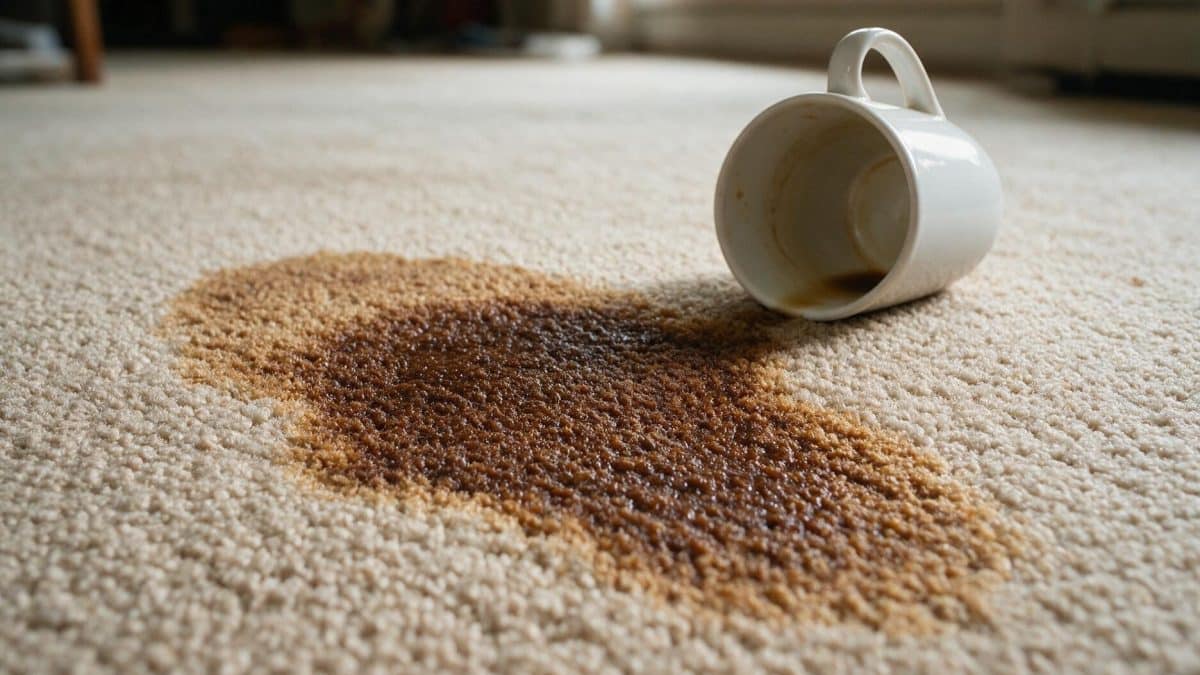
A spot is material resting on the surface of the yarn. Grease, mud, food, the coffee that went down an hour ago. It has thickness, you can usually feel it with a fingertip, and some of it transfers onto a white cloth when you press one against it. Spots come out. How much trouble they give depends only on what the material is.
A stain is color that has moved into the fiber. Something has dyed your carpet, and that is not a figure of speech. The colorings in red sports drinks, children’s medicine and a lot of packaged food are acid dyes, which is the same class of dye the mill used to color nylon carpet in the first place. On a nylon floor those colorings are not sitting on the yarn, they are dyeing it, and cleaning takes off what is on top of a fiber rather than what is now inside it.
The third thing is not a stain at all, because the carpet has lost color instead of gaining it. Chlorine bleach, a spilled cleaning product, benzoyl peroxide transferred off an acne cream. The dye has been chemically destroyed. Nothing puts it back, and the only repair is re-dyeing that patch by hand, which is a service you buy rather than a bottle you use.
A fitted carpet is a stack — pile, backing, pad, floor — and you can only clean the top of it. Every drop you put in that you do not pull back out goes down into the layers you cannot reach, and it comes back up as the carpet dries. So the right dose is the smallest one that works, applied twice if it has to be, and the blotting matters more than the product does. If you are cleaning a whole floor rather than one mark, how to clean carpet works through the same constraint at room scale.
Two tests, three minutes, before the first drop
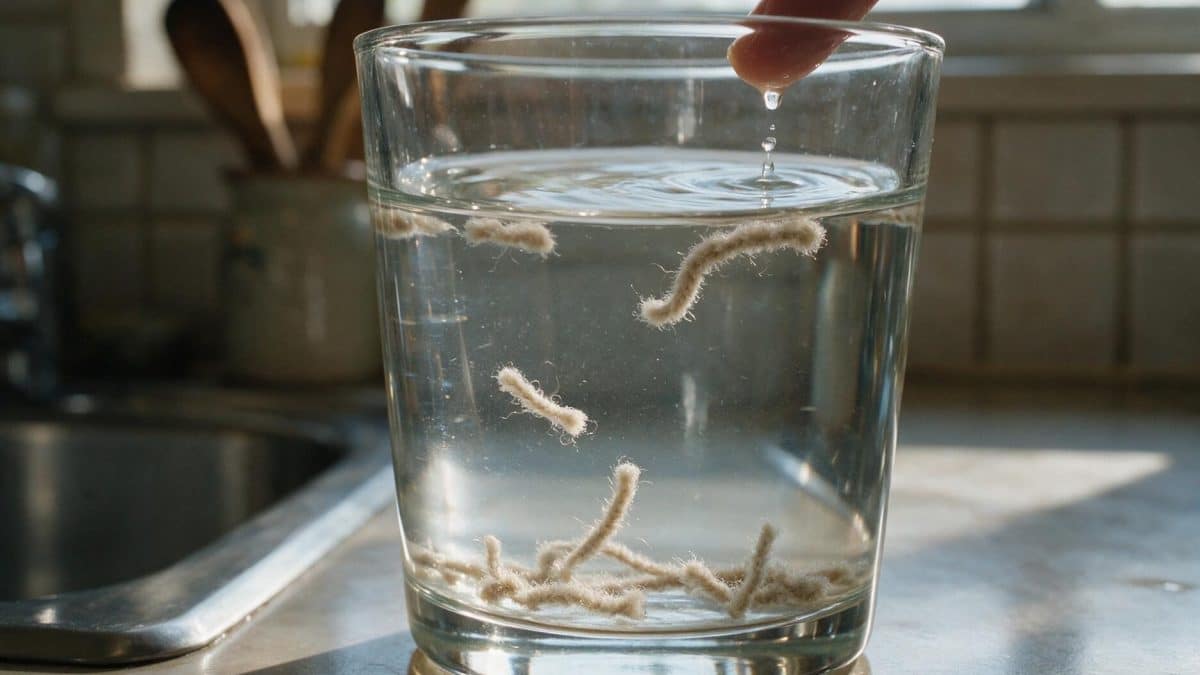
Neither test is optional, because both rule things out rather than confirming them, and what they rule out is the damage.
The float test. Snip a few strands of pile from inside a closet or under the edge of a bed, drop them into a glass of water, and push them under with a finger. Olefin, sold as polypropylene, floats back up. It is the only common carpet fiber less dense than water, and nylon, polyester and wool all sink. That single answer flips two rules at once. Olefin carries its color as pigment mixed into the plastic before the yarn is extruded, rather than dye applied to finished yarn afterward, so chlorine bleach does not strip the color out of it the way it does out of nylon. It also softens at around 310 °F (154 °C) and melts at around 330 °F (166 °C), which is below where a household iron sits on its cotton setting. The fiber that shrugs off the harshest chemical is the one that will not survive heat.
The colorfast test. Press a damp white cloth into the pile in a corner, thumb behind it, and hold for ten seconds. Any color on the cloth means the dye moves while it is wet, and a wet treatment will drag that dye sideways into pile that was fine. A carpet that fails this can still be spot cleaned, but with noticeably less liquid than any instruction assumes, and a mark of any size on it is a reasonable thing to hand to a professional.
If the fibers sank and you want to know whether they are wool, hold one in tweezers over a saucer and touch a flame to it. Wool curls away from the flame, smells like burning hair, goes out on its own, and leaves an ash that crumbles between your fingers. Nylon and polyester shrink away, melt into a hard bead, and smell faintly of celery or of something sweet. Wool is a protein, and that rules out several of the products below.
What you’ll need
| Item | Why | Substitute |
|---|---|---|
| White cotton cloths | The thing the mark actually leaves in. White so you can see how much is transferring and when it stops | An old white towel cut into pieces, or plain paper towels |
| Clear dish detergent | Handles oil and general soil. Clear so it adds no dye of its own. The manufacturers’ published home recipe is a quarter teaspoon in a quart of warm, not hot, water, which is far weaker than most people mix | A wool-safe carpet spotter, which is what to use if the burn test said wool |
| White vinegar | A rinse acid. It neutralizes alkaline residue and it is the standard home answer to browning, at one part vinegar to four parts water | A ready-made acidic carpet rinse, which is the same chemistry sold by the bottle |
| Enzyme cleaner | Digests protein: urine, blood, vomit, milk. The only thing that removes an odor rather than covering it | A biological laundry liquid, well diluted: the same enzyme families, in a form that has to be rinsed back out |
| Rubbing alcohol | Dissolves ink, marker and dye transfer, which detergent cannot touch at all | Hand sanitizer with a high alcohol content |
| Dry towels and a weight | Your extraction. This is where the mark actually leaves the carpet, and it is the step people skip | Books inside a plastic bag |
The method, step by step
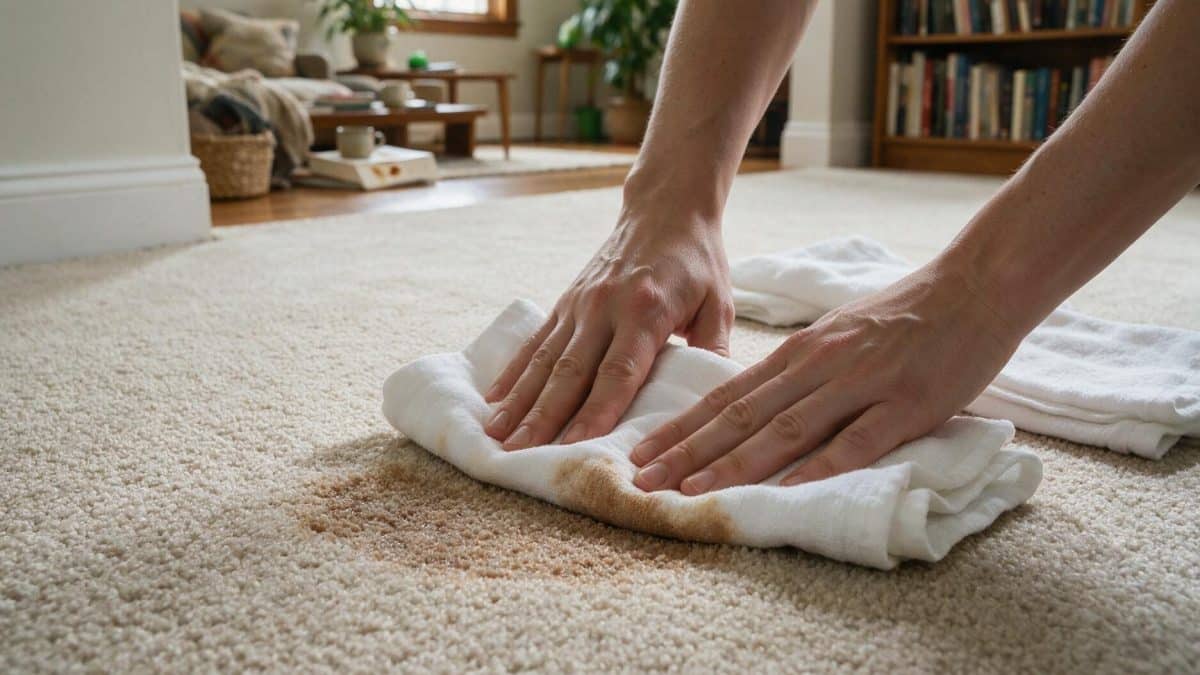
The sequence is the same whatever the mark is. Only step three changes, and the table further down says what goes into it.
Lift what is still material, before it turns into color
Scrape solids toward the middle of the mark with the edge of a spoon, and press dry towels onto liquid without wiping. A spill blotted inside the first minute often needs no chemistry at all. Wiping at this stage is what turns a coin-sized spill into a plate-sized one.
Start on the clean pile outside the mark and work inward
Going the other way pushes the outer boundary of the mark into fiber that was clean, and that widened edge is usually what is still visible after the middle has come out.
Put the treatment on the cloth, not on the carpet
Dampen a cloth with the matched solution and press it into the pile, rather than spraying or pouring onto the floor. The cloth meters the dose for you, which is the whole reason the manufacturers write their home instructions that way. On a carpet there is no rinse to undo an overdose.
Let it sit, then blot, turning to dry cloth every time
Detergent needs three to five minutes on the fiber. An enzyme cleaner needs ten to fifteen, and longer on anything already dried. Then press down with your palm, hold a few seconds, lift, and look: while color keeps coming onto the cloth the mark is still leaving the carpet. A saturated cloth just puts it back.
Rinse by transfer, with nothing in the water
Wipe the area with a cloth wrung out in plain cool water, then blot dry again. This is the substitute for the rinse a washing machine would have given you. Detergent left in the pile stays faintly tacky and holds every particle that lands on it, which is why a spot cleaned without this step becomes the dirtiest patch in the room within a month.
Escalate once, if at all, and only on synthetic pile
Shaw publishes a stubborn-mark solution of half a cup of 3% hydrogen peroxide with one teaspoon of clear, non-sudsy household ammonia, used within two hours of mixing, followed by undiluted white vinegar to neutralize the ammonia and then a plain water rinse. It works. It is also the point where you can do real damage, so test it somewhere hidden first, keep it off wool entirely, and stop after one attempt rather than three.
Weight it dry, then move air across it
Stack dry towels over the damp area, put something heavy on top, and leave it half an hour so moisture is pulled up out of the backing and into the towels instead of into the pile tips. Then a fan at floor level, aimed across the carpet rather than down at it. Keep furniture off until the backing feels dry to the back of your hand.
What comes out, and what does not
Five of these categories are spots and behave predictably. The last three are the ones where honest advice is that cleaning is the wrong tool, and where continuing to work at the mark does more harm than leaving it.
| Mark | What it actually is | What to use | Recoverable |
|---|---|---|---|
| Coffee, tea, wine, fruit juice | Tannin: color with almost no substance behind it | Blot, then cool water with a little white vinegar. Oxygen bleach powder on synthetic pile only | Yes |
| Blood, milk, egg, vomit | Protein, which sets permanently the moment it meets heat | Cold water first, then an enzyme cleaner given real dwell time | Yes |
| Butter, dressing, make-up, food oil | Oil, which spreads into a wider ring if you wet it before you absorb it | A dry absorbent such as cornstarch for an hour, vacuumed off, then the detergent solution | Yes |
| Ink, marker, polish, dye off a rubber-backed mat | Pigment or dye carried in a solvent | Rubbing alcohol on the cloth, in small dabs, working inward | Yes |
| Candle wax, crayon | A solid that only happened to be liquid when it landed | Chill it hard, crack it off, lift the rest through a paper towel with warm iron pressure — never if the float test said olefin | Yes |
| Red drink dye, mustard, turmeric | An acid dye that has bonded to nylon or wool the way the mill’s own dye did | Nothing in a household cupboard. A reducing agent or a controlled heat transfer, done by someone who does it often | No |
| Bleach, acne cream, plant food, an unlabeled cleaner | Color destroyed rather than covered | Spot re-dyeing by hand, matched to the surrounding pile | No |
| Old pet urine | Salts and odor sitting in the backing and the pad, not in the pile | Treatment that reaches the layer the urine reached, which surface cleaning does not | No |
The five recoverable categories behave the same way on any textile, and the clothing versions are worked through in more detail: a coffee stain for tannin, a blood stain for protein and the heat rule that governs it, ink for anything a solvent is carrying, and wax for the chill-and-crack sequence. What a carpet adds to all of them is the missing rinse.
Wicking, and the mark that comes back on Tuesday
You clean the spot, it disappears, the carpet dries overnight, and two days later a faint ring is sitting where the clean spot was, usually browner and slightly wider than the original. This is the failure that catches people who did everything else right, and it has two different causes that look identical.
The first is wicking. Your treatment carried part of the mark downward, toward the backing, instead of out through the top. As the carpet dries, water moves back up through the fibers by capillary action and evaporates at the tips of the pile, and it brings whatever was dissolved in it along for the ride and leaves it at the surface. The fix is not another cleaning, which would only push more of it down again. It is a damp white towel laid over the spot with a weight on it and left overnight, so the moisture rises into the towel rather than into the yarn.
The second is cellulosic browning, and it depends on what your carpet is built on rather than what you spilled. Older woven carpets and many wool ones have a jute backing, and jute is a plant fiber that releases lignin and tannin when it gets wet. Those travel up the same capillary route and arrive brown. Age makes it worse, because the backing degrades over time. The usual home treatment is one part white vinegar to four parts water, blotted on and blotted straight off, since the browning is driven by alkalinity. A high-pH cleaner makes it much more likely in the first place, which is one more argument for the smallest dose that works. The rug version of this problem, where you can at least get a fan under the thing, is covered in how to clean stains on a rug.
Five ways people make a carpet stain permanent
- Heat on a protein spill. Blood, milk, egg and vomit contain proteins that coagulate when they are warmed, exactly the way an egg white firms in a pan. Once that has happened between the filaments the mark is bonded rather than resting there. So no hot water, no steam, and no rented extractor over a fresh protein spill until it has been treated cold and enzymatically. This is one of the few genuinely hard rules on this page.
- Rubbing. Even when scrubbing lifts the mark, it splays and untwists the fiber tips inside that one circle. Damaged tips scatter light instead of reflecting it, so the circle reads gray against the pile around it from then on, whether it is clean or not. A clean spot with distorted pile is still a visible spot, and no cleaning repairs a scratched fiber.
- An iron on olefin. The heat-transfer trick — white towel over the mark, warm iron on top, dye draws up into the towel — is a real technique and it is the right one for wax. It is also the single thing you must not do on polypropylene, which softens near 310 °F and melts near 330 °F while a domestic iron on cotton runs well above both. The pile fuses into a shiny flat patch that cannot be reversed. This is why the float test comes first.
- Ammonia, on wool and on any pet accident. Wool is a protein and alkaline chemistry is what damages it. There is no single safe number to quote here: WoolSafe’s published approval criteria limit how strongly a product is buffered as well as where it reads on a meter, because a weakly buffered solution gives up its alkalinity to the fiber and a well buffered one keeps supplying it. Household ammonia is outside anything sensible on both counts. On any fiber it is also the wrong answer to urine, since urine turns to ammonia as it breaks down and an ammonia-treated spot smells to the animal like a place already marked.
- Bleach, including the kinds nobody labels as bleach. Chlorine bleach removes dye from nylon permanently and attacks wool fiber itself rather than just its color; undiluted, it dissolves wool. Benzoyl peroxide in acne cream does the same job more quietly. It is an oxidizer, which is why the tubes carry a warning about bleaching towels and bedding, and a smear carried in on a towel or a slipper goes on lightening the pile in a spot nobody thinks to look at.
Related guides
- If the whole floor has gone dull rather than one square foot of it being marked, the job is a different one and the residue trap is the main risk: how to clean carpet.
- A rug can be lifted, rinsed and dried with air underneath it, which removes the constraint this whole page is built around: how to clean stains on a rug.
- Pet accidents reach the backing, the pad and often the subfloor, so a spot treatment leaves three of the four layers untouched and the smell returns: how to clean dog urine from a rug.
- Vomit is a protein spill with stomach acid in it, which adds a dye-damage risk on top of the heat rule: how to clean vomit from a carpet.
Questions
What is the best homemade carpet stain remover?
For general spots, a quarter teaspoon of clear dish detergent in a quart of warm water, applied on a damp cloth rather than poured on. That is the manufacturers’ own published recipe and it is far weaker than most people mix. It handles oil and everyday soil. It does nothing for ink, which needs alcohol, and nothing for protein odors, which need an enzyme. The part that decides the outcome is not the recipe anyway, it is the plain-water rinse afterward.
Does vinegar and baking soda work on carpet stains?
Not together. Vinegar is useful because it is acidic, baking soda because it is alkaline, and combined they destroy each other and give off carbon dioxide. The fizzing is the two ingredients being used up, not the stain coming out, and what stays in the pile is a salt plus whatever powder did not dissolve. Vinegar diluted in water is genuinely useful as a rinse and against browning. Baking soda on its own deodorizes acidic smells. Poured on top of each other they do less than either does alone.
Can old, set-in carpet stains be removed?
It depends entirely on which of the three things it is. An old grease or food spot is usually still recoverable, because it is material sitting on the fiber and age mainly means it has collected more soil around it. An old dye stain from a red drink is not, because it bonded to the fiber the day it landed and time changed nothing. A bleach spot was never a stain. Age matters far less than category, which is why the tests come before the products.
Will hydrogen peroxide bleach my carpet?
It can, and the risk is real enough to test for. Three percent hydrogen peroxide is mild and is part of the manufacturers’ own stubborn-stain recipe, but it is still an oxidizing bleach and some dyes lift under it, particularly if it is left to dry in place rather than rinsed out. Test it on pile inside a closet, use it once rather than repeatedly, and rinse and blot afterward. On wool, do not use it at all.
Should I rent a steam cleaner for one spot?
Usually no, and on a fresh protein spill definitely not, because heat is what sets protein into the fiber for good. A rented machine also sprays more readily than it recovers, so on a single mark it puts more water into the backing than towels can pull back out, which is the exact condition that produces a ring two days later. Machines earn their keep on whole floors. On one spot, a cloth and your body weight do more.