How to Clean Vomit from a Carpet (the Stain Is Not the Urgent Part)
Vomit is a protein stain sitting in stomach acid at roughly pH 1 to 3, and the acid works on the carpet dye faster than the stain sets. Everything here stays cold until the pile is clean.
Quick answer · care label Carpet — wool or synthetic pile
-
1 · Wash
Do not wash -
2 · Bleach
Oxygen bleach -
3 · Dry
Dry flat -
4 · Iron
Do not iron -
5 · Pro care
No dry clean
In one line Scrape the solids off, bury the wet area in a dry absorbent, then flush the acid with cold water before touching any product. An enzyme cleaner takes the protein out, a cold rinse-by-transfer takes the residue out, and a fan takes the smell out. About 30 minutes hands-on.
Can vomit on a carpet wait until the morning?
Almost everything about protein stains says you have time. Blood on a sheet stays treatable for weeks as long as nothing warm touches it. Milk, egg, and urine behave much the same way. On that logic, a patch of vomit on the carpet is a job that can wait until the person who produced it has stopped needing your attention.
It cannot, and the reason is the liquid the protein arrived in rather than the protein itself. Stomach acid sits at roughly pH 1 to 3, at the low end more acidic than white vinegar. What lands on the floor is diluted by food and saliva, so it is milder than that, but still the most acidic thing that will touch your carpet this year. Wool and nylon are both colored with acid dyes, which hold to specific sites along the fiber by ionic bonds. A strong acid works on those same sites, and on nylon it works on the polymer as well. What that leaves is not a mark but a patch reading lighter or warmer than the pile around it, which the eye finds from across the room.
So two clocks run at different speeds. The protein and the food pigment will wait, because a mark can be worked on tomorrow. The acid on the dye will not, and it is the only part of this that produces damage rather than a stain. A pale patch where the carpet lost its dye is not a stain you failed to remove. It is missing color, and nothing sold in a supermarket puts it back.
Dilute the acid out with cold water before you think about the stain. Every other step on this page can be repeated tomorrow if it does not work. The dye cannot. The urgent treatment here is plain cold water, which you already own, and the products can all wait ten minutes.
What you’ll need
| Item | Why | Substitute |
|---|---|---|
| Disposable gloves and a bag you can tie shut | If this came from a stomach bug, what you are handling is infectious, and it stays infectious on carpet for days | Any carrier bag, plus twenty seconds of soap and water afterward |
| A spoon or a stiff plastic card | Lifts solids off the pile. Anything you press with drives the load down into the backing instead | A takeaway lid, or a putty knife held almost flat |
| Baking soda, cornstarch, or cat litter | Pulls liquid up out of the pile before you add liquid of your own. This step decides how deep the problem goes | Plain clay cat litter for a large volume; it holds more per spoonful |
| Cold water in a spray bottle | The actual treatment for the acid. A spray wets the pile tips where a poured cup soaks the underlay | A cloth wrung out hard under a cold tap |
| An enzyme cleaner | The protease digests protein into pieces small enough to blot away. It removes the smell rather than covering it | Biological laundry liquid, a capful in cold water, carries the same proteases; rinse it out just as carefully |
| White cotton cloths or paper towels | What the stain leaves in. White, because the cloth is how you tell whether anything is still transferring | An old white towel cut into pieces |
The method, step by step
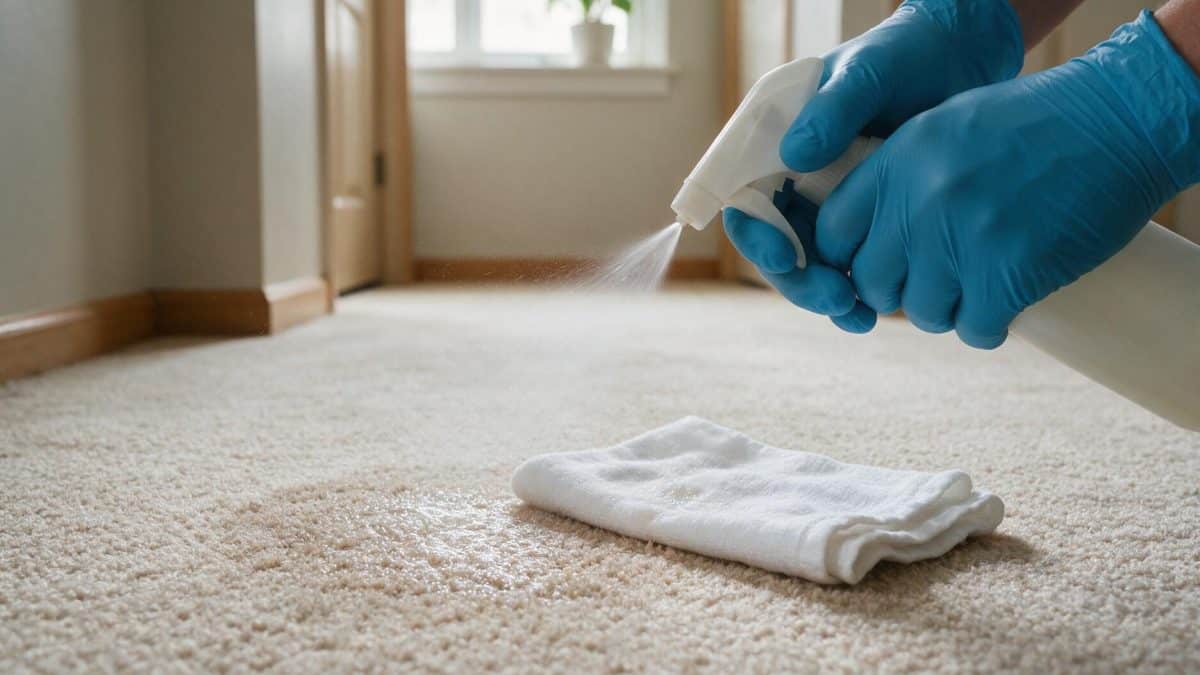
Steps one to three are the time-sensitive half and take about twenty minutes. Everything after that can be done at your own pace.
Glove up and lift the solids without pressing
Scrape inward from the edge with the spoon held nearly flat, so material collects toward the middle rather than spreading. Do not vacuum yet: a vacuum turns a contained mess into airborne particles and contaminates the machine, and if this came from an illness that is how it reaches the rest of the house. Paper towels into a bag you can tie shut is the whole of the CDC’s first step, and it is the right one here.
Bury what is left in a dry absorbent
Cover the damp area in baking soda, cornstarch, or cat litter, thickly enough that you cannot see carpet through it, and leave it while you deal with the person. It draws moisture and acid up into something you can throw away, which is the cheapest extraction you will ever get. Scrape the crust off when it stops looking wet.
Flush the acid with cold water, twice
Mist until the pile tips are damp, blot hard with a dry white cloth, then repeat. This is the step that saves the color, and it works by dilution rather than chemistry. Cold is not optional, and this is one of the few hard rules rather than a preference. Heat sets protein into the fiber, and a set protein stain does not come back out, so warm water here trades a solvable stain for a permanent one.
Apply the enzyme cleaner and leave it alone
Spray it on rather than pouring, enough to dampen the pile and no more. Enzymes need dwell time, not pressure: fifteen minutes is usually enough, up to thirty on synthetics if the smell is heavy. Wool is the exception, and the next section is where that argument sits. Pressure is what damages pile, and every minute the product sits is a minute you do not have to scrub for.
Blot with white cloth until nothing transfers
Press with your palm, hold a few seconds, lift. Move to a dry section of cloth each time, because a saturated cloth puts the stain back. Work from the clean pile outside the mark inward, so you are not pushing the boundary into fiber that was fine.
Rinse by transfer, then weight it dry
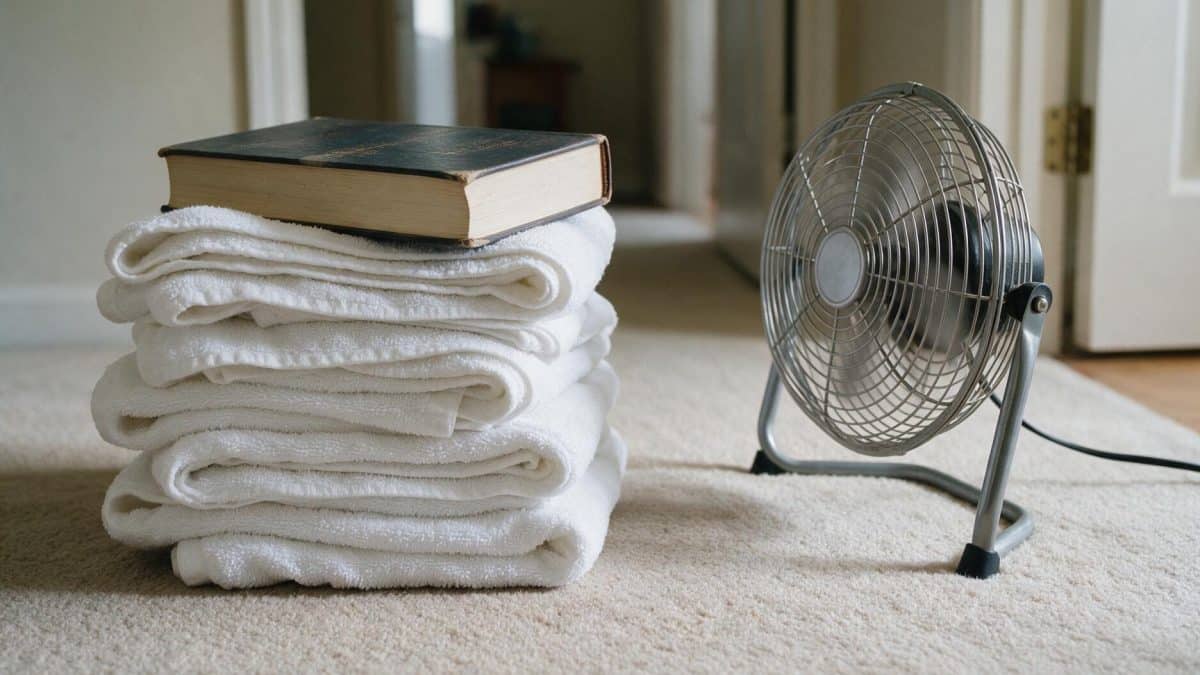
Wipe with a cloth wrung out in plain cold water and blot again. Residue left in the pile stays tacky and collects soil, which is why a cleaned patch often becomes the dirtiest part of the room within a month. Then stack dry towels over the area and stand something heavy on them.
Dry it fast with moving air, then vacuum the pile up
Point a fan across the area and leave it until the backing feels dry to the palm, not just the tips. Slow drying gives residue time to travel back up. Vacuum last, once everything is dry, to lift the pile out of the flattened state blotting leaves it in.
Which carpet you have decides what is safe
Residential carpet is one of four or five fibers, and the acid is what separates them, because it does something different to a protein fiber than it does to a plastic one.
| Fiber | What the acid does to it | Enzyme | 3% peroxide |
|---|---|---|---|
| Wool | The fiber resists acid well; the dyes do not, so color shift is the risk rather than damage. Wool suffers at the opposite end of the scale, above about pH 8 | Avoid | No |
| Nylon | Dyed with the same acid dyes, and strong acid attacks the polymer as well as the dye. The one fiber where both color and fiber are exposed | Yes | Test first |
| Polyester and triexta | Little for acid to grip. Disperse or solution dyed, so the color is not sitting on acid-reactive sites | Yes | Yes |
| Polypropylene, sold as olefin | Solution dyed, meaning the color is mixed into the plastic before the fiber is spun. Acid has nothing to remove | Yes | Yes |
Enzymes on wool are the judgement call on this page, and the disagreement behind it is real rather than sloppy. Wool is a protein and a protease exists to cut proteins apart, which is why wool detergents are non-biological and why the wool guides on this site tell you to keep enzyme products away from the fiber. Against that, the carpet trade does not treat “contains enzymes” as automatically disqualifying, on the reasoning that a short, cool, thoroughly rinsed application gives the enzyme neither the time nor the conditions to do much to the wool. Both positions are defensible, and neither comes with a number you can check on your own floor. So the cautious version is the one to follow: on wool, go as far as cold water, blotting and patience will take you, and if the smell still needs an enzyme, keep the application brief and cool and rinse it out properly rather than leaving residue in the pile. If it is a loose wool rug you can lift, how to clean a wool rug covers the version where you can get underneath it.
Hydrogen peroxide answers the orange or red shadow left once the protein is gone, which is food pigment rather than stain chemistry. Use the 3% household strength rather than the 6% and above sold for hair, keep it off wool, test it on a hidden edge for two minutes, then give it five to fifteen minutes on the mark.
Heat is where two correct answers collide
Search for this problem and you find two confident pieces of advice that contradict each other. Stain guidance says never put heat on a protein stain. Public health guidance says put heat on the carpet, because vomit from a stomach bug is most often norovirus, and carpet that is not properly cleaned after a vomiting incident has been traced as a route of onward infection.
Both are right, and what reconciles them is order rather than compromise. The CDC’s own cleanup instructions are gloves, paper towels into a bag you tie shut, and a bleach solution of 1,000 to 5,000 ppm left in place for at least five minutes, which is sound advice for a hard floor and not something to pour on wool. For carpet itself the steam temperatures quoted from source to source do not agree, so the figures worth trusting are the ones somebody measured; the alternative to heat is an EPA-registered product that names norovirus on its label. A 2024 study in Applied and Environmental Microbiology tested this on nylon carpet: steam gave at least a 5.2 log reduction of a norovirus surrogate in fifteen seconds on both permeable and waterproof backings, while three EPA-registered antimicrobials managed between 0.8 and 3.1 log after a full thirty minutes on the permeable-backed carpet. Repeated use of two peroxide-based products also lowered the tensile strength of the backing, and one cracked the fibers. The authors were clear that fifteen seconds suited thin carpet fiber and that a thicker pile needs longer contact. That is the figure to lengthen on a deep domestic carpet. An earlier study in the same journal ran steam over wool as well as nylon and found it worked on both, at the cost of minor abrasion to the fiber tips.
So the sequence is: clean it out cold, dry it, and only then apply heat, and only if the source was an illness. Heat on a carpet that still holds protein sets the protein. Heat on a carpet already cleaned kills what is left of the virus.
Never run a hot-water extractor or a steam cleaner over vomit as the first step. This is the most common way a treatable spot becomes a permanent one, and rented machines make it easy to do by accident. A domestic machine’s water reaches the pile far cooler than its tank setting suggests: warm enough to start setting protein, nowhere near hot enough to disinfect. Used first, it does the damage without delivering the benefit.
What comes out, and what does not
| What is left | Recoverable | What decides it |
|---|---|---|
| Protein, and the smell that comes with it | Yes | Enzyme, dwell time, and a real rinse. Age barely matters; heat does |
| Food pigment, the orange or red shadow | Usually | Peroxide or oxygen bleach once the protein is gone, tested on the fiber first |
| Color lost to the acid | No | Nothing household restores dye. A carpet specialist can sometimes spot-dye it; the match is the hard part |
| Pile broken by scrubbing | No | Merely flattened pile lifts again with vacuuming. Tips split by abrasion catch light differently forever, even where the stain came out |
| Anything that reached the underlay | Sometimes | Whether it stopped at the backing. Once it is in the pad, cleaning the pile does nothing |
Why the smell comes back on the third day
You clean it, the carpet dries, the room is fine for two days, and then a warm afternoon brings the smell back. This is the failure specific to fixed carpet, which is the only textile in the house with no way for water to leave through the bottom. Whatever you did not lift out went down instead, into the backing and often the underlay, and as the area dries, moisture travels back up through the fibers by capillary action and carries dissolved residue to the surface with it. Warm, humid air then gets the residual bacteria active again. The same constraint governs any spill on a fixed floor: how to clean carpet stains covers the general form, and how to clean carpet covers doing the whole room without creating this across all of it.
- Use less liquid than feels sufficient. Wicking needs a wet backing. If moisture never got below the pile, there is nothing to come back up.
- Weight it with dry towels while it is still damp. That moves moisture into something disposable, on your schedule, rather than letting it surface into the pile on its own.
- Dry it fast. Slow drying gives capillary action hours to work, and a backing damp for days is a mildew problem stacked on a stain problem. Once it is a colony it has to be killed rather than cleaned, on the same principle as how to clean mold off clothes.
The other reason the smell survives is that the most-recommended home recipe does less than it appears to. Baking soda and vinegar poured onto the same spot neutralize each other: the fizz is an acid and a base destroying one another, and what remains is salt water and carbon dioxide with very little cleaning power left. Here it is worse than merely useless, because vinegar is an acid and the mess is already acidic, so it neutralizes nothing. On wool it is worse again, since the baking soda half sits above pH 8, the end of the scale wool suffers at. Baking soda earns its place as a dry absorbent in step two and as a dry deodorizer vacuumed up afterward. It is not a stain treatment, and it should not meet vinegar on your floor.
If the smell is coming from the underlay rather than the carpet, no amount of surface work reaches it. Lift that section, cut the affected pad back past the edge of the visible mark, and splice in a new piece.
Related guides
- On a rug you can pick up, the method changes completely, because you get a rinse and a two-sided dry: how to clean stains on a rug.
- The other household protein stain follows the same cold rule but splits into two halves, one of which no enzyme touches: how to clean a blood stain.
- Pet accidents reach four layers rather than three and leave a marking scent vomit does not: how to clean dog urine from a rug.
- When it went past the floor and onto the bed, the absorbency changes the timings but not the chemistry: how to clean a mattress.
Questions
Can I just use a carpet cleaning machine on it?
Not as the first step. A machine puts far more water into the carpet than a spot needs, which is the condition that brings the smell back, and if it heats the water at all it sets the protein. Blot the stain out cold, dry it, then consider a machine for the disinfection pass.
It has been there since yesterday. Have I missed the window?
For the stain, no. Protein stays treatable for a long time provided nothing hot has touched it, and dried vomit lifts fine once you soften it under a cold damp cloth for five to ten minutes and scrape the crust off. For the dye, possibly. If the carpet under the mark reads as a different shade rather than a different color, that is acid damage, and it happened in the first hours.
Is white vinegar useful at any point?
Marginally, and not in the way it is usually recommended. Its one real job on carpet is neutralizing alkaline detergent residue at the end, and even there plain cold water does most of it. On this stain it is the wrong tool, because the mess is already acidic. Skip it on wool entirely.
Do I need to disinfect, or is cleaning enough?
If it was travel sickness, alcohol, or a reaction to food, cleaning is enough. If it was a stomach bug, treat it as infectious: carpet is a documented route of onward infection when it is not properly cleaned after a vomiting incident, and in testing, disinfectant products have performed worse on wool carpet than on nylon. Clean it out cold first, then steam the dry carpet, or use a product whose label specifically names norovirus.
Why is the clean patch now dirtier than the carpet around it?
Enzyme or detergent residue left in the pile. It stays slightly tacky and holds everything that lands on it. Repeat the rinse-by-transfer step with plain cold water on that patch, blot it dry, and it will stop attracting soil.