How to Clean Armpit Stains on White Shirts (Bleach Is the Wrong Bottle)
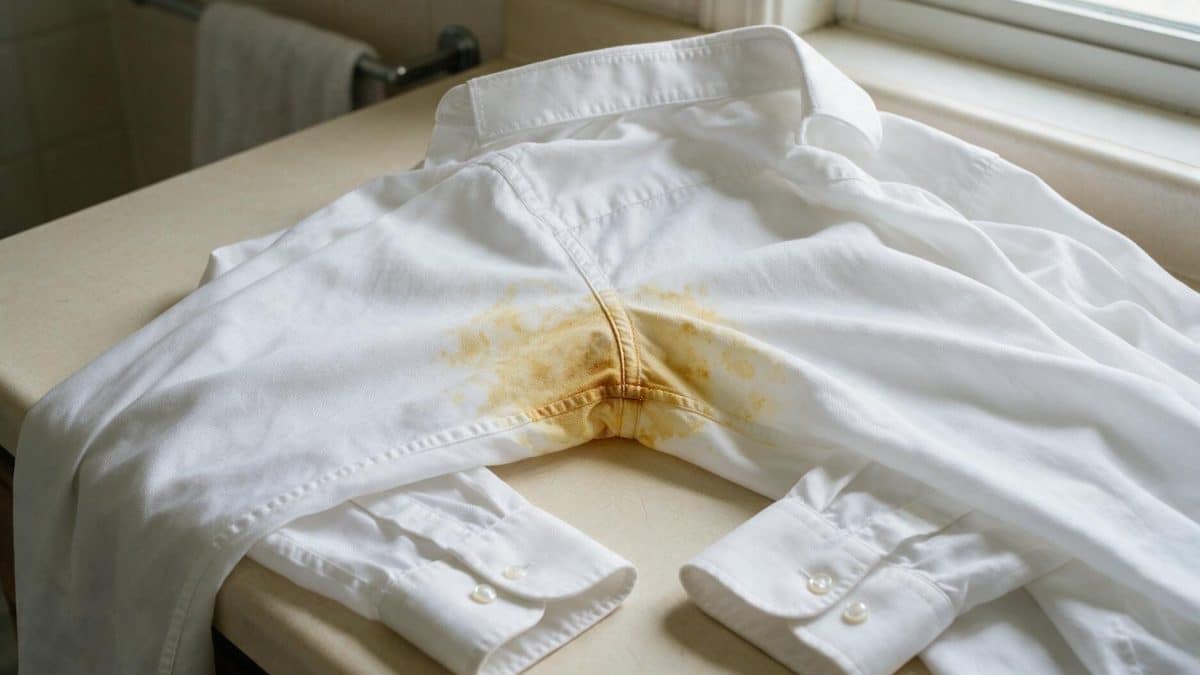
The obvious move is bleach, and it is the one product most likely to make the mark darker. This is a protein and mineral deposit rather than a dye, and heat is what makes it permanent.
Quick answer · care label Cotton — white shirting
-
1 · Wash
Wash 40° -
2 · Bleach
Oxygen bleach -
3 · Dry
No tumble dry -
4 · Iron
Do not iron -
5 · Pro care
No dry clean
In one line Rinse the underarms cold from the inside, work a liquid enzyme detergent into the mark and leave it thirty minutes, then apply a hydrogen peroxide and baking soda paste on white fabric only. Wash at the hottest temperature the label allows, air dry, and read the mark dry in daylight before the shirt goes anywhere near a dryer or an iron; repeat the cycle rather than escalating to a stronger product. About 15 minutes hands-on.
Can you bleach a white shirt back to white?
It is the obvious move. The shirt is white, the mark is yellow, and there is a bottle under the sink whose entire job is making white things whiter. Almost everyone tries it, usually more than once, and the same outcome gets reported back: the underarm came out of the wash darker than it went in.
The reason is that the mark under the arm of a white shirt is not a tint sitting on white cloth. It is a deposit. Antiperspirants work by plugging the sweat ducts with aluminum salts, normally aluminum chlorohydrate or an aluminum zirconium compound, and a little of that transfers onto the fabric with every wear. It settles into the weave alongside sweat protein and body oil, and the whole layer slowly oxidizes into something yellow. Chlorine bleach is itself an oxidizer, so on a deposit that is already part-oxidized it is at best redundant and at worst the thing that finishes the job. That is the mechanism most stain guides give for the darkening.
Whether aluminum is really the villain is more open than those guides admit. The Drycleaning and Laundry Institute describes perspiration on its own as water plus chloride salts, amino acids and ammonium compounds that oxidize and yellow when heat reaches them during drying or pressing, with no antiperspirant needed at all. Consumer sources put the aluminum reaction first. The two accounts disagree about the cause and agree completely about the handling, because both describe a protein-and-mineral deposit rather than a dye, and a dye is the only thing bleach is good at.
Nothing hot touches the shirt until the mark is confirmed gone in daylight. A dryer cycle or an iron sets whatever is left, and a set mark stops responding to any treatment afterwards. This is one of the few hard rules rather than a judgement call, and every step below is ordered so that the heat arrives last.
What you’ll need
| Item | Why | Substitute |
|---|---|---|
| 3% hydrogen peroxide | The oxidizer that acts on this deposit without the chlorine reaction. Pharmacy strength is the right strength | Oxygen bleach powder (sodium percarbonate) dissolved warm, which releases the same peroxide more slowly |
| Baking soda | Raises the pH. Peroxide barely bleaches in neutral water: the active species is the perhydroxyl anion, which forms in useful quantity only in alkaline solution | Washing soda, the more aggressive alkali of the two. Start with less than you would use of baking soda |
| Liquid enzyme detergent | A protease takes apart the sweat protein and a lipase handles the body oil. Neither is something bleach does, and this deposit contains both | None that works. Skip enzymes altogether on silk and wool, which are protein themselves |
| White vinegar | For marks weeks or months old, to loosen the mineral half before the oxidizer goes on | Household ammonia instead, on a mark that is fresh. Never both, and never either one near chlorine bleach |
| A soft toothbrush | Drives the treatment through the inside face, where the deposit is thickest and where nobody thinks to work | A nail brush, or a fingertip on fine shirting |
| A window | You read this mark wet and again dry, and kitchen light hides yellow almost perfectly | Stepping outside with the shirt, on an overcast day as readily as a bright one. Bulb light is the reason people put a still-marked shirt in the dryer |
The method, step by step
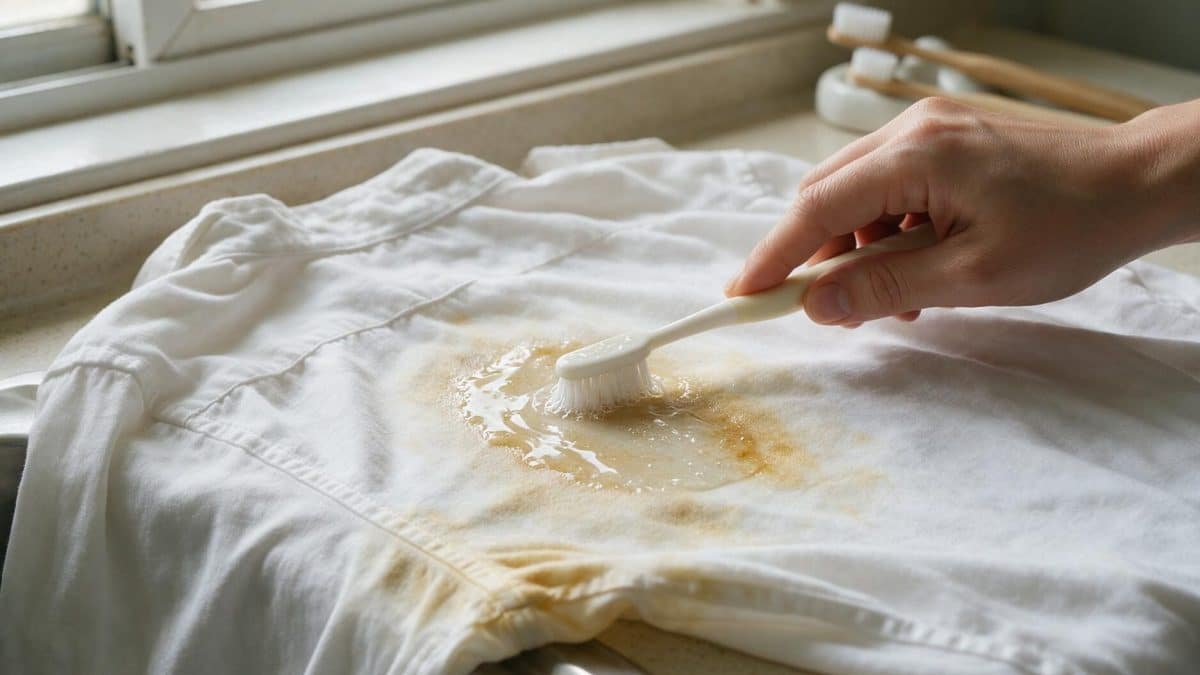
The order carries more weight here than any single product. Steps 2 to 4 all happen before the shirt meets warm water, and step 6 is the one that gets skipped.
Turn the shirt inside out and read the mark
The deposit is heaviest on the face that touched skin, so that is the side to treat. Hold it to a window. A flat yellow tint following the shape of the underarm is the oxidized layer. A stiff patch that crackles when folded is buildup sitting on top of it, and that has to be broken up before anything soaks through. Most worn shirts have both.
Rinse the underarms in cold water, from the inside
Cold water flushes the loose salts back out the way they arrived. The International Hyperhidrosis Society’s advice is to do this the moment the shirt comes off rather than on laundry day, which is the cheapest thing on this page. Cold and not warm, because warmth here starts setting protein you have not treated yet, exactly as it does on a blood stain.
Work enzyme detergent into the mark and leave it
Rub liquid enzyme detergent straight into the underarm with the toothbrush, on the inside face, and leave it. Tide’s published instruction for this stain is five minutes; the Hyperhidrosis Society says thirty. On a mark that has been building for months, take the longer figure. This is the only step that touches the body oil, and on a shirt with polyester in it the oil is most of the problem.
Add the peroxide, on white fabric only
Mix hydrogen peroxide with baking soda into a loose paste and spread it over the mark. Clorox publishes half a cup each of 3% peroxide, baking soda and water, left on for five minutes. The Drycleaning and Laundry Institute prescribes something far weaker and far slower: two to four ounces of 3% peroxide per gallon of water, soaked four to six hours. Use the short version on a recent mark and the long bath on an old one. Both instructions are limited to white fabric.
Wash at the hottest temperature the label allows
Warmth helps now, and only now. Peroxide bleaches faster as the water heats, and enzymes are more active warm than cold. A white cotton shirt commonly carries a 40 °C (104 °F) label and often survives 60 °C (140 °F), but the label decides rather than the fibre name: a fused collar or a glued interlining can delaminate above its rated temperature while the cotton around it is untouched. Check the symbol against the care label decoder.
Air dry, then look at it dry, in daylight
Hang it up. Damp fabric conceals a faint yellow almost completely, which is why a shirt that looked clean out of the machine looks marked again the next morning. This is the one point every source agrees on: Clorox, Tide and the Hyperhidrosis Society all say to keep the shirt out of the dryer until the mark is gone.
Repeat rather than escalate
If yellow survives, run steps 3 to 6 again. Do not move up to a stronger product. Clorox’s own page says crusted buildup will likely need several treatments, and a second pass of the right chemistry does more than a first pass of the wrong one.
The stiff patch is a separate problem from the yellow
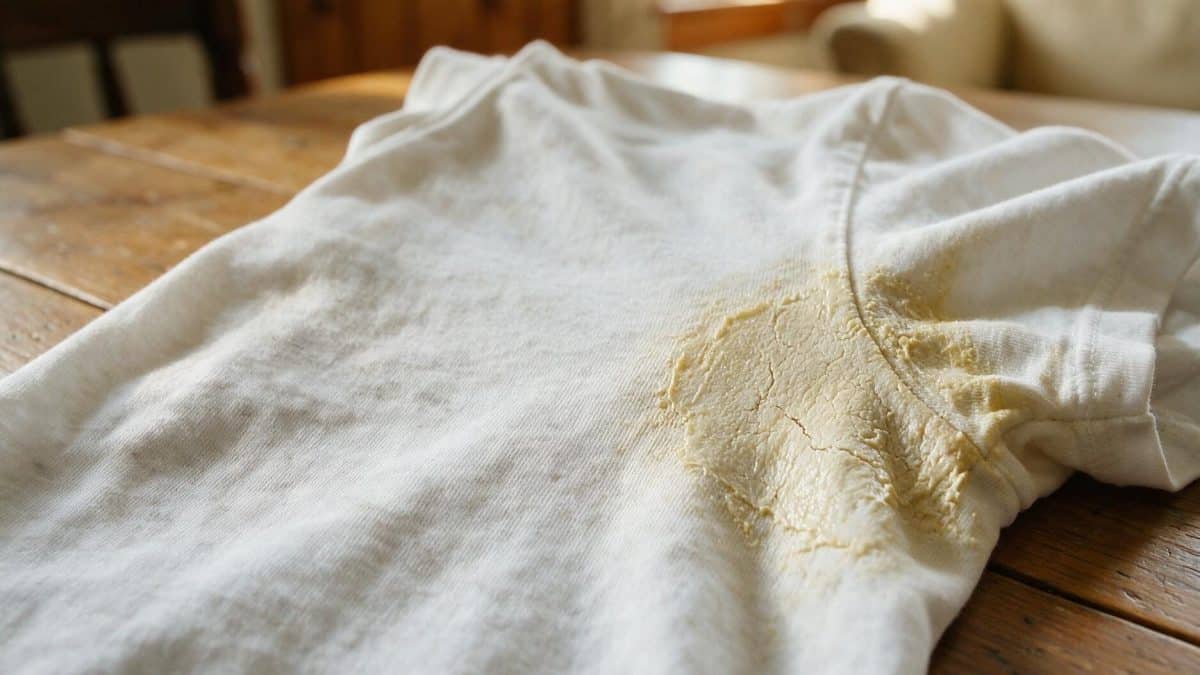
Two things live in a worn underarm and only one of them is a stain. The yellow is a question of shade. The stiffness is a physical layer of aluminum salts bound up with sebum, and it behaves like a thin water-repellent coating that does not dissolve in wash water, so detergent never reaches the fabric underneath. That is why a shirt goes through five hot washes with no improvement at all. Nothing is failing to dissolve the stain, because nothing is reaching it.
This is what Clorox’s opening step is aimed at, and it is the most surprising instruction in any of the published methods: pour boiling water straight onto each armpit to melt the buildup, then apply the peroxide paste while it is still soft. Clorox’s own version lays the shirt in a plastic dishpan and calls for a kettle, tongs and heat-proof gloves, which is the part to copy if you try it. It sits awkwardly against the heat rule, and the resolution is that the two heats do different jobs. Boiling water softens a wax-like crust before any protein treatment has begun. A dryer applies heat to a part-treated protein mark at the end. If that sounds too risky, the toothbrush and a long enzyme soak reach the same place more slowly.
The same split explains why aluminum-free deodorant helps less than people expect: it removes the aluminum, but the stick still deposits waxes and plant butters that build up in the same place. That residue is a stain in its own right, separated out in how to clean deodorant stains from shirts.
Where the published advice actually disagrees
The major sources contradict each other on the central question, and that is worth naming rather than smoothing over. Clorox adds a third of a cup of chlorine bleach to a hot wash for white cotton or polyester. The Drycleaning and Laundry Institute never mentions chlorine and sends you to a long, weak peroxide bath. The University of Georgia’s extension service prescribes a sodium perborate soak of fifteen to thirty minutes, then the hottest wash the garment allows.
They agree on more than they differ on: pretreat first, use enzymes, wash as warm as the label permits, keep the shirt out of the dryer until the mark has gone, repeat rather than reach for something harsher. The disagreement is confined to chlorine, and the honest summary is that the manufacturer of chlorine bleach says it works on white cotton and the trade body for cleaners does not use it here. Trying it means running the experiment on the shirt.
| What you might reach for | What it does | Removes the yellow? |
|---|---|---|
| Chlorine bleach | Oxidizes, and also reacts with protein residue. Recommended by Clorox for white cotton and polyester; avoided by cleaners for exactly this mark | Disputed |
| 3% hydrogen peroxide | The oxidizer with no chlorine chemistry attached. Slow, which is why it is prescribed as a soak of hours | Yes |
| Oxygen bleach (percarbonate) | Releases hydrogen peroxide into the water. Same result as the bottle, in a form that keeps and works through a whole wash | Yes |
| Liquid enzyme detergent | Digests the sweat protein and the body oil, and does nothing to the shade of what is left. A first step, not the method | The oil half |
| White vinegar | A weak acid that loosens the mineral half of an old deposit. Not an oxidizer, so it cannot take a chromophore apart | Not alone |
| Baking soda on its own | An alkali and a mild abrasive. Its real job here is raising the pH so the peroxide works; alone it lifts loose residue and no more | No |
| Crushed aspirin paste | A weak acid in tablet form. It does roughly what vinegar does, more slowly, and leaves a binder to rinse out of the weave | No |
What the shirt is made of sets the ceiling
| Shirt | What changes |
|---|---|
| 100% white cotton | The method runs as written. Cotton tolerates the peroxide paste and the hot wash, and has the best odds of full recovery |
| Cotton and polyester | Polyester repels water and holds oil, so more of this yellow is sebum than aluminum. The enzyme step matters more than the peroxide step, and a cold wash will not shift it. See can you machine wash polyester |
| White with a few percent elastane | Hypochlorite degrades elastane, which is why Clorox routes these shirts to a bleach-free stain remover even when they are white. Peroxide is the safer oxidizer |
| Silk or wool | Skip the enzymes: a protease cannot tell sweat protein from the fibre holding the shirt together. The Institute also notes that chloride salts weaken silk and eventually open holes, so an old mark there is a repair question as much as a stain one. See can you machine wash silk |
Worth knowing before you spend money on it: the dry cleaner is not the answer to this mark. The Drycleaning and Laundry Institute says plainly that perspiration staining and smell may not come out in the drycleaning process, and its own remedy is a water bath rather than solvent. The deposit is water-soluble salts and protein; solvent is built for grease. Ask specifically for wet cleaning, and see how to dry clean at home for what solvent does and does not reach.
Related guides
- The white residue that rubs off on contact is a different stain with an opposite temperature rule, and it is usually sitting on the same shirt: how to clean deodorant stains from shirts.
- For sorting an unidentified mark into a category before anything touches it, the framework is in how to clean stains from clothes.
- A yellow mark on white cotton that has nothing to do with sweat is usually mould or dissolved iron from hard water. Both look the same in the basket and neither responds to this method: how to clean mold off clothes and how to clean rust off clothes.
- The same rule, that only an oxidizer takes the yellow apart while soap merely moves it around, shows up again in how to clean a coffee stain.
Questions
Does bleach remove yellow armpit stains from white shirts?
The sources genuinely split. Clorox recommends a third of a cup in a hot wash for white cotton and polyester. Cleaners and most stain guides say chlorine reacts with the protein and mineral residue and drives the mark darker rather than lighter. Both sides agree that hydrogen peroxide works on this deposit and carries none of that risk, which makes peroxide the sensible first attempt and chlorine the gamble, not the other way round.
Can you still remove yellow armpit stains that are years old?
Often, partly, and rarely completely. Age is not the obstacle; heat is. A mark that has been through a hot dryer or under an iron dozens of times was set each time, and every cycle bound a little more of it into the weave. Expect a long peroxide soak to lift it several shades rather than clear it, and judge after two passes whether the shirt is worth a third.
Why does the underarm of a white shirt go stiff and crunchy?
That is buildup rather than staining: aluminum salts bound up with body oil into a layer that sits on the fabric instead of in it. It repels water, which is why ordinary washing does nothing to it and why the cloth underneath stays dirty. It has to be softened and broken up before any treatment reaches the fabric.
Will switching to aluminum-free deodorant stop it happening?
It removes the aluminum, and with it the most commonly cited yellowing mechanism, so the yellow slows down. It does not stop residue: aluminum-free sticks are built on waxes and plant butters that transfer onto fabric, build up in the same place and yellow themselves as the oils age. The stain slows and changes character rather than stopping.
Does hydrogen peroxide damage white cotton?
Not at pharmacy strength and not at the exposures described here. The pharmacy 3% bottle is the same solution cleaners dilute for a six-hour whitening bath, a few ounces to the gallon, and cotton handles it undiluted for the minutes this method asks for. Damage comes from concentration plus heat plus repetition, which is why this method uses a weak solution for a long time rather than a strong one quickly.
Should I hand wash the shirt instead of machining it?
Hand washing gives better control of the pretreatment and worse rinsing, and rinsing is what carries the loosened salts away. Do the pretreatment by hand and the wash in the machine, which is where the water volume is. If the whole thing has to be done by hand, the rinse is the part to plan for: see how to clean clothes by hand.