How to Clean Rust Off Clothes (Acid Works, Bleach Makes It Permanent)
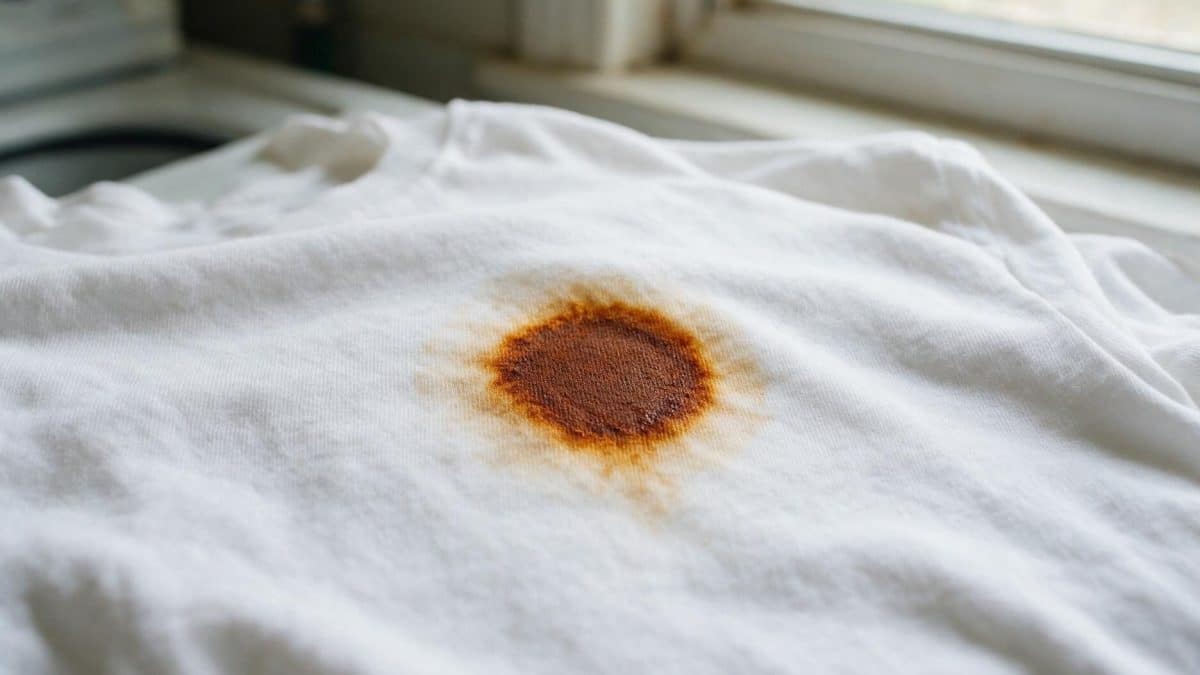
Rust is iron oxide, so the usual stain reflex is exactly wrong: chlorine bleach oxidizes the iron further and sets the mark for good, and dryer heat finishes it. Acid is the only route.
Quick answer · care label Washable fabric — rust (iron oxide)
-
1 · Wash
Wash 30° -
2 · Bleach
No bleach -
3 · Dry
No tumble dry -
4 · Iron
Do not iron -
5 · Pro care
Pro clean P
In one line Find the metal that caused it, then treat with acid rather than bleach: salt and lemon juice dried in sun first, a commercial rust remover if that fails, then a hard rinse and a cool wash on its own. Nothing hot goes near the fabric until the mark is gone, because dryer heat is what turns a treatable rust stain into a permanent one. About 20 minutes hands-on.
Why is rust the one stain bleach makes permanent?
Nearly every other mark on a garment is a substance sitting in the weave — a pigment, an oil, a protein — and bleach removes it by oxidizing it into something the eye stops registering. Rust is not that kind of mark. Rust is iron oxide: by the time you see the orange patch, the iron has already oxidized and settled among the fibres, and there is nothing left for an oxidizer to do.
There is something worse than nothing, though. Sodium hypochlorite works as an oxidizer at an alkaline pH, and that is the condition that carries iron further along rather than lifting it out of the weave. So this is one of the few hard rules rather than a judgement call: chlorine bleach does not remove a rust stain, it fixes it.
What does work is acid. Acid pulls iron oxide back into a soluble form that rinses out of the weave, which is why every serious rust treatment, from a cut lemon to the bottle in the hardware aisle, is acidic. The disagreements are only about which acid, and how strong.
Rust does not set with age the way a protein stain does. It sets with heat and with oxidizers. A mark you found this morning and one that has sat in a wardrobe for a year are often in comparable condition — unless the old one has been through a tumble dryer, which is usually what made it permanent. Nothing hot goes near the garment until the mark is gone.
What you’ll need
| Item | Why | Substitute |
|---|---|---|
| Lemons | Citric acid: enough for fresh or light rust, mild enough for most washable fabrics | Bottled lemon juice, or white vinegar as a weaker version |
| Table salt | Holds the juice against the mark instead of letting it run off | Any fine salt; coverage matters more than grain |
| Commercial rust remover | A strong acid, and the only thing that reliably shifts a stain the lemon failed on | Cream of tartar, for white cottons and linens you can boil |
| White cotton cloths | Blot dissolved iron out rather than spreading it sideways | An old white T-shirt, no printing |
| Rubber gloves | Every rust remover worth buying is an acid strong enough to injure skin | Dish gloves for lemon or oxalic; for anything stronger, what the label specifies |
The method, step by step
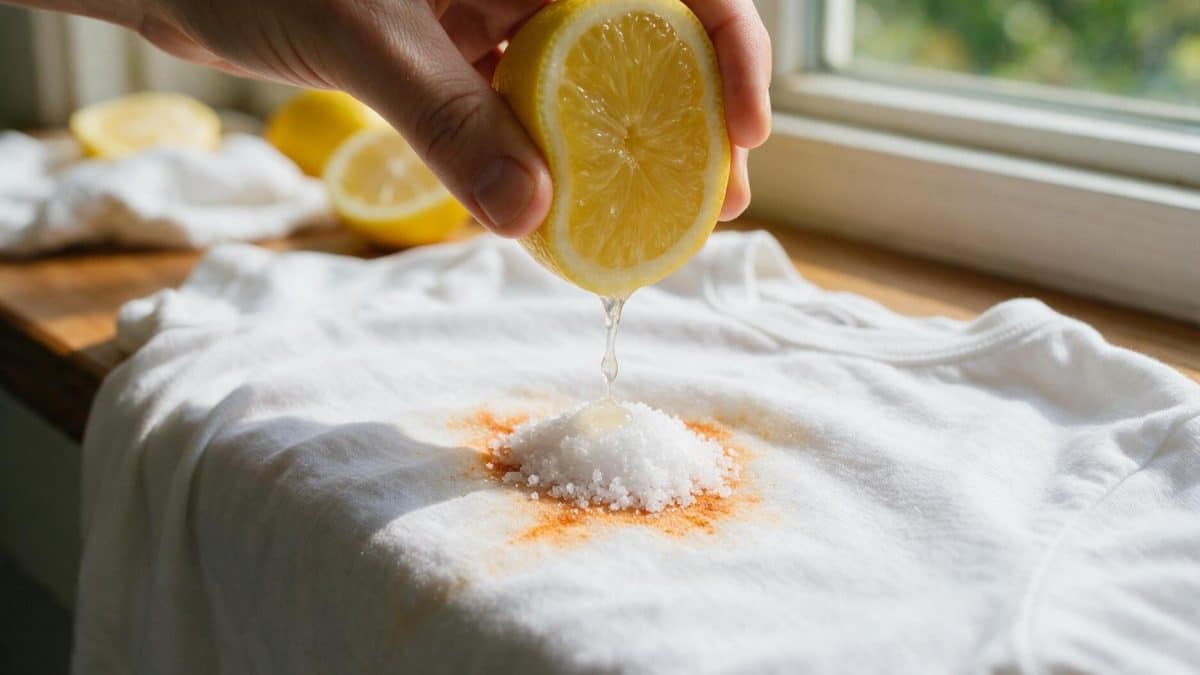
Two things make this sequence different from an ordinary stain. You look for the source before you look at the mark, because a stain with a live source returns on the next wash. And heat is held back until the end: the dryer and the iron wait until the fabric is visibly clean.
Find the metal before you touch the stain
Check the pockets for a hairpin, a key or a screw, then the zip, the snaps, the hooks and any bra wire. Then count the casualties: marks on several garments from one load point at the machine or the water, not the clothes.
Keep it off the ironing board and out of the dryer
People skip this because it does not feel like a step. Heat is what turns a treatable orange patch into the permanent kind, and a garment already dried once is harder to save than one that has not been.
Spot-test the acid on a hidden seam
Inside seam or hem, one drop, two minutes, then blot with a white cloth and look for dye on the cloth. On a dyed fabric it is the only way to learn whether the acid costs more than the rust does.
Salt, lemon juice, then daylight
The oldest published method is deliberately plain: sprinkle salt over the mark, squeeze lemon juice on until it is saturated, spread the item in the sun to dry, rinse thoroughly, repeat if a shadow remains. This is the right first attempt on white and colourfast cotton. Sun and citric acid both fade dye, so keep it off anything dark or printed.
Step up to a rust remover if the mark survives
Laundry-aisle and hardware rust removers are strong acids, and not all the same acid. Some are built on oxalic acid; some contain dilute hydrofluoric acid, which is the word to look for on the label, because hydrofluoric burns can be slow to hurt and slow to show, so an exposure gets ignored until it is serious. Read the bottle before you open it and follow that rather than this page. These act in seconds, so watch the mark and stop the moment it goes.
Rinse hard, then wash cool and alone
Flush the treated area under plenty of cold running water so no acid stays behind in the fibres. Then wash the item on its own at 30 °C (86 °F), detergent and nothing else in the drawer — no bleach of any kind, including whatever is left in the dispenser from the last load.
Air-dry, then inspect in daylight
Hang it until properly dry, then look at the spot in daylight rather than under a kitchen bulb. A faint orange shadow means repeat from step four, not proceed. Only once the mark is genuinely gone do the dryer and the iron come back into play.
Where the rust came from, and whether it comes back
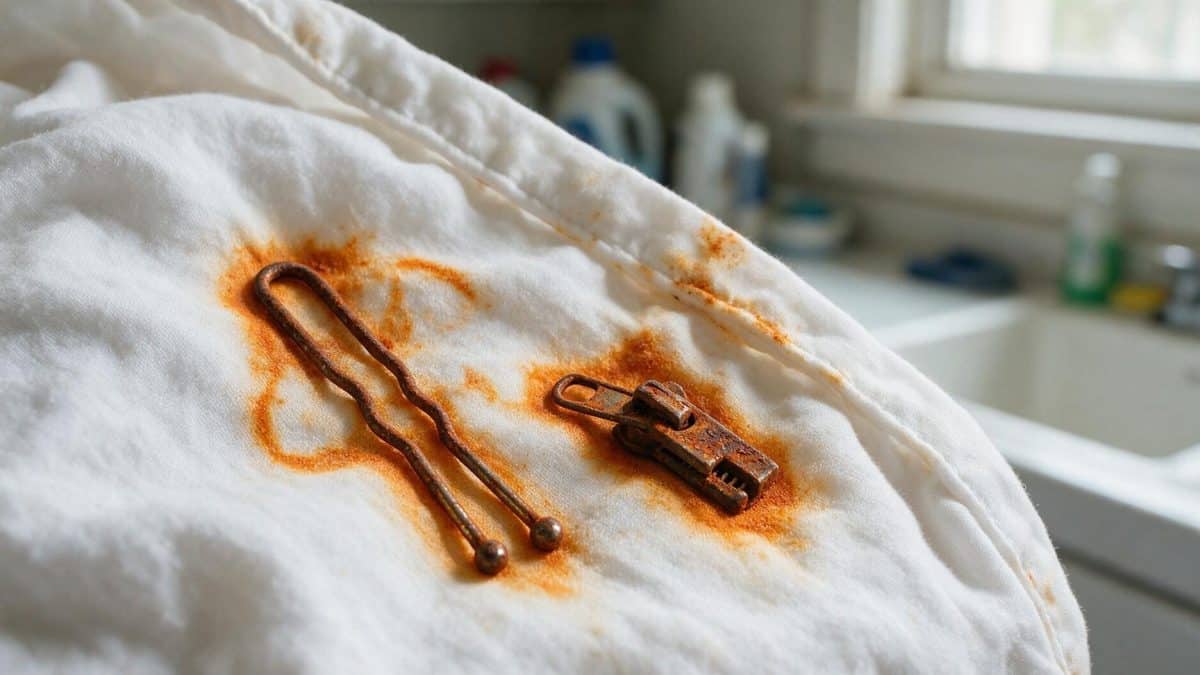
A rust stain is evidence that corroding metal touched wet fabric. Remove the stain without finding that metal and you have only reset the clock — and the pattern of the marks usually names the source for you.
| Source | What it looks like | What to do about it |
|---|---|---|
| Metal in a pocket or loose in the drum | One or two sharply defined marks on a single garment | Empty pockets; check the drum and door seal |
| Zips, snaps, hooks, underwires | A mark exactly where the hardware sits, often after storage | Dry things fully before storing; damp storage is what corrodes hardware |
| Chipped drum or rusting agitator shaft | Marks on random items, load after load, in no repeating position | Look inside the drum for exposed metal; an appliance repair, not a laundry problem |
| Iron in the water supply | An overall orange or yellow cast on whites, not a defined spot | Have the water tested; the EPA lists orange staining as an effect of iron and sets a non-enforceable guideline of 0.3 mg/L |
| A steam iron spitting brown water | A streak or spatter laid down while pressing | Descale the iron before pressing anything else pale |
The last row deserves separating out, because the fix has nothing to do with stain removal: a steam iron filled with hard water long enough pushes scale and iron out through the soleplate onto whatever is under it. Cleaning the appliance is the whole repair, covered in how to clean a clothes iron.
Which fabrics you can treat at home
Acid is the right tool for the stain and a variable one for the fabric. Cellulose fibres take a brief, well-rinsed acid treatment without complaint. Protein fibres and coated materials do not.
| Fabric | What to use | Treat at home? |
|---|---|---|
| White cotton and linen | Salt and lemon in sun; on whites you can boil, a cream of tartar bath instead | Yes |
| Coloured cotton, denim, polyester | Spot-test, then a rust remover with the shortest contact time that works | Yes |
| Wool, silk, cashmere | Nothing stronger than heavily diluted lemon juice, and only after a seam test | No |
| Elastane and activewear blends | Brief acid contact, cold rinse; skip the boiling and the sun | Yes |
| Leather and suede | Nothing. Rust on leather is a job for a specialist cleaner | No |
| Carpet and upholstery | An oxalic acid solution made up as the packet directs, worked in with a toothbrush | Yes |
Wool and silk are the honest gap in the advice. Protein fibres tolerate mild acid better than alkali, which is why a very dilute lemon solution turns up in some guidance — while other sources say strong acid has no business on wool or silk at all. We could not find that split resolved anywhere, and on a jumper you like it is reason enough to hand the problem to a cleaner and say the word rust out loud. The wider rules are in how to clean wool.
Where the published advice disagrees
Rust is well covered and badly agreed on. These are the points where sources contradict each other, and what we would do about each one.
- Whether vinegar does anything. Vinegar is an acid, so the mechanism is real, but people testing it on a set stain report anything from clear improvement to no visible change. Lemon juice with salt and sun does better in the same informal tests. Worth one attempt on a fresh mark; not a plan for an old one.
- Whether oxygen bleach belongs near rust. Some guidance offers an oxygen-bleach soak for whites gone rusty-looking overall. Other sources argue every oxidizer is wrong on iron for the reason chlorine is. The conservative reading: acid first, always, and any oxygen soak afterwards and only on whites.
- How often you can repeat an acid treatment. A brief, well-rinsed acid treatment lifts iron out of cotton and linen without obvious damage, which is why it is the standard route. That is not a licence to keep going: acid and cellulose are not long-term friends, and the caution scales with the age and value of the cloth. Two careful attempts on a modern shirt is not the same as soaking an heirloom.
- What nobody disagrees about. Chlorine bleach sets rust and dryer heat sets rust. Neither is a judgement call, and between them they account for most of the stains people give up on.
Related guides
- If the orange mark appeared during pressing rather than in the wash, the appliance is the problem and stain removal is the wrong tool: how to clean a clothes iron.
- Rust is one stain family among several, and both the temperature and the agent change depending on which one you have: how to clean stains from clothes.
- Blood is the other everyday stain where heat, not time, makes it permanent: how to clean a blood stain.
- Mold goes further still — it is the stain where washing before treating actively makes things worse: how to clean mold off clothes.
Questions
Will bleach get rust out of a white shirt?
No, and it is the one stain where bleach reliably makes things worse. Chlorine bleach is an oxidizer at an alkaline pH, exactly the condition that carries iron further along, so it sets the mark instead of removing it. Use acid: lemon juice on a light mark, a commercial rust remover on a set one.
Does white vinegar actually remove rust stains?
Sometimes, on a fresh and faint mark. Vinegar is a weak acid and the chemistry points the right way, but reported results on set stains range from a useful fade to nothing at all. Lemon juice with salt, dried in sun, does better, and neither is in the class of a dedicated rust remover.
Can you get an old rust stain out of clothes?
Often, yes — age alone is not what makes rust permanent. Heat is, so the real question is whether the garment has been through a dryer or an iron since the mark appeared. If it has, expect to need a commercial rust remover and two or three attempts, and expect a fade rather than a clean removal.
My whole white wash came out orange. Is that rust?
Probably iron in the water rather than a stain from an object. The tell is an overall cast on many items instead of defined marks on one. The EPA lists reddish or orange staining among the effects of iron and sets a non-enforceable guideline of 0.3 mg/L, so a water test is the next step. Treating garment after garment while the supply stays the same is a losing game.
What about rust on a rug or on carpet?
Same chemistry, different method, because you cannot rinse a carpet the way you rinse a shirt. The usual route is an oxalic acid solution, made up as the packet directs and applied with a toothbrush and light agitation, then blotted rather than flooded. The wider approach is in how to clean stains on a rug.
Can I just pour rust remover into the washing machine?
No. These are made for direct application and a fast rinse, not for a drumful of water where they are diluted past usefulness and left sitting against the machine’s own metal. Treat the spot at the sink, rinse thoroughly, then wash.