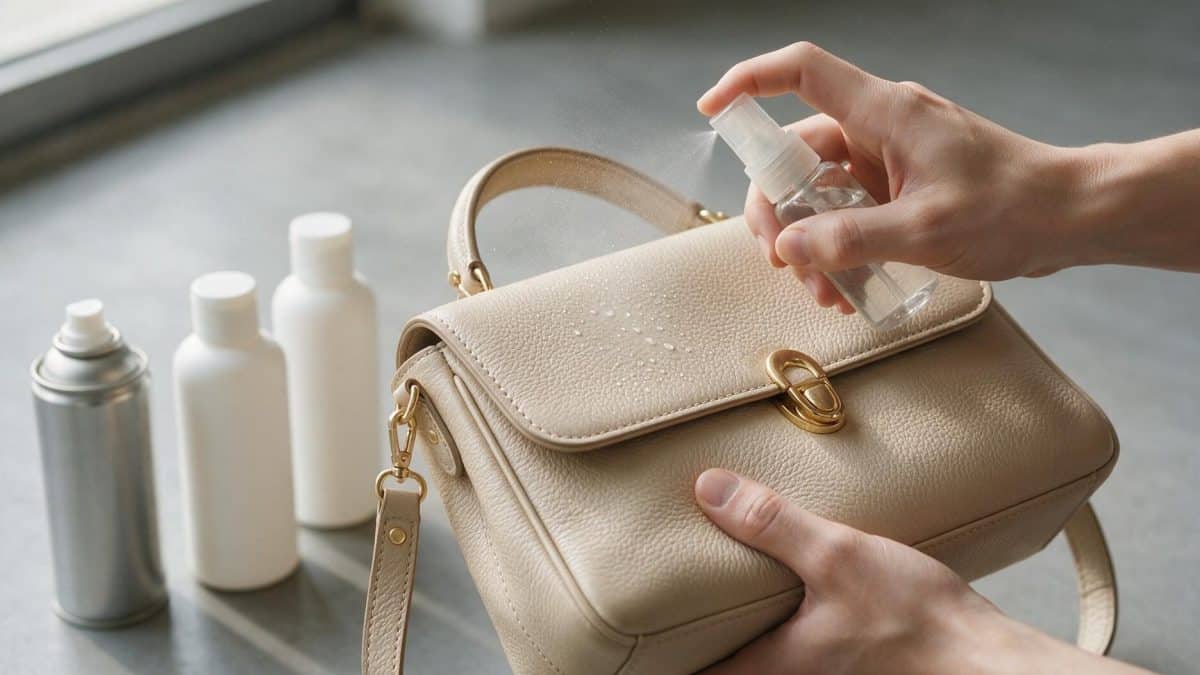
How to Clean Stains Off Leather
Every guide sorts leather stains by what spilled. On finished leather that misses the point, because the stain is sitting on a plastic film and the solvent that dissolves it dissolves the film too. Here is the white-cloth test that says whether a mark is removable at all.
Quick answer · care label Leather · pigmented, aniline or unfinished
-
1 · Wash
Do not wash -
2 · Bleach
No bleach -
3 · Dry
No tumble dry -
4 · Iron
Do not iron -
5 · Pro care
Pro clean P
In one line Find where the mark is before choosing a product. Press a damp white cloth on it for ten seconds: color on the cloth means the stain is on the finish and comes off with distilled water, then two drops of dish soap in a cup, worked panel-wide to the nearest seam and conditioned once dry. No color on the cloth means the dye has migrated into the finish or the oil is in the hide, and no household cleaner reaches either. Never melamine foam, WD-40 or hydrogen peroxide.
On most leather, the stain is not in the leather
Pigmented leather covers the large majority of sofas, car seats, jackets and bags sold today, and it is not a bare hide. It is a hide with a thin coat of pigment sprayed over it, sealed under a clear polyurethane or acrylic film a few hundredths of a millimeter thick. Coffee, ink, olive oil and the dye off a new pair of jeans all land on that film. The skin underneath never meets them.
That one fact reorders the whole problem. Search this question and you get a matrix: cornstarch for grease, rubbing alcohol for ink, mild soap for food. Every one of those answers the question what dissolves the stain. On finished leather that is the easy half. The binding question is what dissolves the finish, and it has the same answer. Alcohol lifts ballpoint ink because ink is pigment suspended in a resin, and alcohol dissolves that resin. The topcoat on your armchair is also pigment suspended in a resin. The solvent cannot tell the two apart, and neither can the person holding the cotton swab.
So the useful sorting is not by what spilled. It is by where the mark ended up: sitting on the finish, dissolved into the finish, or through it and in the hide. The first comes off with almost nothing. The second does not come off at all. The third is a refinishing job. Thirty seconds with a white cloth tells you which one you have, and it is worth spending them before opening anything under the sink.
Dampen a white cotton cloth with distilled water, press it flat on the edge of the mark for ten seconds, and lift it straight off. Do not rub. Any color on the cloth means the stain is sitting on top of the finish, and the method below will take it off. A clean cloth and a mark still there means it is inside the finish or under it, and no household cleaner reaches either. First tilt the piece to a window: if the marked area is duller or shinier than the leather around it, the finish itself is damaged, which is not a cleaning problem at all.
One caveat before you wet anything. This assumes finished leather. On aniline or unfinished hide, a damp cloth is itself a stain, so run the water-drop test in how to clean leather first and come back to the unfinished section further down.
What you’ll need
| Item | Why | Substitute |
|---|---|---|
| Distilled water | Hard tap water leaves its own mineral ring as it dries, which is a common way one mark becomes two | Cooled boiled water, or bottled still water |
| Two white cotton cloths | One for the location test and the cleaning, one dry for immediate follow-up. White because a colored cloth hides the transfer you are testing for | An old white T-shirt cut in half |
| pH-neutral soap, heavily diluted | A surfactant lifts what water alone leaves behind without attacking the topcoat’s binder the way a solvent does | Two drops of dish soap in a cup of water, no more |
| Cotton swabs | Keeps a solvent on the mark and off the finish around it. Anything applied with a cloth spreads several centimeters wider than you intend | A cotton ball pinched to a point |
| Leather conditioner | Cleaning removes some of the surface oils along with the soil, and the panel dries visibly flatter than the ones beside it without it | A cream with no wax or silicone on the label |
| Cornstarch | Draws absorbed oil back out of an unfinished hide. On a sealed topcoat there is nothing for it to draw, and it is the most over-prescribed item on this list | Talc, or plain baking soda |
The method, for a stain sitting on the finish
This is the common case and the good news: it needs the mildest thing that works, applied to a whole panel rather than a spot.
Lift the solids dry, before any liquid
The edge of a spoon or a blunt card, scraping toward the middle of the mark rather than outward. Ketchup or makeup pushed around with a wet cloth becomes a stain three times the size, and the extra area is the part that shows once everything dries.
Run the white-cloth test
Ten seconds of contact at the edge of the mark, then look at the cloth. This decides whether you carry on or stop and read the dye transfer section instead. Skipping it is how people spend an hour scrubbing something that was never on the surface.
Try distilled water on its own first
A cloth wrung out until it feels barely cool, wiped in one direction across the mark. A surprising share of what looks permanent is dried food or a drink residue that water alone releases, and starting here costs you nothing if it fails.
Escalate once, to diluted soap
Two drops in a cup of water, worked in small circles with a barely damp cloth, then a second cloth with plain water over the same area to pick the soap back up. Soap left on leather is slightly hygroscopic and the spot collects dirt faster than the leather around it, which is why the mark seems to come back within two weeks.
Work outward to the nearest seam
Whatever you did to the mark, repeat it lightly over the whole panel, stopping at a stitch line. Cleaning a ten-centimeter circle on a five-year-old sofa does not remove a stain so much as reveal how dirty the rest of the cushion is, and that halo is more visible than the coffee was.
Dry cold, then condition the panel
Blot with the dry cloth immediately, then leave it at room temperature away from any radiator, hairdryer or sunny window. Heat pulls oil out of the hide itself rather than off it. Condition once fully dry, again panel-wide, not spot-wide.
Interactive
Label decoder
Tap a symbol from your care label. No guessing, no scrolling.
19 symbols. Pick one.
The household products everyone asks about
Four of the six questions Google shows alongside this search are about a specific product from under the sink rather than about a stain. They deserve straight answers, because two of them work exactly as advertised and that is the problem.
| Product | What it does | Verdict |
|---|---|---|
| Magic eraser (melamine foam) | It is a micro-abrasive. It works like extremely fine sandpaper, and it removes the mark by removing the top of the pigment layer with it | Never, on any finish |
| WD-40 | A blend of light solvents and mineral oil. The solvent softens the topcoat, the oil darkens the leather so the mark stops being visible against it | No. It hides rather than removes, and leaves a film that holds dust |
| Hydrogen peroxide | An oxidizer. It does not distinguish between the pigment in the stain and the pigment in the finish, and bleaches both | No on anything colored. A permanent pale patch is the usual result |
| Dish soap, two drops in a cup | A plain surfactant. It loosens soil without dissolving resin, which is exactly what you want here | Yes, diluted hard and wiped back off |
| White vinegar, half and half | Dilute acetic acid. It dissolves salt deposits, which is why it earns its reputation on winter shoes, and does very little to anything else | Only on salt rings, and diluted further than the usual recipe |
| Rubbing alcohol on a swab | Dissolves the resin holding ink together. It also dissolves the resin holding your finish together, at the same speed | Ink only, dabbed never rubbed, and stop the moment color shows on the swab |
Look at the foam after two or three passes. It comes away grey, or tinted the color of the leather. That tint is the pigment layer. The spot will look clean for a week, then read matte against the panel around it and start picking up dirt faster than anywhere else, because the sealed layer that used to keep dirt out is no longer there.
The same reasoning demotes the single most repeated tip on this subject: cornstarch under cling film, left overnight, to draw out grease. A drawing powder needs oil it can reach. Sitting on an intact topcoat, it has none, and the grease it was supposed to lift wipes off with the diluted soap in half a minute. Keep that trick for the hides where oil genuinely soaks in, which is the section after next.
Dye transfer: the mark that nothing lifts
Read the forum threads behind this search and one case dominates: a cream bag that spent an evening against a red dress, white car seats that turned blue-grey under new jeans, a pale sofa marked exactly where someone sits. It is the most asked version of this question and the one no listicle answers, because the honest answer is that it is not a stain in the sense the other sections use the word.
The clear topcoat is a plastic film, and it stays flexible because of plasticizers dispersed through it. Those plasticizers move. Under pressure and a little warmth, they migrate toward the surface, and the dye from whatever is pressed against the leather dissolves into them and travels back the other way. What you end up with is not a deposit resting on the finish, it is color dissolved inside it, in the same way sugar is inside tea. There is nothing on the surface left to wipe, which is why every cleaner in the house appears to do nothing at all. It also explains the pattern people find strange: the mark has no splash edge, it is diffuse, and it maps precisely onto a contact area rather than an accident.
Two things make it worse, and both are worth knowing before it happens. Heat accelerates the migration, so a car left in summer sun transfers denim into a light seat in days rather than months. And time matters in one direction only. Caught in the first hours, while some of the dye is still sitting on top, a dedicated leather cleaner takes off the share that has not yet dissolved in. After that, the remainder is a coloring job: a specialist strips and re-pigments the panel, and home touch-up kits do the same thing less precisely. Both replace the color rather than remove the stain, and on cream or white the match is the hard part.
Which makes prevention the real answer, unsatisfying as that is to read after the fact. A protector cream renews a sacrificial layer that takes the dye instead of the finish. And the offender is predictable: raw or unwashed dark denim sheds indigo for its first several wears, the same surface-dye behavior described in how to clean jeans. New jeans against a pale leather seat is a known pairing, not bad luck.
Marks that went through the finish
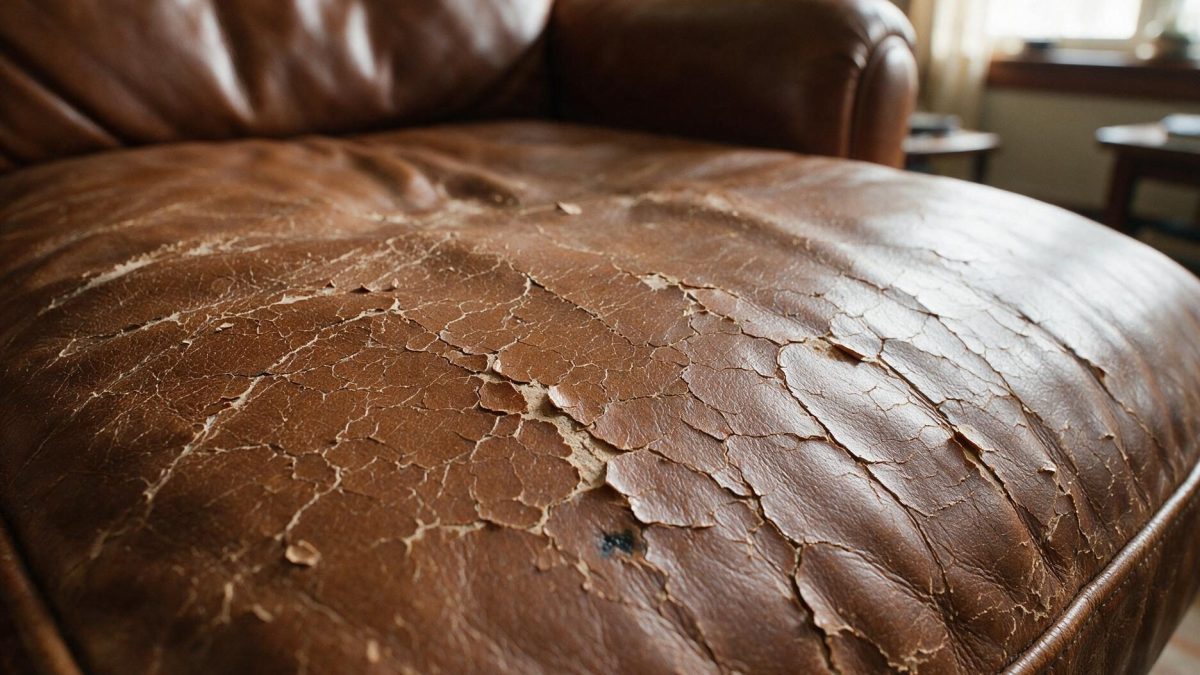
The third location is the hide itself, and there are two ways to get there. Either the leather never had a topcoat, or it wore through in the place you sit, grip or lean.
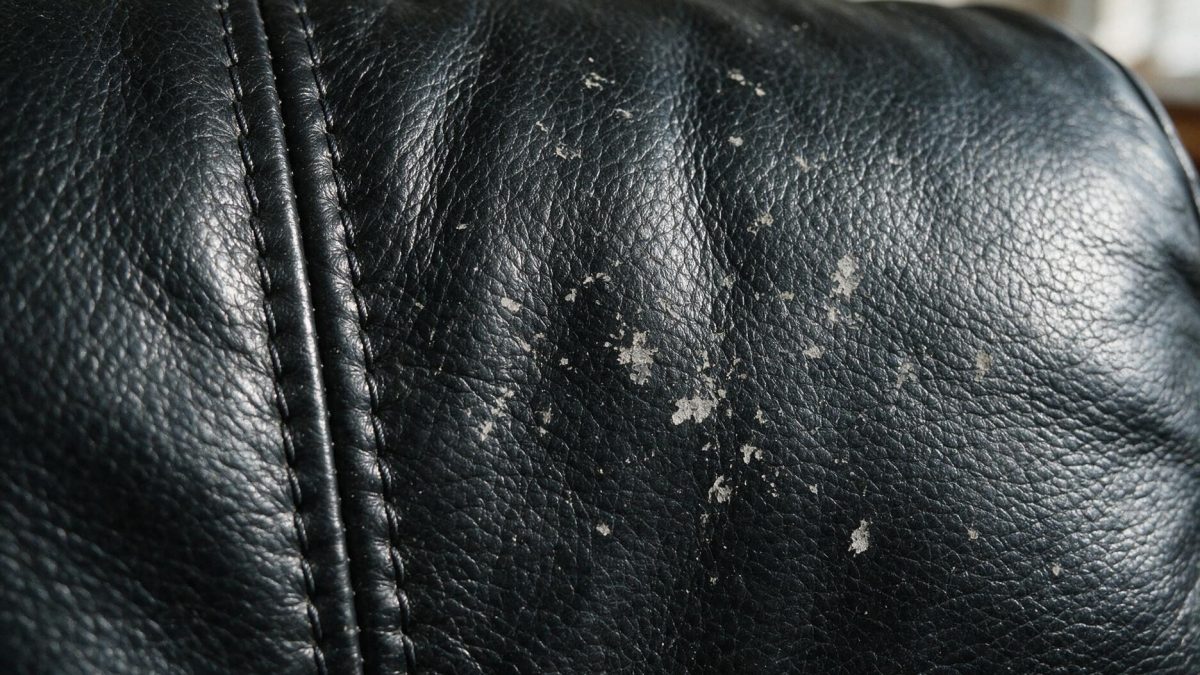
The dark, faintly shiny patch on a sofa headrest, an armrest, or the handle of a bag is the second case. The finish has been abraded away by contact over years, and body oil has entered the hide underneath. Nothing applied to the surface reaches it, and a degreaser strong enough to reach it strips whatever finish survives around it. This is refinishing, not cleaning, and it is worth saying plainly rather than sending someone through six home remedies first. Bags concentrate this in a single spot, which is covered in how to clean a leather bag.
Unfinished and aniline hide is the first case, and it behaves like a very dense fabric. Every liquid that touches it is absorbed rather than deposited, so the rules invert:
- Fresh oil or grease is where cornstarch finally makes sense. A thick mound over the spot, left several hours, brushed off dry. There really is absorbed oil for it to pull, which is what the technique was designed for.
- Water rings need the whole panel dampened, not the ring. A tidemark is the edge where dissolved matter dried in a line, and the only way to remove a line is to stop it being a line. Dampen evenly to the nearest seam with distilled water and let it dry slowly and flat.
- Fresh spills get blotted straight down. Press and lift, never wipe sideways, which spreads a two-centimeter spill across a hand’s width of hide.
- Set-in stains go to a specialist. The methods that work on pigmented leather push a stain outward on open hide, and the second attempt is always harder than the first.
Suede is the extreme version of the same material, sanded on the flesh side into a nap, and it takes a different toolkit entirely: how to clean suede covers it.
By what the leather is attached to
The three locations above hold for every leather object. What changes is drying, pressure and how much of a panel you are allowed to wet at once.
- Jackets mark most at the collar and cuffs, where body oil and finish wear meet. See how to clean a leather jacket.
- Bags add a lining that holds odor and a handle that wears through its finish long before the body of the bag does. See how to clean a leather bag.
- Sofas and car seats are where dye transfer and worn contact points both concentrate, and where the panel-to-seam rule matters most, because a cleaned patch on a large surface is very hard to hide. On furniture that rule has a second reason behind it: many sofas are built as leather match, and the seam you stop at is often where the hide ends and a matched polyurethane panel begins. See how to clean a leather sofa.
- Shoes and boots take salt rather than dye, which is the one case where diluted vinegar is the correct tool rather than a folk remedy.
Related guides
Before anything on this page, it is worth knowing which leather is in front of you: how to clean leather has the water-drop test and the routine care that keeps a topcoat intact in the first place. On fabric the sorting logic is completely different, because the stain really is in the material and a rinse is available, which is the framework in how to clean stains from clothes. If the mark is ink specifically, the three ink types behave differently even before the leather question comes up: see how to clean ink stains on clothes.
Questions
Does WD-40 remove stains from leather?
It appears to, and that is the trap. WD-40 is mostly light solvent and mineral oil: the oil darkens the leather until the mark no longer contrasts with it, and the solvent softens the topcoat while it does so. Nothing has been removed. A few weeks later the treated area is a slightly darker, slightly tacky patch that holds dust, and it is harder to clean than the original stain.
Is a magic eraser safe on leather?
No, on any finish. Melamine foam works by abrasion, so on pigmented leather it takes off the mark and the top of the pigment layer together. The tell is the foam itself: if it comes away tinted, that color is your finish. The spot looks clean immediately and reads matte and dirt-prone within a month.
Can I use Dawn or another dish soap?
Yes, if you dilute it far more than feels sensible. Two drops in a cup of water is the right strength, applied on a barely damp cloth and wiped back off with a second cloth of plain water. Dish soap is a surfactant rather than a solvent, so it lifts soil without attacking the resin the finish is made of. What causes trouble is leaving the residue on, since it attracts dirt to the exact spot you just cleaned.
Does hydrogen peroxide remove stains from leather?
It removes color, not stains, and it cannot tell your pigment from the stain’s. On white or very pale leather you may get away with it. On anything else the likely outcome is a permanently lighter patch in the shape of whatever you dabbed it with, which is a worse mark than the one you started with.
Why won’t an old stain come out no matter what I use?
Because it is almost certainly no longer on the surface. Dye that has migrated into the topcoat, or oil that has passed through a worn finish into the hide, leaves nothing on top for a cleaner to lift. Confirm it with a damp white cloth: if no color transfers, more scrubbing only wears the finish. At that point the honest options are re-pigmenting the panel or living with it.
What is the best stain remover for leather?
A dedicated pH-neutral leather cleaner, and mainly because of what it leaves out rather than what it contains. On the stains that are genuinely removable, plain distilled water and two drops of dish soap perform about as well. Products sold as heavy-duty leather stain removers are usually solvent-based, which is the class of product most likely to take your finish along with the mark.