How to Clean a Mattress
Every mattress guide on this site so far starts after something's already gone wrong. This one is the routine that comes before that: vacuuming, deodorizing, and a protector doing the real barrier work in between, the maintenance that keeps most of those emergencies from happening at all.
Quick answer · care label Mattress cover — foam, innerspring or hybrid core
-
1 · Wash
Do not wash -
2 · Bleach
No bleach -
3 · Dry
No tumble dry -
4 · Iron
Do not iron -
5 · Pro care
Pro clean P
In one line Vacuum the whole surface, deodorize with a full hour (or overnight) of baking soda, then rotate or flip depending on construction. A mattress protector does the real barrier work between cleanings. Total hands-on time: about 30 minutes.
Routine care is a different job from stain removal, and this site has been light on it
Every guide on this site about a mattress so far starts after something has already gone wrong: urine that’s crystallized into a stain that won’t stop smelling, or blood, vomit, and sweat that need cold water before anything else. Both are reactive, aimed at damage that’s already there. This one is proactive: the maintenance that keeps dust, allergens, and everyday odor from building up in the first place, and that in practice cuts down how often you’ll ever need the stain-specific fixes at all. If you’re here because of a fresh stain, the routine below still applies once that’s handled, and the accident-specific guides linked further down cover the chemistry this one doesn’t.
A mattress that gets vacuumed and deodorized on a schedule, with a protector doing the actual barrier work, rarely reaches the point of a set-in stain or a mystery odor. The routine is short, roughly 30-40 minutes including a dwell time you don’t have to babysit, and most of it doesn’t require moving the mattress off the frame.
A rug can be hung over a line so both sides dry at once. A couch cushion cover comes off and the foam insert can be propped up on its own. A mattress sits directly on a frame, box spring, or platform slats with almost no airflow underneath, so any liquid that soaks past the surface, even during routine cleaning, has only one direction to evaporate: up, through however many inches of foam or batting sit on top of it. That’s why every step below stays light on liquid. Full extraction cleaning or a soaked spot treatment belongs to a professional with the right equipment, not a spray bottle and a fan.
What you’ll need
| Item | Why | Substitute |
|---|---|---|
| Vacuum with an upholstery attachment | Pulls out dust, dead skin cells, and shed dust mite debris that a mattress accumulates just from being slept on nightly | A handheld vacuum works fine for a full mattress; a stick vacuum without an upholstery head is too aggressive on the fabric |
| Baking soda, a full box | Full-surface deodorizing draws out trapped moisture and odor from body oils, not just the smell sitting on top | A commercial mattress deodorizing powder, though baking soda alone works as well for a fraction of the cost |
| A mattress protector, waterproof and mite-proof rated | The actual barrier against future stains and allergens; everything else in this routine is maintenance around it, not a replacement for it | None. A mattress without a protector will need this routine far more often |
| Enzymatic spray, small bottle | For the odd light mark from sweat or a spill that isn’t a full stain, without reaching for the heavier stain-specific methods below | A damp cloth with a drop of dish soap for anything caught within minutes |
| A few hours of daylight, ideally with a window open | Airflow and indirect sunlight speed up drying and help with odor; direct, hours-long sun exposure can yellow light-colored fabric over time | A fan pointed at the mattress if sunlight or an open window isn’t available |
The method, step by step
Strip the bed completely
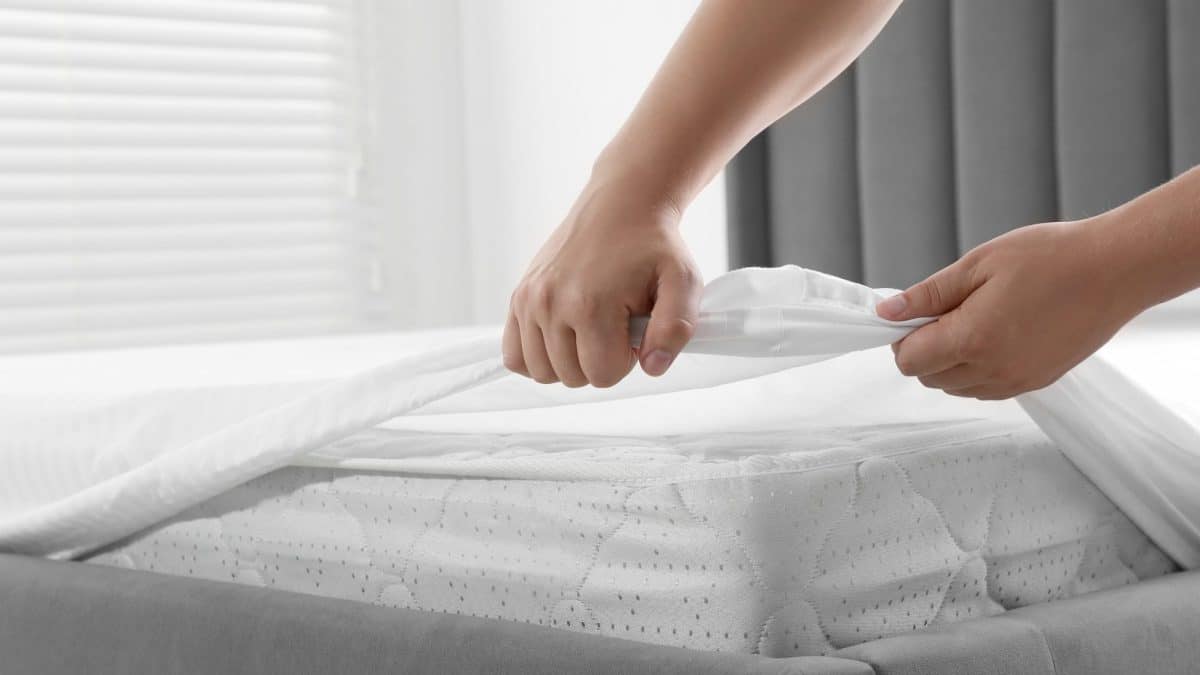
Remove sheets, the mattress protector, and any topper. Wash the protector and sheets separately on the warmest setting the care label allows; this routine is for the mattress itself, not what’s on top of it.
Vacuum the entire surface, edges and seams included
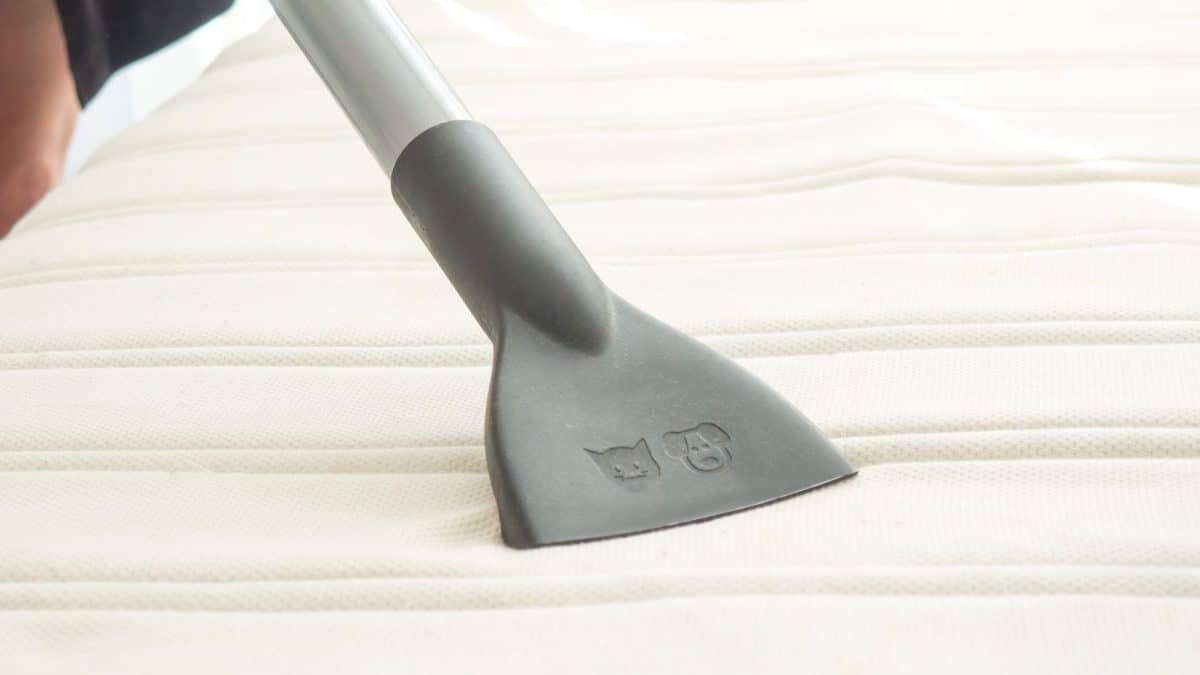
Work the upholstery attachment in overlapping passes across the whole top, then the sides down to where the mattress meets the frame. Seams, tufting, and the piping around the edge are where dust and debris settle deepest and where a quick pass over the middle misses almost everything.
Sprinkle baking soda evenly across the surface
A light, even dusting over the entire top, not just visibly dingy spots. Let it sit at least an hour; overnight if there’s a musty smell rather than just general staleness. The longer dwell time is what pulls moisture and oil out of the surface layer rather than just sitting on top of it.
Vacuum the baking soda off completely
Go over the whole surface again until no powder residue remains, including the seams where it settles and is easy to miss on a first pass.
Spot-treat anything light that turns up
A faint mark that isn’t a stain in progress, just old and dry, usually responds to a little enzymatic spray blotted on and off. Anything that looks like blood, vomit, sweat, or urine needs the dedicated method for that stain, linked below, rather than a general spray.
Rotate, or flip if the mattress allows it, then remake the bed
Turn the mattress head-to-foot before the fresh, clean protector and sheets go back on. Whether flipping is also an option depends on the mattress, covered in full below.
Interactive
Label decoder
Tap a symbol from your care label. No guessing, no scrolling.
19 symbols. Pick one.
Rotate or flip? Check the tag before assuming
Most mattresses sold today are one-sided: a comfort layer of foam or a pillow-top is built into the top only, with a firmer support layer underneath that was never meant to be slept on. Flipping one of these puts that support layer face-up and does nothing useful, and on some hybrid constructions it can put uneven pressure on the wrong side entirely. These get rotated head-to-foot only, typically every three months, which evens out the body impression that forms from sleeping in roughly the same spot every night.
Traditional innerspring mattresses and some all-latex builds are still made two-sided, with sleepable comfort layers on both faces. These can be flipped end-over-end as well as rotated, usually every six months, and doing both is what keeps one side from developing a permanent dip years before the other. The mattress tag or the manufacturer’s page for that model states which category it falls into; guessing based on age or price isn’t reliable, since one-sided construction is now common at every price point.
Dust mites: what vacuuming removes, and what it doesn’t
Dust mites feed on shed human skin cells, and an average mattress sheds enough to sustain a population in the tens of thousands within a couple of years of regular use. They thrive above roughly 50% relative humidity, which is part of why a bedroom that runs warm and humid overnight has more of them than a dry one. Vacuuming physically removes mites, their droppings, and skin-cell debris sitting on the surface, and the routine above measurably reduces what’s there. What it doesn’t do is sterilize the mattress or reach mites and eggs already lodged deeper in the foam or batting; no amount of home vacuuming does that.
The mattress protector from the kit above is doing the real long-term work here, not the vacuuming. A protector rated for allergens has a weave tight enough to block mite and skin-cell particles from reaching the mattress at all, which matters more than any cleaning step after the fact, since you can’t vacuum out what never got a chance to build up. Wash the protector itself on the hottest setting its label allows, roughly every one to two months, since it’s doing the accumulating that the mattress underneath used to. That instruction stops at anything wired: a heated mattress pad occupies the same slot in the stack and is washed cold, briefly, and never in a hot dryer, for reasons set out in how to clean an electric blanket.
When to call a professional instead
- A musty smell persists after a full baking soda treatment and two full days of airflow. That usually means moisture reached deeper than surface deodorizing can fix, and it’s worth having a professional upholstery cleaner check for mold before it spreads further into the foam or spring cassette.
- A visible stain covers a wide area rather than a single spot. A large treated area takes proportionally longer to dry and carries a higher risk of oversaturating the core than spot-treating a single mark ever does.
- The mattress came secondhand with an unknown history. A professional deep clean before it goes on a frame is worth the cost against whatever allergens or residue arrived with it, especially if no protector was used previously.
- The mattress is approaching the end of its typical 7-10 year lifespan. Sagging, lumps that don’t respond to rotating, or odor that returns right after a proper clean are often signs of the materials breaking down rather than a cleaning problem, and no routine here fixes structural wear.
Related guides
If there’s already a specific stain to deal with rather than routine upkeep, the chemistry is different enough to need its own method: how to clean urine out of a mattress covers the enzymatic treatment dried uric acid crystals actually need, how to clean a stained mattress covers blood, vomit, and sweat and the cold-water rule that matters most for all three, and how to clean bed stains covers the same stains on washable sheets and pillowcases, which can go a lot further in the wash than the mattress itself ever can. For the same trapped-moisture risk on another absorbent home textile, see how to clean a rug and how to clean a down comforter. If a musty smell turns out to be mold rather than ordinary staleness, how to clean mold off clothes covers the kill-first method a living colony needs, though a mattress with mold reaching the core is usually a professional job rather than a DIY one.
Questions
How often should a mattress actually be cleaned if nothing’s been spilled on it?
Vacuum and deodorize with baking soda every one to three months, and wash the mattress protector every one to two months on the hottest setting its label allows. Rotate on the schedule your mattress tag specifies, typically every three months for one-sided mattresses and every six for two-sided ones.
Can I use a fabric refresher spray like Febreze instead of baking soda?
It masks odor for a day or two but doesn’t have the dwell time or the absorbency to draw moisture and body oil out of the surface the way baking soda does. It’s fine between deeper cleans, not a substitute for the full routine.
Do I need to flip my mattress?
Only if it’s built two-sided, which most modern mattresses aren’t. Check the care tag or the manufacturer’s product page for your specific model rather than assuming from price or age; flipping a one-sided mattress does nothing useful and can put pressure on a layer that was never meant to be slept on.
Is it safe to vacuum a memory foam mattress the same way as an innerspring one?
Yes, the upholstery attachment and light pressure in this routine are safe on both. The difference between the two matters more for liquid: memory foam absorbs and holds moisture deeper and dries more slowly, so it needs even lighter applications during spot-treatment and stain removal than an innerspring mattress does.