Can You Machine Wash Pillows?
The fill inside decides the answer, not the price tag or the cover fabric. Here's the yes/no by fill type, and how to check what's inside when the tag is missing.
Quick answer · care label Pillow fill — fill-dependent
-
1 · Wash
Wash 40° -
2 · Bleach
Oxygen bleach -
3 · Dry
Tumble low -
4 · Iron
Do not iron -
5 · Pro care
No dry clean
In one line Down, feather, polyester fiberfill, and synthetic cluster pillows are machine-safe washed in pairs on a warm, gentle cycle. Memory foam, latex, and buckwheat hulls are never machine washable, regardless of the care tag.
The short answer: it depends entirely on what’s inside
Yes for most sleeping and throw pillows filled with down, feather, polyester fiberfill, or synthetic clusters. No for anything filled with memory foam, latex, or buckwheat hulls, no matter what the outer cover looks like or how new the pillow is. The fill is the whole decision. The price, the brand, and the fabric of the case tell you nothing about what happens once that fill gets wet.
Most of the confusion comes from pillows that look identical from the outside but hide completely different fill. A memory foam pillow with a quilted cotton cover looks, from across the room, exactly like a fiberfill pillow with the same cover. Only the inside decides whether the washing machine is safe or ruinous.
| Fill | Machine safe? | Why |
|---|---|---|
| Down and feather | Yes | Natural fibers tolerate water and a warm, gentle cycle; the risk is drying time, not the wash itself |
| Polyester fiberfill | Yes | Synthetic fibers hold up to agitation and dry faster than natural fill |
| Shredded memory foam clusters (loose, in a removable cover) | Usually | Only if the clusters are removable and washed separately from a solid foam core; check the seam for a zipper before assuming |
| Solid memory foam | No | Absorbs water into the cell structure permanently; never dries through in a home machine |
| Latex | No | Same permanent water absorption as memory foam, plus the material breaks down faster when wet |
| Buckwheat hulls | No | Hulls swell and split when wet and never return to their original shape |
| Non-removable trim, beading, or embroidery | No | Usually glued or hand-stitched with materials not rated for machine agitation |
A “dry clean only” tag sometimes appears on down and feather pillows for liability reasons, not because the fill actually requires it. What the tag can’t get wrong is a fill type that’s fundamentally incompatible with water, like memory foam or buckwheat. When the tag and the fill type disagree, trust the fill.
Down, feather, and fiberfill: yes, with two conditions
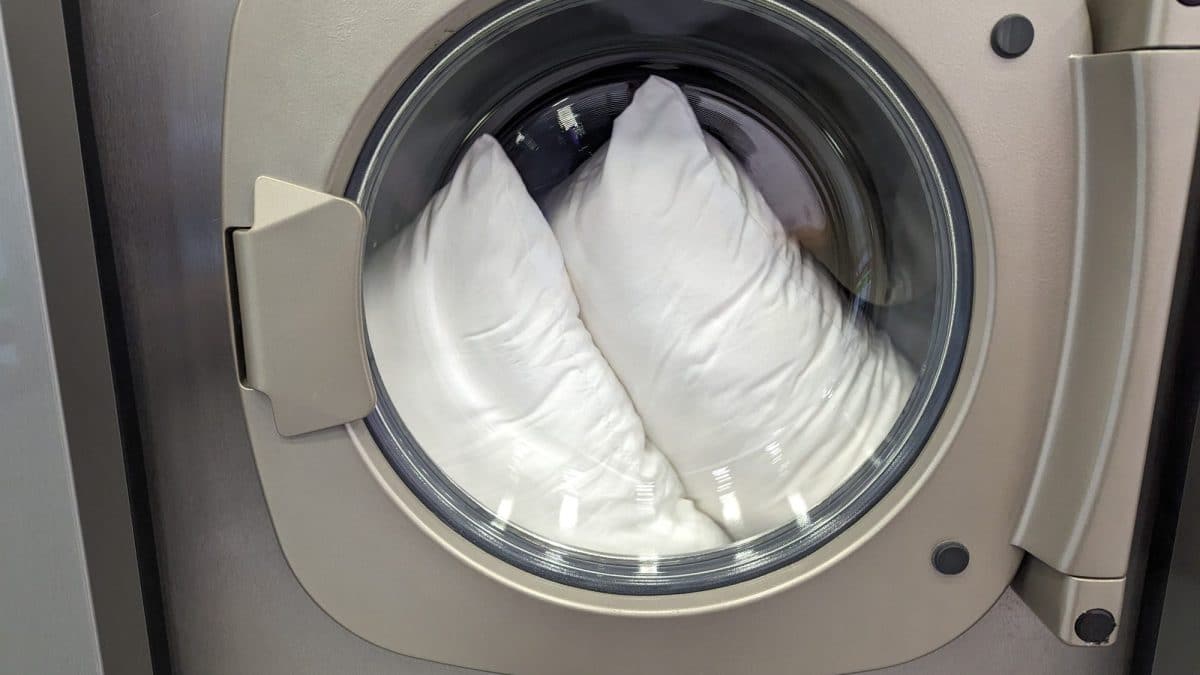
A machine-safe fill still needs two things to come out right: a balanced load and a fully dry core. Wash two pillows together, or pad a single one with towels, so the drum doesn’t bang through the spin cycle. Then dry on low heat with a few tennis balls to break up clumps, checking the center every 30 to 45 minutes rather than assuming the outside tells you anything about the inside. The full method, including detergent amount, cycle settings, and how to test the core for dryness, is in how to clean pillows in the washing machine.
Memory foam, latex, and buckwheat hulls: never, regardless of the tag
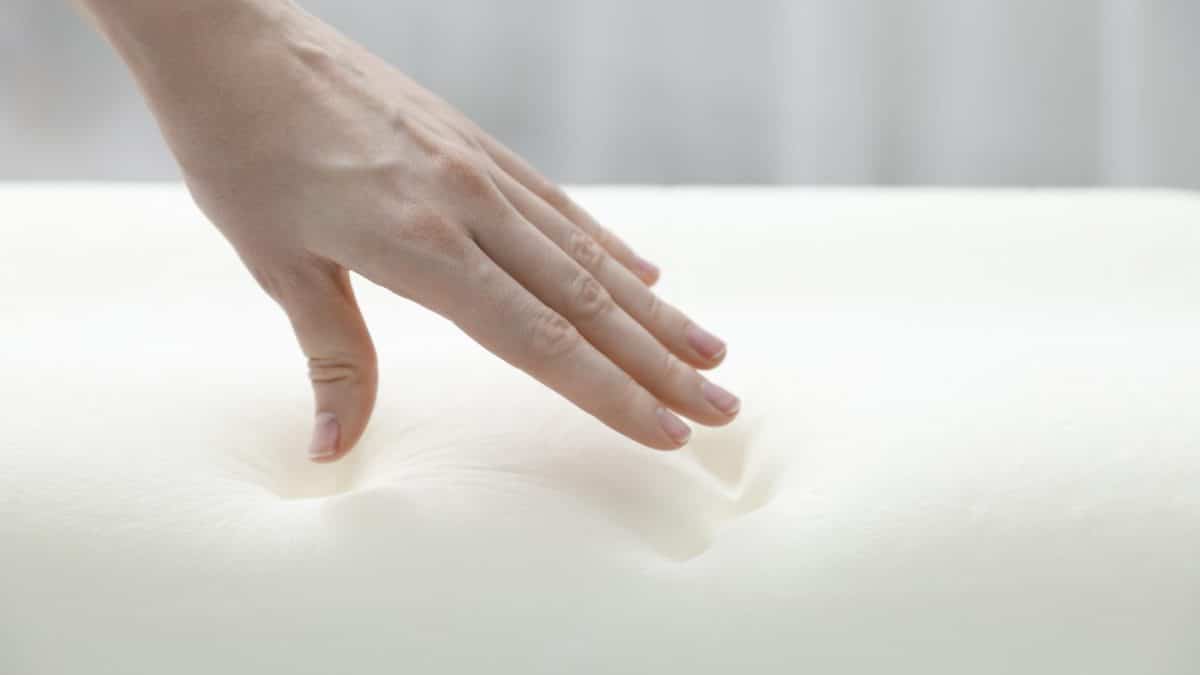
These three fill types share one problem: they hold water instead of releasing it. Foam and latex absorb into a solid block that stays wet for weeks inside a pillow you can’t take apart to check. Buckwheat hulls swell, crack, and lose the shape that gave the pillow its support in the first place. None of this reverses once it happens, and none of it shows on the outside cover.
The part that makes this worse than a ruined pillow is what grows inside one that’s been washed by mistake. A solid foam core that stays damp for weeks is close to ideal conditions for mold, and because the growth is sealed inside the foam, there’s often no visible sign until the smell is already strong. If a pillow has already been through a wash it shouldn’t have had, or you’re dealing with mold on fabric elsewhere in the house, the removal method is different from routine cleaning; see how to clean mold off clothes.
How to tell what’s inside if the tag is gone
Older pillows lose their care tags, and some inserts are sold without one at all. Three checks, used together, are more reliable than any single one:
- Weight for the size. A standard pillow that feels dense and heavy for its size is almost always foam or latex. Down and fiberfill pillows are noticeably light relative to how full they look.
- Feel near a seam. Press near the edge seam through the cover. Individual clusters shifting under your fingers point to down, feather, or fiberfill. A single unbroken resistance, with nothing moving independently, points to a solid foam core.
- Listen for it. Squeeze the pillow near your ear. A faint crinkle or rustle usually means synthetic fiberfill. Down and feather are close to silent. Foam makes no sound at all because nothing inside is separate enough to move.
If two of the three checks agree, that’s a reliable enough answer to act on. If they contradict each other, unzip the inner cover if there is one rather than guessing.
Related guides
For the full wash-and-dry method once you’ve confirmed a machine-safe fill, see how to clean pillows in the washing machine. A similar damp-core risk applies to duvets and comforters built from sewn fill compartments; see how to clean a down comforter. A comforter adds a problem a pillow never has, since it can pass the fill test and still be too big for the drum to wash it: how to clean a comforter has the two checks that settle that before the cycle starts. Decorative pillows raise a question this page does not settle, because a good half of them are sewn shut and the fill cannot be inspected or removed at all: how to clean throw pillows covers the sealed-seam case, including how to open one on purpose.
Questions
The tag says “dry clean only.” Can I still machine wash it?
If the fill is down, feather, or fiberfill, usually yes. Many manufacturers print “dry clean only” as a liability disclaimer rather than a material requirement. The fill type is the real deciding factor, not the tag’s wording.
Is a pillow with a foam insert sewn inside a removable cover safe to wash?
The cover is safe on its own. The foam insert is not, and shouldn’t go anywhere near water even briefly. Wash the cover separately and spot-clean or vacuum the foam insert instead.
Can I run pillows through the dryer alone, without washing, just to freshen them?
Yes, and this is safe for foam and latex pillows too, since no water is involved. A low-heat dryer cycle with a couple of dry towels fluffs the fill and reduces odor without the drying-time risk that comes with a wet wash.
How would I know if a pillow already has mold growing inside it?
A musty smell that doesn’t air out, and returns within a day of airing the pillow, is the most common early sign, especially if the pillow was ever put away even slightly damp. Visible dark spots on the ticking fabric are a later-stage sign. Either one means the pillow should be replaced, not washed again.