How to Clean Pillows (Every Fill, Including the Ones You Can’t Wash)
What you can do to a pillow is set by the fill, not the tag. Down and fiberfill wash and must dry to the core; memory foam, latex and buckwheat hulls can never be submerged at all.
Quick answer · care label Pillow fill — down, feather, fiberfill, foam
-
1 · Wash
Wash 30° gentle -
2 · Bleach
No bleach -
3 · Dry
Tumble low -
4 · Iron
Do not iron -
5 · Pro care
No dry clean
In one line Identify the fill first. Down, feather and polyester fiberfill wash two at a time on a gentle cycle with half a dose of mild liquid detergent and a second rinse, then tumble dry low with dryer balls, opening the clumps by hand every half hour until the center is bone dry. Memory foam, latex and buckwheat hulls never get wet at all: vacuum them, spot-clean with a barely damp white cloth, and air-dry flat out of the sun. About 30 minutes hands-on, spread across a wash and a long dry.
What are you actually cleaning off a pillow?
Not dirt, the way a muddy jacket is dirty. A pillow collects sweat, sebum, saliva, skin cells, and the dust mites that live on the skin cells. All of it passes through a cotton pillowcase within weeks and settles into the fill, which is why a pillow under a fresh case can be the least clean thing on the bed. The yellowing on the ticking was never spilled there. It is those secretions oxidizing over months.
So cleaning a pillow is not lifting something off a surface. It is flushing something out of the middle of a thick, absorbent object, then getting that object dry all the way through.
Which situation you are in is decided by the fill alone, not the price, not the cover fabric, not the tag. Two pillows can look identical and need opposite treatment.
The fill decides what is allowed, and the drying decides whether it worked. Down, feather, and polyester fiberfill can be washed, then must be dried until the center is bone dry, not dry to the touch. Memory foam, latex, and buckwheat hulls cannot be washed at all: they hold water where you can neither reach it nor inspect it.
What you’ll need
| Item | Why | Substitute |
|---|---|---|
| Mild liquid detergent | Powder rarely dissolves around bulky fill, and residue left deep inside turns yellow later | Half your usual liquid measure, whatever is already open |
| A second pillow, or two bath towels | One pillow alone rides up the drum and unbalances the spin, which makes a machine bang and walk | Wash pillows in pairs whenever the load allows |
| Three or four wool dryer balls or tennis balls | They pound the fill apart as it tumbles; without them it dries into clumps that never separate | Socks balled up inside a pillowcase |
| A vacuum with an upholstery tool | The cleaning method for foam, latex, and buckwheat, none of which ever get wet | A stiff clothes brush over a sheet you can shake out |
| A white cloth and a spray bottle | Spot-cleaning foam needs a barely damp cloth, and a dyed one can transfer color into pale foam | An old white t-shirt, wrung until it feels almost dry |
| A zippered pillow protector | The only thing that meaningfully slows sebum reaching the fill, which is what the yellowing and the smell are made of | A second pillowcase under the first, changed weekly |
The method, step by step
Find out what the fill is
Press the pillow flat and let go. Springs back in a second or two: down, feather, or fiberfill, and the rest of these steps apply. Holds the dent: memory foam or latex, and it stops here. Shifts in loose grains: buckwheat. Both are covered below.
Strip it and run a thumb along the seams
Case, protector, inner cover. A split seam lets fill escape into the drum and reach the drain pump, so stitch any gap shut first. A seam merely weak going in will be open coming out.
Wash two at a time, gentle cycle, cool rather than hot
Half a dose of mild liquid detergent on the delicate setting. The sewn-in label beats general advice, this page included. Pacific Coast, which makes down pillows, gives a cold wash on gentle as its standard. Where the label has no number, treat cold as the default rather than warm.
Rinse a second time
Set an extra rinse, or a rinse-only cycle afterward. Detergent buried in feather or fiberfill does not announce itself on wash day; it surfaces weeks later as a stale smell or a yellow patch.
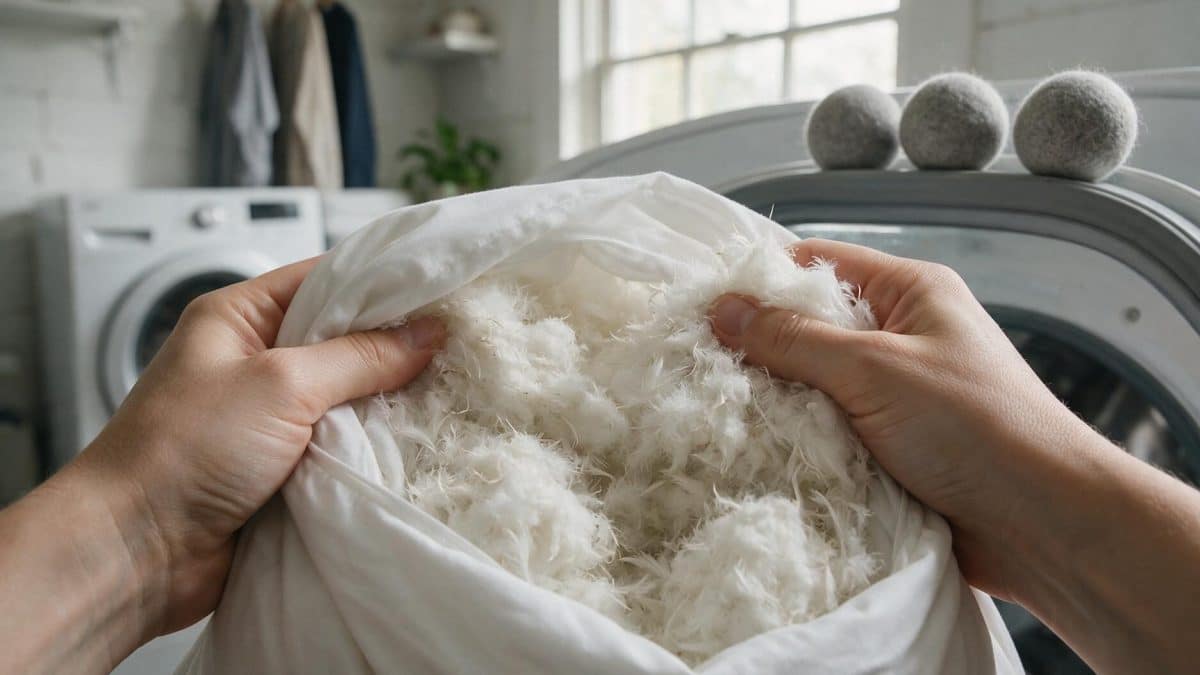
Tumble dry low, opening the clumps by hand every half hour
Low heat, dryer balls in. Every 30 to 45 minutes, take the pillow out and knead it like dough to break apart the wet lumps in the middle. Skipping both is what produces a hard core. Raising the heat does not shorten this, it bakes the outside while the middle stays wet.
Test the core, not the surface
Squeeze the exact center and compare it to the edges. Any coolness, damp weight, or wet clump the edges do not have means moisture is still trapped, and it goes back in. Pacific Coast puts it plainly: the shell can feel dry while the middle is not. That is how mold starts where nobody can see it; fabric mold is a different job, see how to clean mold off clothes.
Put it straight into a protector
The protector decides how long you get before the next wash: it goes through the weekly sheet load, and the pillow then needs washing twice a year rather than every three months.
The three fills that never get wet
These are not delicate versions of a washable pillow. They fail by a different mechanism, and invisibly.
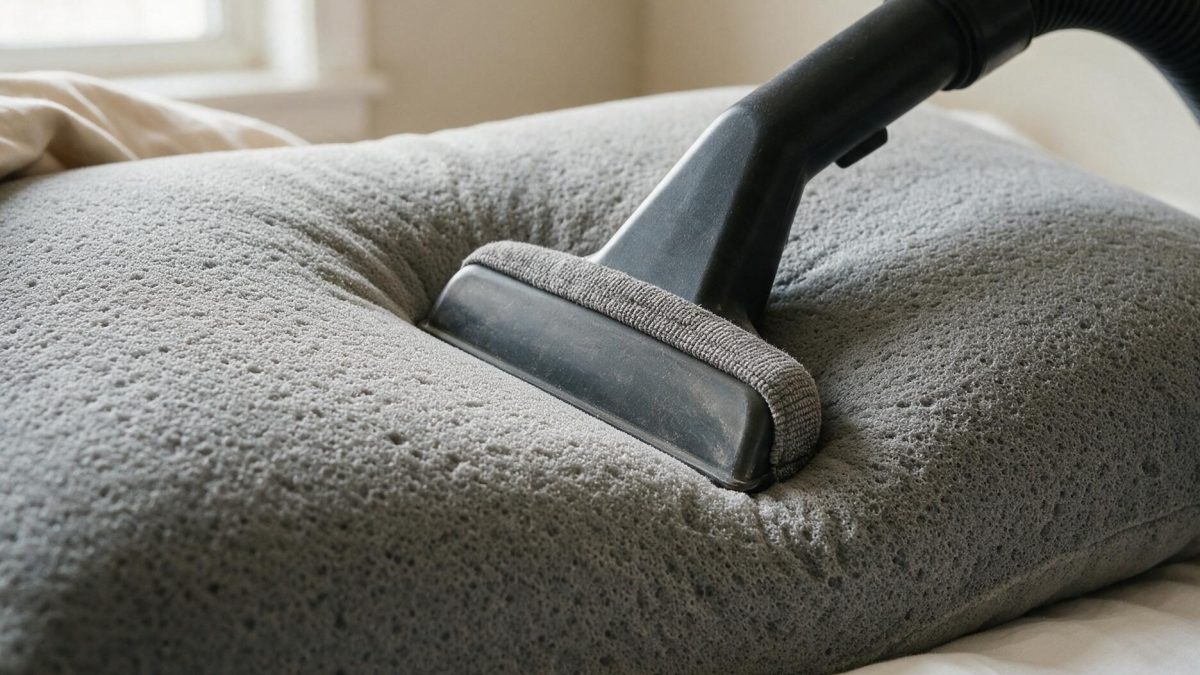
Memory foam absorbs water into its cell structure and holds it. A solid core stays damp for weeks inside a pillow you cannot open to check, which is close to ideal for mold. Tempur-Pedic’s own instruction is blunt: never wash TEMPUR material, and the material should never become wet at all. Its refresh is to remove the covers, roll the bare pillow like a sleeping bag, unroll, and repeat in the other direction. The cover washes cold and dries cool. The foam itself gets vacuumed; for a spill the instruction is to press the moisture out with towels and let it air-dry, not to add water. A barely damp white cloth on a mark is the whole allowance beyond that.
Latex has the same water problem plus one that catches people out. Sunlight turns natural latex crumbly over time, so the obvious instinct after spot-cleaning, hanging it outside to air, is the wrong one. It dries indoors, in moving air, out of direct sun.
Buckwheat hulls are plant material: soaked hulls soften, lose the shape that gave the pillow its support, and grow mold. What saves this one is the zip. Empty the hulls into a dry container, wash the case cool, air-dry it, pour them back. Hullo, which sells them, gives that same order and adds that slightly damp hulls dry out on their own, faster in a sunny window. Damp is recoverable. Laundered is not.
Never submerge memory foam or latex, even if a tag or a seller says otherwise. No home drying cycle gets water back out of a solid foam core. What comes out is not a wet pillow you can rescue. It is a mold culture with a cover on it.
The temperature that kills dust mites is hotter than down survives
This is the one place where good sources genuinely contradict each other. From the allergy direction the numbers are settled. A Yonsei University team tested mechanical laundering directly in 2008: at 60°C (140°F) every house dust mite was killed, while a 40°C (104°F) wash killed 9.6 percent of them and a 30°C (86°F) wash killed 6.5 percent. Washing a pillow cool does not remove the mites.
The allergen follows a different curve, and it is the more useful one. In that same work the mite allergen left after washing measured 26.8 percent at 30°C, but only 2.4 percent at 40°C and 1.3 percent at 60°C. So the coolest wash, the one that best protects the fill, is also the one that leaves the most allergen in the pillow. Extra rinses close that gap, and they helped more after the 30°C wash than after any hotter one.
From the fill direction the instruction is lower and it does not move: down makers specify cold or cool water and low or no dryer heat. Both directions are correct, and one wash cannot satisfy both. The usual escape offered is a cool wash followed by a long hot tumble, on the basis that every mite dies in water at 55°C and above. But nobody can tell you whether a home dryer holds that heat in the middle of a thick pillow, and it needs the setting every down maker tells you to avoid.
A fiberfill pillow whose label permits it is the one that can take the hot wash. For down or feather nothing both kills mites and respects the fill, so the answer is a zippered allergen-barrier protector plus a cool wash with extra rinses. If the allergy is medical rather than a preference, change the pillow, not the cycle.
What comes out of a pillow, and what does not
| What is in there | Recoverable | What actually happens |
|---|---|---|
| Recent sweat and body oil, weeks old | Yes | A gentle wash with a second rinse clears it before it oxidizes |
| Set-in yellowing, months or years old | No | Oxidized sebum bonded into the ticking; a soak lightens it a shade at best, and it comes back |
| Drool marks and the stale smell with them | Yes | Water-soluble and shallow, if washed before the marks have sat for a season |
| Blood on the ticking | Yes | Only treated cold; a warm wash sets the protein, see how to clean a blood stain |
| Mold growing inside the fill | No | Growth inside a structure you cannot open, rinse, or verify as clean; this one gets replaced |
| Makeup and hair product on the cover | Yes | Treat it as an ordinary fabric stain first, not something the cycle will lift |
Which brings up the whitening recipe that circulates every few months: near-boiling water, laundry powder, dishwasher powder, borax, and bleach, soaked before a normal wash. It does lighten white cotton ticking, so the photographs are real enough. It is also the opposite of every instruction a down maker gives, combining the hottest water in the house with a strongly alkaline bleach mix. And the yellowing returns on any fill, because the person who caused it still sleeps there.
When a pillow is finished
Cleaning extends a pillow’s life, not indefinitely. A pillow whose fill has set into hard lumps is finished on the spot; clumped fill does not redistribute however long you knead it.
The test for down and feather is to fold the pillow in half and let go. If it springs open it still has loft; if it stays folded, the fill has broken down and there is nothing to wash back into it. For memory foam the equivalent is whether it returns to shape once pressure comes off.
The Sleep Foundation’s replacement ranges vary widely by fill: polyester every six months to two years, down and feather every one to three years, memory foam every two to three, latex every two to four. Buckwheat is the outlier: the shell outlasts everything, and it is the hulls that get replaced, roughly every three years once they flatten.
Two things stretch those numbers: a zippered protector, and washing on a schedule rather than on smell, since by the time a pillow smells the residue is months old. If the bed underneath is due the same attention, see how to clean a mattress.
Related guides
- Whether one particular pillow belongs in the machine at all is decided fill by fill in can you machine wash pillows.
- Cycle settings, load balance, and drying in full rather than as one step: how to clean pillows in the washing machine.
- Down differs enough from fiberfill on detergent and drying time to need its own treatment: how to clean down pillows.
- Decorative pillows raise a problem a bed pillow never has, since many are sewn shut and the fill cannot come out: how to clean throw pillows.
Questions
How often should pillows actually be washed?
Every three to six months for a pillow slept on nightly, or twice a year once a zippered protector is doing the work.
Does putting a pillow in the sun clean it?
It airs the pillow and drives off surface moisture, which helps a stale smell, and Hullo suggests a sunny window for damp buckwheat hulls. It will not reliably reach the temperatures that kill dust mites, which start above 50°C (122°F). And it should not be done to latex, which stays out of direct sun because sunlight eventually turns it crumbly.
Can I have a pillow dry cleaned instead?
For down and feather it is a poor trade. The solvents do nothing to the water-based staining from sweat and saliva that prompted the cleaning, and then have to be aired out of the fill before the pillow goes back on the bed.
Can I wash a pillow if I do not have a dryer?
Yes, but budget for it. Air-drying takes roughly 24 to 48 hours, needs moving air rather than a still room, and needs the pillow turned and shaken open several times so the fill does not dry as one mass. It is not done until the core passes the squeeze test.
Is a yellowed pillow unhygienic, or just unattractive?
Mostly the second, if it has been washed on schedule. The stain sits in the ticking and can cover a pillow that is otherwise clean. What matters is whether it still has loft.