How to Clean Down Pillows (the Drying Is the Job)
Down survives the wash. What it does not survive is coming out of the dryer at ninety percent dry: the shell dries hours before the core, and the musty smell starts in the middle.
Quick answer · care label Down and feather fill — pillow
-
1 · Wash
Wash 30° gentle -
2 · Bleach
No bleach -
3 · Dry
Tumble low -
4 · Iron
Do not iron -
5 · Pro care
No dry clean
In one line Wash two down pillows together on a gentle cycle in cool water with half a dose of mild liquid detergent, no bleach and no fabric softener, then rinse one or two extra times and add a second spin. Tumble on low with dryer balls for two to four hours, kneading the wet clumps apart by hand every half hour, and stop only when the exact centre feels no cooler, damper or heavier than the edges. About 30 minutes hands-on.
Can a down pillow survive a wash, or does that flatten it for good?
It survives. Down is washed, rinsed and heat-dried during processing before it is ever blown into a pillow shell, so water is not new to it. The pillows that come out of a wash ruined were, almost always, not ruined by the water.
They were ruined afterwards, by leaving the dryer too early. A down pillow is one of the few objects in a house whose outside can be completely dry while the middle is still wet, and it gives no signal at all. Damp clusters mat together, the fill around them dries in that shape, and you then seal the whole thing in a cotton case and warm it to body temperature for eight hours a night. That is where the musty smell comes from. People blame the wash. It is the drying.
The second thing that ruins them is what you leave behind. A down cluster is a three-dimensional puff of filaments radiating from a centre, with no quill, and its loft comes entirely from those filaments springing apart. Anything that coats them sticks them together: surplus detergent, fabric softener, the finish off a dryer sheet. The pillow comes out thinner than it went in, and no amount of fluffing brings it back.
Water is not the enemy. Residue and trapped moisture are. Use half the detergent you think you need, rinse more times than feels reasonable, and keep tumbling well past the point the pillow feels dry, because the shell dries hours before the core.
What you’ll need
| Item | Why | Substitute |
|---|---|---|
| Mild liquid detergent | Powder can sit undissolved inside bulky fill, and any surplus coats the clusters and flattens the loft | Half your usual dose of whatever unscented liquid is already open |
| A down-specific wash, optional | Made to clean without stripping the oils on the filaments. Nikwax gives 100 ml on a 30 °C (86 °F) synthetic cycle, slow spin, an extra rinse if the machine has one, and no conventional detergent alongside it | Half a dose of mild liquid detergent and one more rinse than you planned |
| Three or four wool dryer balls | They pound the wet clusters apart as the pillow tumbles. Without them the fill dries into lumps that never fully separate again | Clean tennis balls, each pushed inside a sock — loose ones can smell of hot rubber and new ones can shed dye onto pale ticking |
| Two bath towels | To press the water out. Wringing a wet down pillow snaps filaments and drags on the seams | Any spare towels, as long as the dye is fast |
| A needle and strong thread | A seam that is merely weak going in is an open seam coming out, and escaped down reaches the drain pump | A close row of hand stitches in ordinary sewing thread, doubled |
| A zippered pillow protector | The only thing that meaningfully slows sebum reaching the fill, which is what decides how long you get before the next wash | A second pillowcase under the first, changed with the sheets |
The method, step by step
Read the law label before anything else
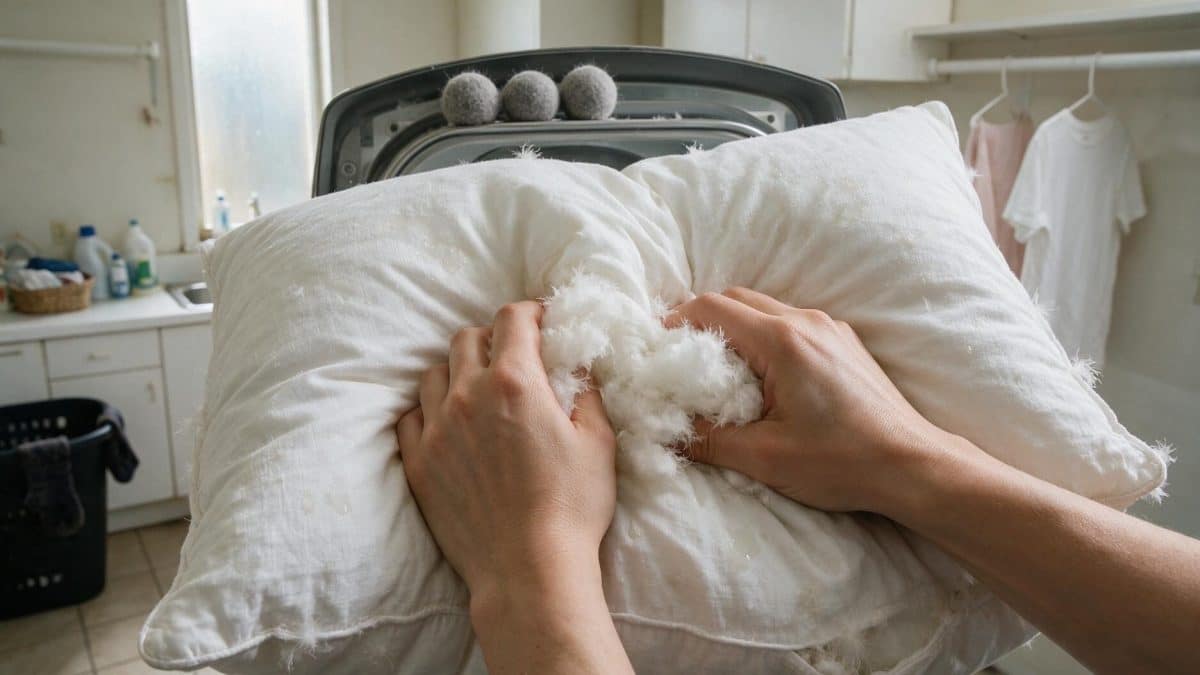
It carries the filling materials as percentages by weight, and it beats every general article including this one. That label is a state requirement rather than a federal one — thirty-one states ask for it — and it is the only place the down-to-feather split is actually stated. The feather share is the part with quills in it, and quills are what find a weak seam.
Run a thumb along every seam and mend what moves
Corners first, then the piping if there is any. Whatever is weak going into the drum comes out open, and a pillow that splits mid-cycle puts loose down through the machine and into the pump.
Wash two at a time, gentle cycle, cool water
Half a dose of mild liquid detergent. No bleach, no fabric softener. Two pillows balance the drum; one alone rides up the side and makes the machine walk. DOWN inc. specifies an oversized machine with no centre post; DOWNLITE’s workaround for the machine you actually own is to stand the pillows upright beside the agitator rather than wrap them across it.
Rinse twice more than feels necessary
DOWN inc. gives one to two extra rinse cycles beyond the first. Detergent buried in a thick fill does not announce itself on wash day; it announces itself months later, as a pillow gone flat that smells stale. Add a second spin while you are there. Every gram of water pulled out now is dryer time you do not spend.
Press the water out between towels
Lay the pillow flat, fold a towel over it, and lean on it with a flat hand. Do not wring or twist it. That snaps filaments and pulls directly on the seams you just checked.
Tumble on low with the balls in, opening the clumps by hand
Every 30 to 45 minutes, take the pillow out and knead the middle like dough until you cannot feel a hard lump. Expect two to four hours in total: DOWN inc. quotes three to four cycles, Down & Feather Co. a minimum of two fifty-minute ones with the second started immediately. DOWNLITE runs the same job on high heat. Low is the conservative call here, and the cost of taking it is time rather than fill.
Test the core, not the shell
Squeeze the exact centre and compare it against the edges. Pacific Coast’s version of this test is the useful one: the centre should not feel cooler, damper, denser or heavier than the outside, and there should be no wet clump and no odd smell. Anything that fails goes straight back in.
Smell it before it goes near the bed
Wet down smells faintly of barnyard: remnant oils in the clusters reacting to heat and humidity. It goes when the pillow is genuinely dry. A smell still there after the core test means moisture you have not found. Only once it smells of nothing does it go into a protector.
The manufacturers do not agree, and the gap is about heat
This is not one good source and a lot of noise. Companies that make, process and sell down bedding publish materially different instructions, and the spread is worth seeing rather than being handed one number.
| Source | Wash | Dry | How often |
|---|---|---|---|
| Pacific Coast, pillow maker | Cold, gentle, only the detergent amount the label allows | Low, air fluff or no heat. States there is no universal number of minutes or cycles | About once a season |
| DOWN inc., down processor | Warm, delicate, mild detergent, one to two extra rinses, no centre agitator | Low heat, three to four cycles, dry well beyond the point the outer fabric feels dry | At least one to two times a year |
| DOWNLITE, down bedding maker | Warm, delicate, two at a time, a little down cleaner or a teaspoon of dish soap, then a rinse cycle with no soap | High heat, three to four full cycles, and expressly do not air dry | Not stated |
| Down & Feather Co., retailer | Front-loader, gentle or delicate, and no detergent at all | Low heat, at least two fifty-minute cycles, back to back | Emergencies only |
| Sleep Foundation | Cool or warm, delicate, small amount of mild detergent. Says hot water damages down | Low or no heat over several cycles, with dryer balls | At least every six months |
No source above asks for hot water. The band runs from cold at Pacific Coast to warm at DOWN inc. and DOWNLITE, with Sleep Foundation taking either, so cool on a gentle cycle is the setting that sits inside all of them and that is the default above. On heat, low is the conservative call and DOWNLITE’s high-heat instruction is the outlier: being wrong about high heat costs fill that will not loft again, and that does not come back, while being wrong about low heat costs another hour of tumbling.
The detergent split is the interesting one. Down & Feather Co. says use none, on the grounds that detergent strips the microscopic oil keeping the filaments flexible, and that stripped feathers go brittle and break. Everyone else says a mild one, sparingly. Both point the same way in practice, which is why the method uses half a dose. All five agree on the part people skip: more rinsing than seems reasonable, and far more drying.
Most of a down pillow is not down
The word on the front of the packaging does less work than it looks, and less than it used to. The FTC once published Guides for the Feather and Down Products Industry, under which an unqualified “down” claim meant more than 70 percent down content. Those guides were rescinded in 1998 and nothing federal replaced them, so the 70 percent figure survives as an industry expectation rather than a rule; the testing house IDFL still states it, and argues North American sellers should be held to the Canadian minimum of 75 percent. Where a percentage is printed, the tolerance IDFL allows is two to five percent, and only for unavoidable manufacturing variation. Treat the front of the pack as a claim someone chose to make. The law label is the part someone was required to fill in.
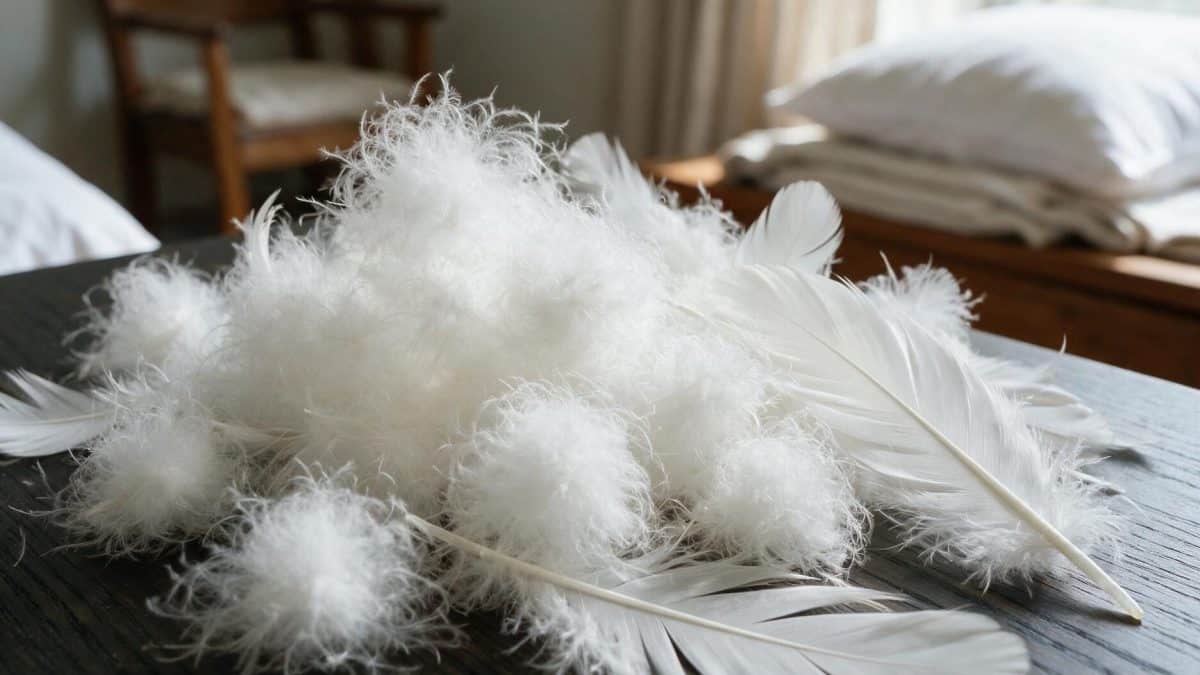
So a pillow sold as down is usually a blend, and that is deliberate rather than a cheat. Down clusters come from the breast and underbelly and have no quill; feathers are the outer plumage, with a stiff central quill through them. Pure down has almost no structure, so a head sinks straight through it. The feathers hold the pillow up.
They are also the part that causes trouble in a wash. A quill migrates through the fill, finds the weakest point in a seam, and works its way out. That is why step two exists, and why a pillow that starts shedding after a wash was usually close to shedding before it.
A second mechanism comes with a caveat. Shells are made down-proof by weaving cotton very tightly and then closing the weave further with a finish. White Knight, a company that cleans pillows commercially and so has an interest in you not doing it yourself, argues the finish is a water-soluble starch that washing dissolves, after which the shell leaks. Weigh that interest. But it does explain a pillow that starts shedding only after its first wash, and the answer there is a tightly woven protector, not a second wash.
Dry clean a down pillow. Solvents dissolve the oils coating the filaments, the clusters lose the interlocking structure that gives them loft, and the fill comes back flat. White Knight’s second point is that solvent is unlikely to evaporate fully out of a fill that dense in a normal cleaning cycle, which leaves it buried in something you press your face into all night. DOWNLITE, which makes down bedding, puts it plainly: many of the chemicals used in dry cleaning hurt down fibres. This is one of the few hard rules here.
What a wash takes out, and what it does not
A wash is very good at one category and close to useless at another. Knowing which is which stops you running four cycles chasing something that was never going to move.
| What is in there | What a wash does | Recoverable |
|---|---|---|
| Sweat, sebum and skin cells in the fill | Flushed out by a full cycle with a double rinse. This is the thing washing is actually for | Yes |
| Musty smell from an earlier bad dry | DOWNLITE puts a teaspoon of liquid dish soap in the wash as a degreaser. The smell itself goes with more drying, not more washing | Usually |
| Flattened, clumped fill | The tumble with dryer balls is what separates clusters; the wash alone does nothing for loft | Usually |
| Dust mites and their allergen | Reduced by the rinsing and the tumble, but not eliminated. The temperature that reliably kills mites is above what down should be washed at | Partly |
| Yellowing on the ticking | Very little. It is oxidised body oil set into the cotton over years, and White Knight puts the odds of washing it back to white at close to zero | No |
| Mould already growing in the fill | Nothing you can verify from the outside. A pillow with a bloom inside it is finished | No |
When a down pillow is finished
Down pillows outlast foam, and the usual figure quoted is five to ten years with reasonable care; Down & Feather Co., which argues against frequent washing, puts it at seven to ten on that basis. What ends them is not dirt but broken clusters, and no wash reverses that.
The test is bounce-back. Fold the pillow in half, press the air out, let go. One with life in it opens itself. One that lies there folded has lost its cluster structure, and so has a pillow that stays flat and lumpy after fluffing. That is a replacement, not a wash.
What to look at in the replacement:
- Buy on the law label, not the front of the pack. The percentages are printed there because state bedding law requires them, and a pillow at 75 percent down behaves nothing like one at 30 percent down and 70 percent feather.
- Look at the seams before the fill. Piped and double-stitched edges survive washing; a single knife-edge seam is where quills come through first.
- Put the protector on the day it arrives. It is the difference between washing twice a year and every season, and every wash costs a little loft.
Related guides
Down behaves the same wherever it is, but the object around it changes the method:
- The same fill in a much larger shell, where the constraint stops being technique and starts being drum capacity. See how to clean a down comforter.
- Down in a garment adds a shell fabric with a water-repellent finish, which changes both the wash and the drying. See how to clean a down jacket.
- If you are not certain your pillow is down at all, the fill test and the fills that must never get wet are covered in how to clean pillows.
- For the machine settings and load questions across every pillow type, see how to clean pillows in the washing machine.
Questions
My down pillow says dry clean only. Can I wash it anyway?
The sources split. DOWNLITE, which makes down bedding, says those labels are largely precautionary, added to limit damage from bad washing rather than because home washing is impossible, and publishes home washing instructions itself. White Knight, which cleans pillows commercially, says do not wash at home at all. Both agree dry cleaning is bad for down. Going against a sewn-in label can void a warranty, so decide that first; if you do it, the cool, gentle, heavily rinsed method above is the low-risk version.
How often should down pillows actually be washed?
The published range runs from once a season (Pacific Coast) to emergencies only (Down & Feather Co.), with DOWN inc. at one to two times a year and Sleep Foundation at every six months. Twice a year is where most land and is a reasonable default. A zippered protector changes the answer, because it intercepts most of what would otherwise reach the fill.
Why does my down pillow smell after washing?
Almost always moisture still in there. Down is extremely absorbent, and a small damp patch in the centre is enough to turn musty inside a week. Put it back in the dryer on low with the balls in for two or three more full cycles, kneading the middle each time. If the smell is more barnyard than musty, that is the natural oils in the clusters and it fades as it dries; DOWNLITE suggests a teaspoon of liquid dish soap as a degreaser for the stubborn version. If it smells properly mouldy and the fill has stiff patches, treat it as finished — see how to clean mold off clothes for why that differs from fabric mould you can see.
Will washing kill the dust mites in a down pillow?
Not reliably. The figure allergy guidance uses for killing mites is 130 °F (54.4 °C) and above, and a 104 °F (40 °C) wash has been measured killing only around six percent of them. That is hotter than down should be washed at, so this is a case where you cannot have both. The allergen is a separate question, and better news: it is water-soluble, so the rinsing carries a good deal of it away whatever the temperature. A zippered protector controls what reaches the fill in the first place better than wash temperature does.
Can I use OxiClean or a stain remover on the yellow patches?
No, and it would not work anyway. Down care instructions say do not bleach — DOWN inc. states it flatly — and that covers the oxygen kind: down and feather are protein, and peroxide chemistry weakens protein fibres and can yellow them further. The yellowing is oxidised body oil set into the cotton shell rather than a mark on the fill, and it does not come out. If it bothers you, the fix is a cover over it or a new pillow, not a stronger chemical.
Can I air dry a down pillow instead of tumbling it?
It is possible but it is the harder route, and DOWNLITE explicitly advises against it. Air drying gives you no mechanical action, so nothing breaks the wet clusters apart and the fill dries in lumps. Sleep Foundation’s version is a drying rack in a well-ventilated spot for 24 to 48 hours, turned and fluffed by hand every few hours. That hand-fluffing is not optional here; it is doing the job the dryer balls would do.