How to Clean an Electric Blanket (Two Minutes, Not a Cycle)
The maker's own instruction is a fifteen minute presoak and a two minute wash, and every article on the subject keeps the words "gentle cycle" and drops the number. Here is why the wire inside decides the whole method, and why the step everyone tells you to skip is the one that makes the drying safe.
Quick answer · care label Heated bedding - wired
-
1 · Wash
Wash 30° gentle -
2 · Bleach
No bleach -
3 · Dry
Tumble low -
4 · Iron
Do not iron -
5 · Pro care
No dry clean
In one line Presoak 15 minutes in cold water, wash 2 minutes on delicate, rinse and spin in the machine, then 10 minutes in the dryer on low and finish flat. Never dry clean it, never iron it, and never reconnect the control until it is completely dry.
Everything on this label comes from one fact: the wire cannot shrink
Every other textile on this site is a chemistry problem. You work out what the stain is, you pick something that dissolves it, and the fabric is a bystander. An electric blanket is not that. There is almost no chemistry in this job, and the entire care label comes from two properties of a thin wire sewn into the quilting: it is a fixed length, and it can only be bent so many times before it breaks.
Hold those two facts and the rules stop looking arbitrary. Hot water and a hot dryer are banned because the fabric shell shrinks and the wire does not. A shell that pulls in even one or two percent around a wire that stays exactly as long as it was has to put that extra wire somewhere, and it goes into the channels as small tight bows and kinks. Nothing looks wrong from outside. The iron is banned for the same reason, plus the obvious one. Wringing is banned because a twist is the tightest bend radius you can put on a wire by hand. Folding it on the same crease every summer is banned because metal that gets bent in the same place work hardens and eventually cracks, which is why the manufacturers tell you to roll it for storage and never explain that this is the same instruction as the one about not wringing it.
So the question is not really how to clean an electric blanket. It is how to get it clean while spending as few bends as possible, because a broken heating wire does not announce itself. It shows up as a cool patch a month later, or as intermittent contact at the break, and intermittent contact is the condition that puts all the heat into one point.
Sunbeam publishes its care sheet in full, and it is more specific than any article written about it. It says: presoak fifteen minutes in mild soap and cold water, then wash on the delicate or gentle cycle for two minutes, rinse, spin. Two minutes. Every article that copies the shape of that instruction keeps the words “gentle cycle” and drops the duration, and a gentle cycle on a home machine runs thirty to fifty minutes. That is roughly twenty times the mechanical work the maker asked for, on the one part of the blanket that has a countable life.
Two checks before anything gets wet
Both take under two minutes, and the first one decides whether the rest of this page applies to you at all.
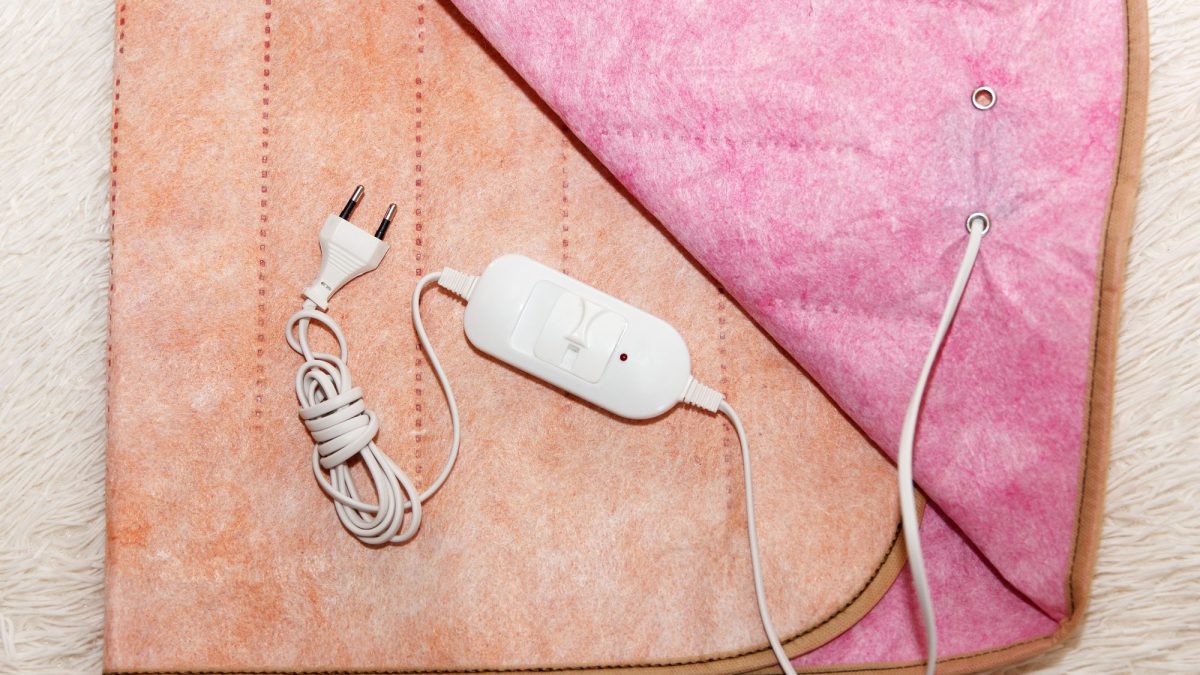
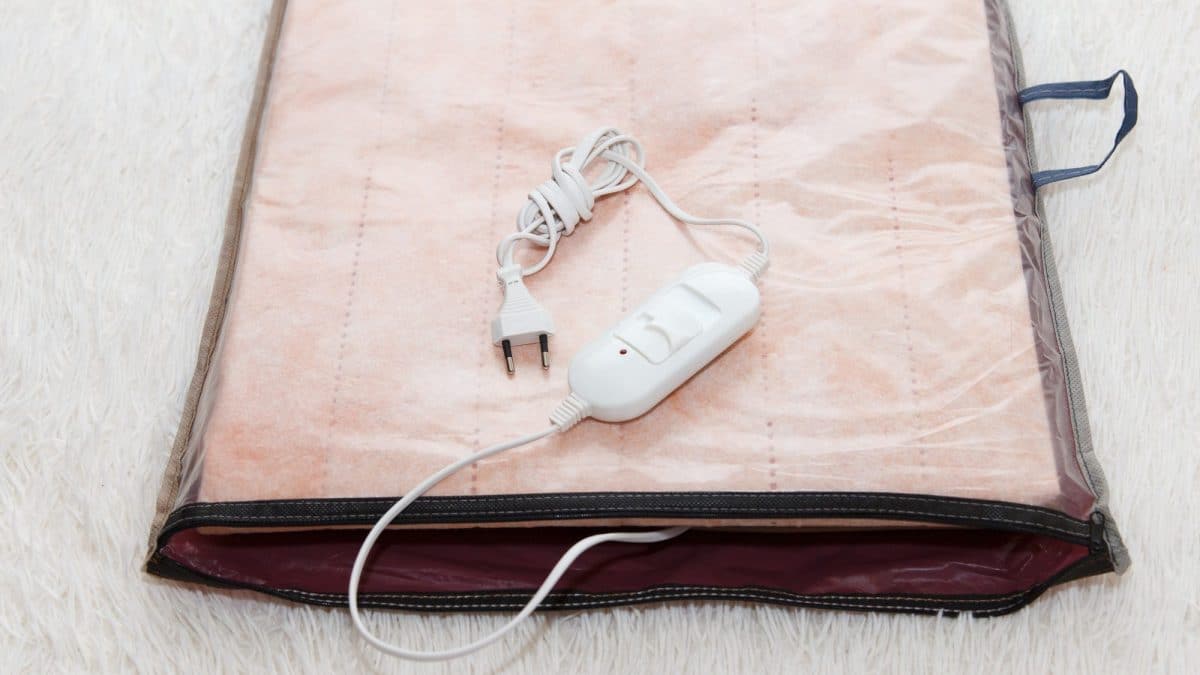
The detach test. Unplug the power cord from the wall first, then follow the cord to where it meets the blanket. On anything washable there is a plastic connector there that unclips, leaving a small socket sewn into the fabric edge. If the cord runs into the blanket with no connector, or the control box is stitched in, the blanket is not washable at any temperature and nothing below applies: it gets the surface treatment further down the page. This is the answer to the question that fills the forum threads on this subject, and it is a yes or no with no judgment involved.
The wire sweep. Lay the blanket flat and run a flat palm slowly along the length of it, across the quilted channels rather than with them. You are feeling for two things: a hard point or a small knot where a wire has already kinked, and a gap in the regular spacing where a wire run should be and is not. Then hold suspect areas up against a window. A wire that has worn through toward the surface shows as a thin shiny line or a slight fraying along the channel. The maker’s own instructions tell you to check that the wires have not worn through the fabric before washing, and then say nothing about what that looks like. A blanket that fails this check does not get washed. It gets unplugged for good.
What you’ll need
| Item | Why | Substitute |
|---|---|---|
| A front loader, or a top loader with no center agitator | An agitator post drags the load across itself, which is bending under load. It is the single most damaging machine you can put this in | The bathtub, with the machine used only for the spin |
| Mild liquid detergent, half dose | The blanket gets a two minute wash and one rinse, so anything you cannot rinse out in that time stays in the fill | Any liquid detergent, measured short. Powder needs more agitation to dissolve than this cycle allows |
| A timer | The two minute wash is the whole method. Without a timer you will run a cycle, and a cycle is not what the instruction says | A phone alarm. Set it before you start the machine, not after |
| A flat surface bigger than the blanket | A spare bed, a clean floor, a drying rack laid out flat. This is where the last and longest part of the drying happens | Two clotheslines side by side so the weight is shared across a broad curve instead of one crease |
| No clothespins, no bleach, no fabric spray | A clothespin puts the weight of a wet blanket onto one small point of a wire. Bleach and solvent based sprays are both banned outright in the care sheets, and the reason is the wire insulation rather than the fabric | None of these has a safe substitute. That is the point of listing them |
The method, step by step
The order matters less here than the clock does. Step 3 is the one people cannot quite bring themselves to do, and it is the only step that separates this from the version that shortens the blanket’s life.
Unplug the wall first, then unclip the control
Wall socket first, then the connector at the blanket. Set the control unit and the cord somewhere they cannot fall in the water. The control is the part that must never get wet, and it is also the part people leave sitting on the edge of the machine while they load it.
Spot treat, and keep the treatment small
Work a drop of mild detergent into any mark with a fingertip. Do not soak the area and do not scrub along a wire channel. Anything you can lift now is something the two minute wash does not have to lift, and the wash is not going to get a second chance today.
Presoak fifteen minutes in cold water
Fill the drum or the tub with cold water and mild soap, put the blanket in, press it under, and leave it. This is the step that does the actual cleaning, and it costs nothing: soaking has no moving parts, so it puts zero bends on the wire. Everything after this is about removing water, not dirt.
Wash for two minutes on delicate, then stop the machine
Start the gentle or delicate cycle, start the timer, and after two minutes advance the machine to rinse. On most front loaders you do that by pausing, turning the dial to rinse and spin, and restarting. If your machine will not let you skip ahead, use the rinse and spin program on its own and treat the presoak as the wash. Two minutes of agitation after a fifteen minute soak removes almost everything a full cycle would, because the soak has already done the loosening.
Rinse cold, then spin in the machine
One cold rinse, then let the machine spin it. This is the step most articles tell you to skip, and skipping it is what makes the next step dangerous. A spin drum holds the blanket flat against a curved wall and takes several pounds of water out of it in four minutes. The alternative is carrying that water yourself.
Ten minutes in the dryer on low, and not a commercial one
Preheat on low for two minutes, put the blanket in, and take it out after ten minutes while it is still clearly damp. Laundromat and commercial dryers run far hotter than a domestic one and are named specifically in the manufacturer warnings, because that is the heat level that shrinks the shell around the wire and softens the insulation.
Shape it back to size, then finish it flat
Lay it out, pull it gently square, and get the quilting lines straight again. A blanket dried out of shape has a shell that is now a slightly different size from the wire inside it. Finish the drying flat, or over two lines so the weight spreads across a wide curve. No clothespins.
Wait until it is completely dry, and give it longer than you think
Completely dry means the channels, not the surface. Press the back of a hand against the seams and the middle; anything that reads cooler than the rest is still evaporating, which is the same check that catches a damp comforter. Do not reconnect the control to speed this up. Running the blanket to dry itself is the one shortcut that puts current through a wet connector.
Interactive
Label decoder
Tap a symbol from your care label. No guessing, no scrolling.
19 symbols. Pick one.
How to clean an electric blanket without washing it
This is the most searched follow-up on the whole subject and almost nobody answers it, probably because it sounds like an excuse. It is not. Every wash spends bends you cannot get back, so a blanket that gets surface cleaned four times and washed once will outlast one that gets washed five times, and it will be just as clean to sleep under.
- Vacuum both faces with the upholstery head. Slow overlapping passes, no beater bar. This takes off skin cells and dust, which is most of what makes bedding smell stale, and it is the same routine that does the real work on a mattress.
- Air it, in shade, on a dry breezy day. Air movement clears odor far better than sun does, and sun on a synthetic shell yellows it. Lay it flat over two chairs rather than folding it over one.
- Spot treat marks the day they happen. A damp cloth and a drop of detergent, blotted rather than rubbed, working from the outside of the mark inward.
- Do not use a fabric refresher spray. The care sheets ban sprays of any kind, and it is worth knowing why rather than filing it as excess caution: an aerosol puts solvent and propellant onto plastic wire insulation, and it puts moisture into channels that have no way to dry. It also does not work on the actual cause, which is covered below.
- Put something washable between you and it. A heated blanket under a flat sheet, or a heated throw inside a cover, moves the whole problem onto an object you can boil if you want to. This is the same conclusion the comforter guide reaches for a different reason, and here it is worth more, because there the cover saves you effort and here it saves you cycles.
Three things the first page gets wrong
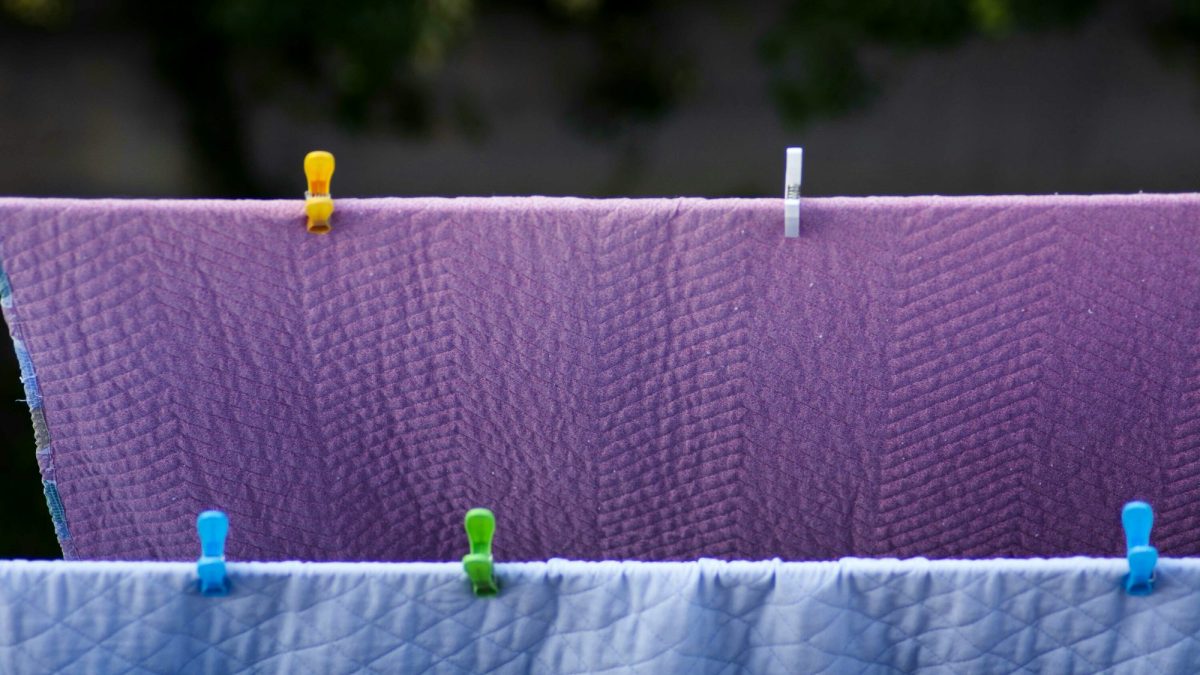
- “Skip the spin cycle.” This appears on some of the biggest results on the subject, and it is backwards. The maker’s own sequence is wash, rinse, spin, then a short tumble, then hang it damp. Delete the spin and you are carrying a queen blanket holding ten pounds or more of water to a shower rod, where all of that weight sits on one crease line with the wire inside it. The thing to avoid is a hard unbalanced spin that thumps, and wringing it by hand. A steady machine spin on a load spread evenly around the drum is the gentlest way that water is ever coming out. The same reasoning decides the outcome of every wash done outside a machine, including an ordinary basin of laundry: the spin is the part your hands cannot replace, and how to clean clothes by hand follows it through to the rinse.
- “Use the warmest water the fabric allows.” Standard advice on bedding, wrong here, and not for an electrical reason. Cold is specified because the shell must not shrink around a wire that keeps its length. The cost is real and nobody states it: cold water does not emulsify body oil, which is why the yellowing on white bedding builds up over months, explained in full in how to clean a comforter. You cannot fix that with temperature on this object. You fix it with a layer of something washable on top.
- “Take it to the laundromat, the machines are bigger.” True for almost every bulky textile and specifically wrong for this one. Commercial dryers are named in the warnings because they run hot enough to damage the wiring. If the blanket genuinely will not fit your machine, the tub and your own machine’s spin cycle is the better pair, and a heated blanket that is too big for both is one to have professionally handled or not to wash.
The fold test: how to know the wash did no damage
A blanket laid out flat on a bed does not feel hot even when it is working perfectly, so the usual way people check after a wash tells them nothing and they conclude it is broken. The manufacturers publish a proper test and it never appears in any article about washing.
Once the blanket is completely dry, fold it the way you would to store it, keeping the control in the middle fold. Reconnect the control and plug it in, set it to the highest setting, and wait five to seven minutes. Put a hand between the folds. Folding stacks the heated layers so the warmth accumulates instead of dissipating into the room, which is the only way to feel output that is designed to be gentle. Never run this for more than seven minutes, and never fold a blanket that is switched on for any other purpose, which is the whole reason it is a timed test rather than a habit. No heat between the folds after seven minutes means the blanket is done and needs replacing, not repairing.
Storage is the same problem as washing, one season later
Most electric blankets die in a cupboard in July rather than in a machine in January. A blanket folded into quarters and stacked under other bedding holds four sharp creases under compression for six months, and those creases fall in the same place every year because that is how the blanket folds most easily. Metal that is bent in the same spot repeatedly work hardens and then cracks, and the crack is invisible inside its sleeve.
Roll it around a length of pool noodle or a spare towel instead, loosely, and store it on top of everything else rather than under it. Nothing heavy on top. The rest of the storage rules follow from the same wire: do not use mothballs, which are solvent crystals sitting against plastic insulation, and do not store it damp, which is how a blanket comes out of the cupboard with mildew spotting rather than a smell you can air out. If it does, treat it as a live colony rather than a stain, using the method in how to clean mold off clothes.
Related guides
The blanket above the sheets has the same drying trap in a much larger package, plus a capacity problem this one does not have: see how to clean a comforter, or how to clean a down comforter for a down fill. For a stain on the sheets or a duvet cover, which can take far more washing than anything heated, see how to clean bed stains, keeping in mind that its warmest-safe-setting advice stops at the first wired layer. The routine care of the mattress underneath, which is the other bed item that cannot go in a machine, is in how to clean a mattress. If the smell is the reason you are here rather than a mark, the mechanism is the same one as in how to clean smelly shoes: odor is a living colony producing acid, not a deposit sitting there waiting to be wiped off.
Questions
Can an electric blanket be washed?
Nearly all modern ones can, and the test is the connector rather than the brand: if the control cord unclips from a socket sewn into the blanket, it is washable. If the cord or the control box is permanently attached, it is not, at any temperature. The care tag confirms it, but the connector tells you even when the tag is long gone.
Can you put an electric blanket in the dryer?
Yes, briefly and on low. The maker’s instruction is about ten minutes at a low setting, removed while still damp, then finished flat or over a line. What is banned is a full drying cycle, high heat, and commercial or laundromat dryers, which run hot enough to shrink the shell around the wiring and soften the insulation.
Can you dry clean an electric blanket?
No, and this one is absolute. Dry cleaning solvents attack the plastic that insulates the wires, the same way they destroy a rubber backed rug and the coating on faux leather. Sunbeam writes it as a flat prohibition rather than a caution, and no cleaner can work around it.
How often should an electric blanket be washed?
Once a season is plenty, and once a year is defensible if it lives under a flat sheet. This is the opposite of the advice for ordinary bedding, and it is deliberate: each wash costs a fixed amount of the wire’s bending life, so the goal is to keep the blanket clean by keeping things between it and you rather than by washing it more.
My blanket has cool patches since I washed it. Can it be fixed?
Not at home, and it should not be attempted. A cool patch means a break or a bad joint in the heating wire, and a partial break is worse than a clean one because intermittent contact generates heat at a single point. Run the fold test to confirm, then retire the blanket. Nothing sewn inside the quilting is user serviceable, and the makers say so in the same paragraph where they tell you not to open it.