How to Clean a Weighted Blanket (The Seams Fail, Not the Beads)
Glass beads and plastic pellets are indifferent to water. The stitching that keeps them spread across the blanket is not, and the spin cycle is where it gives way.
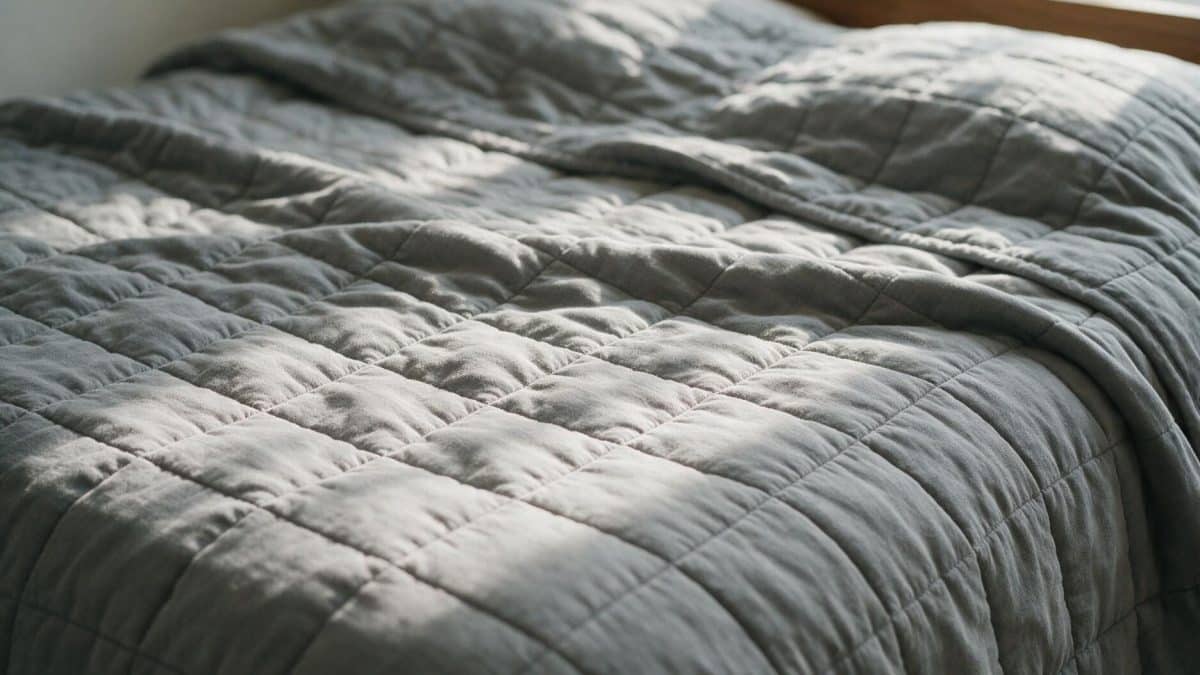
Quick answer · care label Cotton shell — glass-bead fill
-
1 · Wash
Wash 30° gentle -
2 · Bleach
No bleach -
3 · Dry
Tumble low -
4 · Iron
Do not iron -
5 · Pro care
No dry clean
In one line Strip the removable cover and wash that alone, then check every quilted seam by hand, because wet fill tearing through stitching is the only real failure mode. Wash the blanket by itself, cold, on the gentle cycle at the lowest spin speed available, with half the usual detergent and no bleach or softener. Dry it flat or tumble on low, never hung, breaking the pockets apart every half hour: about 40 minutes hands-on.
Can a weighted blanket go in the washing machine at all?
The makers do not agree, which is how most people end up stuck. One label says machine wash the removable cover and hand wash the weighted insert in a bathtub. Another says the whole blanket is machine washable, cold, on the gentle cycle. Bearaby, whose knitted Nappers carry their weight in the yarn rather than in a fill, says to wash separately in cool water on the delicate or permanent-press cycle, tumble dry low, and never hang it up. Those are not three opinions about one object, but accurate instructions for three different objects that share a name.
So the question is not which setting to use, but whether your blanket and your machine can do this at all. That comes down to two numbers: what the blanket weighs, and what the drum is rated to carry. Consumer guidance clusters around 20 pounds as the point where a home machine stops being sensible, with a drum of about 4.5 cubic feet as the smallest that copes; some sources put the ceiling nearer 15 pounds without explaining the gap. Treat those as rules of thumb and the capacity printed in your own machine’s manual as the real limit.
The wet weight is less alarming than with a comforter, because glass and plastic absorb nothing and only the shell takes on water. It gains enough, though, which is why the spin rather than the wash is the dangerous part.
Nothing a washing machine does harms the fill. Glass beads and plastic pellets are indifferent to water, detergent and any temperature a home appliance reaches. What you are protecting is the stitching that holds the fill spread out. Beads that cross from one sewn pocket into the next never come back, and a blanket with its weight pooled in one corner is finished even though nothing looks torn. Everything below exists to keep wet fill off a single line of thread.
What you’ll need
| Item | Why | Substitute |
|---|---|---|
| Bathroom scale | Its weight against the machine’s load rating is the whole decision, and box weights are rounded up | The shipping label, if you kept it |
| Needle and strong thread | A seam slightly open when dry becomes a hole once wet weight leans on it | Waxed dental floss and a large-eye needle |
| Mild liquid detergent, half dose | Quilted pockets rinse badly, and trapped detergent is why a clean blanket smells stale a week later | Any liquid detergent, measured short. Powder settles undissolved in the pockets |
| 3 or 4 wool dryer balls | They keep striking the blanket and break up wet lumps while those are still separable | Clean tennis balls |
| A drying rack, or two chairs | The weight has to be supported along its whole length, never hanging from one edge | A clean floor and a flat sheet, turned every few hours |
| A white cloth | Dyed plush bleeds, and a shell that bleeds onto itself cannot be fixed | A clean white sock |
The method, step by step
Take the cover off and wash it on its own
If there is a removable duvet-style cover, that is what has been against skin, and it washes like any other bedding. Decide separately whether the weighted part needs anything.
Weigh the blanket, then read the machine’s rating
Stand on the scale holding it and subtract, then find the load capacity in the manual. Inside that rating, and roughly under 20 pounds in a drum of about 4.5 cubic feet or more, a home wash is reasonable. Over the rating, or in a top loader with a center post, the honest answer is a laundromat or the bathtub.
Walk every seam line with your fingers
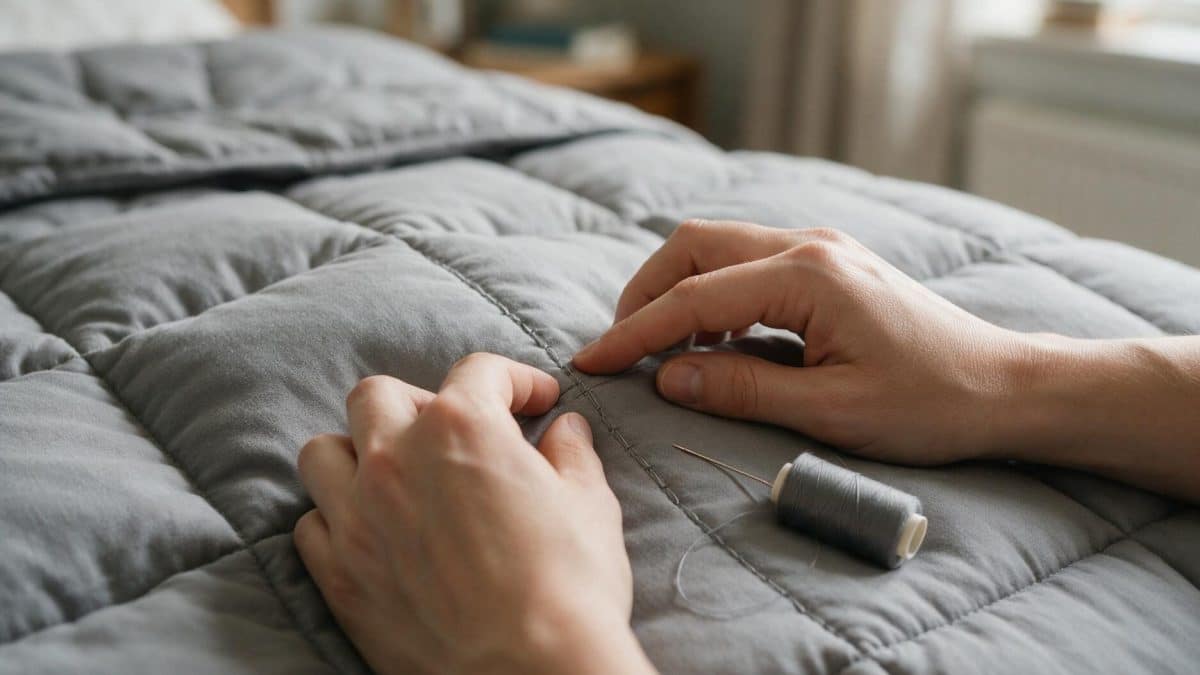
Run both hands along the four edges and every quilting line, feeling for a gap or a thin patch of thread, and repair anything open with a few firm stitches. This is the most skipped step and the one that decides the outcome: a wash turns a small gap into an empty pocket.
Test a dyed or plush face for bleeding
Press a damp white cloth against a hidden corner for ten seconds. Anything on the cloth means cold water, alone, no soaking. Deep grey and navy plush are the usual offenders.
Pretreat the marks, then load it in a ring around the drum
Work detergent into individual marks and leave it ten minutes; marks from the bed itself are sorted by type in how to clean bed stains. Then feed the blanket in as a loose ring against the drum wall, not a folded block. A block cannot tumble, and a load that cannot tumble spins off balance.
Cold, gentle, half the detergent, the lowest spin available
Wash it alone, around 30 °C (86 °F), on the gentle or bedding cycle, half the usual dose of liquid detergent, extra rinse if there is one. No bleach and no softener: softener leaves a waxy film, and film inside a sealed pocket never comes out. Then drop the spin to the lowest speed available.
Open the door, spread the weight, spin again
Pull the blanket off the drum wall, spread it evenly, and run one more slow spin. An unbalanced machine gets a second chance, and water removed now is time not spent drying.
Dry it flat or on low, breaking up the pockets as it goes
Either lay it flat and turn it every few hours, or tumble on low with the dryer balls, stopping every thirty minutes to shake it open and pull apart any lump. Expect four to eight hours in a dryer, up to two days flat. It is not dry when the surface is dry: press the back of your wrist along the seams, and anything cooler is still wet.
Which fill you have decides whether any of this is possible
You can identify the fill through the fabric in fifteen seconds. Push one pocket’s contents into a ridge with your thumb and feel what it does.
| Fill | How it feels through the fabric | Machine wash |
|---|---|---|
| Micro glass beads | Fine and grainy, close to damp sugar. Thin for its weight, because glass is dense | Yes |
| Plastic poly pellets | Bigger, rounder and audible: they click. Bulkier than glass at the same weight | Yes |
| Sand | Finer than glass, and it packs: pushed aside it stays in a ridge | No |
| Rice, beans, corn, other grain | Grain shapes you can name by touch, usually home-made or novelty | No |
The two noes are hard rules, not caution. Sand packs solid when wet, holds water for days inside a sealed pocket, and is fine enough to work its way out through the weave as the fabric flexes. Grain fills swell, ferment and grow mold where you cannot inspect them. Neither recovers, so spot clean and accept the limit.
One more case looks like a weighted blanket and is not built like one: the chunky knitted sort, where the weight is in the yarn and there is no fill. Those wash separately in cool water on delicate or permanent press and tumble low, and they often need more than one pass through the dryer. The one rule is that they must not be hung, because the loops stretch under their own wet weight and stay stretched. A knitted blanket in velvet is the exception that goes to a cleaner instead.
The seams are what fail, and the spin is when
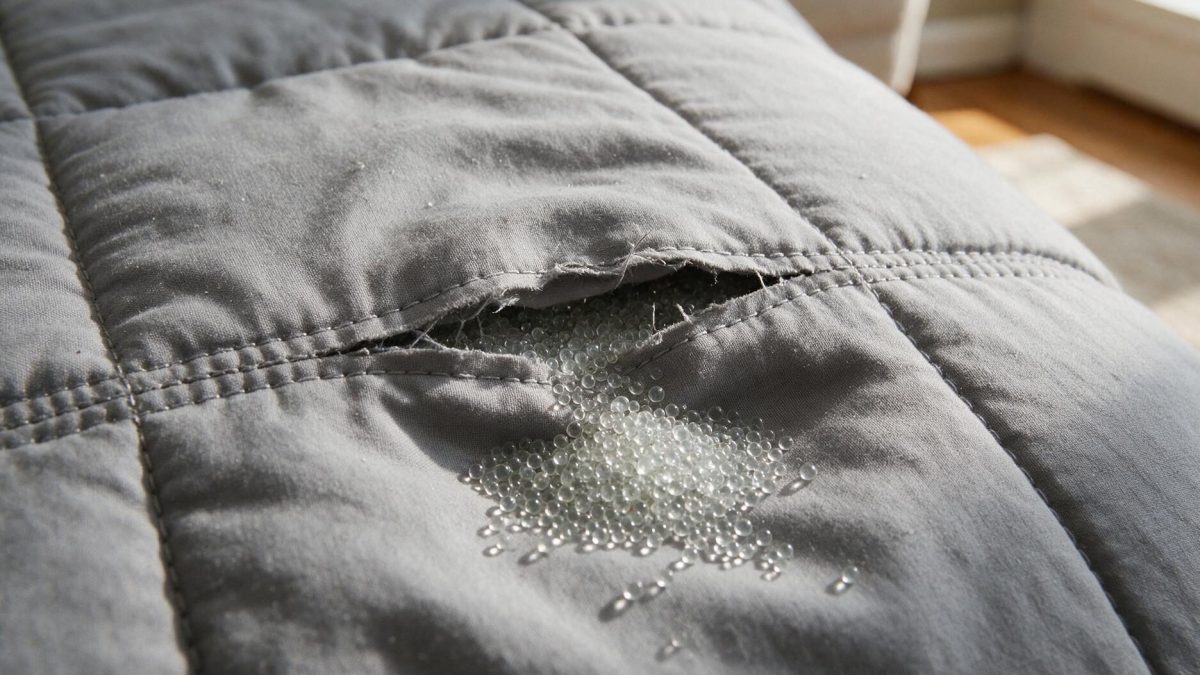
A drum lifts the load to the top and drops it, and the water is driven through the fabric by that fall. With a shirt, the falling mass is the shirt. With a weighted blanket it is fifteen or twenty pounds of glass in a lattice of stitching, landing on whichever pocket is underneath. Then the spin drives all of it against the drum wall at once.
Nothing dramatic usually happens on the first cycle. The damage is cumulative: thread abrades, one pocket opens a fraction of an inch, and beads migrate next door. Six months later there is a bald patch at the top and a sag at the foot, and the seam that let go is impossible to find. That is why spin speed matters more than water temperature, and why makers that permit machine washing at all specify a gentle or delicate cycle.
Nothing in a home dryer is hot enough to melt the pellets
Almost every article on this subject says high heat melts the plastic filling. The numbers do not support it. Domestic dryers run around 52 °C (125 °F) on low and top out near 80 °C (175 °F) on high. Polypropylene, the plastic most poly pellets are made from, melts between about 160 and 170 °C (320 to 338 °F), and even polyethylene needs more than 105 °C (221 °F). A dryer reaches neither, and glass beads are going nowhere at all.
Use the low setting anyway, for the reasons that are real. Heat shrinks a cotton shell while the quilting grid holds its dimensions, which puckers the fabric and puts standing tension on the stitching you just checked. It mats plush permanently. And it dries the outer face fast, which feels like progress and is the opposite: a dry face over a wet pocket is a lid, and that is how a blanket comes out smelling fine and smells of mildew four days later. By then it is a colony rather than a stain: how to clean mold off clothes.
Where the melting warning is straightforwardly correct is the iron. Care-label settings run from 110 °C (230 °F) at one dot to 200 °C (392 °F) at three, well above the melting point of both plastics: an iron fuses pellets into a lump and coats the soleplate. The one bed layer that changes the calculation completely is anything with wiring in it: how to clean an electric blanket.
Most weeks, wash the cover and leave the blanket alone
Published guidance puts numbers on this that match what the object can stand: the cover on the same rota as your sheets, the weighted part every few weeks if you sleep under it nightly and three or four times a year if you do not. Every wash is a withdrawal from the stitching, and the cover exists so you rarely have to make one. That makes the cover the thing to check when buying, ahead of the weight and the fabric marketing, because a sewn-in shell means every cleaning is a full cycle on the seams.
Dry cleaning is not the way out either. Makers generally advise against it: the solvents are hard on synthetic fill and on any bonded layer in the shell, and a cleaner charges by weight for an object that is mostly glass. The exception is a rayon or linen cover whose own label calls for it, and then you send the cover alone. Between washes, vacuum both faces and air it in shade rather than sun.
Related guides
- The other heavy bed layer, where the constraint is drum capacity rather than seam strength: how to clean a comforter.
- A fill that does absorb water, clumps in its channels and must be beaten apart as it dries: how to clean a down comforter.
- The blanket that felts and shrinks instead of shifting its weight, where heat is the enemy: how to clean a wool blanket.
- If something soaked through to what is underneath: how to clean a mattress.
Questions
Can I put a weighted blanket in the washing machine?
If the label allows it, the blanket sits inside your machine’s stated weight capacity, the drum is roomy and there is no agitator post, then usually yes: alone, cold, gentle cycle, lowest spin speed. Past that capacity, use a laundromat or a bathtub. Some makers ask you to hand wash the weighted insert whatever it weighs, and the label beats any rule.
Can you put a weighted blanket in the dryer?
Yes, on low, with dryer balls, stopping every half hour to shake it open. The common warning that dryer heat melts the pellets is wrong for a domestic machine, which cannot get near the melting point of either plastic. Low is still right, because high heat shrinks the shell, mats plush, and dries the outside over a wet inside.
My blanket is filled with sand. Can I wash it?
No, and this is one of the few hard rules. Sand packs solid when wet, is fine enough to seep out through the weave, and will not dry out of a sealed pocket: mildew inside a blanket you cannot open. The same applies to rice, beans and corn. Spot clean the surface and accept the limit.
Beads are coming out of my blanket. Is it repairable?
The hole is, with small tight stitches in strong thread or waxed dental floss, sewn from the outside. The redistribution is not: beads that crossed into the next pocket stay there, so the blanket is heavier in one place and lighter in another for good. Stitch it before the next wash, because a wash makes the hole much larger.