How to Clean Towels (and Why They Stop Absorbing)
Towels stop absorbing because they are coated, not dirty. Fabric softener, excess detergent and hard water all leave a film water will not cross, so the fix is less product and more rinsing.
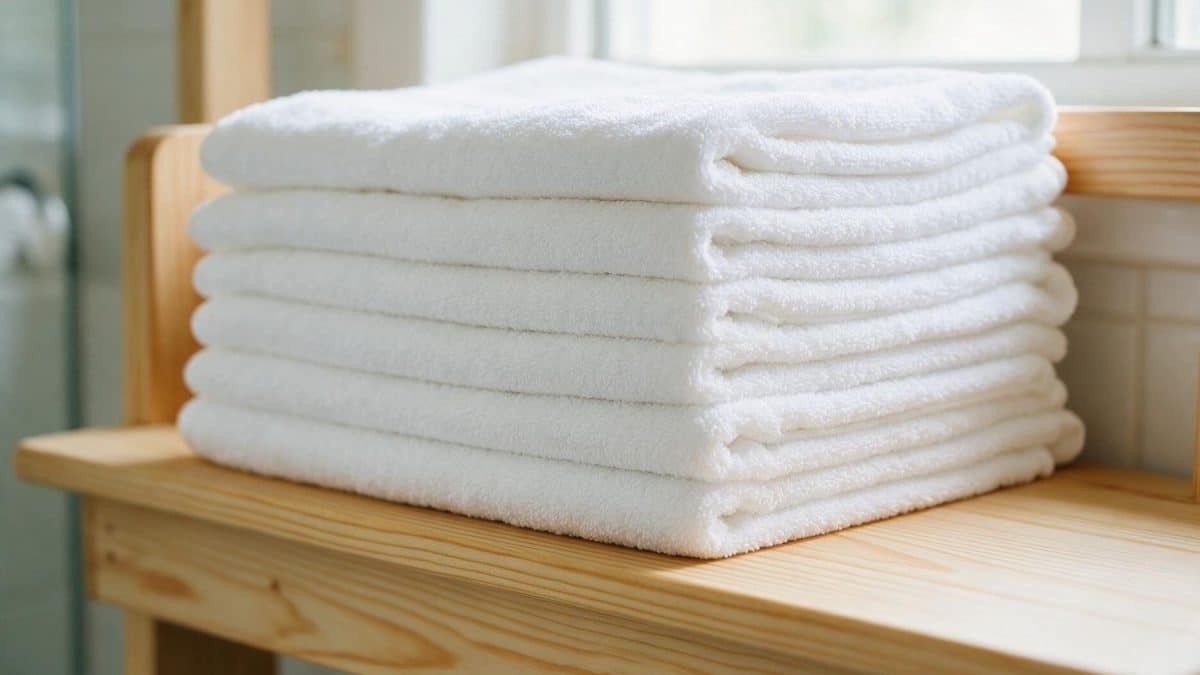
Quick answer · care label Cotton terry
-
1 · Wash
Wash 40° -
2 · Bleach
Oxygen bleach -
3 · Dry
Tumble low -
4 · Iron
Do not iron -
5 · Pro care
No dry clean
In one line Wash towels alone with the drum two-thirds full, half a dose of liquid detergent and no fabric softener, at 40 °C for the routine load or 60 °C when they have gone sour. Add an extra rinse, tumble on low with dryer balls, and hang them spread out rather than folded over a rail. About 20 minutes hands-on.
Why do clean towels stop absorbing water?
A towel that has been through forty washes is usually cleaner than a new one and works considerably worse. It comes out of the dryer smelling fine, feels soft folded in the cupboard, and then pushes the water around your back instead of taking it up. Nothing is stained. Nothing is worn through. The loops are all still there.
What has changed is that they are coated. Terry cloth works by capillary action: thousands of upright loops of loosely twisted cotton, each one a narrow channel, drawing water in by wicking. That mechanism needs two things, and only two. The cotton surface has to stay water-loving, and the loops have to stay open and separate from each other. Every common way of ruining a towel attacks one of those two things — it lays a water-repelling film over the fiber, or it glues the loops down flat.
Which is why washing a badly performing towel harder almost never fixes it, and why washing it with more product usually makes it worse. The job here is not getting dirt out. It is getting out everything the previous forty washes left behind.
A towel absorbs because of what its surface is, not because of how thick it is. Fabric softener, dryer sheets, undissolved detergent and hard-water minerals all end up as the same object: a film on the cotton that water will not cross. So the method is the opposite of the instinct. Use less product than feels right, rinse more than feels necessary, and dry with movement rather than with heat.
What you’ll need
| Item | Why | Substitute |
|---|---|---|
| Liquid detergent, half the usual dose | Terry holds detergent the way a sponge does, and what the rinse cannot clear stays in the pile as a stiffening residue. Liquid rinses out of a thick pile far better than powder | Any liquid detergent, measured short. If you only have powder, dissolve it in warm water first |
| White distilled vinegar, 1 cup | Acetic acid dissolves the alkaline soap-and-mineral scale hard water leaves in the loops, and neutralises the positively charged residue softener leaves behind | Citric acid powder, a heaped tablespoon, dissolved first |
| Oxygen bleach powder | Sodium percarbonate releases hydrogen peroxide in warm water. It is the only thing on this list that touches the yellowing from body oil, and it does it without eating the cotton | Any powder listing sodium percarbonate as the active ingredient. Not chlorine bleach, despite the shared word |
| Three or four wool dryer balls | They keep hitting the fabric while it dries, and that mechanical knocking is what stops the loops setting hard. This is a physical job, not a chemical one | Clean tennis balls. A pair of clean sneakers with the laces out also works |
| A load of nothing but towels | Towels shed lint onto everything else and need room to tumble. A drum packed to the door cannot rinse the middle of the load at all | Cotton bed linen, which takes the same cycle, if you have too few towels to make up a load. Never clothing, which the lint ruins |
| A white cotton cloth | Colorfast check before any oxygen bleach goes near a dark or deeply dyed towel. A colored cloth hides the transfer, which is the entire point of the test | A clean white sock |
The method, step by step
Sort by color, and pull out anything a face cream has touched
Whites and pale towels in one load, darks in another, because the whites are the ones that want warmth and oxygen bleach. Set aside any towel used to dry a face treated with benzoyl peroxide: that is a bleaching problem rather than a washing problem, and it is covered further down.
Fill the drum two-thirds, dry
Towels swell when they wet out and then hold their volume. A drum that looked comfortably full dry becomes a solid plug wet, and a plug turns as one lump instead of tumbling. The middle of it is never washed and, more importantly, never rinsed.
Measure half the detergent, and skip the softener entirely
Half a dose in a two-thirds load is plenty for towels, which carry body oil and water rather than ground-in dirt. Fabric softener is not an optional extra here. It is actively working against the thing you bought the towel for, for reasons set out below.
Wash at 40 °C (104 °F) for the routine load, 60 °C (140 °F) when it has to be a hygiene wash
Warm is the everyday setting most towel manufacturers publish, because repeated hot washing shrinks cotton and frays hems faster than anything else you will do to a towel. Save 60 °C for towels that have gone sour, for gym and kitchen towels, and for anything used around illness. Do not put a colored towel through a 60 °C cycle you have not tested first.
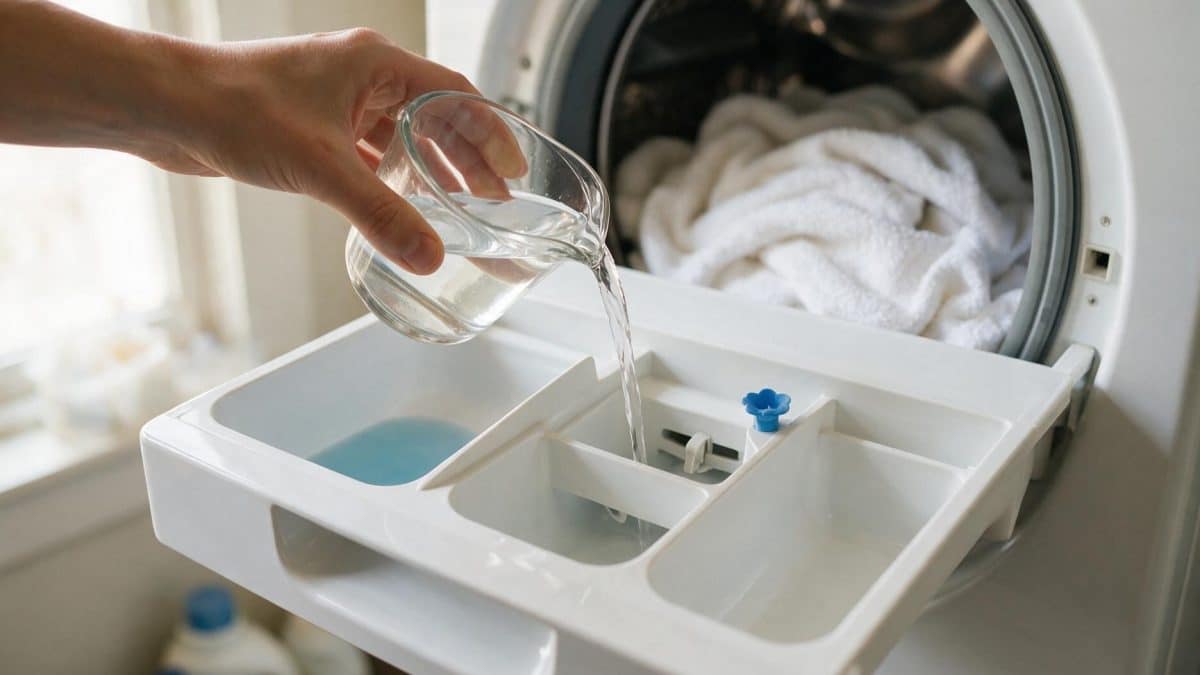
Add an extra rinse, or a vinegar rinse if they have been feeling waxy
The extra rinse is free and it is where most towel problems are actually solved. If the towels have been repelling water, pour a cup of white vinegar into the fabric softener compartment instead, so it arrives during the rinse rather than the wash. Vinegar put in with the detergent is simply neutralised by it and does nothing.
Tumble on low with the dryer balls, and take them out slightly damp
Low heat over a long tumble beats high heat over a short one every time. High heat scorches the tips of the cotton loops, which is what makes an old towel feel scratchy rather than soft, and that does not come back. Pull them out while they still feel faintly cool in the folds and finish them on a rail.
Hang them spread out, not folded in half over a rail
A towel folded over a rail is drying two layers pressed face to face, and the inside of that fold stays damp for hours. Spread the full width along the rail, or across two hooks. This one habit does more about the smell than any product does.
Fabric softener does the exact opposite of what the bottle promises
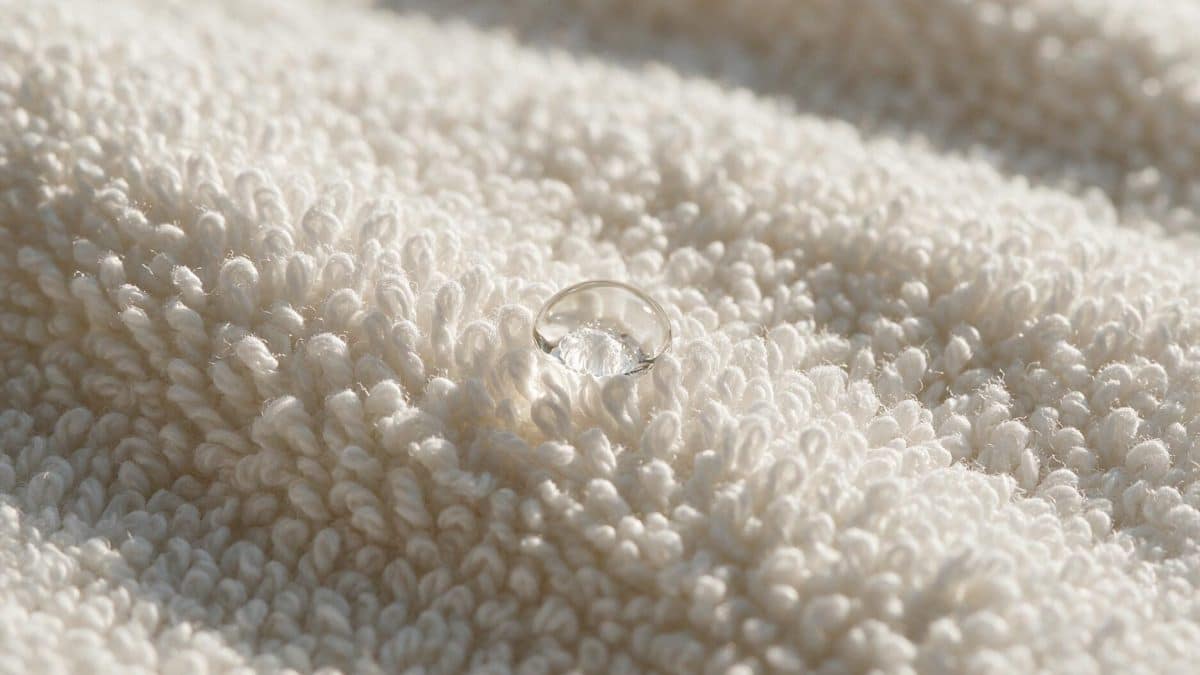
Liquid softeners work with cationic surfactants, usually quaternary ammonium compounds, which carry a positive charge. Cotton in rinse water carries a slight negative surface charge, so the softener is pulled onto the fiber and stays there, lying with its greasy tails pointing outward. That is exactly what makes the fabric feel slippery, and it is the same coating that stops water crossing into the loop. Capillary action needs a wettable surface, and a waxy monolayer is not one. The effect also accumulates, which is why the towel that has stopped working is almost always the one softened for years rather than the one softened last week.
Published absorbency losses vary widely with the test method used, so the percentages that circulate are not comparable with each other and none of them is worth repeating as a figure. The direction is not in dispute, and every towel maker that publishes care instructions uses the same word about softener: never. Dryer sheets do the same job by a different route, melting a thin coating onto the fabric with heat, and they leave the equivalent film on the dryer lint screen where you can see it.
Two other coatings arrive without you buying them. Hard water leaves calcium and magnesium bound up with detergent as an insoluble scale in the pile, and that is the gritty stiffness people blame on cheap towels. An overdose of detergent leaves its own residue, because a thick pile does not rinse the way a shirt does — the same problem that makes hand washing harder than it looks, set out in how to clean clothes by hand. Both answer to the same vinegar rinse, and both come straight back if you go back to full doses.
Line-dried towels go stiff for a reason that has nothing to do with your water
Hang a towel on a line and it dries like cardboard. Put the same towel in a dryer and it comes out soft. Most people put that down to hard water, or to the softener they have just stopped using. It is neither, and it has nothing to do with anything dissolved in the water.
Cotton never fully dries in room air. It holds several percent of its own weight as water at ordinary indoor temperature and humidity, and a thin layer of that stays clamped to the fiber surfaces after the bulk water has evaporated. The accepted explanation is that this bound layer behaves like a weak glue: it hydrogen-bonds neighboring fibers to one another, and if the towel hangs motionless while the last of the water leaves, it sets the crushed loops in whatever position they happened to be in. The stiffness is not a deposit. It is cotton stuck to cotton, which is why no amount of rinsing or descaling shifts it.
Which is why the fix is mechanical rather than chemical. Tumbling breaks those bonds as fast as they form, so a dryer genuinely produces a softer towel than a line does — one of the few laundry jobs where the machine wins outright. If you line dry for cost or for space, you recover most of the difference by snapping each towel out hard several times while it is still damp, and nearly all of it with ten minutes in a dryer on low with the balls in at the end. Do it before they go on the line as well, because the loops that are already standing when drying starts are the ones that stay standing.
The sour smell has a name, and drying does not kill it
The smell that appears the moment a clean-looking towel gets wet is not mildew and it is not detergent. It is a specific organism. A 2012 study in Applied and Environmental Microbiology isolated Moraxella osloensis as the organism behind the wet-dustcloth smell of laundry dried indoors, and showed it can generate 4-methyl-3-hexenoic acid, the main component of that odor. It lives on skin, transfers onto fabric constantly, and feeds on the sebum left in the pile. The same work reports it tolerating both drying out and ultraviolet light well, which is exactly why an afternoon in the sun does not deal with it, and why the problem is worst in laundry that dries slowly indoors. Getting a towel dry quickly stops it producing more acid. It does not remove it.
Sources disagree on the temperature that clears an established colony. The claim repeated nearly everywhere is that it survives a 30 °C cycle and is eliminated at 60 °C, but the identification work was about naming the organism and the odor compound rather than establishing a domestic kill temperature, so treat 60 °C as the best available answer rather than a proven one. What is consistent in practice is that a 60 °C wash with oxygen bleach clears the smell where a warm wash with detergent alone did not. The oxygen bleach matters as much as the temperature, because the food source is oxidisable body oil sitting in the pile, and a wash that leaves the sebum behind leaves the colony something to come back to.
The other half of the answer is drying time, and it is worth knowing before you buy rather than after. A dense 700 GSM towel carries far more water than a 400 GSM one of the same size and stays damp correspondingly longer in a humid bathroom, and every one of those extra hours is growth time. Plush towels are lovely, and they are the worst possible choice for a small windowless bathroom — the same trade-off that governs the other permanently damp textile in that room, covered in how to clean a shower curtain.
What actually comes out of a towel, and what does not
Towels collect a narrow and predictable set of marks, and the honest answer is that several of them are not stains at all. Sorting the mark into its family before treating it is the whole skill, the same approach set out in how to clean stains from clothes.
| What you see | What it is | Treatment | Recoverable |
|---|---|---|---|
| General yellowing, worst on white towels | Body oil left behind by cold washes, now oxidised and bound to the fiber | Several hours soaking in dissolved oxygen bleach, as warm as the towel tolerates, then a normal wash | Yes |
| Orange or pale blotches, usually on a face towel | Benzoyl peroxide from acne treatment. It has oxidised the dye out of the cotton | None. There is nothing sitting on the fabric to lift; the color has gone from it | No |
| Black or grey speckling that returns after washing | Mold rooted in the pile rather than deposited on it | Treat it as a colony, not a stain, and expect the marks to outlast the smell | No |
| Rust-brown marks where the towel met the rail | Iron oxide transferred from a chipped or permanently damp metal rail | An acid: white vinegar, or a dedicated rust remover. Chlorine bleach makes it permanent | Yes |
| Beige smears near one end | Foundation, sunscreen or self-tanner, which is pigment suspended in oil | Work liquid detergent into the dry mark to break the oil first, wait ten minutes, then wash | Yes |
| Dark red-brown spots | Blood, which is protein and sets irreversibly with heat | Cold water only, at every stage, including the rinse | Yes |
| A stiff white crust deep in the pile | Hard-water scale and soap, not dirt | A vinegar rinse, then permanently less detergent | Yes |
Two of those deserve a note of their own. Rust is the one people reliably make permanent, because the instinct on a brown mark is bleach, and sodium hypochlorite oxidises the iron further and fixes it into the fabric; the method that does work is in how to clean rust off clothes. Blood is the one people make permanent with warmth, and a towel is where it happens most often, because a cut gets pressed with the nearest towel and that towel goes into the next hot load. Details in how to clean a blood stain.
Related guides
- Microfiber fails by the same mechanism as terry but far faster, because its cleaning power is electrostatic and a softener film kills that outright: how to clean microfiber cloths.
- The same oxidised body oil that yellows white towels yellows bedding, on a much bigger object where the soak is the hard part rather than the wash: how to clean a comforter.
- Once the sour smell has become visible spotting, it stops being a laundry problem and becomes a living colony: how to clean mold off clothes.
- Hats and shoes share the towel problem of a thick, slow-drying object that never gets rinsed properly in the middle: how to clean smelly shoes.
Questions
What temperature should I wash towels at?
40 °C (104 °F) for the routine load and 60 °C (140 °F) when the towels need sanitising rather than cleaning. Manufacturers and hygiene guidance genuinely disagree here: towel makers publish warm-not-hot, because repeated hot washing shrinks cotton and frays hems, while microbiologists want the higher temperature. Splitting it by purpose satisfies both.
Why do my towels smell sour as soon as they get wet?
Bacteria living in the pile and producing acid as waste, most often Moraxella osloensis, feeding on the body oil left in the fabric. The smell only registers when the towel is wet because the compound needs moisture to lift off the fibers. Drying a towel quickly stops the population growing but does not remove it, so clearing an established smell takes a hot wash with oxygen bleach rather than another normal cycle.
Does vinegar actually make towels soft again?
It does, but only against one specific cause. Vinegar dissolves alkaline mineral scale and neutralises the cationic residue left by fabric softener, so it works on towels stiffened by hard water or coated by product. It does nothing at all for towels stiffened by line drying, because that is cotton hydrogen-bonded to cotton rather than a deposit. Add it to the rinse, never to the wash, and never anywhere near chlorine bleach.
How often should towels be washed?
After about three uses for a bath towel that dries fully spread out between uses, and after two if your bathroom is humid or the towel sits folded on a rail. Hand towels and kitchen towels are handled far more often by far more people and want washing every couple of days. The reliable signal is smell: if it smells when wet, it went too long.
Can I use chlorine bleach on white towels?
Sparingly at most. Chlorine oxidises cellulose as well as stains, breaking the molecular chains that give cotton its strength, so towels bleached routinely go thin and start shedding at the hems years early. It also sets rust marks permanently and reacts with protein residue already in the fabric. Oxygen bleach does the whitening job more slowly and does not attack the fiber.
Why are my brand new towels not absorbent?
Because terry is usually given a softening finish, often silicone-based, so it feels plush on the shelf, and that coating repels water until it has been washed off. Expect two or three washes before a new towel performs the way it was designed to. A first wash in warm water with vinegar and no detergent is the usual advice for stripping it faster. If you also run a baking soda cycle, run it separately: acid and carbonate in one drum neutralise each other, and you get the benefit of neither.