How to Clean a Leather Chair (The Seat Edge Fails First)
A leather chair fails at the front edge of the seat, not the back, where every sit and stand concentrates the wear. That same edge also reveals whether it was ever real leather at all.
Quick answer · care label Leather chair · genuine hide, bonded leather, or PU-coated fabric
-
1 · Wash
Do not wash -
2 · Bleach
No bleach -
3 · Dry
Dry in shade -
4 · Iron
Do not iron
In one line Check the underside lip of the seat's front edge first; if the coating flakes to reveal a fabric backing, it's bonded leather, not hide, and no conditioner fixes that. Clear the seams, then wipe the chair panel by panel with a barely damp, mildly soapy cloth, drying each section right behind it, and give the seat edge a second light pass since it carries the most flex and oil. Skip conditioner entirely if the chair turns out to be bonded or coated; if it's genuine leather, condition it every six months or so, and keep the whole chair away from direct sun and heating vents either way. About 20 minutes hands-on for a single chair.
Is this leather chair real hide, or a coating about to peel?
A leather chair wears unevenly, and the spot that gives out first is not the back or the arms, it’s the front edge of the seat, the narrow strip you push down on every time you stand up. That single band of flexing and skin oil wears through a finish faster than years of ordinary sitting ever could, which is why how to clean a leather chair has as much to do with protecting that one edge as it does with wiping the rest of it. Before any cleaning starts, that same edge also tells you what the chair is actually made of.
Press a fingernail gently into the underside lip of the seat’s front edge, somewhere that won’t show. Genuine leather keeps its surface grain intact even where the finish has thinned from years of pressure. A chair made from bonded or coated “PU leather” flakes at that same spot and shows a fabric backing, or a different color, underneath. That distinction decides almost everything else in this guide, because a coating that’s already flaking does not come back no matter how carefully it’s cleaned, while real hide that’s merely dirty or dried out still responds to the right method.
This covers a single seat built around leather or a leather-look coating, whether it’s a dining chair, an office chair with a swivel base, a recliner, or an upholstered accent chair; a sofa or couch wears and fails differently because it spreads that same flexing and body contact across cushions several feet wide instead of concentrating it on one seat and one set of arms. A fabric armchair with exposed wood legs fails at a different point, covered in how to clean a fabric armchair.
A leather chair breaks down fastest where the front edge of the seat gets pushed on to stand and sat on to sit, not where nothing presses or flexes. Clean that edge the same way as the rest of the chair, just more gently and more often, and don’t expect a coating that’s already peeling there to recover.
What you’ll need
| Item | Why | Substitute |
|---|---|---|
| Mild dish soap or castile soap | Lifts body oil and everyday grime without stripping the finish | A cleaner labeled safe for leather or vinyl upholstery |
| Two soft microfiber cloths | One carries the barely damp solution, the other dries the same panel right behind it | A clean, soft, lint-free cotton cloth |
| Soft-bristle brush or vacuum attachment | Clears grit out of seams and piping before wiping, so it never gets dragged across the finish | A dry, soft paintbrush for tight seams |
| Bowl of lukewarm water | Dilutes the soap so the cloth stays damp, never wet | N/A |
| Leather conditioner (genuine leather only) | Replaces oils a hide loses over time, which is what actually prevents dry, hairline cracking | Skip entirely if the chair is bonded or coated, or if you’re unsure which it is |
The method, step by step
Clear every seam before any liquid touches the chair
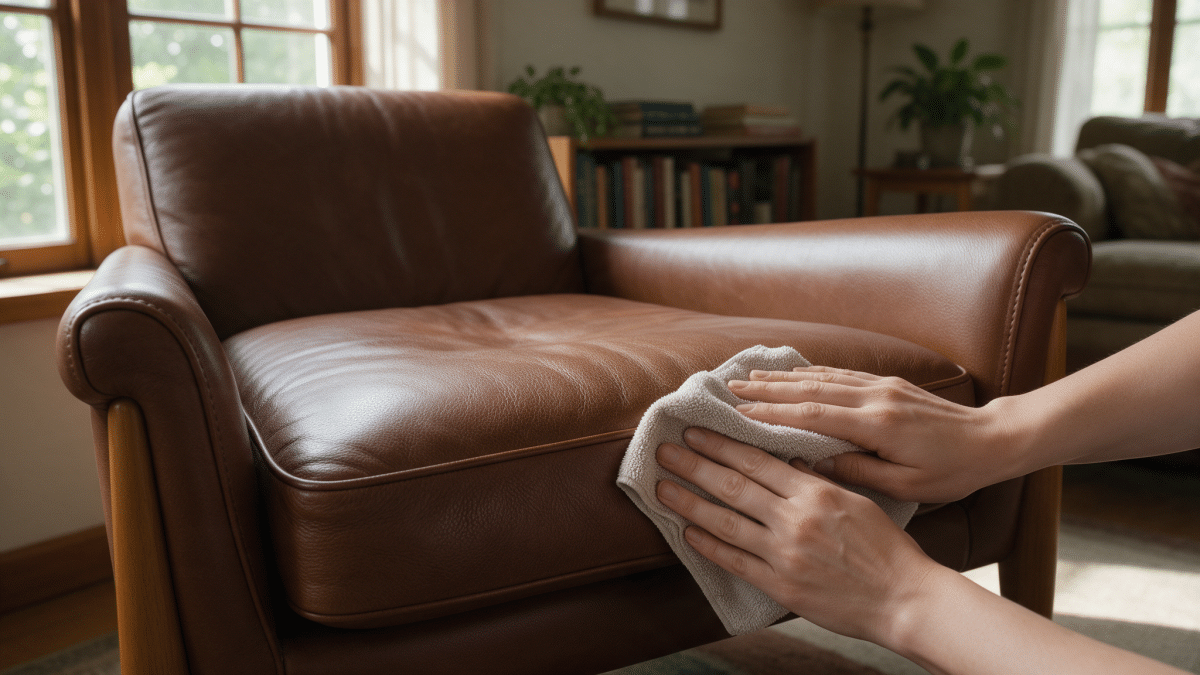
Run a vacuum’s soft-bristle attachment along the seams, the base of the seat, and the piping around the arms. Grit trapped there gets dragged across the finish by a damp cloth if it isn’t removed first, and that light scratching dulls a leather chair’s surface years before it actually cracks.
Check the seat’s front edge in a spot that won’t show
Flip the cushion or crouch down and press a fingernail into the underside lip of the seat’s front edge. Flaking that reveals a fabric backing or a different color means a coated material, not hide; a surface that stays intact just means the finish is worn, and conditioner later in this method will help.
Mix a barely-there soap solution
A few drops of mild dish soap or castile soap in a bowl of lukewarm water is enough. The goal is a solution that smells faintly of soap, not one that foams; a strong mix leaves residue in the grain that attracts dirt faster once it dries.
Wring the cloth out until it barely feels wet
Dip a microfiber cloth in the solution, then wring it until no water drips out on its own. It should feel cool and damp against the back of your hand, not wet enough to leave a mark if you press it to a dry paper towel.
Wipe the seat first, then the back and arms, drying each panel right behind it
Work in sections no larger than the seat cushion, wiping with the damp cloth and following immediately with the dry one before moving on. Leaving a wiped section to air-dry on its own is how moisture sits in the seams and stitching longer than it needs to.
Give the seat’s front edge and armrests a lighter, second pass
These two spots carry more flex and body oil than anywhere else on the chair, so they often need a second wipe with the same barely damp cloth once the rest of the chair is already dry. Never scrub; a second gentle pass does more than pressing harder on the first one.
Condition only if it’s genuine leather, then dry away from sun and heat
If the chair passed the edge check in step two, work a small amount of leather conditioner into a soft cloth and buff it in once the chair is fully dry; skip this step entirely on a bonded or coated chair, since there’s no hide underneath to absorb it. Either way, let the chair finish drying with airflow, out of direct sun and away from a heating vent.
Interactive
Label decoder
Tap a symbol from your care label. No guessing, no scrolling.
19 symbols. Pick one.
Genuine leather and bonded leather don’t fail the same way
Furniture restorers who deal with peeling chairs describe it as a material problem, not a cleaning mistake. Bonded or “PU leather” is a thin layer of ground scrap leather and fabric coated with a polyurethane finish, and that coating breaks down through a chemical process called hydrolysis, not from anything done or skipped during cleaning. The breakdown can show up in as little as eighteen months, often right after a warranty runs out, which is why an early-peeling chair doesn’t necessarily point to a bad routine. A faux leather couch fails the same way, for the same chemical reason, just spread across more surface.
Genuine leather fails on the opposite timeline and for a different reason: it dries out as the oils inside the hide wear away, and a dry hide is what develops the fine, spiderweb cracking people usually associate with old leather furniture. Conditioning every six months or so is what actually prevents that, the same way it does on a leather sofa, though a single chair needs far less product per session. How to clean leather covers the water-drop test for telling finished leather from unfinished leather on any item, which matters here because an unfinished or aniline hide takes a cloth very differently than the pigmented leather most dining and office chairs use.
An office or recliner chair adds a second trap that a plain dining chair doesn’t have: the gap where the seat meets a swivel base or a reclining mechanism. Grit and spilled liquid work into that gap and sit against the underside of the leather far longer than anything on an open, flat panel, which is why that seam is worth checking and brushing out on the same schedule as the seat’s front edge, not just whenever the chair gets a deeper clean.
What actually ruins a leather chair
Most of the damage done to a leather chair after it leaves the factory comes from products built for the wrong surface, not from ordinary use. Detergents, solvents, all-purpose sprays, ammonia, bleach, and furniture polish all strip or soften the finish in ways plain soap and water don’t, whether the chair is genuine hide or a coated material. A sunny window or a nearby heating vent does comparable damage more slowly, drying out genuine leather and speeding up the same coating breakdown that body oil already causes at the seat’s front edge.
Never spray a cleaning solution directly onto a leather chair, and never reach for ammonia, bleach, a detergent-based cleaner, or an all-purpose spray on it. Apply every solution to the cloth first, and keep the chair out of direct sun and away from a heating vent, both of which push a coating toward peeling, or a hide toward cracking, faster than ordinary use ever would.
Problems that need more than a wipe-down
| Problem | What works | Recoverable |
|---|---|---|
| Ink | A cotton swab dipped in isopropyl alcohol, dabbed rather than rubbed, then wiped with the soap solution right after | Yes, if treated soon |
| Grease or body oil built up at the seat’s front edge | A second pass with the barely damp soap solution; repeat rather than switching to a stronger cleaner | Yes |
| Musty smell after the chair stayed damp | Full drying with airflow first; a smell that lingers once bone-dry usually means mildew at a seam, not surface odor | Not always |
| Coating already tacky or flaking color onto a cloth | Nothing reverses a broken-down coating; stop cleaning that spot the same way and expect it to keep flaking | No |
Related guides
- Stain-by-stain treatment goes further than the general wipe-down covered here: how to clean stains off leather.
- A jacket flexes at the elbows and shoulders with every movement instead of at one fixed seat edge, which changes where it wears first: how to clean a leather jacket.
- A bag’s structured shape and fabric lining mean it has to be stuffed while drying instead of left flat, unlike a chair: how to clean a leather bag.
Questions
What is the best thing to clean a leather chair with?
A few drops of mild dish soap or castile soap in lukewarm water, applied with a barely damp cloth and dried immediately behind it, cleans everyday dirt and body oil without stripping the finish. A cleaner labeled for leather or vinyl upholstery works too; anything built for wood, glass, or general household surfaces does not belong on a leather chair.
Can I use Dawn dish soap on a leather chair?
A few drops diluted in a bowl of water is fine and is close to what most leather-safe cleaners are built from. Using it at full strength, or spraying it straight onto the chair instead of onto a cloth, is what causes the over-wetting and residue problems people usually blame on the soap itself.
Why is my leather chair peeling?
A chair that peels in flakes and shows a fabric backing underneath is bonded or coated leather, not hide, and its polyurethane finish is breaking down chemically through a process that can start within about eighteen months regardless of how well it was cleaned. Genuine leather doesn’t peel this way; it dries and develops fine cracking instead, usually from going too long without conditioner.
What should you never clean a leather chair with?
Ammonia, bleach, detergent-based cleaners, all-purpose sprays, and furniture polish all strip or soften a leather chair’s finish, whether it’s genuine hide or a coated material. Plain soap and water, applied to a cloth rather than sprayed on, handles nearly everything a leather chair actually needs.
How long should a leather chair last?
A genuine leather chair conditioned every six months or so can last many years before the hide shows real wear. A bonded or coated chair follows a shorter, fairly fixed timeline set by the coating itself, and can start flaking within about a year and a half no matter how it’s cleaned or cared for.
Can a leather chair be professionally cleaned?
An upholstery cleaner can usually treat genuine leather, the same way one would for a leather sofa, since there’s real hide to condition and recolor if needed. A bonded or coated chair is a different case: professional cleaning doesn’t stop a polyurethane finish from breaking down, since the problem sits inside the coating itself rather than on the surface, so a chair that’s already flaking is past the point where any service helps.