How to Clean Throw Pillows
Every guide tells you to remove the cover and wash the insert, which assumes a zipper that half of throw pillows do not have. The sealed ones can still be washed. What ruins them is not the water, it is being left to cool down flat.
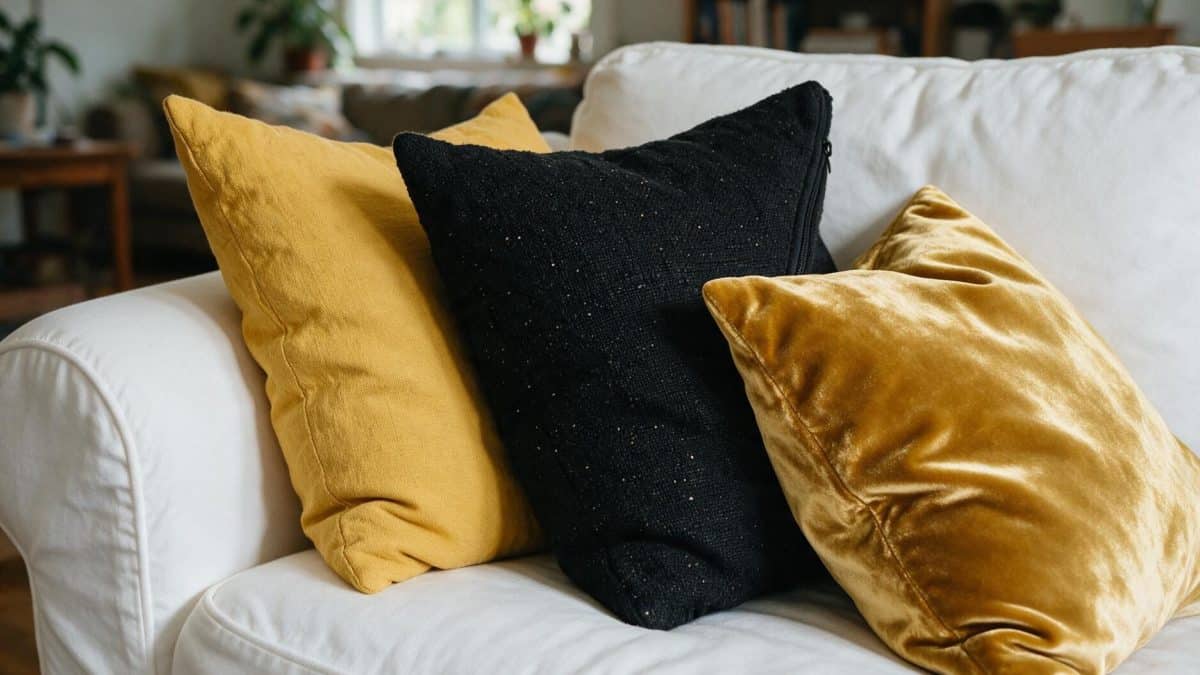
Quick answer · care label Throw pillow · cotton, linen, velvet or faux fur cover over polyester fiberfill, feather or foam
-
1 · Wash
Wash 30° gentle -
2 · Bleach
No bleach -
3 · Dry
Tumble low -
4 · Iron
Do not iron -
5 · Pro care
Pro clean P
In one line Check the seam before the fabric. Zipped pillows split into two separate jobs; sewn-shut pillows with soft fill can be washed whole at 30 °C on gentle, two per load, extra rinse, highest spin. Foam inserts never go in a machine. Tumble low with dryer balls for two to three hours and weigh the pillow: within 5 percent of its dry weight means the core is dry. Fluff it while it is still warm, because polyester fill sets its shape as it cools.
The seam decides this, not the fabric
Almost every guide to washing throw pillows opens the same way: remove the cover, wash the cover, wash the insert separately. That instruction assumes a zipper. Look along the edge of the pillows actually sitting on your couch and you will find that a good half of them have no zipper at all. The cover was sewn shut around the fill at the factory, and the whole object is one sealed unit. That is the pillow people get stuck on, and it is the one the advice skips.
So the first thing to establish is which of the three types you are holding. Run a finger along all four edges before anything else.
- Zipped cover, removable insert. The easy case. Cover and insert are two separate laundry problems with two different answers, and neither one is difficult once they are apart.
- Sewn shut, soft fill. No opening anywhere. Squeeze it: it compresses evenly and springs back. This is polyester fiberfill or a feather insert sealed inside. It can be washed whole, with one condition about drying that decides whether it survives.
- Sewn shut, foam fill. Squeeze it and it stays dented for a second before recovering, or it feels crumbly and granular. Solid or shredded foam. This one never goes near a machine, at any temperature.
The fabric matters too, but less than people expect and later in the sequence. A linen cover and a cotton cover behave nearly identically in water. A sealed pillow and a zipped pillow do not.
Washing a sealed pillow is usually fine. Letting it cool down flat afterwards is not. Polyester fill sets whatever shape it is holding as it cools, so a pillow left crumpled in the dryer basket for an hour comes out permanently flat. The last five minutes of the process matter more than the wash cycle you agonized over.
What you’ll need
| Item | Why | Substitute |
|---|---|---|
| Mild liquid detergent | Half the usual dose. Detergent trapped deep in fill will not rinse out of a sealed pillow, and the residue is what makes a clean pillow smell stale a week later | Any liquid detergent, measured short |
| Two pillows per load, or towels | A single soaked pillow slams to one side of the drum and the machine spends twenty minutes trying to rebalance it | Three bath towels alongside one pillow |
| Wool dryer balls | They keep striking the fill and breaking up the clumps as they form, which is the only thing that stops matting | Two clean tennis balls, or a pair of trainers with the laces removed |
| Kitchen scale | The only reliable way to tell whether the core is dry. Hands cannot feel a wet centre through four inches of fill | None, and this is the one item worth fetching |
| Seam ripper | Turns a sewn-shut pillow into a zipped one, permanently. Details further down | Small scissors and patience |
| White cotton cloth | Colourfast test on dyed or printed covers. A coloured cloth hides the transfer, which defeats the purpose | A clean white sock |
The method, step by step
Weigh it dry and write the number down
Thirty seconds now saves you from the mistake at the end. An 18 inch square polyester pillow usually lands between 350 and 500 g. That number is what you will compare against later, and it is the difference between a pillow that is dry and one that merely feels dry.
Vacuum both faces and the piping
Use the upholstery head. Dust, hair and skin cells collect along the piped edge where the two panels meet, and that seam is a channel that holds far more than the flat faces do. Vacuuming first also stops you from turning dry dust into a grey slurry the moment the pillow gets wet.
Spot-treat the marks before the whole thing gets wet
Head oil on the top edge, food on the front face. Work outward from the edge of the mark toward its centre so the ring does not spread. Sorting the mark into its chemical family first is the whole game here, and it is covered properly in how to clean stains from clothes.
Test the cover for colourfastness
Press a damp white cloth against a hidden corner for ten seconds. Deep indigo, mustard and rust covers are the usual bleeders, and so is anything block printed by hand. Colour on the cloth means hand wash, cold, alone.
Wash cool, gentle, with a second rinse
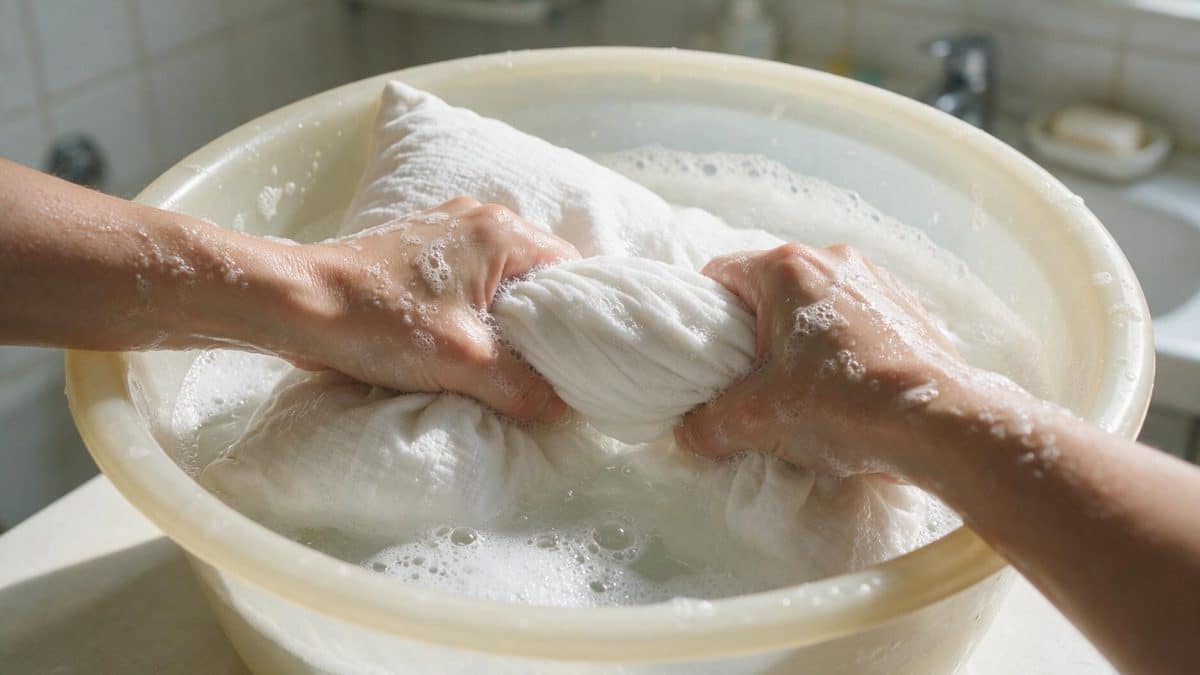
30 °C on the delicates or synthetics programme. The temperature is set by the fill rather than the fabric: heat is what collapses polyester loft, and no throw pillow is dirty enough to need warm water. Add the extra rinse. A sealed pillow holds detergent the way a sponge does.
Spin at the highest speed the machine offers
This is the one place where gentle is the wrong instinct. Every litre the spin cycle pulls out is an hour you will not spend drying, and drying is where sealed pillows are actually lost. Fill is not woven, so it cannot crease the way a garment does.
Tumble low with dryer balls, and check the weight
Low heat, dryer balls in with it, and pull it out every twenty minutes to knead the corners by hand. Weigh it. When it is within about 5 percent of the number you wrote down, it is genuinely dry. Expect two to three hours for a sealed pillow, which is far longer than most people give it.
Fluff it while it is still warm
Take it out hot, hold it by two opposite corners and slap it back and forth, then punch the middle back into shape. Do this before it cools. Warm fill takes the shape you give it; cold fill keeps the shape it already had.
Interactive
Label decoder
Tap a symbol from your care label. No guessing, no scrolling.
19 symbols. Pick one.
Why a washed pillow comes out flat and never recovers
Polyester fiberfill is not a solid mass. It is a tangle of short fibres, each one given a permanent zigzag crimp during manufacture, and often hollow down the middle. The springiness of a pillow comes entirely from that crimp resisting compression. Nothing about it is glued or bonded in a way that water can attack.
Heat is another matter. Polyester softens well below its melting point, and once the fibres are warm and pliable, whatever they are pressed against becomes their new shape as they cool. A hot dryer full of a heavy, wet, tumbling pillow presses those fibres flat against each other constantly. Take it out warm and shake it, and the fibres set in the open position. Leave it in the basket to cool while compressed, and they set flat. That is why two people can run identical cycles and get opposite results, and why nobody can explain the difference afterwards.
The clumping is a separate problem with the same fix. Wet fill mats into dense lumps that dry from the outside in, so the lump survives the cycle and stays a lump forever. Dryer balls exist to strike those lumps loose while they are still damp. A pillow dried on a rack with no mechanical agitation at all comes out lumpy every single time, which is the exact opposite of what you would expect from the gentlest possible method.
The sealed pillow: open the seam instead of giving up
The standard answer for a pillow with no zipper is spot clean only. That answer is written by people selling pillows, and it is worth ignoring on anything you actually use.
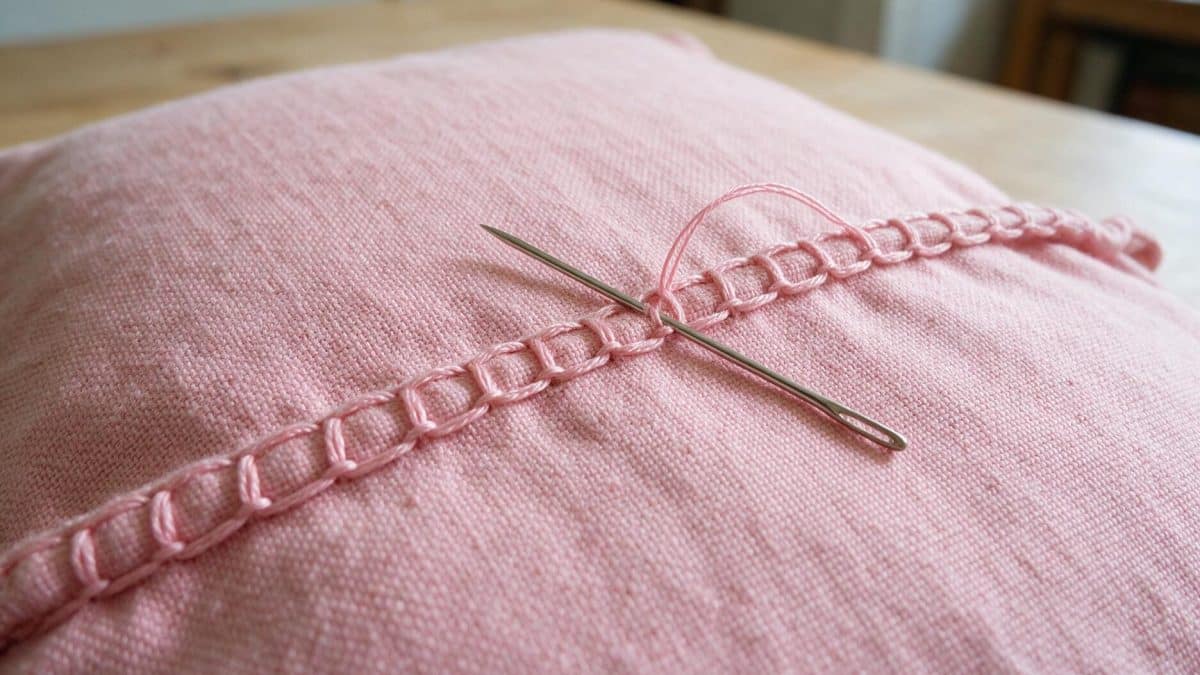
Lay the pillow face down and find the closing seam. It is the one that looks slightly different from the other three: hand-stitched, or machine-topstitched close to the edge where the others are hidden. Unpick four or five inches of it with a seam ripper. Pull the insert out through the gap. You now have a cover and an insert, exactly like a zipped pillow, and you can treat them separately. When both are dry, push the insert back in and close the gap with a ladder stitch, which disappears completely because the thread runs inside the fold.
Two reasons to prefer this to washing the pillow whole. The cover almost always wants a different treatment from the fill, cooler and shorter, and a sealed pillow forces you to compromise on both. And an insert removed from its cover dries in about a third of the time, because water no longer has to cross a layer of decorative fabric to escape.
The case for washing it sealed anyway: a pillow whose cover is heavily embellished, where opening the seam risks more than the wash does, or an insert so cheap that a full replacement costs less than an hour of your evening.
Covers, by what they are made of
Once the cover is off, it is just a small piece of laundry, and it follows the rules of its fabric.
- Cotton and linen. Machine wash cool, gentle, and take them out damp. Iron the linen while it is still slightly wet or accept the creases, because a dry linen cover does not release them.
- Velvet. Never flat-dry velvet and never iron it. Water alone leaves rings on the pile, so hand wash it, roll it in a towel to take the water out, then hang it to dry and brush the pile in one direction while damp.
- Faux fur. Cold, gentle, and no heat at any point. The pile is a polyester knit and a warm dryer melts the tips into a matted crust that no brushing brings back. Air dry, then comb it out with a wide-toothed comb.
- Beads, sequins and applied trims. Hand wash cold at most. These are usually held on with adhesive rather than thread, and that adhesive softens with heat long before water does anything to it. Warm water and a tumble dry together are what strips a beaded cover, not the washing itself.
- Wool and mohair. Hand wash cool with a wool detergent, no agitation, dry flat. Agitation plus water felts wool permanently and the cover comes back a size smaller than the insert it has to fit over.
- Anything backed with vinyl or a rubbery coating. Wipe only. Immersion separates the backing from the face fabric, and the two never bond again.
A dry-clean-only tag on a decorative cover is usually honest, unlike the same tag on a sweater. Solvent is genuinely the right call for silk, for structured covers with interfacing, and for anything mixing several fabrics in one panel. The insert is the part that never goes to a dry cleaner: solvent strips the finish that keeps a feather insert from leaking, and it does nothing useful to polyester fill.
Foam inserts, and why they are a different object entirely
Shredded memory foam and solid foam inserts turn up in the firmer, boxier throw pillows, especially lumbar shapes. They cannot be machine washed, and the reason is mechanical rather than chemical. Foam absorbs many times its own weight in water, and a saturated foam block is heavy enough to tear itself apart under the agitation. What survives the drum will still hold water in its centre for days, which is enough time for mildew to establish inside a sealed object you cannot inspect.
Treat foam by surface only: vacuum it, wipe it with a barely damp cloth and a drop of dish soap, blot with a dry towel, air dry with a fan aimed at it. This is the same logic that governs the seat cushions underneath, and the full version is in how to clean couch cushions. If the couch itself carries a W, S, WS or X code on its tag, that code applies to the throw pillows sold with it, and how to clean a fabric couch explains what each letter permits.
Secondhand pillows are a heat problem, not a dirt problem
A thrift store or marketplace pillow raises a question a normal wash cannot answer. Dust mites and their allergens die at around 55 to 60 °C sustained for half an hour. A cold wash removes a good share of the allergen but kills nothing, and the temperature that does kill is the same temperature that flattens the fill for good.
So the arbitration is straightforward on a sealed pillow: bin the insert and buy a new one. Inserts cost a few dollars, the decorative cover is the part with the value, and a new insert removes the entire question. Open the seam, keep the cover, wash the cover on its own terms, and put a fresh insert inside.
If the insert is worth keeping, run it hot and accept the loss of loft, then restore what you can with a long tumble and dryer balls. What you cannot do is have both. Any advice promising a sanitizing wash that also preserves the fill is describing two temperatures at once. Bed pillows sit differently on this question, because they are washed hot on purpose and their fill is chosen for it: how to clean pillows in the washing machine covers that case.
Questions
Can throw pillows go in the washing machine?
Yes, if the fill is polyester or feathers, whether or not there is a zipper. No, if there is foam inside. Wash two at a time on a cool gentle cycle, spin them hard, and dry them low with dryer balls. The full sequence is at the top of this page, and the verdict by fill type is in can you machine wash pillows.
How do you clean a throw pillow with no removable cover?
Two options. Wash it whole on a cool gentle cycle and give it two to three hours in a low dryer, or unpick a few inches of the closing seam with a seam ripper, take the insert out, wash the two separately and stitch the gap closed afterwards. The second is more work and a much better result.
How do you know when the middle is dry?
Weigh it. A pillow within about 5 percent of its dry weight is dry all the way through. Squeezing tells you nothing, because four inches of fill will feel warm and dry on the outside with a damp core, and that core is where the musty smell that appears three days later comes from.
Should new throw pillows be washed before use?
Vacuum them and air them out for a day rather than washing. New covers carry finishing chemicals and packing dust, both of which air off, and a first wash before the pillow is dirty costs you loft for nothing. Wash it when it needs washing.
What is the 2-2-1 pillow rule?
A styling rule for arranging pillows on a sofa, two large, two medium, one accent, and it has nothing to do with cleaning. It is worth knowing for one reason only: the small accent pillow is the one that gets handled, moved and leaned on the most, so it is the one that needs washing twice as often as the others.
How often should throw pillows be washed?
Covers every two to three months on a sofa in daily use, twice a year on pillows that are mostly decorative. Inserts once or twice a year. Vacuuming them whenever you vacuum the couch does more for them than any wash, because most of what accumulates is dust rather than soil.