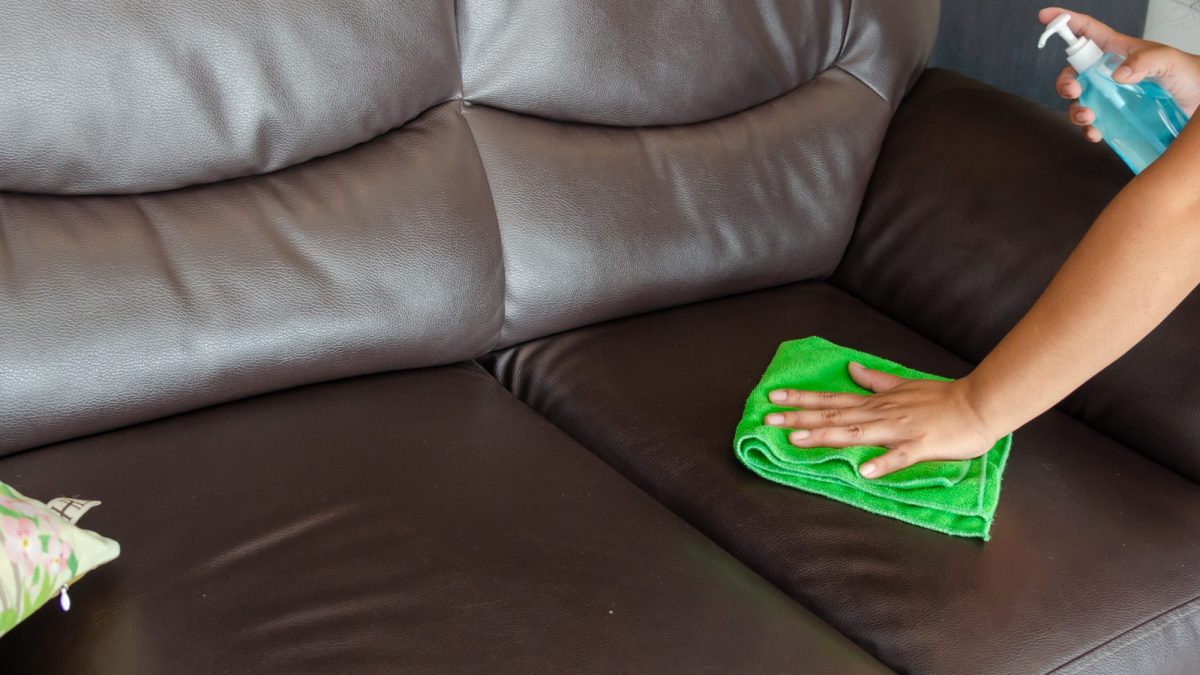
How to Clean a Leather Sofa (and Why Half of It Isn’t Leather)
Most leather sofas are two materials: real hide where you sit, color-matched polyurethane on the panels you don't. That breaks the hidden-spot test every guide tells you to run, because on a sofa the hidden spot is the plastic. Here is the two-drop test that sorts them.
Quick answer · care label Leather · top-grain, aniline or leather match
-
1 · Wash
Do not wash -
2 · Bleach
No bleach -
3 · Dry
Dry in shade -
4 · Iron
Do not iron -
5 · Pro care
Pro clean P
In one line Run the water-drop test twice, not once: low on the outside back and on the underside lip of a seat cushion. Matching readings mean one material throughout. Different readings mean a leather-match sofa, where real hide covers what you sit on and color-matched polyurethane covers the rest. Clean the hide with distilled water first, escalating once to two drops of pH-neutral soap in a cup, wiped back off and worked panel to seam. Dust the polyurethane dry and never leave it damp or warm. No conditioner on a pigmented finish, no Murphy Oil Soap, no steam cleaner.
Most leather sofas are two materials, and every guide treats them as one
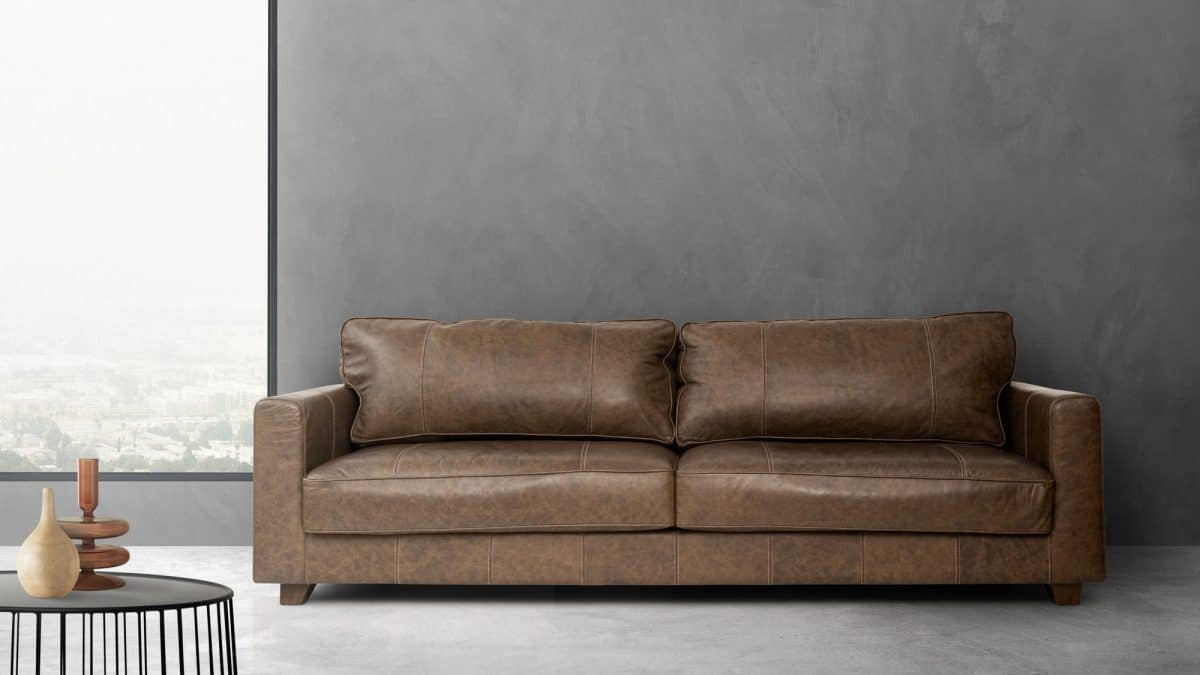
There is a term on furniture spec sheets that almost never makes it into a cleaning article: leather match, sometimes printed as L/M or as “top grain leather seating”. It means the piece is built from two different materials. Real top-grain hide covers everything your body touches, which is the seat cushions, the back cushions, the headrest, the armrests and the footrest on a recliner. The outside back and the outside arms, the panels nobody sits on, are color-matched polyurethane. The grain is embossed to copy the hide beside it, and on a showroom floor the two are hard to tell apart on sight.
This is not a rare or budget construction. It is standard on recliners and on a large share of sectionals, and it exists for a sensible reason: hide is sold by the irregular piece and costs more per square foot than the panels facing the wall are worth. The problem is only that the care advice was written for a jacket and then applied to a sofa.
Follow that advice and two things go wrong at once. The first is the test. Every leather guide, this site’s how to clean leather included, tells you to try your method on a hidden spot first. On a jacket the hidden spot is inside a cuff, and it is the same hide as the sleeve. On a sofa the hidden spots are the outside back and the low outside arm, and on a leather-match piece those are precisely the panels that are not leather. The test is run on the plastic and the result is applied to the hide. The second is that the two materials fail in opposite directions from the same damp cloth, so there is no single answer that is safe everywhere on the piece.
The water-drop test is the standard way to sort leather, but on furniture the useful information is not the reading, it is whether the two readings match. Put one small drop of water low on the outside back, near the floor. Put a second drop on the underside lip of a seat cushion, the part that tucks into the frame. Wait thirty seconds and look at both. If they behave the same way, the sofa is one material throughout and you have one job. If one drop sits as a bead on a smooth film while the other softens into the surface and darkens it slightly, you own a leather-match piece, and the outside panels need a different routine from the seat.
The second test, for when both drops bead
Polyurethane over a fabric backing and a well-sealed pigmented hide can both bead water, so the drop test alone will sometimes come back inconclusive. The tiebreaker costs nothing and needs no products: hide grain never repeats, and printed film always does.
An embossed polyurethane sheet comes off a roll, and the roll is embossed by a cylinder with a finite circumference. Whatever pattern that cylinder carries appears again every time it comes back around. So pick one distinctive feature on a panel, a short scar line, a stretch mark, a tight cluster of pores, and then look along the same panel for the identical feature a forearm’s length away. Find the same mark twice and the panel is film. On real hide the equivalent search fails, because the marks are the animal’s own history and no two are alike.
Two supporting tells, less certain on their own but useful together. Hide arrives in irregular pieces with weak bellies that get cut away, so leather upholstery is pieced and seamed; a very large panel of perfectly even grain with no seam anywhere in it is worth suspecting. And at any exposed edge, under the seat deck or where the dust cover is stapled, real leather shows a fibrous suede-like reverse while film shows a woven fabric backing.
What you’ll need
| Item | Why | Substitute |
|---|---|---|
| Vacuum with a soft brush and a crevice tool | Grit collects in the seat-to-back join and along the piping, and grit under a cloth is an abrasive rather than a cleaner | A soft hand brush and patience |
| Distilled water | Hard tap water dries as a mineral ring, which is a common way one clean panel becomes a marked one | Cooled boiled water, or bottled still water |
| Three white cotton cloths | One damp to clean, one damp with plain water to pick the soap back up, one dry to follow within seconds. White so you can see what is transferring | An old white T-shirt cut into thirds |
| pH-neutral leather cleaner, or dish soap diluted to two drops in a cup | A surfactant lifts soil off a sealed finish without dissolving the resin the finish is made of. The dilution is the whole point, not a suggestion | Nothing stronger; the escalation is more panels, not more soap |
| Leather protector or finish cream, for pigmented pieces | Renews a sacrificial layer on top of the topcoat, which is what actually takes the dye and the wear | Skip it rather than substitute an oil |
| Conditioner, only if the drop test showed absorption | An unfinished or aniline sofa genuinely takes a cream in. A pigmented one cannot, and the section below explains what happens to the cream instead | A cream sold for aniline leather specifically, applied sparingly |
The method, for the panels you sit on
This is the top-grain half of a leather-match sofa, and the whole of an all-leather one. It assumes the drop test showed a sealed finish, which covers the large majority of sofas sold.
Vacuum before anything gets damp
Soft brush across the panels, crevice tool into the seat-to-back join and down both sides of the seat cushions. Crumbs and street grit sit exactly where the body presses hardest, and a damp cloth dragged over them polishes the topcoat with them.
Run the two-drop test, then the repeat test if needed
Outside back and seat-cushion lip, thirty seconds, compare. This decides whether the rest of this method applies to the whole sofa or only to part of it. Doing it once in a hidden spot is the mistake this page exists to prevent.
Try distilled water alone, one panel at a time
A cloth wrung out until it feels barely cool, wiped in one direction, then the dry cloth over the same area straight after. A useful share of what looks like a dirty sofa is body oil and dust that plain water releases, and starting here costs nothing when it fails.
Escalate once, and only once, to heavily diluted soap
Two drops in a cup of water, no more, on a barely damp cloth. Then the second cloth with plain water over the same area to lift the soap back off, then the dry cloth. Soap left behind is slightly hygroscopic, so the cleaned patch collects dirt faster than the leather around it and appears to get dirty again within two weeks.
Work panel to seam, never in a circle
Whatever you do to a mark, carry it lightly across the whole panel and stop at a stitch line. On a five-year-old sofa, cleaning a small circle does not remove a stain so much as show you how dirty the rest of the cushion is, and that halo is more visible than what you started with. On a leather-match piece the seam has a second job: it is often the boundary between the two materials, which is why stopping there is the safe habit rather than just the tidy one.
Dry at room temperature, away from the window
No hairdryer, no radiator, no sunny afternoon to speed it along. Heat pulls oil out of the hide rather than off it, and that shows up as stiffness and fine cracking weeks later rather than immediately.
Protect rather than feed, unless the drop test said otherwise
On a pigmented sofa, a finish protector renews the sacrificial layer that takes dye transfer and abrasion. If the drop soaked in and darkened, you have an aniline or unfinished piece, and that one does want a proper conditioning cream, applied thinly and evenly to a whole panel.
Interactive
Label decoder
Tap a symbol from your care label. No guessing, no scrolling.
19 symbols. Pick one.
The method for the polyurethane panels
Shorter, and deliberately more cautious. These panels see almost no wear, so they rarely need more than dusting. What they cannot take is being left damp.
- Dry microfiber first, and usually last. A panel that never gets touched is a dust problem, not a soil problem.
- If something has actually spilled on it, mild soap and water is still the right cleaner, but it has to be followed by a dry cloth within seconds rather than left to air dry. Polyurethane is a film whose polymer chain includes ester links, and water molecules break those links apart over time, which is why a PU panel goes tacky before it goes anywhere else.
- Nothing warm, ever. Heat accelerates that same reaction. A steam cleaner sold for upholstery is the single worst tool you can point at this half of the sofa.
- Do not condition it. There is no hide under the film for a cream to reach, so it sits on the surface collecting dust. The full picture for both plastics sold as faux leather is in how to clean faux leather.
Three things the first page of results tells you to do
All three are repeated by the AI summary at the top and by most of the results under it. Each one collides with something else on that same page.
1. “A few drops of mild dish soap”
The furniture makers on this page do not agree with each other, which is the first sign that the question is not settled. American Leather’s own care sheet says to use “a mild non-detergent soap and lukewarm water”, and its do-not-use list reads: “saddle soap, cleaning solvents, furniture polish, oils, varnish, abrasive cleaners, detergent soaps or ammonia water”. Dish soap is a detergent soap. Klaussner, quoted approvingly in the same AI summary, gives a Castile soap dilution instead. And Leather Honey, the specialist brand Google picks to answer its own follow-up question about Dawn, rules out the whole category: “Dawn’s ingredients are great on greasy dishes, which is exactly why it will damage your leather.”
The mechanism behind that warning is real and it is worth knowing, because it also tells you when it does not apply. Leather is not soft because of oils the animal left in it. It is soft because of fatliquor, an emulsion of fat and oil worked into the hide at the tannery, which bonds to the protein fibers and lets the individual fibrils slide over each other instead of locking together. Take the fatliquor out and the hide dries hard, stiff and prone to cracking. A surfactant is a device for surrounding oil and carrying it away in water. That is not a side effect on leather, it is the same job it does on a frying pan.
So why does everyone report that diluted dish soap is fine? Because on a finished sofa the fatliquor is not reachable. The pigment and the clear topcoat sit between the cloth and the hide, and a heavily diluted surfactant wiped straight back off never gets past them. Both positions are correct, about different sofas. The manufacturer writes one instruction that has to hold for every piece it sells, including the aniline ones where the warning is exactly right. Your drop test is what tells you which sofa is in your room, and it is the reason that test comes before the method rather than after it.
2. “Finish with a nourishing conditioner”
Note that oils appears on the manufacturer’s forbidden list too, one item after saddle soap. The reason is the same topcoat. A conditioner cannot pass through a polyurethane film any more than a soap can, so on a pigmented sofa the cream does not go in. It stays on top, and what stays on top of a seat gets sat on: it reads slick for a few days, then dull, then it holds dust and hand marks better than the bare finish did.
This is also the honest answer to the question people actually ask, which is how to make a leather sofa look new again. The sheen being chased is the topcoat, and the topcoat is not restored by adding oil to it; where it has been abraded away at a headrest or an armrest, that is a refinishing job rather than a cleaning one, and how to clean stains off leather covers how to tell the two apart. The every-three-to-six-months conditioning schedule on this site’s leather page is written for a jacket, and a jacket does not have a body sliding across it four hours a night.
3. “Try Murphy Oil Soap”
Google asks this one twice, under two different parent questions, which is usually a sign that people are not satisfied with the answer they got. Both halves of the name point the wrong way here. It is a soap, meaning the salt of a fatty acid produced with an alkali, and soaps are alkaline by construction; leather is stabilized on the acid side of neutral, and alkalinity is the direction that works against it. And the “oil” in the name is not a conditioner for hide, it is what the product is made from. It is a good wood cleaner. That is what it is for.
Vinegar, which turns up in the related searches and in the busiest forum thread on this query, has one legitimate use on leather and it is dissolving salt deposits, which is why it earns its reputation on winter boots. A sofa does not get salted. The full product-by-product breakdown is in how to clean stains off leather.
A sofa has three zones, and they fail in three different ways
| Zone | What it gets | How it fails |
|---|---|---|
| Headrest and top of the back cushions | Hair oil, scalp sebum, styling product, concentrated into a band | The topcoat abrades, then body oil enters the hide underneath. Once it is in, nothing applied to the surface reaches it |
| Seat surface and the front edge | Body weight, friction, denim dye, the highest flex cycle on the piece | Dye transfer into the topcoat, plus stretching and looseness. On a leather-match sofa this is the real hide, and it is the half worth looking after |
| Outside back and outside arms | Almost nothing. Dust, and the humidity of the room | Polyurethane hydrolysis: tacky first, then lifting in sheets. This needs no mistreatment at all, only time and moisture in the air |
That last row is worth sitting with, because it inverts the usual expectation. On a leather-match sofa, the panel that fails first is very often the one nobody has ever touched. It is not a manufacturing fault and it is not something you did. It is the shelf life of a polyurethane film, running quietly at room humidity while the hide two feet away is still fine. It also explains a pattern people find baffling, which is a sofa that looks worn out around the back and sides while the seat it gets used on looks nearly new.
The one thing you cannot do with a sofa
Every other leather object on this site can be put away. A jacket hangs in a closet, a bag sits in a cupboard, boots live by the door. A sofa stays in one position in a lit room for ten years, and that is a care instruction in itself.
Ultraviolet light and heat work on the topcoat and on the plasticizers that keep it flexible. The panel facing the window fades first and stiffens first, and because the change is even and slow it usually gets noticed only when a cushion is moved and reveals the color underneath. There is no product that undoes it. The whole of the fix is placement: not against a south-facing window if that can be avoided, not directly beside a radiator or a vent, and cushions rotated end to end a few times a year so the fading is at least even across the piece. A rotation habit does for a sofa what turning a mattress does, and for the same reason.
Both are sold for upholstery, and a leather sofa is upholstery, which is how this ends up happening. Steam is heat and water arriving together, and that pair is the worst case for both materials on the piece at once: it softens the topcoat on the hide and accelerates the hydrolysis on the polyurethane panels. There is also nowhere for the water to go. Unlike a fabric couch, a leather one has a sealed surface that keeps the moisture at the seams and the stitch holes, which is where it stays.
Related guides
Before anything on this page, it is worth confirming what the hide actually is: how to clean leather has the water-drop test and the difference between pigmented and aniline finishes. For a specific mark rather than the whole piece, how to clean stains off leather sorts by where the stain stopped, which is the question that decides whether it comes off at all. The matched panels on a leather-match sofa are covered by how to clean faux leather, which explains why polyurethane and vinyl fail in opposite ways. If the couch turns out not to be leather after all, the method is chosen by the code letter on the tag: see how to clean a fabric couch, or how to clean a microfiber couch and how to clean a suede couch for the two that react badly to water. The cushions themselves come off and follow their own rules: how to clean couch cushions.
Questions
Can I use Dawn and water to clean my leather couch?
On a finished, pigmented sofa, yes, at two drops in a cup of water, wiped back off with a second cloth of plain water rather than left to dry on. On an aniline or unfinished sofa, no. Dish soap is a surfactant built to lift oil, and the oil in leather is the fatliquor that keeps it soft; on a finished piece the topcoat stands between the two, and on an unfinished one nothing does. The drop test is what tells you which one you have, and it takes thirty seconds.
What household cleaner can I use on a leather couch?
Distilled water, on its own, does more than people expect, and it is the only thing worth reaching for first. After that the list gets short rather than long: heavily diluted pH-neutral soap, and nothing else. Everything else commonly suggested is either an abrasive, a solvent or an oil, and each of those attacks the finish faster than the dirt does.
Is Murphy Oil Soap good for leather furniture?
No. It is an alkaline soap, and leather is stabilized on the acidic side, so it works against the tannage rather than with it. The word “oil” in the name refers to what the soap is made from, not to a conditioner for hide. It is an excellent cleaner for finished wood, which is what it is sold for.
How do I make my leather sofa look new again?
It depends entirely on whether the finish is still there. If the panel is dull but intact, cleaning it evenly to the seams and applying a finish protector restores most of what is missing. If there is a dark, slightly shiny patch at the headrest or the armrest, the topcoat has worn through in that spot and body oil is in the hide underneath; no cleaner reaches that, and the honest options are a specialist re-pigmenting the panel or leaving it alone.
How do I clean a leather sofa naturally, or with vinegar?
Distilled water is the natural option, and on a well-maintained sofa it is usually enough. Vinegar is dilute acetic acid and its one real use on leather is dissolving salt rings, which is a shoe problem rather than a sofa problem. Used on furniture it mostly contributes acid to a finish that did not need any and a smell that lingers in a large upholstered object longer than people expect.
How often should a leather sofa be cleaned?
Vacuum the crevices monthly, since grit does more damage sitting there than any cleaner does. A full wipe-down two or three times a year is plenty for normal use, and more often than that is counterproductive: every cleaning cycle removes a little of the protective layer along with the soil. The headrest is the exception and can be wiped more often, because it is the zone that collects the most oil in the smallest area.
Does the whole sofa have to be cleaned at once?
Not the whole sofa, but a whole panel at a time. Leather shows boundaries: a cleaned area next to an uncleaned one reads as a patch even when both are technically clean, because the difference is in the sheen as much as the color. Work to the nearest stitch line and stop there. On a leather-match piece that habit does a second job, since the seam is often where the hide ends and the matched polyurethane begins.