How to Clean Stains on a Rug
Every stain method written for clothing ends with a rinse, and a rug is the one thing you cannot rinse. That changes the whole approach: the risk isn't setting the stain, it's the stain coming back two days later, browner than it started.
Quick answer · care label Rug pile · wool, nylon, jute or viscose
-
1 · Wash
Do not wash -
2 · Bleach
Oxygen bleach -
3 · Dry
Dry flat -
4 · Iron
Do not iron -
5 · Pro care
Pro clean P
In one line Blot with white cloth from the outside of the mark inward, never rub. Match the treatment to the stain category: enzyme cleaner for protein, dish soap for oil, alcohol for ink, oxygen bleach for wine on synthetics only. Then wipe with plain cold water to replace the rinse a washing machine would have given you, weight the spot under dry towels for 30 minutes, and dry with air under the rug so the stain does not wick back up.
A rug stain is a clothing stain you are not allowed to rinse
Every stain method written for clothing ends the same way: rinse it out, then wash it. The rinse is doing more work than people notice. It carries the loosened stain and the product you used to loosen it out of the fabric and down the drain, so whatever you got wrong gets flushed away with it.
A rug gives you none of that. There is no other side to push the water through, no drain under the pile, and no spin cycle. Everything you pour on stays in the rug: the pigment you did not lift, the detergent you used, and the water carrying both. It settles into the backing, and often into the pad and the floor beneath it. That single difference reorders the whole method. On a shirt, the main risk is setting the stain with heat. On a rug, the main risk is that the stain looks gone on Sunday and is back on Tuesday, slightly browner and slightly wider than before.
So the goal on a rug is not to wash the spot. It is to move the stain out of the pile and into something absorbent you can throw away, using as little liquid as the job allows.
Blot, never rub, and use a fraction of the product you would use on clothing. On a rug, the amount of liquid you apply is a cost you pay back later in drying time and wicking risk, so the correct dose is the smallest one that works, applied twice if needed.
Two tests before the first drop of anything
Both take under five minutes, and both decide whether the treatment below is safe on your rug in particular.
Fiber. Wool is a protein, like hair, and reacts to alkaline cleaners, enzymes, and chlorine the way your skin would. Nylon and polypropylene are plastic and tolerate almost anything. Jute, sisal, and seagrass should barely be dampened at all, and viscose or “art silk” stains permanently from plain water, so a stain on one of those is a professional’s job from the start. If you are unsure which you have, how to clean a rug opens with the identification test and the full-rug cleaning method that this page assumes you are not doing.
Colorfastness. Press a damp white cloth into a hidden corner for ten seconds and look at the cloth. Any color on it means the dye moves when wet, and a wet treatment will pull that dye sideways into the surrounding pile. That is a bigger and less fixable mark than the stain you started with.
What you’ll need
| Item | Why | Substitute |
|---|---|---|
| White cotton cloths or paper towels | The thing the stain actually leaves in; white so you can see how much is transferring | An old white towel cut into pieces |
| Cold water in a spray bottle | A spray wets the pile tips only, where a poured cup soaks the backing | A cloth dampened at the tap and wrung out hard |
| Clear dish soap | Handles oil and general soil; clear so no dye is added to the rug | A wool-safe detergent, well diluted |
| White vinegar | Neutralizes alkaline residue and helps on tannin marks; safe on synthetics | Skip on wool, jute, and sisal |
| Enzyme cleaner | Digests protein: urine, blood, vomit, milk. The only thing that removes the smell rather than covering it | None, for anything with an odor |
| Rubbing alcohol | Dissolves ink, dye transfer, and marker, which soap cannot touch | Hand sanitizer with high alcohol content |
| Oxygen bleach powder | Lifts wine, coffee, and tea from synthetic pile without stripping color | Not on wool, which it yellows over repeated use |
| A stack of dry towels and a weight | The extraction step, which is where the stain actually leaves the rug | Books in a plastic bag |
The five categories, and what each one changes on a rug
The categories are the same ones that sort stains on clothing. What changes is the constraint column: a rug adds a restriction to each category that a washing machine would have handled for you.
| Category | Examples | Treatment | What a rug adds |
|---|---|---|---|
| Protein | Blood, urine, vomit, milk, egg | Cold water, then an enzyme cleaner left to dwell | Never steam it first: hot extraction cooks protein into the fiber permanently |
| Tannin | Coffee, tea, red wine, juice, grass | Blot, then cool water with a little vinegar or oxygen bleach | Oxygen bleach is for synthetic pile only; on wool it dulls and yellows |
| Oil and grease | Butter, salad dressing, cosmetics, candle wax | Absorb dry first (cornstarch, an hour), then dish soap | Skipping the dry absorbent spreads the oil to a wider ring than you started with |
| Dye and pigment | Ink, marker, shoe polish, dye transfer from a mat | Rubbing alcohol on a cloth, dabbed from the outside in | Alcohol travels fast through pile; work in small dabs or the mark widens |
| Biological | Mold, mildew, that damp-basement smell | Dry the rug out completely first, then treat | The colony is usually in the backing, not the pile, so a surface clean misses it |
The method, step by step
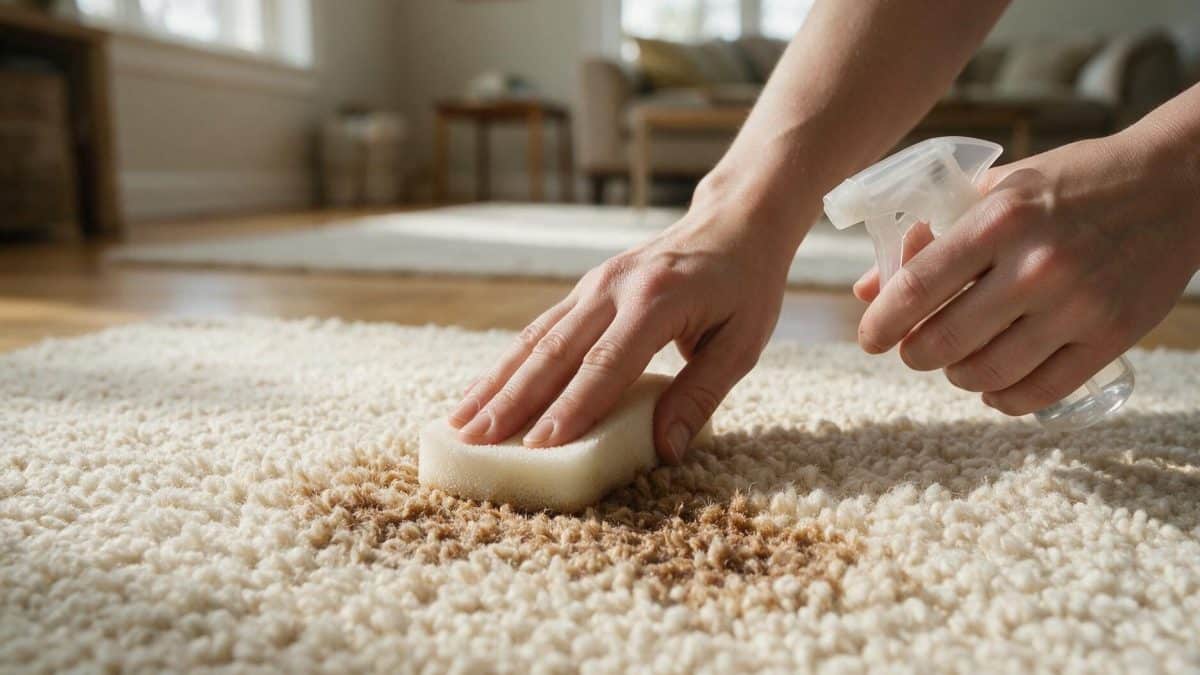
The sequence is the same for every category. Step 3 is the only one that changes, and the table above tells you what goes in it.
Lift what is still solid or liquid, before it becomes a stain
Scrape solids toward the center with the edge of a spoon, and press dry towels onto liquid without wiping. A spill that is blotted within the first minutes often needs no chemistry at all. Wiping at this stage is what turns a coin-sized spill into a plate-sized one.
Work out from the edge of the mark, not from the middle
Start on the clean pile just outside the stain and work inward. Going the other way pushes the outer boundary of the stain into fiber that was clean, and the widened edge is usually what remains visible after the center comes out.
Apply the matched treatment, sparingly, and let it sit
Spray or dab it on rather than pouring. Enzyme cleaners need real dwell time to work: 10 to 15 minutes on wool, longer on synthetics. Everything else needs about five. Time on the fiber does more than pressure does, and pressure is what damages the pile.
Blot with a dry white cloth, and keep changing it
Press down with your palm, hold for a few seconds, lift. Look at the cloth: as long as color keeps transferring, the stain is still leaving the rug. Move to a dry section of cloth each time, because a saturated cloth just puts the stain back.
Rinse by transfer, not by flooding
Wipe the area with a cloth wrung out in plain cold water, then blot dry again. This is the substitute for the rinse a washing machine would have given you, and it matters more than it sounds: detergent left in the pile is sticky, and a spot cleaned without this step becomes the dirtiest patch on the rug within a month.
Weight it dry, then get air underneath
Stack dry towels over the damp area, put a weight on top, and leave it 30 minutes to pull moisture up out of the backing. Then lift the rug off the floor with a fan angled at the underside until the backing itself feels dry to the palm, not just the pile.
Interactive
Label decoder
Tap a symbol from your care label. No guessing, no scrolling.
19 symbols. Pick one.
Wicking: why the stain comes back two days later
This is the failure that is specific to rugs, and it catches people who did everything else right. You clean the spot, it disappears, the rug dries, and a faint brown ring shows up where the clean spot was.
What happened is straightforward once you see the rug as a stack rather than a surface. Your treatment carried some of the stain down toward the backing instead of out through the top. As the rug dries, water moves upward through the fibers by capillary action and evaporates at the tips, and it carries dissolved residue up with it. The residue arrives at the surface and stays there. On a rug with a jute backing, that residue is partly the backing itself: jute releases a brown dye when it is wet, which is why the returning mark is often browner than the original spill was.
Three things prevent it, all of them at the end of the process rather than the beginning.
- Use less liquid than feels sufficient. Wicking needs a wet backing. If the moisture never got below the pile, there is nothing to travel back up.
- Weight the area with dry towels while it is still damp. This pulls moisture upward into something disposable, on your schedule, instead of letting it surface into the pile on its own.
- Dry it fast, with air under the rug. Slow drying gives capillary action hours to work. A fan on the underside cuts that window down and takes the mildew risk with it.
If a ring appears anyway, treat it as a fresh tannin stain: cool water with a little vinegar on synthetic pile, plain water on wool, blot, and then dry it properly this time. It usually comes out, because it is residue sitting near the surface rather than a stain bonded to the fiber.
What makes a rug stain permanently worse
- Scrubbing. Even when the scrubbing removes the stain, it splays and breaks the fiber tips, and that patch catches light differently from the pile around it forever. A clean spot with distorted pile is still a visible mark.
- Steam or hot water on a protein stain. Heat coagulates protein into the fiber. This is the most common way a treatable blood or urine spot becomes permanent, and rented hot-water extractors make it easy to do by accident.
- Chlorine bleach on wool. It dissolves the fiber rather than only stripping the color. Wool bleached with chlorine goes weak and slightly slimy while wet, and the damage is structural.
- Ammonia-based cleaners after a pet accident. Ammonia is a component of urine, so to a dog the treated spot still reads as a marking site. See how to clean dog urine from a rug for the four-layer version of that problem.
- Putting the rug back down while the backing is damp. This is how a stain that was cleaned turns into a mildew patch and a mark on the floor underneath, which is a worse problem than the stain was.
When a stain-specific guide goes further
- Pet urine soaks through the pile, the backing, the pad, and into the floor, so treating only the top layer is why the smell returns. See how to clean dog urine from a rug.
- Ink splits into ballpoint, gel, and permanent marker, and each needs a different solvent. The garment method transfers directly to rug pile: see how to clean ink stains on clothes.
- Mold and mildew are a living colony, not a mark, and have to be killed before cleaning or the spores spread. See how to clean mold off clothes.
- A rug that is dirty overall rather than spotted needs the full wash and, more importantly, the full dry. See how to clean a rug.
- Carpet fixed to the floor cannot be lifted, rinsed, or dried from both sides, so the whole floor inherits the restriction this page puts on one spot. See how to clean carpet.
- Coffee appears in the tannin row above, but only black coffee belongs there on its own. Milk puts the same spill in the protein row too, which is why a latte spot on a rug needs a cold enzyme pass before anything warm: see how to clean a coffee stain.
- The same stain on clothing follows the same five categories with the rinse step restored, which changes several of the products. See how to clean stains from clothes.
Related guides
This page is the rug counterpart of how to clean stains from clothes: same chemistry, no rinse. For the fiber identification test and the drying times that decide whether a wet rug survives, start with how to clean a rug. The one-way-street problem also applies to anything else you cannot put in a machine, which is why how to clean a stained mattress reads so similarly despite being a completely different object.
Questions
Can I use a carpet cleaning machine on a single stain?
On synthetic pile with no rubber backing, yes, with cold water rather than hot. On wool, natural fiber, or anything with a latex backing, a machine puts far more water into the rug than a spot needs, which is exactly the condition wicking requires. For one stain, blotting removes more and risks less. On carpet that is fixed to the floor the same constraint covers the entire room rather than one spot, which changes which products are usable at all: see how to clean carpet.
How long can a stain sit before it becomes permanent?
It depends on the category, not the clock. Oil migrates deeper by the hour and gets harder to reach. Tannin stains oxidize and darken over a few days. Protein stains stay treatable for a surprisingly long time as long as nothing hot touches them, which is why a week-old blood spot often still lifts with an enzyme cleaner.
Is baking soda useful on rug stains?
For odor and for absorbing fresh liquid, yes: sprinkle it on, leave it several hours, vacuum it out. As a scrubbing paste it is a poor choice, because the abrasion damages the pile tips and the powder is difficult to fully remove from the base of the pile once it is wet.
Why did the clean patch get dirty faster than the rest of the rug?
Detergent residue left in the pile. It stays slightly tacky and holds every bit of dust that lands on it, so the cleaned area collects soil faster than the fibers around it. The rinse-by-transfer step exists to prevent this, and repeating it now on the affected patch will fix it.
Should I treat both sides of the rug?
For anything that soaked through, yes. Fold the rug back and check the underside: if the stain shows there, it is also in the pad and on the floor. Blot from the back as well, and clean the floor underneath before the rug goes back down, or the rug simply reabsorbs it.