Can You Machine Wash Leather? (The Drying Is What Ruins It)
Leather is made wet in a tannery drum, so water alone is not what ruins it. A wash strips the oils that stop its fibres bonding as they dry, and no conditioner puts them back.
Quick answer · care label Leather — tanned hide
-
1 · Wash
Do not wash -
2 · Bleach
No bleach -
3 · Dry
No tumble dry -
4 · Iron
Do not iron -
5 · Pro care
Pro clean P
In one line Do not machine wash leather unless the label carries a wash symbol: detergent strips the fatliquor that keeps collagen fibres from bonding, and the hide then dries hard, unstretched and cracked. Clean it instead by brushing dry, wiping panel by panel with a barely damp cloth and a near-neutral cleaner, drying slowly at room temperature stuffed to shape, then conditioning and flexing while it is still faintly cool. About 35 minutes hands-on, plus 6 to 12 hours drying.
Can leather survive a wash cycle when the tannery soaked it in a drum to begin with?
Almost never, and the usual explanation for why is wrong. People say leather must not get wet. Leather gets extremely wet on its way to becoming leather: hides rotate for hours in drums full of water while they are limed, tanned, dyed and fatliquored. Water alone is not what ends a leather jacket.
What ends it is everything the tannery does after the water, which a washing machine does not do. In the drum, the wet hide is loaded with fatliquor: lubricating oils whose job is to sit between the collagen fibres so that, as the leather dries, those fibres do not stick to each other. The hide is then dried under tension and mechanically flexed, a process called staking. Skip the oils and skip the flexing and the fibres bond as the water leaves. That is the stiff, shrunken, cracked board people pull out of the drum, and it is not a stain or a finish problem. It is the structure of the material changed.
A wash cycle does the soaking half and none of the rest. Detergent is alkaline, leather is acidic, and forty-five minutes of tumbling in that solution strips fatliquor out of the hide, which then dries unlubricated, unstretched and crumpled into whatever shape it landed in. Add a tumble dryer and you also shrink the item, crack the finish and soften the glue holding a shoe or a bag together. There is one narrow exception, covered below, and it is printed on the label rather than guessed at.
It is not the wetting that ruins leather, it is the drying. Any process that removes the internal oils and then lets the hide dry hard, flat and unflexed converts a supple skin into cardboard, and no amount of conditioner afterwards fully converts it back.
What you’ll need
| Item | Why | Substitute |
|---|---|---|
| Soft horsehair brush | Takes grit off the surface before any moisture turns it into a smear | A clean, soft toothbrush |
| Two microfibre cloths | One to clean with, one dry to lift residue before it dries in place | A cut-up cotton T-shirt, no seams or printing |
| Leather cleaner, near pH-neutral | Cleans without the alkalinity that swells collagen and lightens dye | One drop of unscented liquid soap in a cup of lukewarm water, tested first |
| Leather conditioner or cream | Replaces some of the oil that any wet cleaning carries off | A beeswax-based shoe cream in the nearest shade |
| Newspaper or a boot tree | Holds the shape while the item dries, which is the whole game | A rolled hand towel |
The method, step by step
Find out which leather you have
Put one drop of water on a hidden spot. If it beads and sits, the leather is pigmented and tolerates surface cleaning well. If it soaks in and darkens, it is aniline or unfinished, and every wet step below has to be lighter and more even. If the surface is fuzzy rather than smooth, treat it as suede or nubuck instead.
Brush and empty before anything is damp
Grit ground into wet leather scratches the finish permanently. Brush the whole surface dry, get into seams and welts, and turn out every pocket: a forgotten pen is a far worse outcome than the dirt you started with.
Mix weak, and test in a hidden spot
Leather cleaner as directed, or one drop of unscented liquid soap in a cup of lukewarm water. Test on an inside hem or the underside of a strap and let it dry before judging: dye lift often only shows once the water has gone.
Wipe in sections with a cloth that is damp, not wet
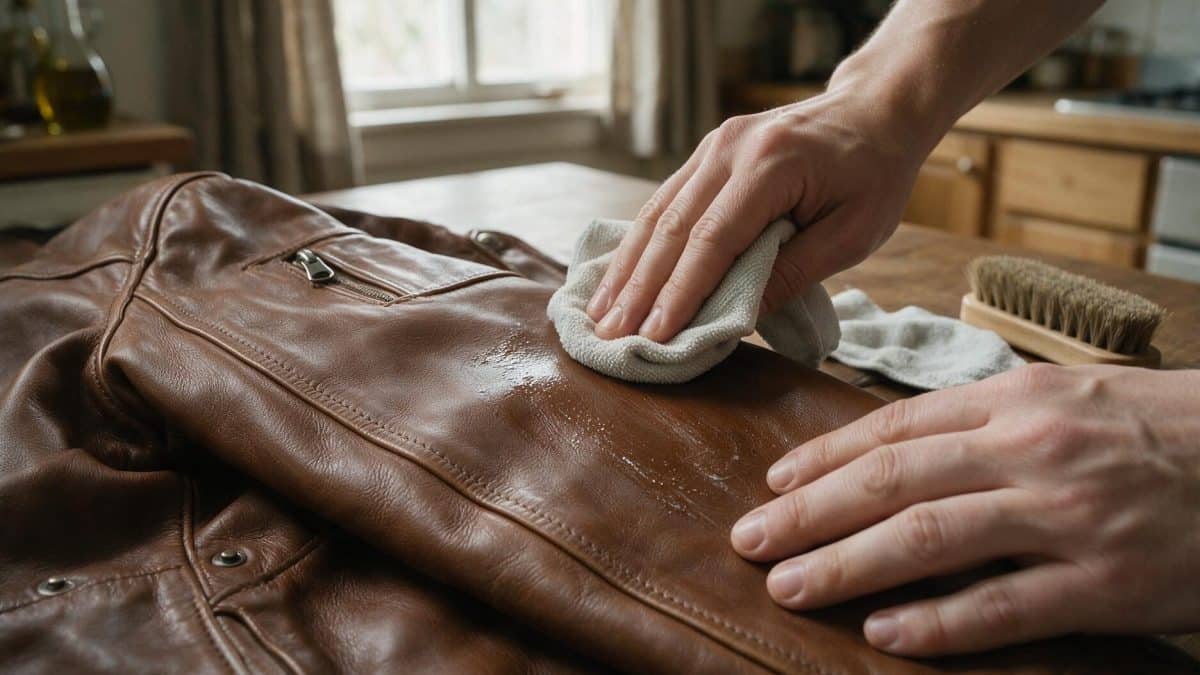
Wring the cloth until nothing drips, then work one panel at a time in overlapping circles. Sections matter: a boundary that dries at a different rate from its neighbour leaves a tide line, and tide lines on aniline leather are close to permanent.
Rinse the cloth, never the leather
Rinse and wring the cloth, wipe the same panel again to lift the loosened dirt and soap residue, then go over it with the second, dry cloth. Left in place, residue keeps working on the finish long after you have stopped.
Dry slowly, at room temperature, stuffed to shape
Pack shoes and bags with newspaper, hang a jacket on a broad-shouldered hanger, and keep it away from radiators, hairdryers, direct sun and car dashboards. Fast drying hardens leather well below any temperature that would damage it outright.
Condition while it is still faintly cool to the touch
Not soaking, not bone dry. A thin, even coat over the whole panel rather than dabs on the spots you cleaned, because conditioner darkens leather slightly and patchy application shows.
Flex it, then buff
Bend and roll the leather gently in your hands for a minute or two. It is a crude version of tannery staking, and it keeps fibres from setting hard as the last moisture leaves. Then buff with the dry cloth.
What the drum actually does to a hide
Several things go wrong at once, which is why the damage is so hard to argue with afterwards. Worth knowing which of them you can do anything about.
| What happens | Why | Recoverable |
|---|---|---|
| Fatliquor washes out | Detergent lifts the oils that keep collagen fibres from sticking together as they dry | No |
| Alkaline swelling | Detergent solution sits around pH 8 to 11 against acidic leather; fibre bundles swell and never repack the same way | No |
| Surface finish cracks | Pigment topcoats go brittle as the leather hardens, and the drum keeps flexing them meanwhile | No |
| Dye bleeds or goes patchy | Water plus mechanical action moves dye toward the surface and out into the drum | Rarely |
| Shape sets wrong | Leather dries into the crumpled shape it held in the drum, with no tension and no staking | Partly |
| Glued construction lets go | Shoe and bag adhesives soften with long immersion, and a polyurethane midsole put away damp breaks down sooner | No |
One point deserves precision, because it gets repeated wrongly: a wash cycle does not cook leather. Denaturation, the true shrinkage temperature where collagen changes state, sits somewhere between 85 and 100 °C (185–212 °F) for chrome-tanned leather, and chrome tanning can carry it to a published maximum near 120 °C. Vegetable tanning is lower: it can start shrinking around 70 °C (158 °F), and published figures for vegetable and alum tanning top out at about 85 °C (185 °F). A 30 °C (86 °F) wash is nowhere near either figure, and neither is a low tumble-dry setting, which sources place anywhere between about 27 °C and 55 °C (80–130 °F). The stiffness is not cooked leather. It is stripped leather that dried without help, which is arguably worse: heat damage announces itself while it happens, and this does not show until the item is dry.
Never put leather in a tumble dryer, at any heat setting, for any length of time. A wash is a bad decision that sometimes leaves a wearable item. The dryer combines heat, tumbling and fast moisture loss on a hide that has just lost its oils, and it hardens and cracks the piece in one cycle. Not a judgement call.
The exception: leather with a wash symbol on the label
Machine-washable leather is a real category, not marketing. It is tanned and finished to survive water and detergent, usually a thin garment lamb or a leather bonded to a cotton backing, and it ships with washing instructions because it needs them. The label decides, not the material. A tub symbol means the maker has tested it; a crossed-out tub, a leather-clean-only line, or no instruction at all means treat the item as unwashable.
Published instructions for washable leather converge on the same narrow settings: cold or 30 °C (86 °F) maximum, the delicate programme on the shortest cycle, the item washed on its own, and a very small amount of liquid gentle detergent in the dispenser drawer rather than tipped onto the leather in the drum. No powder, no capsules, no bleach, no softener. Then the part people skip: take it out the moment the cycle stops and lay it flat on a towel. A wet leather garment left hanging stretches out of shape under its own weight, and that is not fixable either.
Everything else sits on the other side of the line, and the brands are unusually direct about it. UGG tells owners never to machine wash or dry clean sheepskin and leather, and to clean by hand and dry naturally in a cool, ventilated spot away from direct heat and sunlight. Converse’s guidance for leather uppers is a damp cloth, lukewarm water and mild soap, with an explicit instruction not to machine wash or dry. Timberland’s published routine for leather boots has the same shape: let mud dry, brush it off, then a damp cloth and their own cleaner. A maker with every incentive to be permissive still saying no outweighs a forum thread saying it worked once.
If it has already been through a cycle
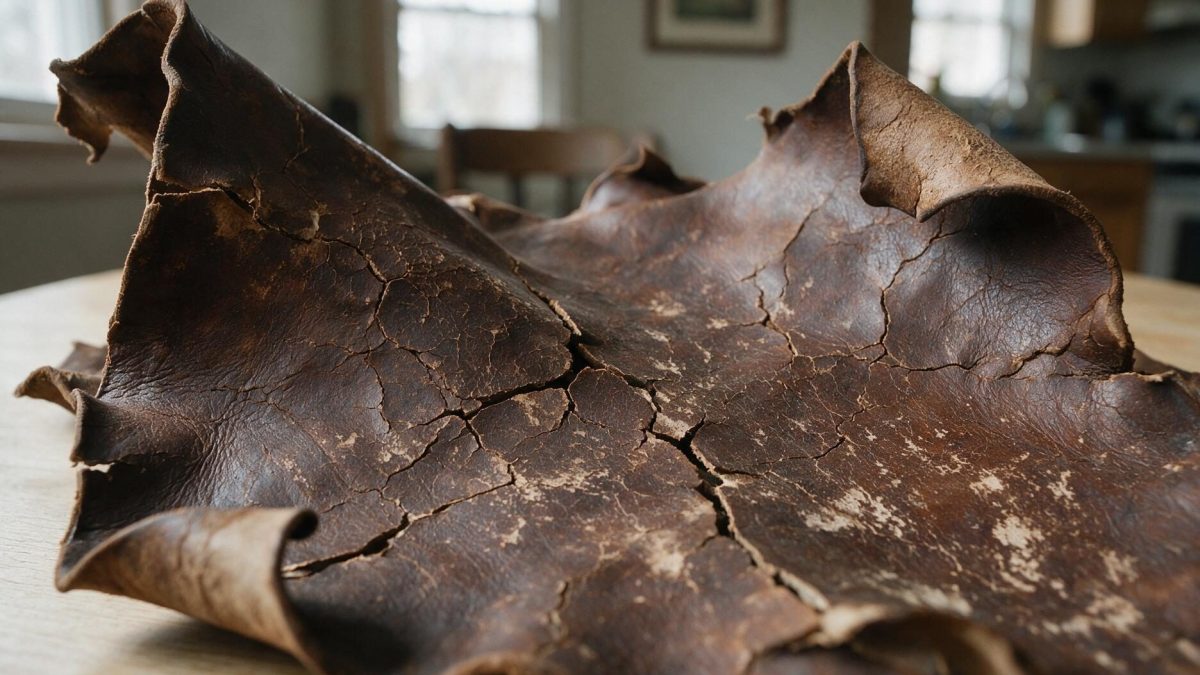
The window is while it is still damp. Once leather has dried hard, the fibres have already bonded and you are managing the result rather than preventing it.
- Do not put it anywhere warm to speed things up. Room temperature, out of the sun and the airing cupboard. Every hour saved on drying costs flexibility you cannot buy back.
- Stuff and shape it now. Newspaper in shoes and bags, a broad hanger for a jacket, collar and cuffs pulled straight. The shape you leave it in is the shape you get.
- Condition while it is damp, not after. Conditioner absorbs into a damp hide and mostly sits on a dry one. An even coat once the surface is no longer wet to the touch, then a thinner one a few hours later.
- Flex it repeatedly as it dries. Roll, bend and work the panels every hour or so. Tedious, and the single most useful thing you can do, because it is the only part of staking you can reproduce by hand.
- Expect the colour to have moved. Patchy lightening after a wash is dye loss, not dirt, and cleaning it further makes it worse. A pigmented leather can sometimes be recoloured by a specialist; aniline usually cannot. For the marks left behind, see how to clean stains off leather.
Be realistic about the outcome. Conditioned and flexed carefully, a washed item often ends up wearable and visibly different: darker in places, softer in some spots and stiffer in others, the finish finely cracked where it bends. Shoes and structured bags fare worst, because glue and stiffeners fail alongside the leather. Soft unlined garments fare best. Nothing comes back identical.
Related guides
The answer shifts with the type of hide, and with how much of the item is actually leather:
- For the full method across pigmented, aniline, nubuck and bonded leather, see how to clean leather.
- A jacket adds a lining, interfacing and often a fused shoulder that react to water differently from the hide. See how to clean a leather jacket.
- If a drop of water sits on the surface without ever darkening it, the material may not be leather at all. See how to clean faux leather.
- Suede and nubuck are the same hide with the finish abraded off, which changes what a wash does. See can you machine wash suede.
Questions
Can I machine wash a leather jacket on the delicate cycle?
Not unless its label says so. The delicate cycle reduces agitation but changes neither the detergent chemistry nor the time the hide spends saturated, and both of those strip fatliquor. People do wash leather jackets deliberately, usually to distress them, and report anything from a pleasantly softened jacket to a shrunken one. That spread is the point: unpredictable, and not reversible.
What about trainers with leather uppers? The canvas ones survive it fine.
Canvas survives because cotton does not mind alkaline detergent and dries back to what it was. Leather does not, and a shoe adds a problem a jacket does not have: the sole is glued on, and long immersion softens those adhesives. A soaking does not crumble a polyurethane midsole on its own, because hydrolysis is a process of years rather than one cycle, but it runs faster on a sole that goes back in the cupboard damp. For leather boots, see how to clean leather boots.
The item is mostly fabric with leather trim. Does that change anything?
It usually makes things worse. The fabric washes fine; the leather patch, collar tab or handle stiffens, darkens and often bleeds dye onto the fabric beside it. Wash by hand around the trim, or accept the trim as the limiting factor for the whole garment.
Is dry cleaning safe instead?
Only with a cleaner who handles leather specifically. Standard garment dry cleaning uses solvents that strip leather’s oils much as detergent does, and the piece then needs refatting and refinishing to come back right. That is a leather specialist’s job, and it is what a professional-clean symbol on a leather label points you toward.
How acidic is leather really? I have seen different numbers.
Sources disagree, and it is worth saying so. Some leather-trade references put finished leather at pH 4.5 to 5.0; others at 3.5 to 4.0. Nothing credible puts it near neutral. Detergent in solution sits around pH 8 to 11, so whichever figure is right for your hide, the gap runs to several orders of magnitude in hydrogen-ion concentration, and that gap drives the swelling.