How to Clean Faux Leather (and Tell Which Plastic It Is)
Every result gives the same recipe: warm water and a few drops of dish soap. That is harmless on one of the two plastics sold as faux leather and it is the exact reagent that decomposes the other. Here is how to tell which one you own, and what sticky actually means.
Quick answer · care label Faux leather · PU, PVC or bonded
-
1 · Wash
Do not wash -
2 · Bleach
No bleach -
3 · Dry
No tumble dry -
4 · Iron
Do not iron -
5 · Pro care
No dry clean
In one line Work out which plastic you have before choosing anything. Vinyl smells like a new shower curtain and fails by going stiff and cracking. Polyurethane is odorless and fails by turning tacky and peeling, because water splits its chain apart. Both clean the same way: brush the grit off dry, wipe one small section with a barely damp cloth, dry that section within seconds. No steam, no soaking, no dry cleaning, and no oil or conditioner, which a plastic film cannot absorb. Tack that leaves the item's own color on a dry white cloth is the coating breaking down, and nothing fixes that.
Faux leather does not really get dirty. It expires.
Real leather is a hide, and a hide can be fed, repaired and kept in service for decades. Faux leather is a fabric backing with a skin of plastic bonded to it, usually between a tenth and half a millimeter thick, and that skin has a shelf life whether you use the item or not. The clock starts in the factory. Cleaning it well does not stop the clock, but cleaning it the way the internet tells you to can wind it forward by years.
Search this question and every result gives the same recipe: warm water, a few drops of dish soap, a microfiber cloth, wipe in circles. That advice is harmless on one of the two plastics sold as faux leather and it is the exact reagent of decomposition on the other. Nobody on the first page mentions which one you have, because the label almost never says either.
So the useful sorting is not by object. It is by polymer, and there are two, with opposite failure modes and opposite tolerances.
Vinyl, sold as leatherette or PVC, is a hard plastic made soft by plasticizers mixed through it. Those plasticizers slowly leave. It goes stiff first, then cracks, and heat and sunlight speed it up. Water does nothing to it.
Polyurethane, sold as PU or vegan leather, is a soft polymer whose chain includes ester links, and water molecules split those links apart. The reaction is called hydrolysis, it runs on ambient humidity alone, and it ends in a surface that turns tacky and then peels away from its backing in sheets. Warmth and damp accelerate it. Sitting unused in a closet does not stop it.
Which one is in front of you
Nothing on the hang tag will tell you. Manufacturers use faux leather, vegan leather, leatherette, pleather, PU and bicast more or less interchangeably in marketing copy, and the composition label often reads polyurethane on an item whose coating is mostly vinyl. Four checks get you there without a lab, and the last one is the most reliable.
| Check | Vinyl (PVC) | Polyurethane (PU) |
|---|---|---|
| Smell it, up close | The new shower curtain and pool toy smell. That is plasticizer leaving the material, and it is diagnostic | Close to odorless, or faintly like a solvent when brand new |
| Fold a corner hard | Resists, feels plasticky, holds a white stress line where it bent | Creases softly and springs back, more like a thin skin than a sheet |
| Look at the underside | Heavier, often a knit backing, the coating reads as one thick solid layer | Lighter, cloth or microfiber backing, the coating reads as a thin film sitting on it |
| See how it is failing | Stiff, hard, splitting into cracks along fold lines | Tacky to the touch, then flaking and lifting in sheets |
Bonded leather and bicast are a third case worth naming, because they are sold beside real hide at real hide prices. Both are a polyurethane film laid over something else: leather scrap ground to dust and glued to a backing in the first case, a split hide in the second. The visible surface is PU, so it hydrolyzes like PU, and it does it faster because the layer underneath is not a continuous material either. A three year old bonded leather sofa shedding what looks like sunburned skin is not a defective sofa. That is the material doing what it does.
If none of the four checks fit and the surface takes a drop of water rather than beading it, you may be holding actual leather. Run the water drop test in how to clean leather before you go further, because everything below is wrong for a hide.
What you’ll need
| Item | Why | Substitute |
|---|---|---|
| A soft brush or a vacuum brush head | Grit is the real enemy of a coating this thin. Wiping unswept dust across it is fine sandpaper with extra steps | A dry microfiber cloth, shaken out often |
| Two microfiber cloths | One barely damp, one bone dry and used within seconds. The second cloth is what keeps this method safe on PU | Any soft cotton, white so you can see what transfers |
| Dish soap, two drops in a cup of water | A surfactant loosens skin oil and grime without softening the coating. Two drops, not a squirt | Castile soap at the same dilution |
| Cotton swabs | Keeps rubbing alcohol on the ink mark and off the square inch around it | A cotton ball pinched to a point |
| Baby oil or leather conditioner | Nothing. A plastic film has no fiber network to absorb it, so it sits on top collecting dust, and some oils pull plasticizer out of vinyl rather than putting softness back | None needed. This is the most repeated bad advice on the subject |
| Magic eraser | Melamine foam is a micro abrasive. On a coating a tenth of a millimeter thick it removes the mark by removing the coating | None. See the warning below |
The method, and the one step everyone skips
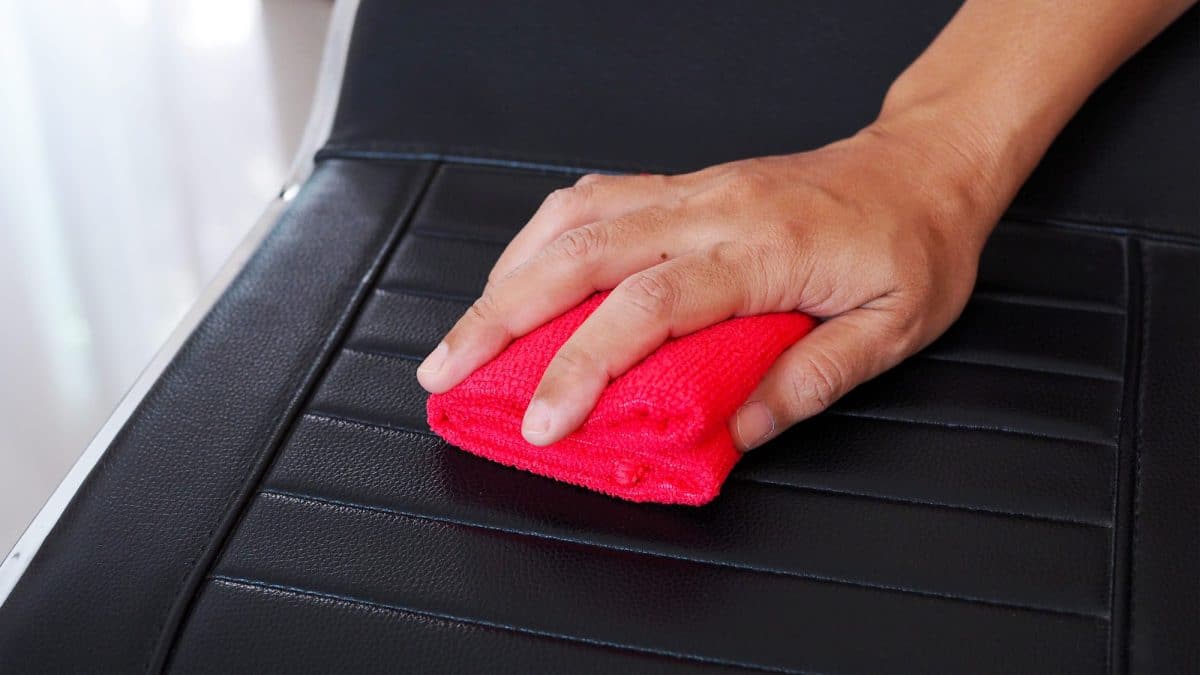
What follows works on both plastics. The difference is not in the products, it is in how long the surface stays wet, and that difference is the whole article.
Get the grit off dry, first
Brush or vacuum the whole surface, seams and piping included. Dust on faux leather is mostly mineral and it scratches. Every wipe you take before this step is polishing the coating with abrasive.
Wring the cloth until you would call it dry
Damp means it feels cool against your wrist and leaves no shine behind it. A cloth wet enough to darken the surface is wet enough to reach the seams, and the backing under the coating is fabric that holds water for hours.
Wipe a small area, then dry it immediately
Work in sections about the size of a sheet of paper, plain water first. Follow the damp cloth with the dry one before moving on. On PU the whole risk is contact time with water, so a surface that is wet for ten seconds and then dry is a different proposition from one left to air dry.
Escalate once, to two drops of soap
Only where plain water failed, which on a sofa is the armrests and the headrest and nowhere else. Same routine, damp then immediately dry, then a pass with plain water to pick the soap back up so it does not sit there attracting dirt.
Treat ink and dye marks on a swab, not a cloth
Rubbing alcohol on a cotton swab, dabbed and lifted, never rubbed. Stop the moment color other than the ink appears on the swab, because that color is the coating. Alcohol dissolves the resin ink is made from and the resin the surface is made from at similar speed.
Dry it away from every heat source you own
Room temperature, out of direct sun, nowhere near a radiator or a hairdryer. Heat is the accelerator for both failure modes at once: it drives plasticizer out of vinyl and it speeds hydrolysis in polyurethane.
Interactive
Label decoder
Tap a symbol from your care label. No guessing, no scrolling.
19 symbols. Pick one.
A steam cleaner delivers hot water directly into the surface, which is both halves of hydrolysis at once, and the steam finds the stitch holes where the coating is already pierced. The same goes for a hot soapy soak, a washing machine cycle on anything with a coated panel, and a car interior done with a wet extractor. Dry cleaning is out too: perchloroethylene attacks polyurethane coatings and dissolves the adhesive in bonded leather, which is why the care label on most faux leather garments carries the crossed circle rather than the P.
Sticky: two causes, one of them terminal
The single most common description in the forum threads behind this search is a chair or a jacket that has gone tacky, often with some discoloration. It is worth separating the two things that produce it, because one wipes off in a minute and the other cannot be fixed at any price.
Residue is the good outcome. Sunscreen, hand lotion, silicone based protectant, furniture polish and the film left by an undiluted cleaner all leave a tack that sits on the surface. It tends to be blotchy, worse where hands and heads go, and it lifts with a cloth dampened in the soap dilution, or with rubbing alcohol on a small area if soap does not shift it. Underneath, the surface is intact and slightly matte.
Hydrolysis is the other one, and the tack is not on the material, it is the material. The polyurethane chain has broken down into shorter, softer fragments that no longer hold together, and what your fingers feel is the coating itself turning to gum. It shows up first where warmth and moisture concentrate, so a seat base before a seat back, a car door panel before the dashboard, a garment stored in a basement before one kept upstairs.
Press a dry white cloth firmly on the tacky area for ten seconds in a place nobody looks, then lift it and check both the cloth and the spot. Residue leaves a clear or whitish film on the cloth, and the tack under it is reduced. Degradation leaves the item’s own color on the cloth, and the tack is exactly as it was. If the cloth comes away colored, you are wiping off the coating, and every further wipe removes a little more of what is left.
The products sold to rescue sticky vinyl work the second way. They soften and carry off the degraded top layer, which genuinely improves how the surface feels for a while, at the cost of the thickness that was still protecting the backing. On a car interior worth keeping that trade can be worth making. On a jacket it usually is not.
Peeling, and why the repair kits do not hold
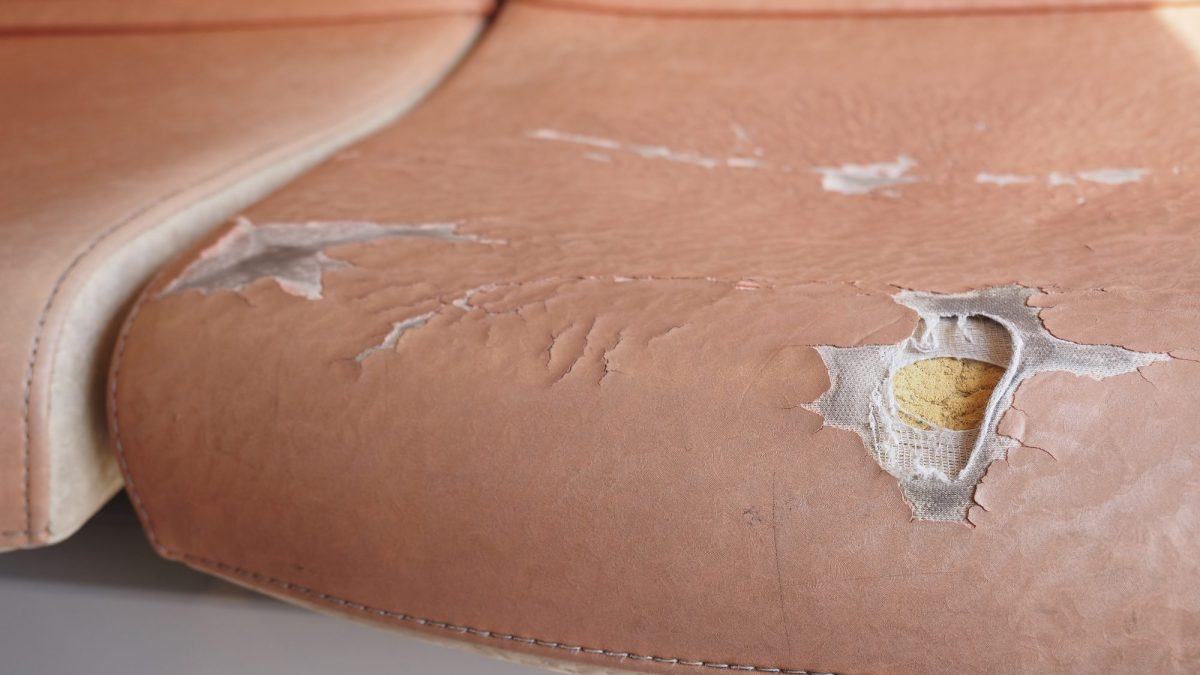
Peeling is not a cleaning problem and no method on this page reaches it. It means the coating has either lost its grip on the backing or become brittle enough to fracture, and both are end of life. The reason it always seems to start at the same places is mechanical: the seat edge you slide across, the inside of an elbow, the corner of a bag, wherever the film flexes over the same line thousands of times.
This matters for the repair kits, which really do look convincing for the first few months and then come apart along a new edge. A vinyl patch, a flexible filler or a coat of PU paint bonds to the layer it is applied to. That layer is the one that is already failing. When the next inch of it lets go, the repair leaves with it, and the new edge is usually larger than the original because the patch was stiffer than what surrounds it.
What genuinely extends the life of a piece that is still sound is unglamorous and all preventive: keep it out of direct sun, keep it away from radiators and heater vents, wipe spills the same day rather than the same week, and do not store it sealed in plastic in a damp room, which is a humidity chamber. On a sofa, rotating the cushions spreads the flexing that peeling follows.
By object
The polymer decides the chemistry. The object decides how wet you are allowed to let it get and where it will fail first.
- Sofas and armchairs have no W, S, WS or X code, because that code belongs to woven upholstery and is the framework in how to clean a fabric couch. On faux leather the equivalent rule is simpler: damp cloth, dry cloth, never a machine. Seat bases and arm caps take almost all the wear, so clean those weekly and the rest twice a year. One case this page assumes away: the question above is which plastic you own, and on a sofa the answer is sometimes that you own a plastic and a hide, on the same piece. Furniture sold as leather match puts top-grain leather on the seating surfaces and a color-matched polyurethane on the outside back and arms, so the two methods apply to the same object at once. See how to clean a leather sofa.
- Jackets crease at the elbow and the inner arm, which is where PU cracks first. Never iron, never tumble, and hang on a wide hanger rather than a wire one so the shoulders do not take a permanent fold. The care routine for the real thing is in how to clean a leather jacket, and much of it does not transfer.
- Pants and skirts are the items people most often try to machine wash. If the label allows it, that means cold, inside out, gentle cycle, in a garment bag, hung to dry away from heat. If it does not, agitation flexes a wet coating against a wet backing, and the seams go first.
- Bags concentrate the damage on handles and the base corners, both from hand oil and from abrasion. The stuffing and drying logic in how to clean a leather bag applies; the conditioning step does not.
- Shoes and boots take road salt, which leaves a white tidemark that diluted white vinegar removes on faux leather as readily as on hide. What they do not take is a washing machine, for the reasons in can you machine wash shoes.
- Car seats combine the two accelerators, since a closed car in summer reaches temperatures that no living room does. They are also where dye transfer from new denim shows most, the same indigo behavior described in how to clean jeans, and on a plastic film that dye dissolves into the surface rather than resting on it.
Related guides
If the water drop test says you have a hide after all, start again at how to clean leather, which sorts pigmented from aniline and gives the routine care faux leather cannot use. For a specific mark on real leather, the sorting logic by where the stain stopped is in how to clean stains off leather, and it is worth reading even for a synthetic, because a pigmented hide is also a plastic film over something else. And if the surface is soft and napped rather than smooth, it is more likely microfiber than faux leather: see how to clean a microfiber couch.
Questions
What is the best thing to clean fake leather with?
A barely damp microfiber cloth, followed within seconds by a dry one. If plain water is not enough, two drops of dish soap in a cup of water, then a plain water pass to take the soap back off. That is the whole list. The reason it is so short is that faux leather is a plastic film, so there is nothing to feed and nothing to nourish, and every product past this point is either an abrasive, a solvent or an oil that will sit on top and collect dust.
What ruins faux leather?
Heat and standing water, in that order, and neither of them looks dramatic at the time. Heat drives the plasticizer out of vinyl until it cracks and speeds up the hydrolysis that turns polyurethane sticky. Water is the actual reagent in that second reaction, so a surface left damp, steam cleaned or stored in a humid room ages faster than one that is wiped and dried in the same minute. After those two: acetone and nail polish remover, bleach, dry cleaning solvent, and melamine foam sponges, which abrade the coating away rather than cleaning it.
Can I use Dawn dish soap on faux leather?
Yes, and it is the right choice, as long as you dilute it much harder than feels sensible. Two drops in a cup of water. Dish soap is a surfactant rather than a solvent, so it releases skin oil and grime without softening the coating the way alcohol or a degreaser would. The mistakes are using it neat, and leaving the residue on: soap film is slightly hygroscopic and the patch you cleaned starts attracting dirt faster than the area around it.
Why is my faux leather sticky?
Either something was left on it or it is breaking down, and a dry white cloth pressed on it for ten seconds tells you which. A clear or whitish film on the cloth with less tack underneath means residue from lotion, sunscreen, polish or an undiluted cleaner, and soap dilution removes it. The item’s own color on the cloth with the tack unchanged means the polyurethane has hydrolyzed, and the sticky layer is the coating itself. That one has no fix, and continuing to scrub only thins what remains.
How do you make faux leather look new again?
You can make a sound piece look cared for, and you cannot make a degrading one look new. If the surface is intact, a full clean and the removal of any oily residue does most of the visible work, and a matte finish is the correct result, not a failure. What does not work is anything promising to restore or condition: there is no fiber to absorb it, so it leaves a temporary shine and a dust magnet. If the coating is already peeling or tacky, the honest choices are having it professionally recovered, a slipcover, or replacing it.
How long does faux leather last?
Roughly three to five years for bonded leather in daily use, and five to ten for a decent polyurethane or vinyl, with humidity and heat moving both numbers more than usage does. This is worth knowing before buying: a faux leather sofa that costs a third of a hide one does not last a third as long, it lasts until the coating fails and then stops, whereas the hide is still repairable at fifteen years. Storage counts as use, since hydrolysis runs on ambient moisture whether anyone sits on it or not.